Quantum Theory and Wave-Particle Duality
Connect localized detections and interference with photon and matter-wave models and supplied boundary conditions.
AP Physics 2 Topic 15.1 · College Board CED printed p. 136, 137 / PDF p. 143, 144 · See this topic in the course outline
A photon can transfer one localized packet of energy, while many events make an interference pattern. Matter can also make patterns that a purely classical particle picture misses.
Before you start
- Wave interference
- Energy and momentum
- Scientific notation
Choose a model that accounts for the observation
Classical mechanics and classical continuous-wave energy transfer cannot account for all atomic observations: discrete atomic spectra, the measured blackbody spectrum, and photoelectric thresholds require quantum ideas. Atomic and subatomic matter can exhibit wave behavior, while light can exhibit particle-like energy and momentum transfers. Neither label says the object is a tiny classical ball or a literal material ripple.
For light, an interference pattern is naturally modeled with phase and superposition. A detector still records separate localized photon interactions. For electrons, a stream sent through two openings can build an interference pattern even when detections occur one by one. Use the wave model for the distribution and the particle-like description for individual localized detections; the quantum description connects them.
Photon energy, momentum, and propagation
A photon is massless (zero rest mass) and electrically neutral, yet it carries energy and momentum. , where λ₀ is its vacuum wavelength. Here h = 6.63 × 10⁻³⁴ J·s, c = 3.00 × 10⁸ m/s. In vacuum . Greater frequency means more energy per photon; more photons at the same frequency means more total energy, not more energy in each photon.
In a uniform medium, the ray travels straight unless it interacts with matter or an interface; absorption, scattering, and refraction can change the direction or terminate/replace a photon interaction. All photons in vacuum propagate at c. In the AP propagation model, the speed through index n is and λmedium = λ₀/n at unchanged frequency. This is the effective propagation speed of light in the medium; microscopic interactions with matter underlie it. Do not replace c with c/n in E = hf or assume the simple vacuum momentum relation describes every dielectric momentum problem.
Compare de Broglie wavelength with system size
For matter, . At nonrelativistic speeds p = mv; doubling momentum halves the wavelength. Electron diffraction and electron double-slit patterns demonstrate that particles have wave properties. A detectable diffraction pattern needs openings or lattice spacings of a useful scale relative to λdB, just as optical diffraction depends on λ compared with aperture size.
A 0.10 kg ball moving at 1 m/s has λdB ≈ 6.6 × 10⁻³³ m, much smaller than ordinary obstacles, so classical mechanics is an excellent practical approximation for its motion. An electron with p ≈ 6.6 × 10⁻²⁴ kg·m/s has λdB ≈ 10⁻¹⁰ m, comparable to atomic spacing; quantum effects cannot be ignored. The relevant question is wavelength compared with the system size, not merely whether the object looks small.
Boundaries restrict allowed states
Bound quantum systems have discrete allowed energy levels. In a standing-wave model, the wave must fit its boundary: only certain wavelengths and associated momentum magnitudes are permitted. A ring model requires with integer n, leading to a quantized angular momentum in the Bohr description. An arbitrary wavelength would not join smoothly after a circuit.
Quantization means permitted values separated by gaps rather than every classical value. It does not mean every freely moving particle must have a discrete energy or that every component of momentum in every bound state is one fixed classical number. Use the provided energy levels and the boundary/standing-wave model for AP comparisons; do not extend the simple orbit picture into a general quantum theory.
Energy per photon versus total beam energy
A 500 nm vacuum beam delivers 2.0 × 10¹² photons each second. Find photon energy and beam power. What changes if the photon rate doubles?
.
Why this step? Use vacuum wavelength and energy in one photon.
P = photon rate × Eγ = (2.0 × 10¹²)(3.98 × 10⁻¹⁹) = 7.96 × 10⁻⁷ W.
Why this step? Power counts how much energy arrives each second.
Doubling photon rate doubles P but leaves Eγ unchanged if wavelength stays fixed.
Why this step? The number of quanta and energy per quantum are separate.
Answer and check
Eγ = 3.98 × 10⁻¹⁹ J; P ≈ 0.80 μW, then 1.6 μW at double photon rate.
An electron wavelength on the atomic scale
An electron has nonrelativistic speed 2.0 × 10⁶ m/s and mass 9.11 × 10⁻³¹ kg. Find its de Broglie wavelength and compare with a 0.20 nm lattice spacing.
p = mv = (9.11 × 10⁻³¹)(2.0 × 10⁶) = 1.82 × 10⁻²⁴ kg·m/s.
Why this step? v is much less than c, so nonrelativistic momentum is suitable.
λdB = h/p = 3.64 × 10⁻¹⁰ m = 0.364 nm.
Why this step? Matter-wave wavelength is inversely related to momentum.
The wavelength and lattice spacing have the same order of magnitude; diffraction can matter.
Why this step? Compare the result with a physical system scale rather than only declaring it small.
Answer and check
0.364 nm; the atomic-scale lattice calls for wave reasoning.
More energy does not mean a faster photon
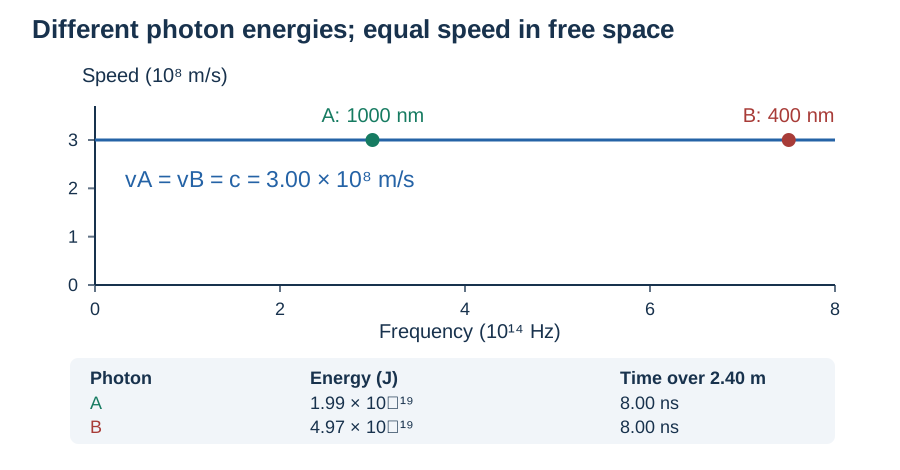
Compare two photons traveling through free space: a long-wavelength infrared photon and a shorter-wavelength visible photon. Both move at c = 3.00 × 10⁸ m/s. The visible photon has a larger frequency, energy hf, and momentum h/λ₀, but it does not overtake the infrared photon. Over the same distance d, both take t = d/c. A photon has zero rest mass and no electric charge, yet carries energy and momentum. It is not a massive particle whose speed can be increased by adding kinetic energy.
A frequency change changes the spacing of the wave cycles, not the free-space propagation speed. This is why λ₀f = c and E = hf can both hold: larger f means smaller λ₀ and larger E at the same c. A beam can form interference fringes through superposition and still deliver energy in localized photon events. Those two observations describe complementary behavior of the same light.
Keep the free-space condition explicit. In a material, the effective propagation speed is described by c/n in the supplied AP model and may depend on frequency through the material’s refractive index. That does not make a higher-energy photon intrinsically faster in free space.
Inspect diagram labels
The diagram keeps its full size here. Focus the view and use the arrow keys, or scroll across it, to inspect every label.
A boundary restricts momentum and energy together
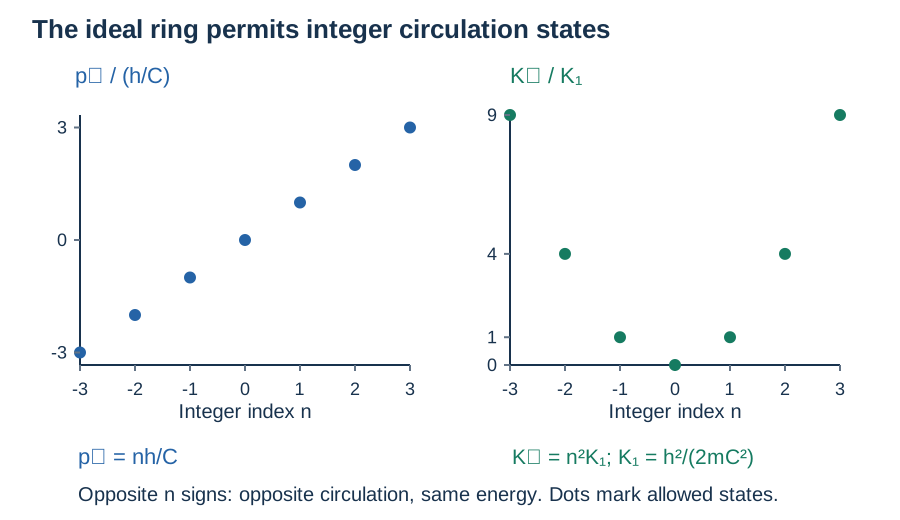
Consider an ideal nonrelativistic particle constrained to a circular ring of fixed circumference C, with constant potential energy chosen as zero. This is a teaching model for a boundary condition, not a model of the whole hydrogen atom. After one circuit, an allowed traveling wave must match its starting phase. For a nonzero mode, the ring fits an integer number of wavelengths: C = |n|λ, where n is an integer whose sign labels circulation direction. Using λ = h/|pₛ| gives the signed circulation-momentum rule pₛ = nh/C.
Because the potential energy is constant, the energy is kinetic: Kₙ = pₛ²/(2m) = n²h²/(2mC²). Thus momentum changes in equal steps h/C, but energy gaps are unequal: the levels for |n| = 1, 2, 3 have energies K₁, 4K₁, and 9K₁. The +n and −n modes have opposite circulation momenta and the same energy. The ideal ring also permits n = 0: a phase that is constant around the ring, with zero circulation momentum and zero kinetic energy in this chosen model.
The fixed ring circumference excludes arbitrary intermediate circulation momenta and energies. Do not transfer this formula to a Bohr atom, where electric potential energy and the allowed radius also matter. More generally, a bound system’s discrete energy levels do not prove that every Cartesian momentum component has a discrete measurement spectrum. Here the quantized momentum is the stated ring’s circulation variable; that limited example illustrates the boundary idea without making the broader claim.
Inspect diagram labels
The diagram keeps its full size here. Focus the view and use the arrow keys, or scroll across it, to inspect every label.
Two colors arrive together
Photon A has vacuum wavelength 1000 nm and photon B has vacuum wavelength 400 nm. They are emitted simultaneously into free space and travel the same 2.40 m to a detector. Use c = 3.00 × 10⁸ m/s and h = 6.63 × 10⁻³⁴ J·s.
Inspect diagram labels
The diagram keeps its full size here. Focus the view and use the arrow keys, or scroll across it, to inspect every label.
- Calculate fA = c/λA = 3.00 × 10¹⁴ Hz and fB = 7.50 × 10¹⁴ Hz. B has 2.50 times A’s frequency.
- Calculate EA = hfA = 1.99 × 10⁻¹⁹ J and EB = hfB = 4.97 × 10⁻¹⁹ J. B carries 2.50 times the energy and 2.50 times the vacuum momentum.
- Both free-space speeds equal c. Each travel time is t = 2.40/(3.00 × 10⁸) = 8.00 × 10⁻⁹ s = 8.00 ns. Their arrival-time difference is zero in the stated model.
Answer and check
Both arrive after 8.00 ns despite different frequencies, wavelengths, energies, and momenta. Simultaneous emission, equal path length, and free-space propagation are essential to this comparison.
Equal momentum steps give unequal energy gaps
An electron of mass 9.11 × 10⁻³¹ kg is confined to the ideal ring above with C = 1.20 nm. Use h = 6.63 × 10⁻³⁴ J·s and 1 eV = 1.60 × 10⁻¹⁹ J. Compare modes n = 0, +1, −1, +2, and +3; use the nonrelativistic ring model.
Inspect diagram labels
The diagram keeps its full size here. Focus the view and use the arrow keys, or scroll across it, to inspect every label.
- The momentum unit is h/C = (6.63 × 10⁻³⁴)/(1.20 × 10⁻⁹) = 5.53 × 10⁻²⁵ kg·m/s. The signed allowed values are 0, +5.53 × 10⁻²⁵, −5.53 × 10⁻²⁵, +1.11 × 10⁻²⁴, and +1.66 × 10⁻²⁴ kg·m/s.
- K₁ = (h/C)²/(2m) = 1.68 × 10⁻¹⁹ J = 1.05 eV. The energies are 0, 1.05, 1.05, 4.19, and 9.42 eV for the listed modes.
- The +1 to +2 energy gap is 3K₁ = 3.14 eV; the +2 to +3 gap is 5K₁ = 5.24 eV. Both momentum steps are h/C. Opposite ±1 circulation changes the sign of momentum without changing energy.
- For |n| = 3, |pₛ|/m ≈ 1.82 × 10⁶ m/s, far below c, so the stated kinetic-energy approximation is consistent. The arbitrary value pₛ = 1.5h/C is excluded because it cannot match phase after one circuit.
Answer and check
This ring permits the stated discrete circulation momenta and energies. Momentum steps are uniform; kinetic-energy gaps increase with |n|. These positive ring energies have a different reference and potential model from negative atomic binding energies.
Make the model respond
Focused Physics 2 model
Photon energy and photoelectric threshold
Predict first. Can brighter light eject electrons if each photon has too little energy?
Ephoton = hf = hc/λ; Kmax = hf − φ when hf ≥ φ; f₀ = φ/h
- Above-threshold KE; zero below threshold means no emission
- Selected or reference point
On a narrow screen, scroll within a figure to read its labels. The table and explanation provide the same physics in text.
Ephoton = 3.1 eV exceeds or meets φ = 2 eV; Kmax = 1.1 eV.
Read the model data and comparisons
| Quantity | Value | Unit | Meaning or limit |
|---|---|---|---|
| Wavelength | 4.000 × 10^−7 | m | |
| Frequency | 7.495 × 10^14 | Hz | |
| Photon energy | 4.966 × 10^−19 | J | |
| Work function | 3.204 × 10^−19 | J | |
| Threshold frequency | 4.836 × 10^14 | Hz | |
| Threshold wavelength | 6.199 × 10^−7 | m | |
| Photoemission energetically allowed | yes | ||
| Maximum kinetic energy | 1.762 × 10^−19 | J | At threshold the maximum is zero |
| Stopping potential magnitude | 1.1 | V | |
| Illuminated area | 1.000 × 10^−4 | m² | Fixed 1 cm² |
| Incident irradiance | 5 | W/m² | |
| Incoming photon rate on this area | 1.007 × 10^15 | s⁻¹ | Photon rate is not measured electron current |
Frequency determines energy per photon. The material’s work function sets the minimum energy needed to escape; any remaining energy sets the maximum electron kinetic energy. Irradiance changes the number of incoming photons per second at fixed wavelength, not the energy of each photon or the maximum kinetic energy. Actual emitted current also depends on absorption, quantum efficiency, and charge collection, which are not calculated here.
Assumptions and limits. Ideal one-photon photoelectric effect, fixed work function, monochromatic light over 1 cm². No multiphoton processes, material absorption spectrum, space charge, electron energy distribution, or detector efficiency. A plotted zero KE below threshold means no emission, not electrons emitted at rest.
Try it from memory
Write your answer and reason before opening the worked answer. Your self-assessment is a study decision; it is not an automatically graded score.
Question 1
A photon crosses from vacuum into n = 1.50 glass without absorption. Which change: f, effective propagation speed, wavelength, energy?
Worked answer and reason
f and hf remain unchanged; v becomes c/1.50 and λ becomes λ₀/1.50.
A stationary interface preserves frequency, while the medium changes propagation speed.
Question 2
An electron detector records separate dots that eventually form two-slit fringes. Which features support particle-like and wave-like descriptions?
Worked answer and reason
Localized detections support particle-like events; the phase-dependent statistical fringes support wave behavior.
One event and a distribution of events are different observations.
JavaScript enables saved drafts and self-assessment. You can always work on paper.
Catch the tempting mistake
- A massless photon cannot carry momentum.
- Zero rest mass does not mean zero energy. A vacuum photon has momentum E/c.
Put it to work
Give the physical reason as well as the calculation. The worked solutions are on a separate page.
- Problem 1 · mixed
- Problem 2 · mixed
- Problem 17 · mixed
- Problem 18 · experimental
Explain and apply the model
Try these problems before opening the solutions. Show the physical model, your calculation or sketch, and the reason your conclusion follows.
Do higher-energy photons arrive first?
Photon R has vacuum wavelength 900 nm and photon S has vacuum wavelength 300 nm. They are emitted at the same instant and travel equal straight 6.00 m paths in free space. Use c = 3.00 × 10⁸ m/s and h = 6.63 × 10⁻³⁴ J·s. A separate two-opening test with the same light records individual detector clicks that accumulate into fringes.
(a) Compare R and S by frequency, energy per photon, and vacuum momentum. Calculate both free-space speeds and both travel times, then evaluate the claim that the higher-energy photon reaches the detector first. State why the speed comparison does not depend on the chosen frequencies.
(b) Explain which feature of the two-opening observations calls for wave behavior and which calls for particle-like energy transfer. A student says that the individual clicks rule out a wave description. Evaluate that statement for the whole set of observations.
(c) A uniform slab on R’s path has index n = 1.50 in the supplied propagation model. At a stationary interface and with no absorption, compare R’s effective speed, frequency, wavelength, and energy inside the slab with its free-space values. Does that medium result change the free-space comparison in part a?
Written working workspace
Drawing is temporarily unavailable. Work on paper if needed, then record your reasoning here.
Saving written working requires JavaScript. Keep your work on paper or in your own notes; the source problem above remains available.
Worked solution and rubric →Revisit the explanation →Revisit the explanation →
A speed claim in free space
Two photons with different frequencies leave together along equal free-space paths. Photon B has twice photon A’s energy. Choose the best speed and arrival-time comparison.
(a) Select the statement that follows from the free-space photon model.
Derive the ring’s momentum and energy rules
An electron of mass m = 9.11 × 10⁻³¹ kg is confined to an ideal circular ring of fixed circumference C = 1.50 nm. Its potential energy is constant and defined as zero. A nonzero circulating matter wave must match its phase after one circuit: C = |n|λ for integer n; sign labels the direction of circulation. Use h = 6.63 × 10⁻³⁴ J·s, λ = h/|pₛ|, K = pₛ²/(2m), and 1 eV = 1.60 × 10⁻¹⁹ J. The ideal model also allows a constant-phase n = 0 state.
(a) Derive the signed allowed circulation momentum pₛ(n) and the allowed energy Kₙ in terms of n, h, C, and m. Explain why a continuously adjustable classical ring momentum is incompatible with the stated wave boundary condition.
(b) Calculate the allowed pₛ and K for n = 0, +1, −1, and +2. Compare the +1→+2 momentum step and energy gap. Test whether pₛ = 1.5h/C is allowed, and whether changing +1 to −1 must change the energy.
(c) Sketch the allowed energy levels for |n| = 0, 1, 2, and 3 on a labeled energy axis using the calculated K₁. Compare the successive gaps, and evaluate: “This proves every Cartesian momentum component of every bound quantum system has discrete measured values.” State the defensible conclusion from this model.
Written working workspace
Drawing is temporarily unavailable. Work on paper if needed, then record your reasoning here.
Saving written working requires JavaScript. Keep your work on paper or in your own notes; the source problem above remains available.
Worked solution and rubric →Revisit the explanation →Revisit the explanation →
Scientific calculator workspace
Keep intermediate precision and report units. This calculator supports arithmetic and elementary functions.
Scientific calculator
This calculator requires JavaScript. Use the physics formula sheets and show your working manually.
+ − * / ^ ! · pi · e · sqrt · sin, cos, tan · asin, acos, atan · atan2(y,x) · ln, log · abs · exp · hypot(x,y). Use * between factors. Keep units in your written working.
For the teacher
- Require the student to name the observation that needs the model. Use vacuum photon momentum only unless a different medium model is explicitly provided.
Source objectives and scope
- 15.1.A — Describe the properties and behavior of an object that exhibits both particle-like and wave-like behavior.
Suggested skills are teaching guidance. The course applies all science practices across its objectives.
Science references for this teaching
- AP Physics 2 Course and Exam Description, official Unit 15 — Official topic/LO/EK scope and boundaries; local pinned pages 143–158, equations and relevant clauses visually checked on 143–144,146,149–150,152–158.
- AP Physics 2 Course and Exam Description Clarifications, effective Fall 2026 — 15.7.B.1 current definition includes decay to a lower energy level of the same nucleus.
- OpenStax University Physics 3, Blackbody Radiation — Verification of Wien peak and integrated spectral intensity versus Stefan–Boltzmann total power.
- OpenStax University Physics 3, Photoelectric Effect — Verification of threshold, maximum kinetic energy, intensity distinctions, and retarding-potential experiment.
- OpenStax University Physics 3, The Compton Effect — Verification of positive electron-at-rest shift and photon energy/momentum accounting.
- OpenStax University Physics 3, Nuclear Binding Energy — Verification of all-nucleon mass defect and atomic-mass convention.
- OpenStax University Physics 3, Radioactive Decay — Verification of exponential survival, half-life, and nuclear transformation balances.
- OpenStax University Physics, Volume 3: 6.1 Blackbody Radiation — Primary textbook verification of the wavelength-based blackbody spectral shape, the distinction between peak height and complete spectrum area, Wien’s displacement law, and Stefan–Boltzmann emitted intensity and power.
Related source reading
These alternative explanations and examples retain their source context. Draft placement does not add accepted exam coverage.
- photon energy · alternative source explanation
Glossary and deeper reading · 21 refreshers
These editorial refreshers supplement the reading. Definitions and examples are added guidance; original source wording and recorded answers remain in their original context.
-
Photon
A photon is a quantum of electromagnetic radiation with energy proportional to its frequency. It has zero rest mass and no electric charge but carries energy and momentum. For example, increasing light’s frequency increases the energy of each photon, while increasing the number of same-frequency photons increases the total energy.
-
Wave interference
Wave interference is the combination of overlapping wave disturbances. In a linear medium, the signed disturbances add at each location and time without permanently destroying the passing waves. For example, two overlapping upward rope pulses temporarily make a larger upward disturbance.
-
Linear momentum
Linear momentum is a vector describing an object’s motion and equals mass times velocity in the nonrelativistic model. The vector sum of momenta is conserved when the net external impulse on the system is zero. For example, two identical carts moving equally fast in opposite directions have zero total linear momentum but nonzero total kinetic energy.
-
Wave
A wave is a propagating disturbance that can transfer energy without transporting the medium as a whole. Mechanical waves require a material medium, while electromagnetic waves can propagate through vacuum. For example, a pulse travels along a rope while individual rope segments move locally around their equilibrium positions.
-
Blackbody
A blackbody is an ideal object that absorbs all incident electromagnetic radiation. Its thermal emission spectrum depends on temperature, and at equilibrium it can emit and absorb equal powers without changing temperature. For example, heating a blackbody shifts its peak emission toward shorter wavelengths and increases its total emitted power.
-
Oscillation phase
Phase specifies the position within a repeating oscillation cycle. A phase difference tells how much one oscillation leads or lags another at a chosen place and time. For example, two sinusoidal waves half a cycle out of phase can cancel when their amplitudes are equal.
-
Superposition
Superposition means adding the separate contributions to obtain a total response in a linear model. Vector fields add vectorially, scalar potentials add algebraically, and wave disturbances add with their signs at each place and time. For example, equal but opposite electric-field contributions can give zero net field at one point while both sources remain present.
-
Wavelength
Wavelength is the spatial distance between neighboring points at the same phase of a periodic wave. It connects propagation speed and frequency through speed equal to frequency times wavelength. For example, neighboring crests of a sinusoidal water wave are separated by one wavelength.
-
Frequency
Frequency is the number of complete repeating cycles per unit time. It is measured in hertz, meaning cycles per second, and is the reciprocal of the period. For example, a vibrating string with a higher frequency produces more cycles each second.
-
Refraction
Refraction is a change in wave propagation at a boundary where wave speed changes. For light entering a new medium, frequency stays fixed while speed and wavelength can change, and the direction generally bends unless incidence is normal. For example, a light ray entering water obliquely from air bends toward the normal.
-
Dielectric
A dielectric is an insulating material that polarizes in an electric field. In a capacitor it changes the field response and capacitance; charge or voltage changes depend on whether the battery remains connected. For example, inserting a dielectric into an isolated charged capacitor can reduce its voltage while its free plate-charge magnitude remains fixed.
-
Diffraction
Diffraction is the spreading and interference of waves near openings or obstacles. The spreading is especially pronounced when the opening or obstacle size is comparable to wavelength. For example, sound spreads through a doorway much more noticeably than visible light because sound wavelengths are far larger.
-
Energy level
An energy level is an allowed energy of a quantum system. Bound systems have discrete levels, and a transition between them requires an energy transfer equal to the level difference. For example, an atom emitting a photon drops to a lower energy level and transfers the difference to that photon.
-
Magnitude
Magnitude is the nonnegative size of a vector quantity. It does not specify direction, and it differs from a signed component. For example, a westward velocity can have a negative x component while its speed, the velocity magnitude, stays positive.
-
Quantization
Quantization means a quantity can take only certain allowed values in the stated quantum system. Bound-state boundary conditions can restrict energy to discrete levels rather than a continuous range. For example, an electron bound in a hydrogen atom cannot have an arbitrary energy between its allowed levels.
-
Electric charge
Electric charge is a conserved property that determines electric interactions. It can be positive or negative and is measured in coulombs; ordinary net charges arise from an imbalance of charged particles. For example, transferring electrons between initially neutral objects leaves one negatively charged and the other positively charged.
-
Kinetic energy
Kinetic energy is energy associated with motion relative to a chosen reference frame. For a nonrelativistic translating object it is one half of its mass times speed squared. For example, doubling a cart’s speed quadruples its translational kinetic energy when its mass stays fixed.
-
Refractive index
Refractive index is the ratio of light’s speed in vacuum to its speed in the material at the relevant frequency. It is dimensionless and can depend on wavelength. For example, glass usually has a larger refractive index than air, so visible light travels more slowly through the glass.
-
Potential energy
Potential energy describes energy associated with the configuration of interacting parts of a system. Its numerical zero is a chosen reference, while differences in potential energy determine physical energy changes. For example, separating Earth and a ball changes their gravitational potential energy even though the energy belongs to their interaction.
-
Electric potential energy
Electric potential energy is energy associated with the configuration of interacting charges. Its value depends on the chosen reference, and a charge pair is counted once when calculating a system’s total pair energy. For example, bringing two positive point charges closer requires positive external work in a slow controlled approach.
-
Electronvolt
An electronvolt is an energy unit equal to the elementary-charge magnitude multiplied by one volt. It is approximately 1.60 × 10⁻¹⁹ joule and is not a unit of voltage. For example, atomic transition energies are often more conveniently expressed in electronvolts than in very small fractions of a joule.