Electromagnetic Waves
Connect electromagnetic field directions, vacuum propagation, and spectrum ordering.
AP Physics 2 Topic 14.4 · College Board CED printed p. 116, 117 / PDF p. 123, 124 · See this topic in the course outline
Light is a traveling arrangement of electric and magnetic fields. The vacuum has no vibrating matter, yet the wave still carries energy.
Before you start
- Electric and magnetic fields
- Transverse waves
- v = fλ
Three perpendicular directions
An electromagnetic wave has an oscillating electric field and an oscillating magnetic field. They are perpendicular to each other and to propagation, so the wave is transverse. For a wave moving along +x, one valid arrangement is E along y and B along z. At a different phase both can reverse while the propagation stays +x.
A plane-wave model has flat surfaces of constant phase, called wavefronts, perpendicular to travel. Sketch parallel y–z planes separated by λ moving along x. Within one plane the fields are at the same phase. This is a useful approximation far from a localized source or over a small part of a broad beam; spherical spreading from a nearby source is not globally planar. Electromagnetic waves propagate without a material medium and in vacuum travel at c.
Mutual perpendicularity alone leaves two possible travel directions. In a right-handed coordinate frame the orientation is : point the fingers of your right hand along E and curl them toward B; your thumb points along propagation. For E along +x and B along +y, travel is +z. Reversing B alone reverses travel; reversing both fields at the next half-cycle leaves travel unchanged.
Order by wavelength, then reverse for frequency
From longest wavelength to shortest: radio, microwave, infrared, visible, ultraviolet, X-ray, gamma ray. Because c = fλ in vacuum, that is also lowest to highest frequency. The spectrum spans kilometers to picometers; the names group one continuous range rather than different physical mechanisms of travel.
Within visible light, decreasing wavelength gives red, orange, yellow, green, blue, violet. Red therefore has lower frequency than violet. Visible radiation is usually called light; sometimes “light” means electromagnetic radiation of every wavelength. State which meaning is intended.
| Wave | Vacuum wavelength | Frequency from c/λ |
|---|---|---|
| Radio example | 3.0 m | 1.0 × 10⁸ Hz |
| Visible example | 600 nm | 5.0 × 10¹⁴ Hz |
| X-ray example | 0.10 nm | 3.0 × 10¹⁸ Hz |
AP Physics 2 requires the ordering, including visible colors, rather than exact category wavelength ranges.
A visible plane wave
A vacuum electromagnetic wave has λ = 480 nm and travels along +z. Choose consistent E and B directions and calculate f.
Convert λ = 4.80 × 10⁻⁷ m and use c for vacuum propagation.
Why this step? All vacuum electromagnetic frequencies share the same propagation speed.
.
Why this step? The inverse wavelength comparison determines frequency.
Choose E along +x and B along +y at a field maximum; the wavefronts are x–y planes.
Right-hand check: +x crossed with +y is +z. A −y magnetic field would instead give −z, so the sign is determined, not arbitrary.
Why this step? Fields are mutually perpendicular and transverse to +z; the plane-wave assumption identifies constant-phase surfaces.
Answer and check
f = 6.25 × 10¹⁴ Hz; E, B, and propagation are mutually perpendicular.
The field triad changes with phase
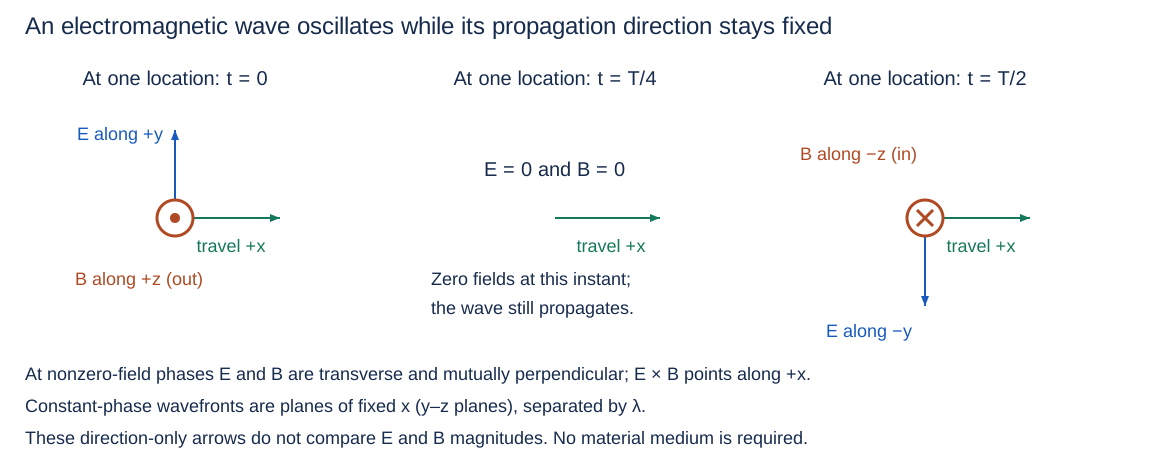
A single field-direction triad is one instant of an oscillation. At a fixed location in a vacuum plane wave moving along +x, choose E = E₀ cos(2πft) in the y direction and B = B₀ cos(2πft) in the z direction. The two fields reverse together each half-cycle, so E × B keeps the same propagation sense. At a quarter-cycle both pass through zero; that instant does not mean the wave has stopped.
At any given time, each constant-phase wavefront is a plane perpendicular to x, extending in the y–z directions. Successive same-phase planes are separated by λ. The fields carry the wave; a vacuum needs no oscillating material particles. The plane model is suitable over a broad beam or a small portion of a distant wavefront.
Inspect diagram labels
The diagram keeps its full size here. Focus the view and use the arrow keys, or scroll across it, to inspect every label.
Connect optical repetition to the field snapshots
A plane electromagnetic wave in free space has λ = 600 nm and travels along +x. At x = 0, E is along +y and B along +z at t = 0.
Inspect diagram labels
The diagram keeps its full size here. Focus the view and use the arrow keys, or scroll across it, to inspect every label.
- f = c/λ = (3.00 × 10⁸)/(6.00 × 10⁻⁷) = 5.00 × 10¹⁴ Hz; T = 2.00 × 10⁻¹⁵ s.
- At t = T/4 = 5.00 × 10⁻¹⁶ s both fields are zero. At t = T/2 = 1.00 × 10⁻¹⁵ s both reverse: E along −y and B along −z.
- (+y) × (+z) and (−y) × (−z) both give +x. The equal-phase fronts are y–z planes, not curves along the fields.
Answer and check
The field oscillations have 5.00 × 10¹⁴ Hz frequency. Their simultaneous sign reversal preserves +x propagation; free-space propagation needs no material medium.
Try it from memory
Write your answer and reason before opening the worked answer. Your self-assessment is a study decision; it is not an automatically graded score.
Question 1
Put ultraviolet, radio, infrared, and X-ray radiation in increasing frequency.
Worked answer and reason
Radio, infrared, ultraviolet, X-ray.
Frequency order reverses wavelength order because all have c in vacuum.
Question 2
Red and violet light cross a vacuum. Which arrives first over the same distance, and which has shorter λ?
Worked answer and reason
They arrive together. Violet has shorter wavelength and higher frequency.
Color changes f and λ, not vacuum c.
JavaScript enables saved drafts and self-assessment. You can always work on paper.
Catch the tempting mistake
- Light needs vibrating air because it is a wave.
- The oscillating quantities are electric and magnetic fields; no material medium is required.
Put it to work
Give the physical reason as well as the calculation. The worked solutions are on a separate page.
Scientific calculator workspace
Keep intermediate precision and report units. This calculator supports arithmetic and elementary functions.
Scientific calculator
This calculator requires JavaScript. Use the physics formula sheets and show your working manually.
+ − * / ^ ! · pi · e · sqrt · sin, cos, tan · asin, acos, atan · atan2(y,x) · ln, log · abs · exp · hypot(x,y). Use * between factors. Keep units in your written working.
For the teacher
- Require three mutually perpendicular arrows. Assess spectrum order, not memorized numerical category boundaries.
Source objectives and scope
- 14.4.A — Describe the properties of an electromagnetic wave.
AP Physics 2 expects students to know the ordering of the electromagnetic spectrum (including visible light). However, students will not be expected to define exact wavelength ranges within the electromagnetic spectrum.
Suggested skills are teaching guidance. The course applies all science practices across its objectives.
Science references for this teaching
- AP Physics 2 Course and Exam Description, official Unit 14 — Official topic/LO/EK scope and boundaries; local pinned source pages 117–134, equations visually checked on 118,120,130,132,134.
- OpenStax University Physics 1, Energy and Power of a Wave — Verification of fixed-amplitude mechanical-wave frequency scaling and distinction from electromagnetic intensity.
- OpenStax University Physics 1, Interference of Waves — Linear superposition and pointwise addition model.
- OpenStax University Physics 3, Single-Slit Diffraction — Verification of aperture minima and small-angle conditions.
- OpenStax University Physics 3, Interference in Thin Films — Verification of reflection phase and normal-incidence thin-film paths.
Glossary and deeper reading · 9 refreshers
These editorial refreshers supplement the reading. Definitions and examples are added guidance; original source wording and recorded answers remain in their original context.
-
Magnetic field
A magnetic field assigns a vector direction and strength to each location and predicts interactions with moving charges, currents, and magnetic materials. Its strength is measured in teslas, and the force on a moving charge need not point along the field. For example, a compass aligns with the local field while a moving charge can be deflected perpendicular to it.
-
Wave
A wave is a propagating disturbance that can transfer energy without transporting the medium as a whole. Mechanical waves require a material medium, while electromagnetic waves can propagate through vacuum. For example, a pulse travels along a rope while individual rope segments move locally around their equilibrium positions.
-
Transverse wave
In a transverse wave, the disturbance is perpendicular to the direction of propagation. The disturbance direction and the energy-transfer direction must therefore be distinguished. For example, a rope pulse can travel horizontally while rope segments move up and down.
-
Electric field
An electric field assigns the electric force per unit positive test charge to each location. The field is produced by the sources and is a vector, while the force on a negative charge points opposite the field. For example, the electric field between ideal parallel capacitor plates can accelerate an electron opposite the field arrows.
-
Oscillation phase
Phase specifies the position within a repeating oscillation cycle. A phase difference tells how much one oscillation leads or lags another at a chosen place and time. For example, two sinusoidal waves half a cycle out of phase can cancel when their amplitudes are equal.
-
Wavefront
A wavefront is a surface joining points of equal wave phase at a given time. Rays are perpendicular to wavefronts in the uniform isotropic ray model used here. For example, a distant source can be approximated by nearly plane wavefronts over a small region.
-
Wavelength
Wavelength is the spatial distance between neighboring points at the same phase of a periodic wave. It connects propagation speed and frequency through speed equal to frequency times wavelength. For example, neighboring crests of a sinusoidal water wave are separated by one wavelength.
-
Gamma radiation
Gamma radiation consists of high-energy electromagnetic photons, commonly produced in nuclear or particle processes. The photons carry energy and momentum but have no electric charge or rest mass; the radiation’s name alone does not specify a decay mode. For example, a gamma photon belongs to the same electromagnetic spectrum as a radio photon but has a much higher frequency and energy.
-
Frequency
Frequency is the number of complete repeating cycles per unit time. It is measured in hertz, meaning cycles per second, and is the reciprocal of the period. For example, a vibrating string with a higher frequency produces more cycles each second.