Fluid Conservation: Follow the Water and the Energy
Connect volume flow, continuity, Bernoulli, and a measurable horizontal-jet model.
Follow the water and the energy
Water speeds up as it passes through a narrow nozzle. Where does the extra kinetic energy come from, and why doesn’t water pile up inside the pipe? Those are two different questions. Conservation of mass handles the amount of water, while conservation of energy connects speed, pressure, and height.
For this lesson we assume a steady, ideal incompressible flow, and pipes completely filled with fluid, unless a task says otherwise. Steady means the flow at each fixed location stays the same over time; a moving bit of water can still speed up. A streamline is a curve that follows the local flow direction. We neglect viscosity, added pumps, and dissipative losses. Bernoulli’s equation applies between locations along a streamline under those assumptions. These boundaries matter: a real partly blocked hose can reduce the overall flow rate, so “smaller opening always means faster water” needs a stated comparison.
Conservation of mass: continuity
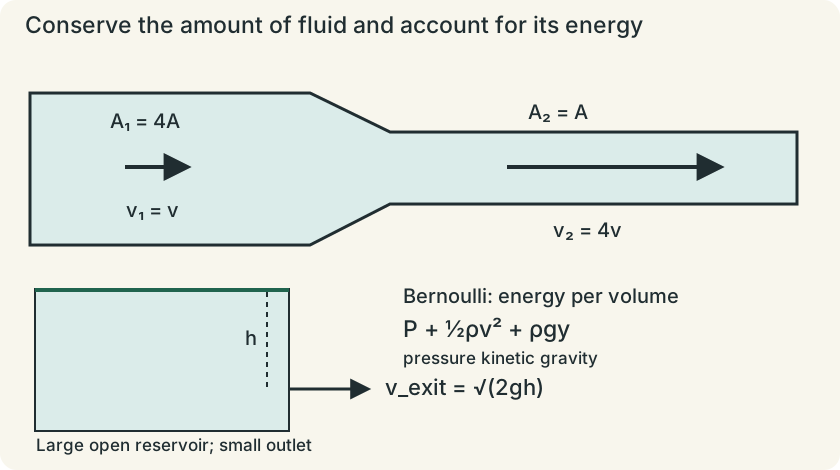
In time Δt, fluid moving at average speed v crosses a length vΔt through area A. The volume that passes is ΔV = AvΔt, giving volume flow rate Q = ΔV/Δt = Av, in m³/s. Mass flow rate is ρQ. In a filled pipe with steady incompressible flow and no branches or leaks, the mass entering per second equals the mass leaving per second. Since density is unchanged, A₁v₁ = A₂v₂. This is the continuity equation. The velocities here are speeds through the selected cross sections, not signed vector arrows that must point the same way in a bent pipe.
If a pipe diameter halves, its area becomes one-quarter as large because A = πd²/4. At the same Q, the speed becomes four times larger. If a 4.0 cm diameter pipe carries water at 0.50 m/s and narrows to diameter 2.0 cm, the new speed is 2.0 m/s. The volume flow rate is π(0.020 m)²(0.50 m/s) = 6.28 × 10⁻⁴ m³/s, or 0.628 L/s. Don’t substitute diameter directly for area. OpenStax’s flow-rate explanation supports the continuity model.
Conservation of energy: Bernoulli
Consider a small volume ΔV moving between two locations. Upstream pressure does work P₁ΔV on it; downstream pressure opposes the motion with work −P₂ΔV. The fluid mass is ρΔV. Including its kinetic and gravitational potential energy changes and dividing by ΔV gives:
P₁ + ½ρv₁² + ρgy₁ = P₂ + ½ρv₂² + ρgy₂.
The terms have units of Pa, or energy per volume. The pressure term accounts for work by surrounding fluid; it isn’t a separate moving mass. At equal height, a greater speed corresponds to lower pressure along this ideal streamline. At different heights, the gravitational term matters too. “Faster means lower pressure” is therefore not a universal conclusion about any two fluid locations. OpenStax’s Bernoulli discussion supports this energy balance.
For the horizontal pipe above with water density 1000 kg/m³, the upstream–downstream pressure difference is P₁ − P₂ = ½ρ(v₂² − v₁²) = 1875 Pa. The unequal pressure forces on the fluid segment produce a net force toward lower pressure: a pressure difference can drive the flow and change its momentum. Pressure work supplies the increased kinetic energy. If the outlet rises by 0.80 m, the required pressure difference at those same speeds becomes 1875 + (1000)(9.8)(0.80) = 9715 Pa. A height change can demand more energy even when the speeds are unchanged.
A reservoir jet: Torricelli’s theorem
A large open reservoir has a small hole h below the water surface. Compare a point at the surface to a point just outside the hole. Both are at atmospheric pressure. The surface speed is approximately zero if the reservoir area is much larger than the hole area. With y_surface − y_hole = h, Bernoulli gives ρgh = ½ρv_exit², so v_exit = √(2gh). This is Torricelli’s theorem. Density cancels in this ideal model, just as mass cancels for a freely falling object. A hole 0.45 m below the surface gives speed 2.97 m/s.
If the surface area isn’t much larger than the hole area, the surface speed isn’t negligible. Use continuity to relate it to the exit speed before applying Bernoulli. Likewise, a sealed pressurized reservoir has different surface and exit pressures, so pressure no longer cancels. Always name why you drop a term. The fluid still accelerates through forces; conservation is an efficient way to account for the result.
Measure the jet using a graph
A small horizontal hole launches a jet from fixed height H above a catch tray. If the jet lands a horizontal distance R away, projectile motion gives fall time t = √(2H/g) and exit speed v = R/t. Torricelli then predicts R² = 4Hh. Vary the water height h above the hole while keeping hole size and H fixed. Mark the center of the landing stream, measure R, and repeat each height several times. Refill between trials so h changes negligibly during each reading. Keep splashes and the finite stream width in your uncertainty discussion.
Plot R² vertically in m² against h horizontally in m. Its ideal slope is 4H, with units m. If H = 0.25 m, a slope near 1.00 m supports the model. A real jet can have losses and a changing stream shape, so compare the measured slope and uncertainty to 4H rather than simply declaring exact agreement. Label scales and units, draw a best-fit line, and use widely separated points on the fitted line for the slope. The slope and its uncertainty let you judge how closely the measured jet follows the ideal energy model.
Count the matter before balancing the energy
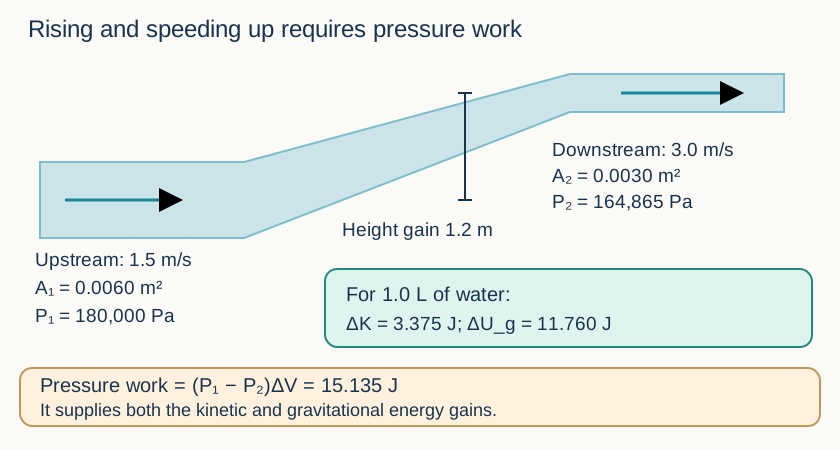
Suppose a steady stream of ideal water enters a filled unbranched pipe through area 0.0060 m² at speed 1.5 m/s. In 2.0 s it advances 3.0 m through that section, so the crossing volume is A(vΔt) = 0.018 m³. Divide by the time to get Q = Av = 0.0090 m³/s, or 9.0 L/s. At density 1000 kg/m³ the mass flow rate is ρQ = 9.0 kg/s. A downstream section of area 0.0030 m² must carry that same 9.0 kg every second, so its speed is 3.0 m/s.
Why must those mass rates match? A rigid filled pipe containing an incompressible fluid cannot accumulate mass while maintaining a steady state with unchanged density and volume. If 9.0 kg entered each second but only 8.0 kg left, its contents would gain 1.0 kg each second, contradicting those assumptions. Continuity expresses this mass accounting. It does not identify the forces that make a moving parcel accelerate: unequal pressure forces, gravity, and boundaries do that. At equal height in an ideal horizontal accelerating stream, pressure work can supply the increase in kinetic energy. A hydrostatic pressure difference that exactly balances gravity need not cause flow, so check the full forces and the flow conditions.
A rising narrow pipe uses both pressure work and height energy
Use the same stream, but let the downstream section be 1.2 m higher than the upstream section, where the absolute pressure is 180,000 Pa. For 1.0 L of water, the mass is 1.0 kg. Its kinetic energy increases from ½(1.0)(1.5)² = 1.125 J to ½(1.0)(3.0)² = 4.500 J, a gain of 3.375 J. Its gravitational potential energy increases by (1.0)(9.8)(1.2) = 11.760 J. The total required gain is 15.135 J.
The surrounding fluid does net pressure work (P₁ − P₂)ΔV. Set that equal to ΔK + ΔU_g: (P₁ − P₂)(0.0010 m³) = 15.135 J. Therefore P₂ = 164,865 Pa. Dividing the general work balance by ΔV yields P₁ + ½ρv₁² + ρgy₁ = P₂ + ½ρv₂² + ρgy₂. This is Bernoulli’s mechanical-energy balance; no calculus is needed. Take y₁ = 0 and compare the terms below, all in Pa or J/m³.
| Location | Pressure term P | Kinetic term ½ρv² | Height term ρgy | Sum |
|---|---|---|---|---|
| Upstream | 180,000 | 1125 | 0 | 181,125 |
| Downstream | 164,865 | 4500 | 11,760 | 181,125 |
Inspect diagram labels
The diagram keeps its full size here. Focus the view and use the arrow keys, or scroll across it, to inspect every label.
If the stream instead descends far enough, the loss of gravitational potential can supply an increase in speed and an increase in pressure. Thus a speed increase alone does not determine the pressure change when height also changes. Apply this balance along a streamline for steady ideal incompressible flow with a filled pipe, no pump between the locations, and negligible dissipative loss.
Derive the open-reservoir result before using it
For a large open tank draining through a small hole, choose point 1 at the free surface and point 2 in the emerging jet. Write the full balance first: P_surface + ½ρv_surface² + ρgy_surface = P_exit + ½ρv_exit² + ρgy_exit. Both exposed points are atmospheric, so their pressure terms cancel. The surface area is much larger than the hole area, so continuity makes v_surface much smaller than v_exit; neglect its squared kinetic term. With h = y_surface − y_exit, the remaining balance is ρgh = ½ρv_exit². Hence v_exit² = 2gh and v_exit = √(2gh), Torricelli’s theorem.
For h = 0.80 m and g = 9.8 m/s², v_exit² = 15.68 m²/s² and v_exit = 3.96 m/s. An ideal graph of v_exit² against h is a straight line through zero with slope 2g = 19.6 m/s². Pressure work cancels in this open-tank comparison; gravitational potential energy becomes kinetic energy. In a sealed tank with extra surface pressure ΔP, the same derivation gives v_exit² = 2gh + 2ΔP/ρ when surface speed is negligible. A nonnegligible surface speed or viscous loss also changes the balance. State the cancellation and approximation rather than treating the square-root formula as universal.
Keep both conservation laws
Pause & try it
Let's see what stuck.
Choose an answer, then check the reasoning. Try the written problems below before opening their solutions.
0 of 3 checked · 0 correct
Written practice: graph slope and a jet
A horizontal jet leaves a reservoir hole 0.20 m above a catch tray. A fitted graph of R² versus water depth h passes through the origin and has slope 0.72 m. Find the ideal expected slope and compare the measured range to the ideal range at h = 0.30 m.
Open the separate worked solution.
For more original-book instruction and its existing quizzes, see Bernoulli’s Equation. The quantitative head-loss and real-gas material in More on Fluids is enrichment beyond these ideal-flow AP requirements.
You can also practice layered hydrostatic pressure, problem 23 and the U-tube problem 24, with their separate solutions. These extend the required constant-density pressure model to useful multisegment comparisons.
Teaching reference: CED topic 8.4, printed pages 137–138 requires both, including Torricelli’s theorem.
Explain and apply the model
Try these problems before opening the solutions. State your assumptions, show the diagram or calculation, and explain what makes your answer follow.
Follow the mass and identify the driving force
Ideal water of density 1000 kg/m³ flows steadily through a rigid filled pipe with no branches or leaks. Inlet area is 0.0040 m² and average inlet speed is 2.0 m/s. Outlet area is 0.0016 m². Separately, consider a horizontal uniform-area fluid segment initially at rest with end area 0.0040 m², pressure 115,000 Pa on its left end and 110,000 Pa on its right. There is no other horizontal force on that segment. All pipes are completely filled; dissipative forces are neglected.
(a) Derive Q = Av by finding the volume that crosses a section in a time Δt. Calculate the inlet volume flow rate in m³/s and L/s, the mass flow rate in kg/s, and the volume crossing in 3.0 s.
(b) Explain why the mass entering per second must equal the mass leaving per second in this filled steady pipe, then derive continuity and calculate the outlet speed. A sensor claims 8.0 kg/s enters but only 7.0 kg/s leaves: explain the implied accumulation and why it contradicts the setup.
(c) For the initially resting horizontal segment, draw its two pressure forces and calculate their net horizontal force. Describe the initial flow direction and explain causally why the pressure difference starts the fluid moving. Why would a stationary vertical hydrostatic pressure difference need a separate gravity force balance?
Your written working
Drawing is temporarily unavailable. Work on paper if needed, then record your reasoning here.
Saving written working requires JavaScript. The problem remains available above; keep your work on paper or in your own notes.
Keep all three terms in a rising pipe
Steady ideal incompressible water, density 1000 kg/m³, flows through a completely filled pipe without a pump or dissipative loss between two points on one streamline. At point 1, A₁ = 0.0040 m², v₁ = 2.0 m/s, y₁ = 0 and absolute P₁ = 170,000 Pa. At point 2, A₂ = 0.0020 m² and y₂ = +1.50 m. Take g = 9.8 m/s².
(a) Use mass conservation to find v₂. For a moving 1.0 L parcel, calculate its mass, kinetic-energy change and gravitational-potential-energy change between these points. Explain why a speed-only energy comparison is incomplete.
(b) Starting from pressure work (P₁ − P₂)ΔV = ΔK + ΔU_g, derive the general Bernoulli equation by dividing through by ΔV. Use it to find P₂, then make a numerical pressure/kinetic/height energy-per-volume table for both points. State the conditions that make this conservation equation applicable.
(c) Explain in words how pressure work is redistributed into kinetic and gravitational potential energy in this pipe. If point 2 were instead 1.50 m below point 1 at the same speeds, calculate P₂ and explain whether a faster stream can also have higher pressure.
Your written working
Drawing is temporarily unavailable. Work on paper if needed, then record your reasoning here.
Saving written working requires JavaScript. The problem remains available above; keep your work on paper or in your own notes.
Worked solution and rubric →Revisit the worked example →Revisit the worked example →
Derive the reservoir speed and test its assumptions
An open tank drains through a small opening at depth h below its free surface. The free-surface area is much larger than the opening area. Follow a streamline from the free surface to the emerging jet, assume locally steady ideal incompressible flow and negligible losses, and use g = 9.8 m/s². Both exposed points are at atmospheric pressure. For a later comparison the liquid is water of density 1000 kg/m³ and a sealed tank has surface pressure 5000 Pa above the exit pressure.
(a) Write the complete surface-to-exit Bernoulli balance and derive Torricelli’s theorem v_exit = √(2gh). State separately why the pressure terms cancel, why the surface kinetic term is negligible, and why the height difference supplies the exit kinetic energy. Do not begin by assuming the final theorem.
(b) Calculate the exit speed at h = 0.50 m. Construct a labeled numerical graph of v_exit² versus h using h = 0.20, 0.50 and 0.80 m. Find its slope and intercept and explain what energy relationship that graph tests.
(c) For the sealed water tank at the same depth h = 0.50 m and negligible surface speed, derive the modified exit-speed expression and calculate its speed. Explain which open-tank cancellation fails and how the v_exit²-versus-h graph changes if the extra surface pressure stays constant.
Your written working
Drawing is temporarily unavailable. Work on paper if needed, then record your reasoning here.
Saving written working requires JavaScript. The problem remains available above; keep your work on paper or in your own notes.
Can faster flow have greater pressure?
Assume a filled pipe, ideal incompressible water, steady flow, no intervening pump and no dissipative loss. Compare the specified points along one streamline.
(a) Ideal water of density 1000 kg/m³ flows steadily along one streamline without losses. From point 1 to point 2 its speed increases from 1.0 to 3.0 m/s while it drops 2.0 m in height. With g = 9.8 m/s², which pressure claim is consistent with the complete mechanical-energy balance?
Related source reading
These alternative explanations and examples retain their source context. Draft placement does not add accepted exam coverage.
- torricelli outflow · alternative source explanation
- Nonideal gas, head loss and jet momentum · source context; placement review pending
Glossary and deeper reading · 14 refreshers
These editorial refreshers supplement the reading. Definitions and examples are added guidance; original source wording and recorded answers remain in their original context.
-
Kinetic energy
Kinetic energy is energy associated with motion relative to a chosen reference frame. For a nonrelativistic translating object it is one half of its mass times speed squared. For example, doubling a cart’s speed quadruples its translational kinetic energy when its mass stays fixed.
-
Conservation of energy
Conservation of energy means total energy is unchanged when the full isolated system is considered. Energy can transfer between objects or change form, so one selected energy store need not remain constant. For example, friction can reduce a sliding block’s kinetic energy while increasing the thermal energy of the block and floor.
-
Incompressible fluid
An incompressible-fluid model treats density as constant despite pressure changes in the modeled situation. This approximation often works for liquids over modest pressure ranges but is not a universal property of all fluids. For example, water flowing through a narrowing pipe can often be treated as incompressible.
-
Fluid
A fluid is a material that flows and continuously deforms under a sustained shear stress. Liquids and gases are both fluids, although their compressibility and other properties can differ greatly. For example, both water in a pipe and air flowing through a duct are fluids.
-
Mass density
Mass density is mass per unit volume of a material or sample. It is commonly measured in kilograms per cubic meter and can vary with temperature or pressure. For example, equal-volume samples of water and oil generally have different masses because their densities differ.
-
Velocity
Velocity describes how position changes with time and includes direction. Instantaneous velocity describes one moment, while average velocity is displacement divided by elapsed time. For example, a car turning a corner can change velocity while maintaining the same speed.
-
Pressure
Pressure is the normal force per unit area exerted on a surface. It is a scalar measured in pascals, with one pascal equal to one newton per square meter. For example, a gas exerts pressure throughout its volume through many microscopic collisions, even when its bulk motion is zero.
-
Mechanical work
Mechanical work is energy transferred by a force through displacement of its point of application. For a constant force on a particle, it depends on the force component along the particle’s displacement, and it can be positive, negative, or zero. For example, a magnetic force perpendicular to a particle’s displacement does zero work on that particle.
-
Streamline
A streamline is a curve tangent to the local fluid velocity at each point at one instant. In steady flow its shape stays fixed and fluid particles follow it, while in changing flow a streamline need not be a particle’s full path. For example, streamline arrows around a smooth obstacle show the local direction of the passing fluid.
-
Force
A force describes an interaction that can change an object’s momentum. It is a vector measured in newtons, so both size and direction matter when forces are added. For example, a rope can pull a cart while the floor exerts friction in another direction.
-
Net force
Net force is the vector sum of all forces acting on the object or system under consideration. For constant mass in an inertial frame, it equals mass times acceleration. For example, equal upward and downward forces give zero net force even though neither force is zero.
-
Projectile motion
Projectile motion describes an object after launch when gravity is the only significant force in the chosen model. Near Earth, horizontal and vertical motion can be analyzed separately using the same time interval and approximately constant downward acceleration. For example, a ball rolling off a table continues horizontally while its downward velocity increases.
-
Gravity
Gravity is the attractive interaction between masses in the Newtonian model. For spherical bodies or point-mass approximations, its strength decreases with the square of the separation between their centers. For example, Earth’s gravity provides the inward force that keeps a satellite in orbit.
-
Gravitational potential energy
Gravitational potential energy is energy associated with the relative positions of attracting masses. Near Earth, changes can be approximated by mass times gravitational field strength times height change when that field is nearly constant. For example, lifting a book increases the gravitational potential energy of the book–Earth system.