Buoyancy and Newton’s Laws: Floating Is a Force Balance
Build force balances for buoyancy, floating, and the initial acceleration of submerged objects.
Floating is a force balance
Now that you know a bit about pressure, it’s time to see how solids and fluids interact. Drop a small block in water and it might rise, sink, or remain submerged. Water exerts a buoyant force in all three cases. Whether the block accelerates depends on the net force, not on whether buoyancy exists.
Fluids follow Newton’s laws too
A small parcel of fluid has mass and momentum just like an ordinary object. Its velocity changes when it experiences a nonzero net force. Pressure forces, gravity, and interactions with boundaries all matter. For a static fluid parcel, upward pressure force balances the downward pressure force and its weight. The fact that particles are continually moving microscopically doesn’t mean the whole parcel must have a changing bulk velocity.
At the macroscopic scale, neighboring parcels push on one another. For a whole chosen fluid system, internal interaction forces cancel in pairs; the external forces determine the change of the system’s momentum. When fluid flows through a narrowing pipe, it can speed up because the forces along its path are unbalanced. A pressure difference can provide that acceleration; the narrowed shape alone isn’t a mysterious force. Gravity can also contribute when the height changes. We’ll connect this force picture to conservation in topic 8.4.
Where buoyancy comes from
Consider a fully submerged rectangular block in a stationary uniform fluid. Pressure on its lower face is greater than pressure on its upper face because the lower face is deeper. The horizontal forces cancel for this geometry. The remaining pressure-force difference is upward. If the block height is H and face area is A, its magnitude is (ρgH)A = ρg(AH). The quantity AH is displaced fluid volume, giving F_B = ρ_fluid V_displaced g. The same result holds for general immersed shapes under the hydrostatic assumptions. This is Archimedes’ principle: buoyant force equals the weight of displaced fluid, not automatically the object’s weight. OpenStax’s Archimedes discussion supports the pressure and displacement model.
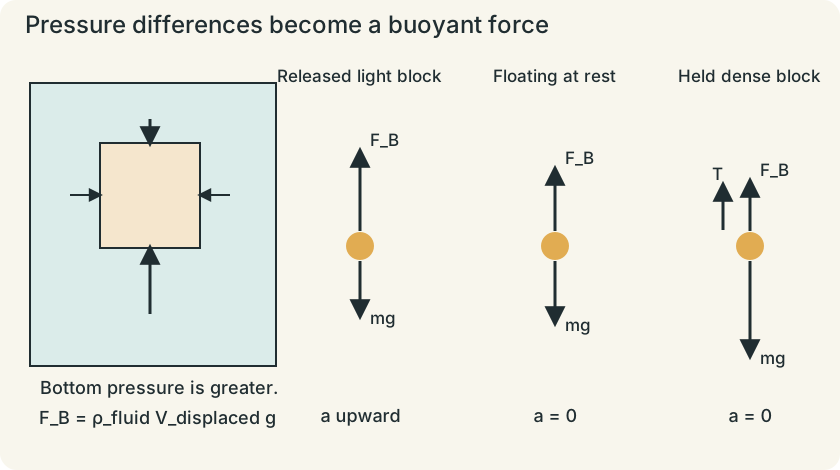
For a completely submerged rigid object, V_displaced equals its full external volume. For a partly submerged object, it equals only the submerged volume. The density in F_B is the fluid’s density. The object’s mass appears in its weight mg and in Newton’s second law. A hollow object may displace much more fluid than a compact object of the same material and mass; use its total external displaced volume.
Rising doesn’t mean floating equilibrium
Take a 0.080 kg block with volume 1.00 × 10⁻⁴ m³, fully submerged in water. Water density is 1000 kg/m³. The buoyant force is 0.980 N, while the block’s weight is 0.784 N. If released from rest and resistance is negligible initially, net force is 0.196 N upward and a = 0.196/0.080 = 2.45 m/s² upward. Buoyancy is larger than weight while the block accelerates upward. It is not yet in floating equilibrium.
Later the block reaches the surface and becomes partly submerged. At rest, F_B = mg, so ρ_fluid V_sub g = ρ_object V_total g. Thus V_sub/V_total = ρ_object/ρ_fluid for an object floating without other vertical forces. Here the fraction is 0.80. For a uniform block, 80% of its volume is submerged. A shape with varying width doesn’t necessarily have 80% of its height submerged.
For an incompressible fluid and a rigid fully submerged object, going deeper doesn’t increase buoyancy: top and bottom pressures both increase, leaving the pressure difference and displaced volume unchanged. If a container is compressible, its volume may change with depth and then buoyancy can change. That’s a different model. Surface tension can also support very small objects, but that extra effect isn’t described by Archimedes’ force alone.
A scale reading in water
Hang a dense object from a spring scale and lower it completely into water without touching the container. Its vertical forces are upward tension T and buoyancy F_B, and downward weight mg. At rest, T = mg − F_B. The scale shows tension, often called apparent weight; the object’s actual gravitational force has not changed. For a 0.30 kg object of volume 2.00 × 10⁻⁴ m³ in water, mg = 2.94 N and F_B = 1.96 N, so the scale reads 0.98 N. A partly submerged object displaces less water and gives a larger tension.
For a freely moving object, use F_B − mg = ma with upward positive and include any specified drag or contact forces. A sinking object may still be moving downward while its acceleration points upward, for example if strong upward resistance slows it. Velocity tells us the current motion; net force tells us how that motion changes. Keep those ideas separate.
Turn a force reading into evidence
Measure the object’s weight in air, then its scale reading at several submerged volumes. Keep it clear of the bottom and walls, remove trapped bubbles, and read the scale after motion settles. Measure submerged volume by the displaced-water rise or a known geometry. Plot weight minus tension, in N, against displaced volume, in m³. The expected slope is ρ_fluid g and the ideal intercept is zero. Repeating trials helps reveal spread; checking that the string and submerged support contribute negligible extra buoyancy addresses a systematic effect. Use the graph to justify the relationship, rather than merely reporting that the scale reading “went down.”
A parcel can speed up, slow down, or turn
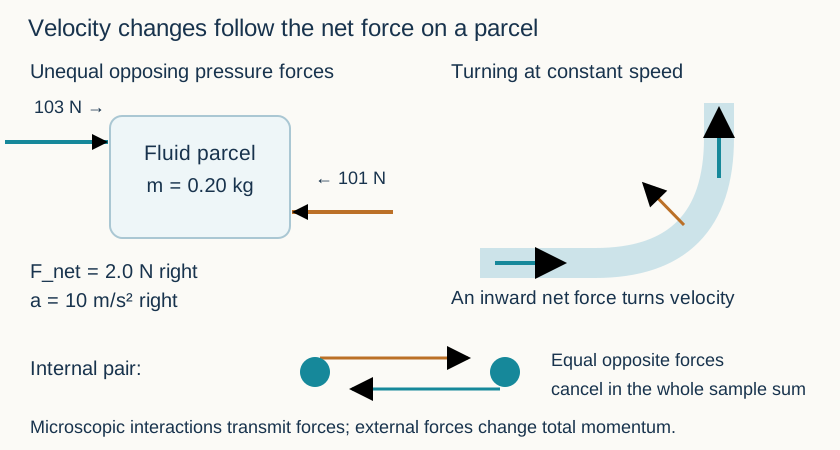
Follow a 0.20 kg parcel of fluid. For a short modeled interval its left and right faces each have area 0.0010 m², with pressures 103 kPa on the left and 101 kPa on the right. Other horizontal forces are negligible and these pressure forces are approximately constant during the interval. The forces are 103 N right and 101 N left, so F_net = 2.0 N right and a = F_net/m = 10 m/s² right. In 0.10 s the velocity change is +1.0 m/s. If its initial velocity was −0.50 m/s, its final velocity is +0.50 m/s: it first slows while moving left, stops, then speeds up to the right. A force arrow alone does not tell you the initial velocity.
More generally, a fluid parcel’s velocity changes whenever its net force is nonzero. A force component along velocity changes speed; a component perpendicular to velocity changes direction. Fluid going around a bend at constant speed therefore still accelerates because its velocity direction changes. Walls and pressure forces can supply that sideways net force. If all forces on a parcel balance, its bulk velocity stays constant, including the possible value zero. In a stationary vertical parcel, the pressure forces must balance gravity rather than simply be equal.
At the particle scale, Newton’s laws still apply. Neighboring particles exert interaction forces that transmit pressure and can redistribute momentum between parts of the fluid. Choose two interacting particles inside a closed material sample: the force of one on the other has an equal opposite partner, so these internal pairs cancel when we sum the entire sample’s momentum change. External forces from walls, surrounding fluid outside the chosen sample, and gravity can change its total momentum. Internal interactions remain essential to how individual particles and parcels move even when their net contribution to the whole sample cancels. Random microscopic motion is distinct from the bulk velocity of the parcel.
Inspect diagram labels
The diagram keeps its full size here. Focus the view and use the arrow keys, or scroll across it, to inspect every label.
Add the water’s particle forces to find buoyancy
Consider a fully submerged rectangular block of horizontal face area 0.010 m² and height 0.20 m in resting water. Its top is 0.30 m below an open surface and its bottom is 0.50 m below it. With ρ = 1000 kg/m³, g = 9.8 m/s², and atmospheric pressure 101,000 Pa, the top pressure is 103,940 Pa and the bottom pressure is 105,900 Pa. Collective particle interactions exert a 1039.4 N downward force on the top and a 1059.0 N upward force on the bottom. Equal-depth forces on opposite vertical sides cancel. Their remaining upward resultant is 19.6 N.
That resultant is the buoyant force; it is not an additional force to add again after the surface forces. Algebra gives F_B = (P_bottom − P_top)A = ρgHA = ρgV_displaced. Here V_displaced = 0.0020 m³ and the displaced water’s weight is 19.6 N. A 3.0 kg block held at rest would still weigh 29.4 N, requiring another 9.8 N upward force from a support. The particles’ collective force on the block depends on the fluid and displaced volume, while the block’s acceleration depends on the sum of buoyancy, weight, and any other external forces.
Lowering this rigid block by another 0.30 m adds 2940 Pa to both pressures. Each horizontal-face force grows by 29.4 N, but their difference stays 19.6 N. Thus greater absolute pressure does not increase buoyancy for a rigid fully submerged block in the same uniform incompressible fluid. This pressure calculation assumes hydrostatic fluid; motion with significant additional dynamic or viscous forces requires a fuller force model.
Add the forces
Pause & try it
Let's see what stuck.
Choose an answer, then check the reasoning. Try the written problems below before opening their solutions.
0 of 3 checked · 0 correct
Written practice: same buoyancy, different acceleration
Two rigid objects with equal external volume V are fully submerged in the same fluid. Object A has mass m and object B has mass 2m. Derive their initial upward accelerations when released from rest with drag neglected. Is B’s acceleration always half of A’s?
Open the separate worked solution.
The book’s original Buoyancy lesson and quizzes remain available for more examples. Its fish and surface-tension discussions are useful extensions; this AP path focuses on pressure, displaced volume, and Newton’s laws.
Teaching reference: CED topic 8.3, printed page 136.
Explain and apply the model
Try these problems before opening the solutions. State your assumptions, show the diagram or calculation, and explain what makes your answer follow.
Describe every way fluid velocity can change
Follow a material parcel of ideal fluid of constant mass 0.10 kg. For a short 0.20 s interval its opposing left and right faces each have area 0.0020 m², with uniform pressures 110,000 Pa on the left and 109,500 Pa on the right. These face forces are approximately constant during the interval; other horizontal forces are negligible. Right is positive. Also consider a separate parcel traveling around a bend at constant speed and a closed material sample containing two neighboring interacting fluid particles.
(a) Describe the conditions under which a fluid’s bulk velocity changes. Use Newton’s laws to distinguish a parcel with zero net force, a net-force component along its velocity, a component opposite its velocity, and a component perpendicular to its velocity. Explain whether fluid going around the bend at constant speed has changing velocity and which forces can supply that change.
(b) Explain how internal interactions between neighboring fluid particles or parcels and external forces together determine macroscopic fluid behavior. Identify the Newton’s-third-law internal pair for the two particles in the closed sample, explain what cancels in the whole-sample momentum sum, and give two external force sources. Why does that cancellation not imply that internal interactions are irrelevant to individual particle motion?
(c) Draw the parcel’s horizontal force diagram and calculate its acceleration and velocity change over 0.20 s. Find its final velocity for initial velocity +1.0 m/s, then for initial velocity −1.0 m/s. Explain the motion through the second interval, including any reversal.
Your written working
Drawing is temporarily unavailable. Work on paper if needed, then record your reasoning here.
Saving written working requires JavaScript. The problem remains available above; keep your work on paper or in your own notes.
Build buoyancy from the surface forces
A rigid rectangular block is fully submerged in resting uniform water, with horizontal face area A = 0.0080 m² and height H = 0.25 m. The top is 0.40 m below the free surface. Water density is 1000 kg/m³, g = 9.8 m/s², and the surface absolute pressure is 101,000 Pa. The block mass is 2.50 kg and it is held stationary by an upward support force. Ignore surface tension and contact with the tank.
(a) Explain how collective forces from the water particles on all the block’s faces produce buoyancy. Calculate top and bottom pressures and draw their pressure-force arrows. Show how the resultant surface force becomes F_B = ρgV_displaced instead of assuming that formula. Explain what happens to opposing side forces.
(b) Calculate the required upward support force. Then lower the block by 0.30 m without changing its volume. Predict the changes to the top and bottom forces, buoyancy and support force, and explain why larger absolute pressure does or does not alter the net buoyant force.
Your written working
Drawing is temporarily unavailable. Work on paper if needed, then record your reasoning here.
Saving written working requires JavaScript. The problem remains available above; keep your work on paper or in your own notes.
Glossary and deeper reading · 19 refreshers
These editorial refreshers supplement the reading. Definitions and examples are added guidance; original source wording and recorded answers remain in their original context.
-
Pressure
Pressure is the normal force per unit area exerted on a surface. It is a scalar measured in pascals, with one pascal equal to one newton per square meter. For example, a gas exerts pressure throughout its volume through many microscopic collisions, even when its bulk motion is zero.
-
Fluid
A fluid is a material that flows and continuously deforms under a sustained shear stress. Liquids and gases are both fluids, although their compressibility and other properties can differ greatly. For example, both water in a pipe and air flowing through a duct are fluids.
-
Linear momentum
Linear momentum is a vector describing an object’s motion and equals mass times velocity in the nonrelativistic model. The vector sum of momenta is conserved when the net external impulse on the system is zero. For example, two identical carts moving equally fast in opposite directions have zero total linear momentum but nonzero total kinetic energy.
-
Velocity
Velocity describes how position changes with time and includes direction. Instantaneous velocity describes one moment, while average velocity is displacement divided by elapsed time. For example, a car turning a corner can change velocity while maintaining the same speed.
-
Force
A force describes an interaction that can change an object’s momentum. It is a vector measured in newtons, so both size and direction matter when forces are added. For example, a rope can pull a cart while the floor exerts friction in another direction.
-
External force
An external force is exerted on part of a chosen system by something outside that system. The sum of external forces determines the rate of change of the system’s total momentum. For example, Earth’s gravitational force is external to a system consisting only of a falling ball.
-
Magnitude
Magnitude is the nonnegative size of a vector quantity. It does not specify direction, and it differs from a signed component. For example, a westward velocity can have a negative x component while its speed, the velocity magnitude, stays positive.
-
Archimedes’ principle
Archimedes’ principle states that a submerged object’s buoyant-force magnitude equals the weight of the fluid it displaces. Only the submerged volume contributes to displaced fluid for a partly floating object. For example, a floating boat displaces enough water for the water’s weight to match the boat’s total weight.
-
Mass density
Mass density is mass per unit volume of a material or sample. It is commonly measured in kilograms per cubic meter and can vary with temperature or pressure. For example, equal-volume samples of water and oil generally have different masses because their densities differ.
-
Weight
Weight is the gravitational force exerted on an object by a specified attracting body. Near Earth’s surface its magnitude is approximately mass times the local gravitational field strength, and it is measured in newtons. For example, an astronaut has less weight on the Moon while retaining the same mass.
-
Net force
Net force is the vector sum of all forces acting on the object or system under consideration. For constant mass in an inertial frame, it equals mass times acceleration. For example, equal upward and downward forces give zero net force even though neither force is zero.
-
Mechanical equilibrium
Mechanical equilibrium means there is no translational or angular acceleration for the system being considered. For a rigid body, both the net external force and the net external torque must vanish. For example, a stationary ladder supported against a wall requires both force balance and torque balance.
-
Incompressible fluid
An incompressible-fluid model treats density as constant despite pressure changes in the modeled situation. This approximation often works for liquids over modest pressure ranges but is not a universal property of all fluids. For example, water flowing through a narrowing pipe can often be treated as incompressible.
-
Tension
Tension is a pulling force transmitted through a stretched rope, string, or similar connector. It acts along the connector away from the object it pulls, and an ideal massless rope has the same tension throughout an uninterrupted segment. For example, a rope supporting an accelerating load can have a tension different from the load’s weight.
-
Gravity
Gravity is the attractive interaction between masses in the Newtonian model. For spherical bodies or point-mass approximations, its strength decreases with the square of the separation between their centers. For example, Earth’s gravity provides the inward force that keeps a satellite in orbit.
-
Drag
Drag is a force from a fluid that opposes an object’s motion relative to that fluid. Its dependence on speed, shape, and fluid properties varies with the physical regime. For example, a parachute increases air drag by presenting a large area to the moving air.
-
Acceleration
Acceleration is the vector rate of change of velocity with time. It can change an object’s speed, direction, or both, and it is measured in meters per second squared. For example, a satellite moving at constant speed in a circular orbit accelerates toward the center.
-
Absolute pressure
Absolute pressure is pressure measured relative to a perfect vacuum. It includes the atmospheric contribution that gauge pressure omits and is required in the ideal gas law. For example, a tire’s absolute pressure is its gauge reading plus the surrounding atmospheric pressure.
-
Resultant vector
A resultant vector is the vector sum of two or more vectors. Its components are the sums of the corresponding components of the vectors being combined. For example, two equal forces in opposite directions have a zero resultant even though both forces are present.