FFR - Work
Original textbook reading.
Throughout this chapter, we have covered a variety of ways you can encounter forces, and how to deal with them. One topic that is closely related to force is called work. This is not the type of work that earns people money, but instead a way of conveying what a force actually does.
When discussing work, we will be using the SI unit Joule. That might be familiar to you, as it is a unit of energy, a topic we’ll be covering in detail in chapter 5. In this section, you will simply learn about mechanical work, or the energy done by a force on an object.
To start out, we must first figure out how work is calculated.
For a constant force, work equals the dot product of force and displacement, so it is a scalar. The equivalent formula below uses the angle between those vectors.
(Equation 2.4.2)
This equation will most likely be used the most, as it is the most useful version unless the vectors are given by components.
One thing that is important to note is that due to the being a part of the equation, the force must have some component in the direction of the displacement. In other words, if a force acts perpendicularly to displacement, then it does no work on the object. In a physical sense, you can imagine sliding a book across a table. We know that the force of gravity is acting on the book, as it has weight. However, that force is straight down, while the book’s displacement is across the table. This means that the between the two forces is , making the . Therefore, the force of gravity exerts no work throughout the movement of the book.
Another aspect of work that is important to grasp is the concept of negative work. If the force exerted is parallel but opposite to the direction of motion, negative work is done.
For example, take the case of a book on a table. If we were to lift the book straight up, then the force of gravity on the book would be pulling in an opposite direction on the book, resulting in it doing negative work on the object. When we say ‘negative work’ what is really happening is that that force is resisting the motion of the option.In the lifted book example, the force doing the lifting (promoting the motion) exerts a positive work on the book, while the force of gravity (hindering the motion) results in negative work being done on the object.
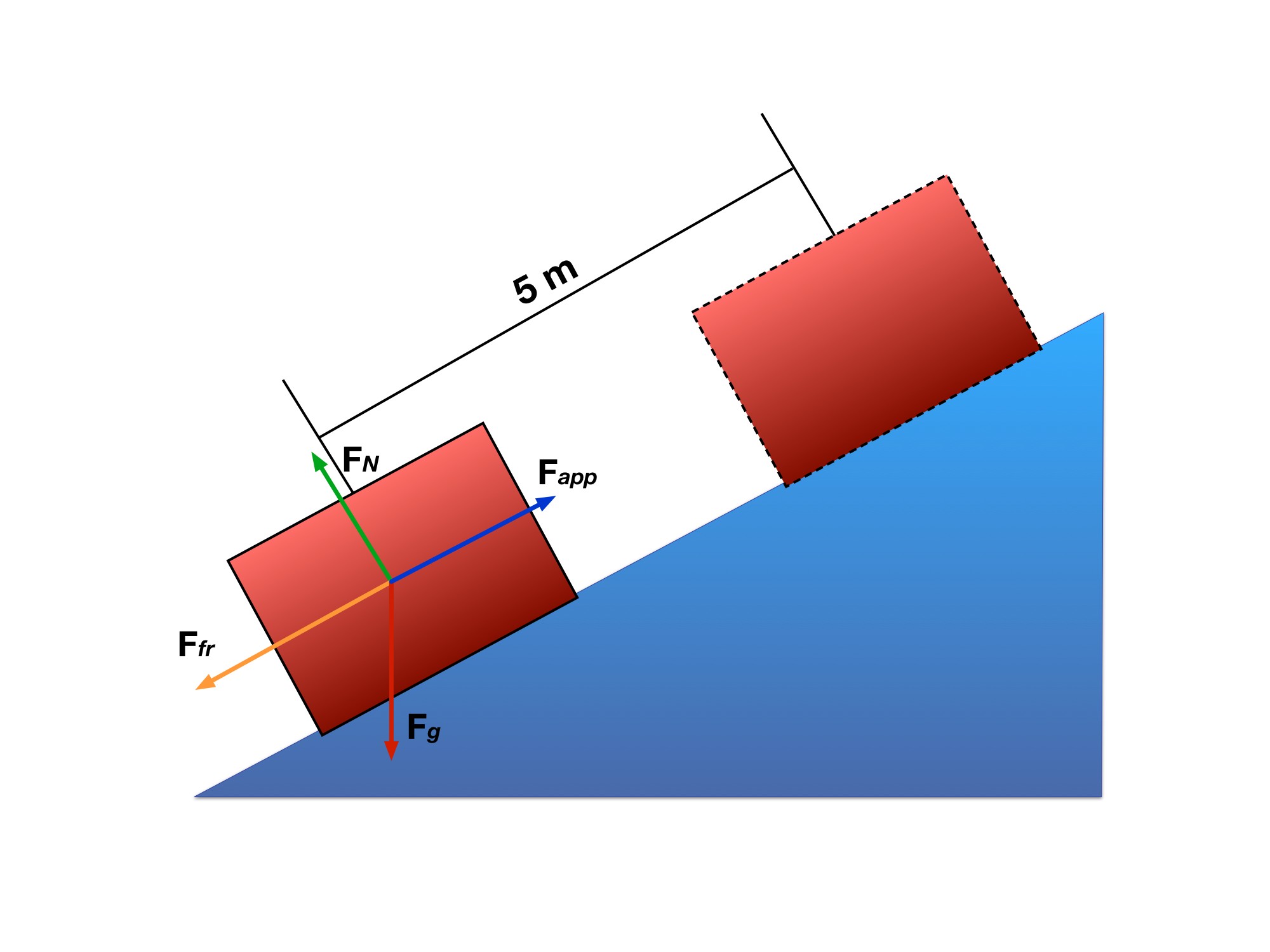
The block weighs , and the applied force has a magnitude of .
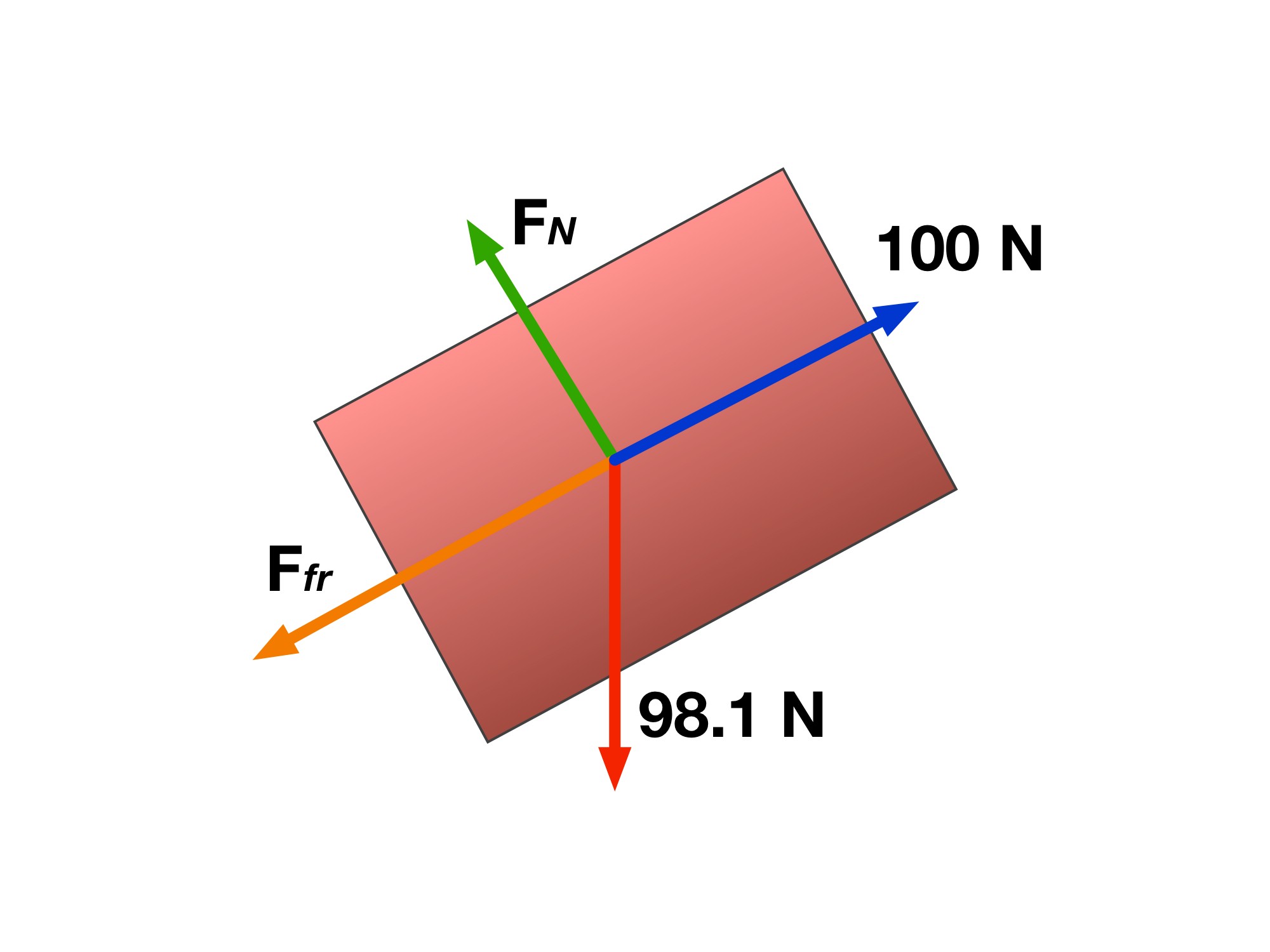
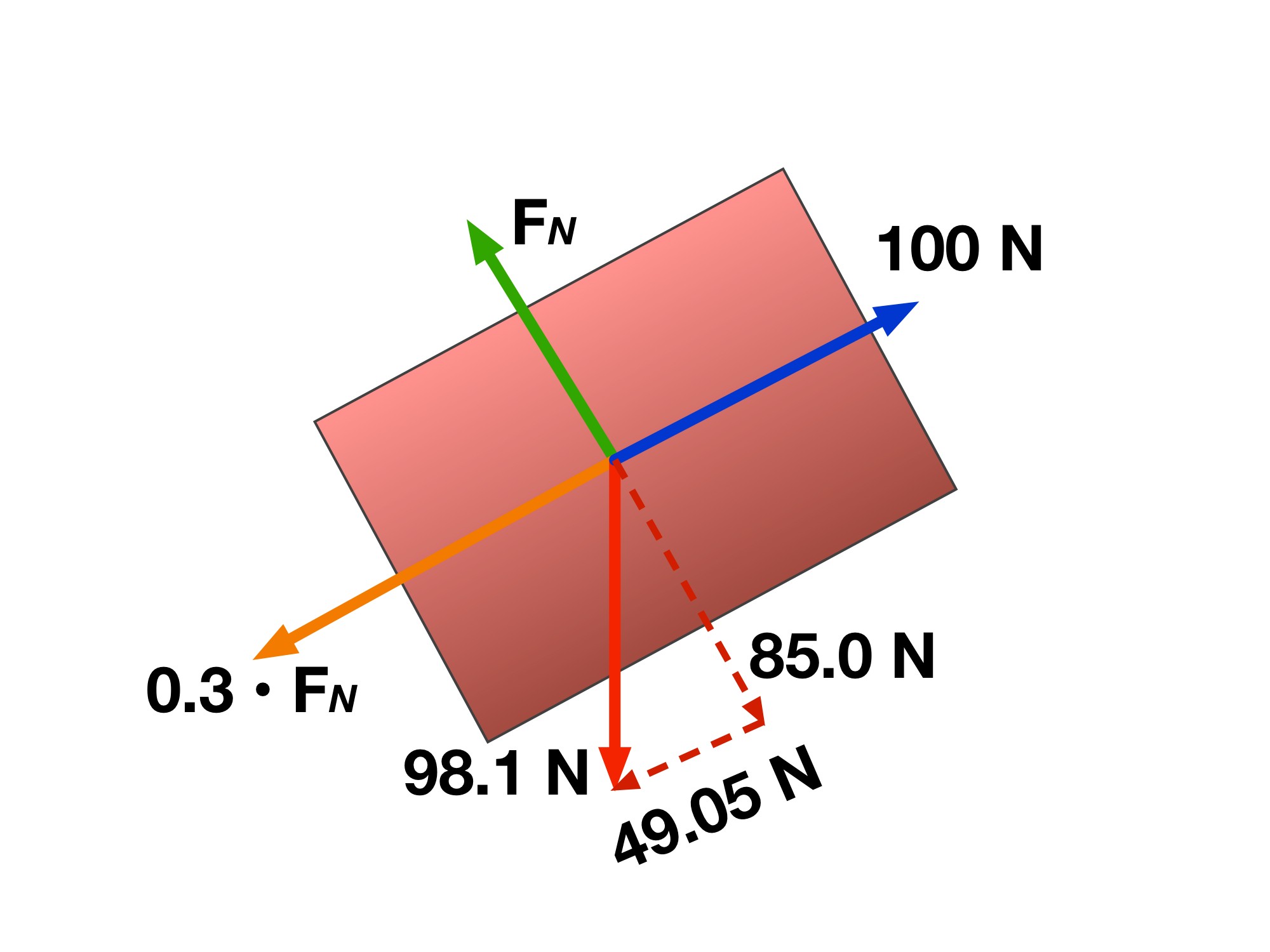
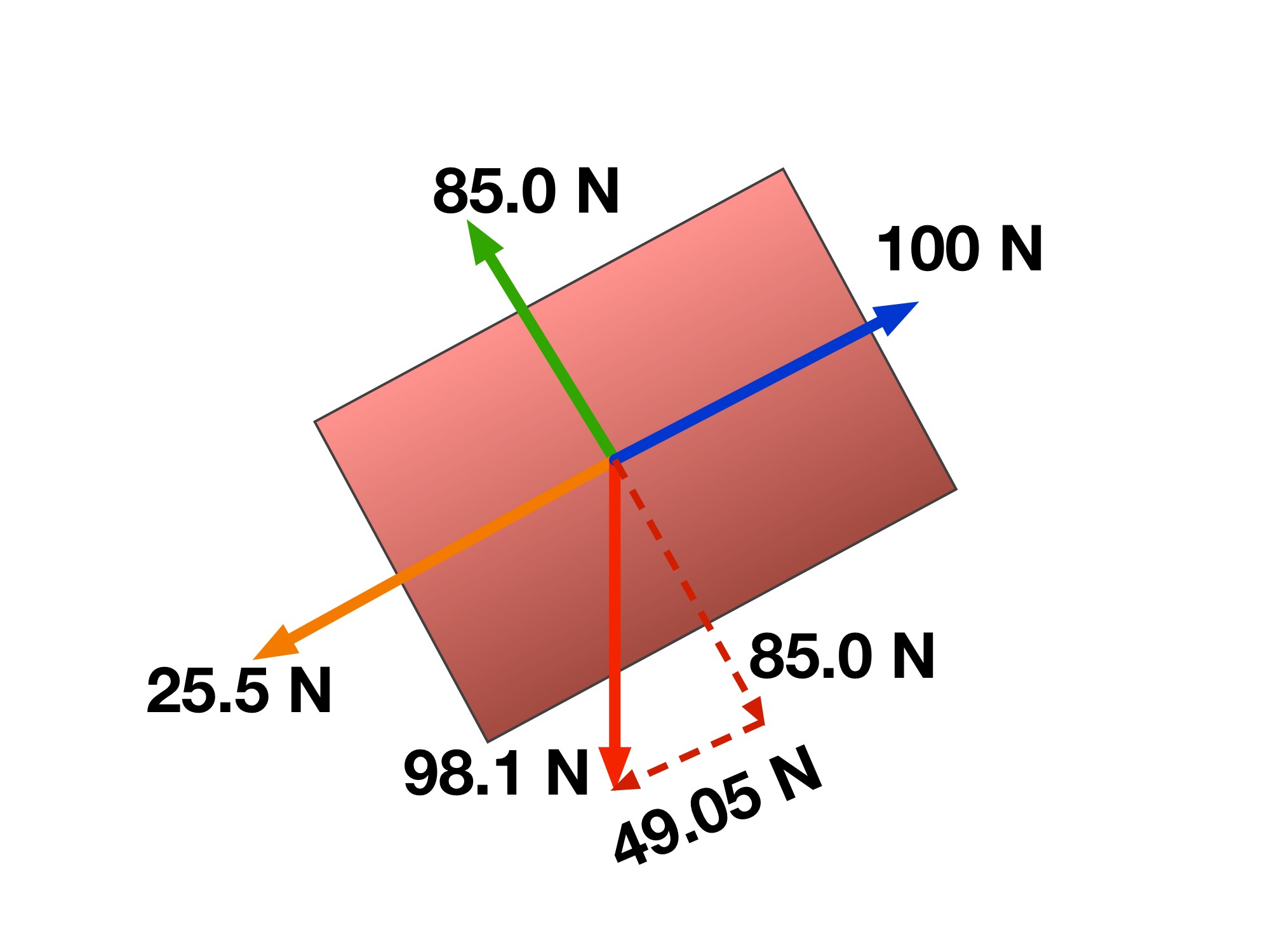
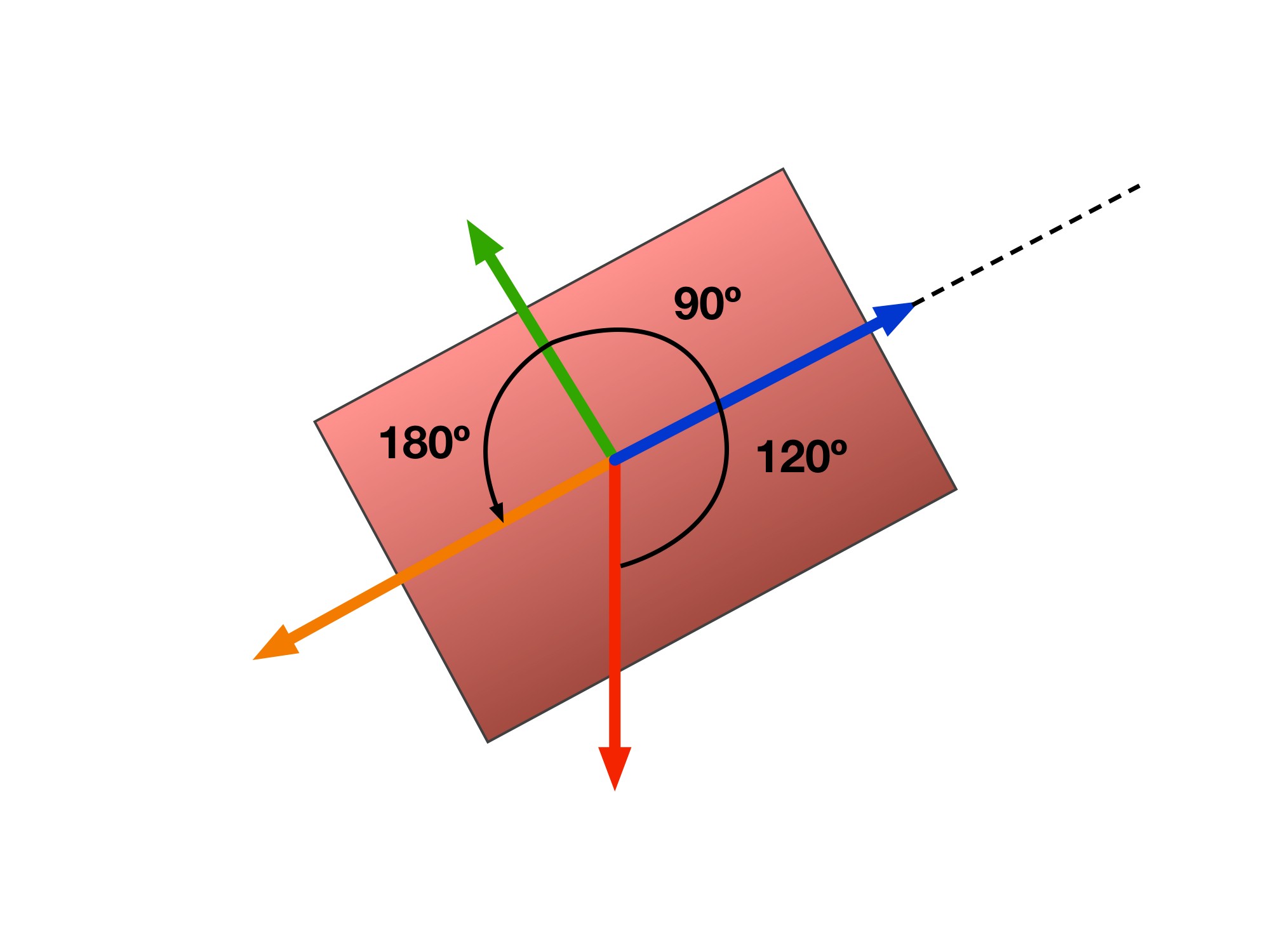
If a block is pulled up a ramp by a rope with a force of , and the block moves a distance of up the ramp at an angle of , give the works done be all the involved forces of the problem. The static of kinetic friction between the ramp and the box is , and it can be assumed that the box will move up the ramp.
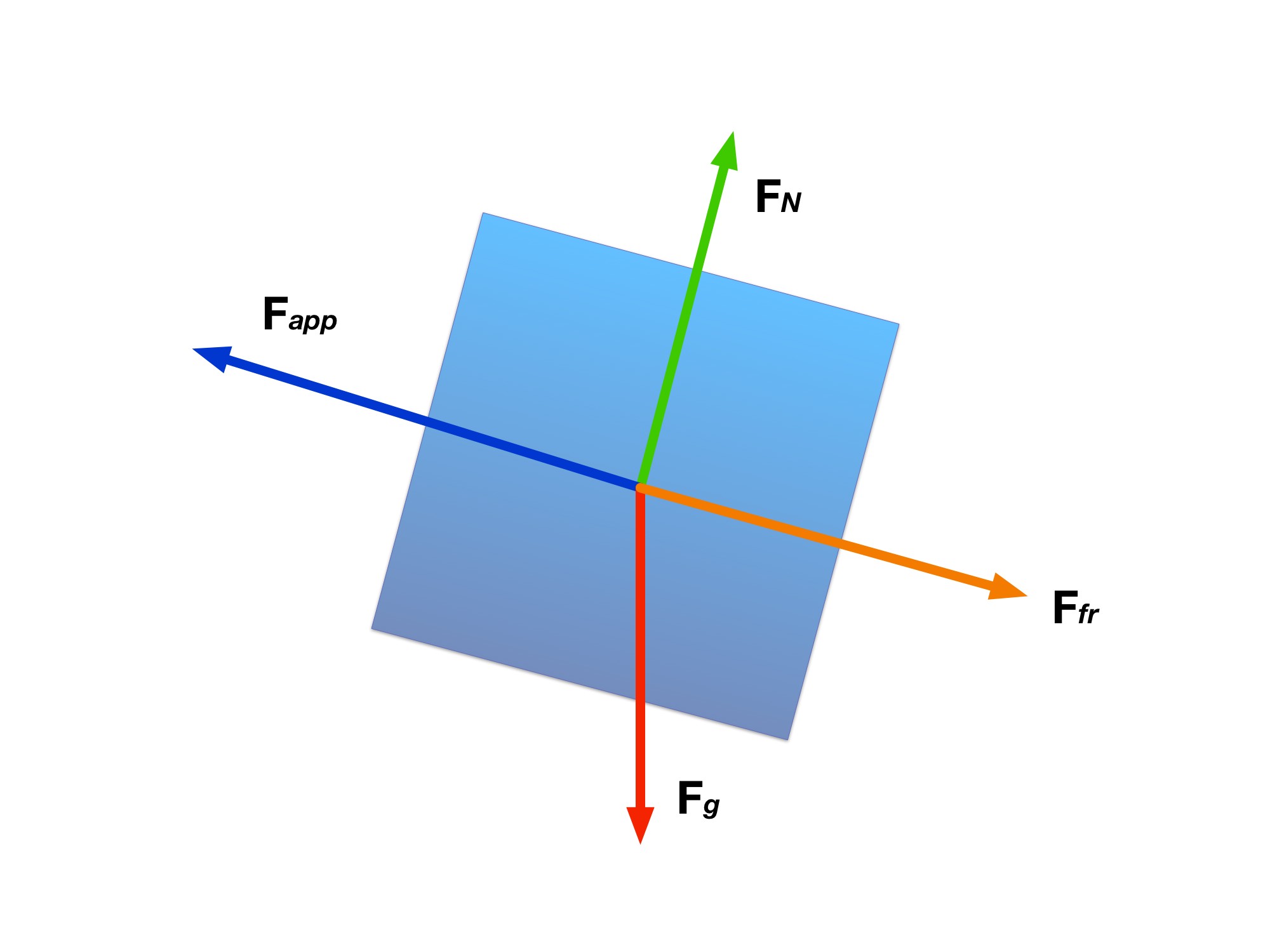
Step 1: Drawing the free-body diagram
The forces on the block are gravity, normal force, kinetic friction and the rope’s applied force. Compute the work done by each.
Step 2: Calculate unknown forces.
We start with the normal force, as that is part of the frictional force. The only force in the system with a component in line with the normal force is gravity.
We separate out the force of gravity into its components, figuring out that the normal force has a magnitude of .
Using this value for the normal force, we discover that .
Step 3: Identify the angles between each involved force and the displacement
By investigating the FBD we drew in step 1, we can come up the angles of all the involved forces. We notice the angle of the applied force from the rope is .
Step 4: Calculate the works done by each force
W_g = −245.25 J; W_friction ≈ −127.44 J; W_applied = +500 J; W_normal = 0 J.
Pop Quiz 2.4.1 Work
Question 1 of 5 · 0 correct
AP Topic 3.2 · Read the worked solution
A box weighs 500 N. Compare the applied work needed to raise it steadily by 5 m vertically with the work needed to push it steadily up a frictionless 30° ramp to the same height. The push is parallel to the ramp. How much less work is needed using the ramp?
Read every full question without answers
Question 1
Question 2
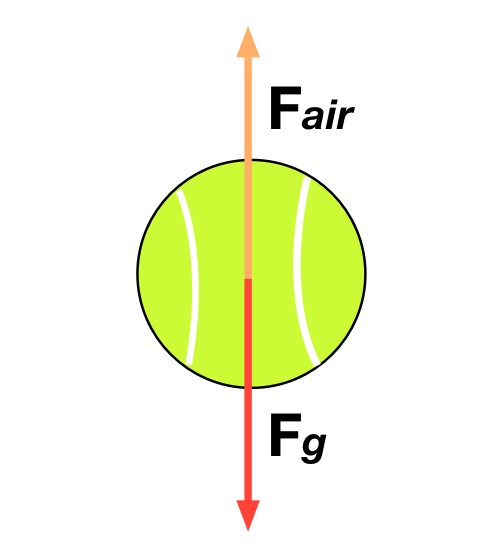
If a tennis ball falls , with air providing a resistive force of , what is the net work exerted on the ball?
Question 3
Question 4
Question 5
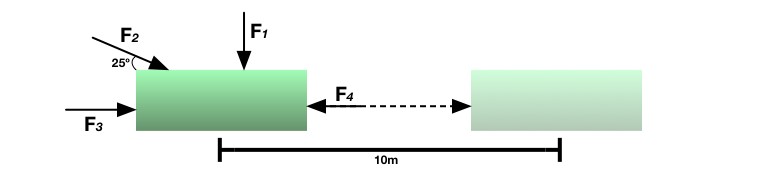
If a block has 4 forces acting on it, as shown, and if moves horizontally 10m, rank the forces in order of increasing work done. The forces are: , , , .
This idea of work is a very useful concept for explaining how much actual energy is needed to move something a certain distance, assuming the work is 100% efficient. Why wouldn’t it be, you might ask? We are about to find out .
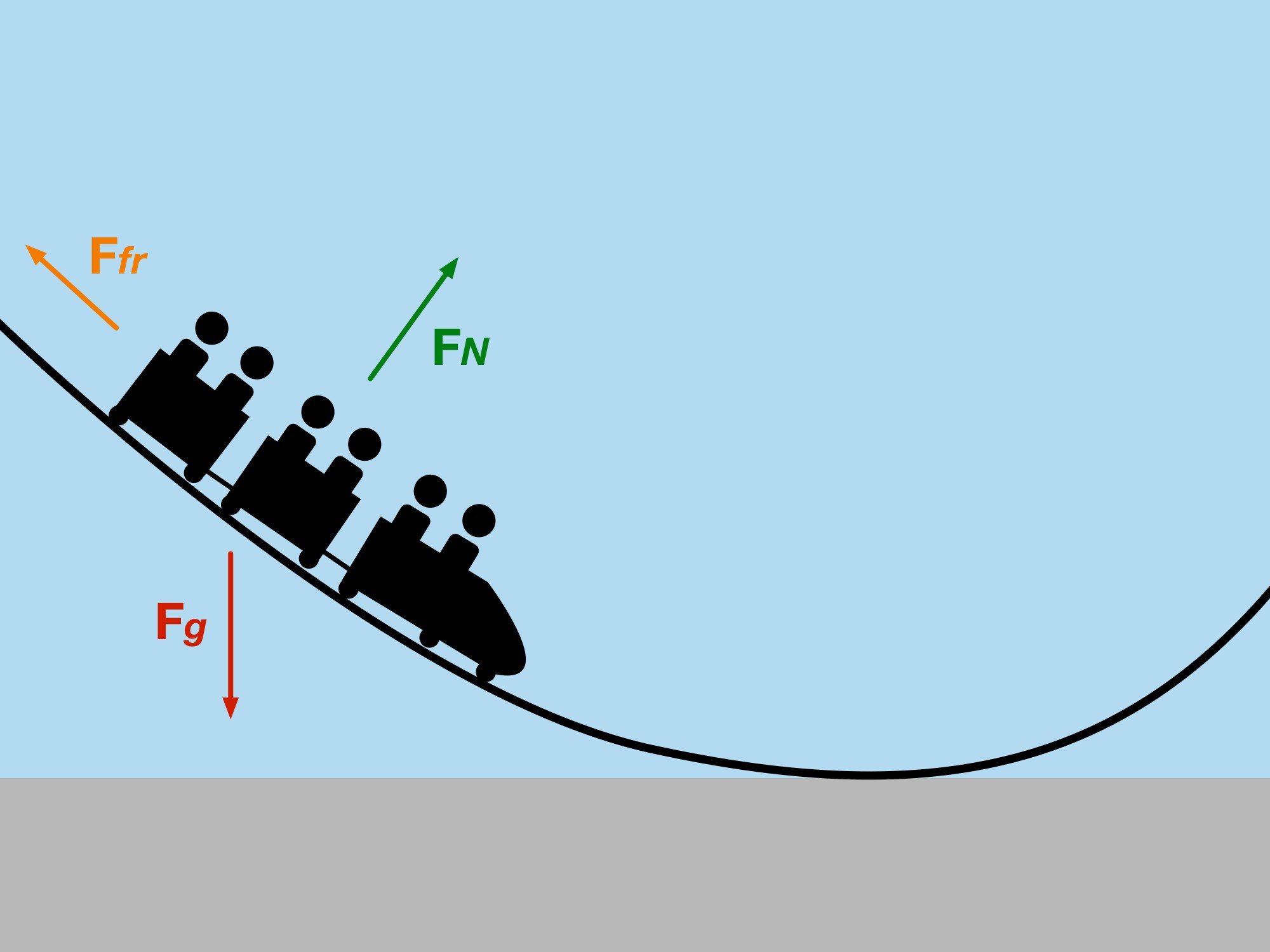
Inspect how each force points relative to the instantaneous displacement.
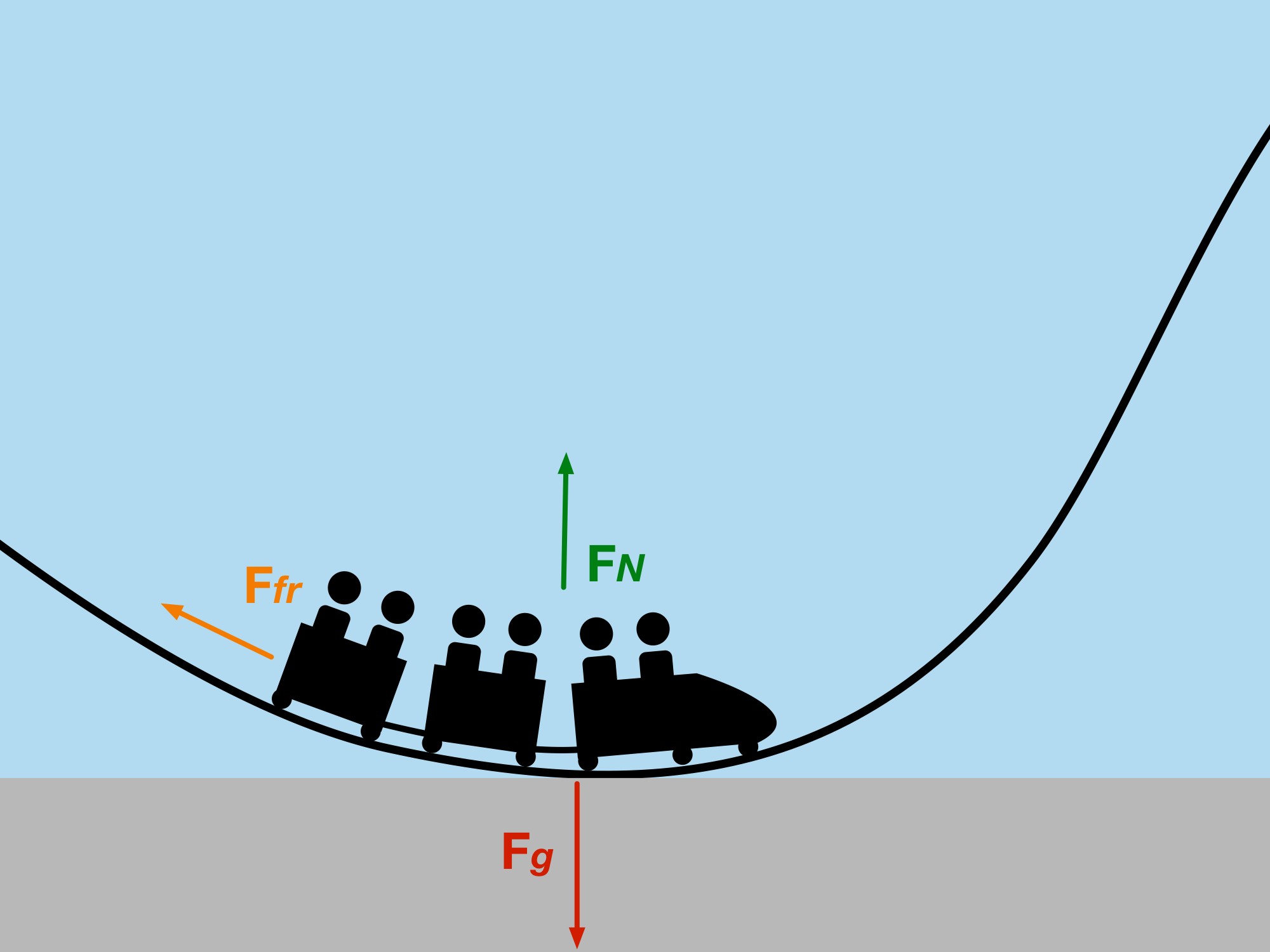
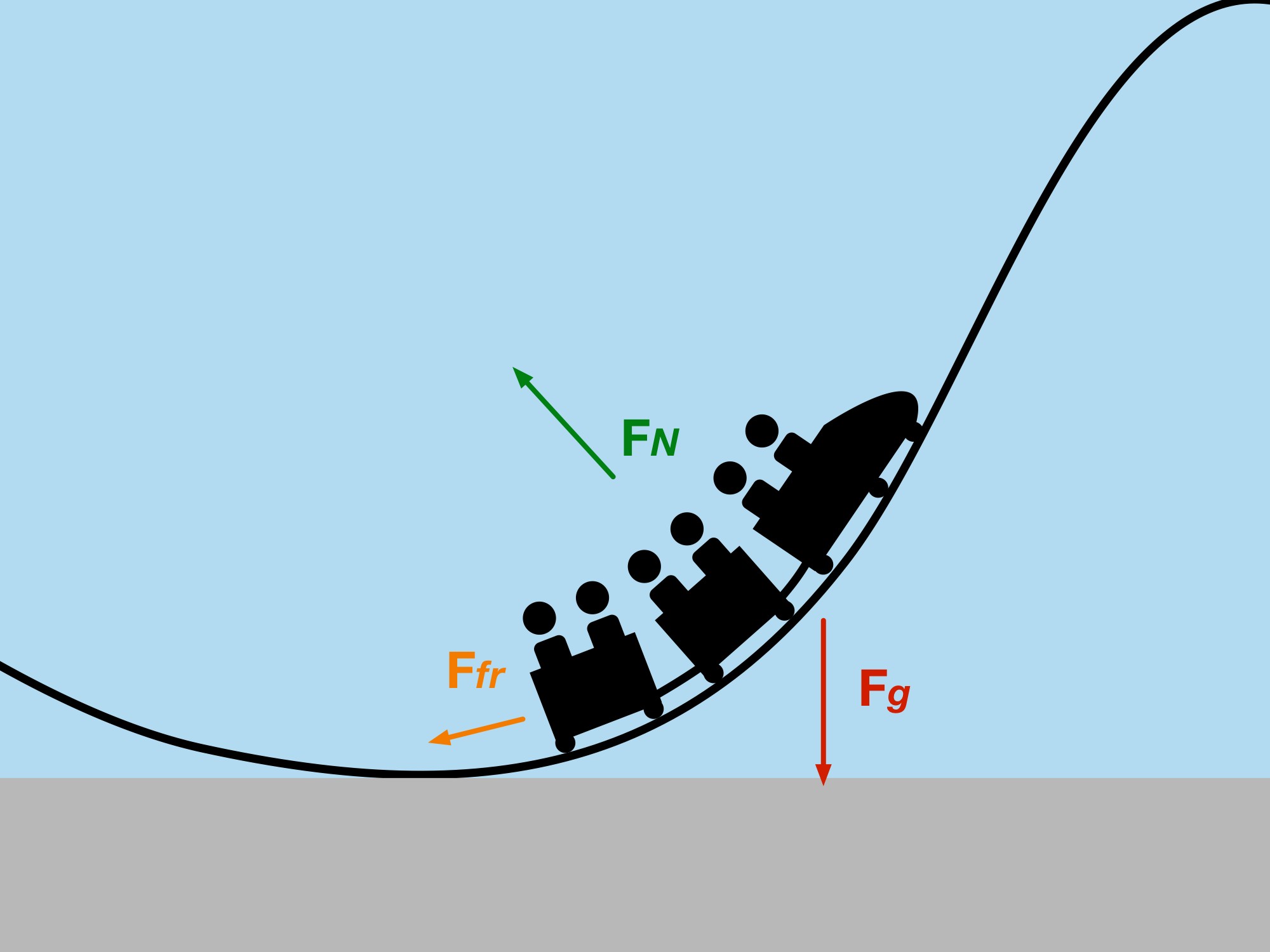
A force is conservative when its work between any two points is independent of the path, equivalently when its work around every closed path is zero. Work itself is defined for both conservative and nonconservative forces.
Conservative forces also have the fun little identity that no matter what the path an object takes, if the displacement is , then that conservative force will have exerted no work on the object.
A nonconservative force can do nonzero work along a closed path even though the net displacement is zero.
Kinetic friction on a block sliding over a stationary surface does negative work because it opposes each displacement. On a trip up a ramp and back, both legs contribute negative friction work. The dot-product and integral definitions apply on either a straight or curved path.
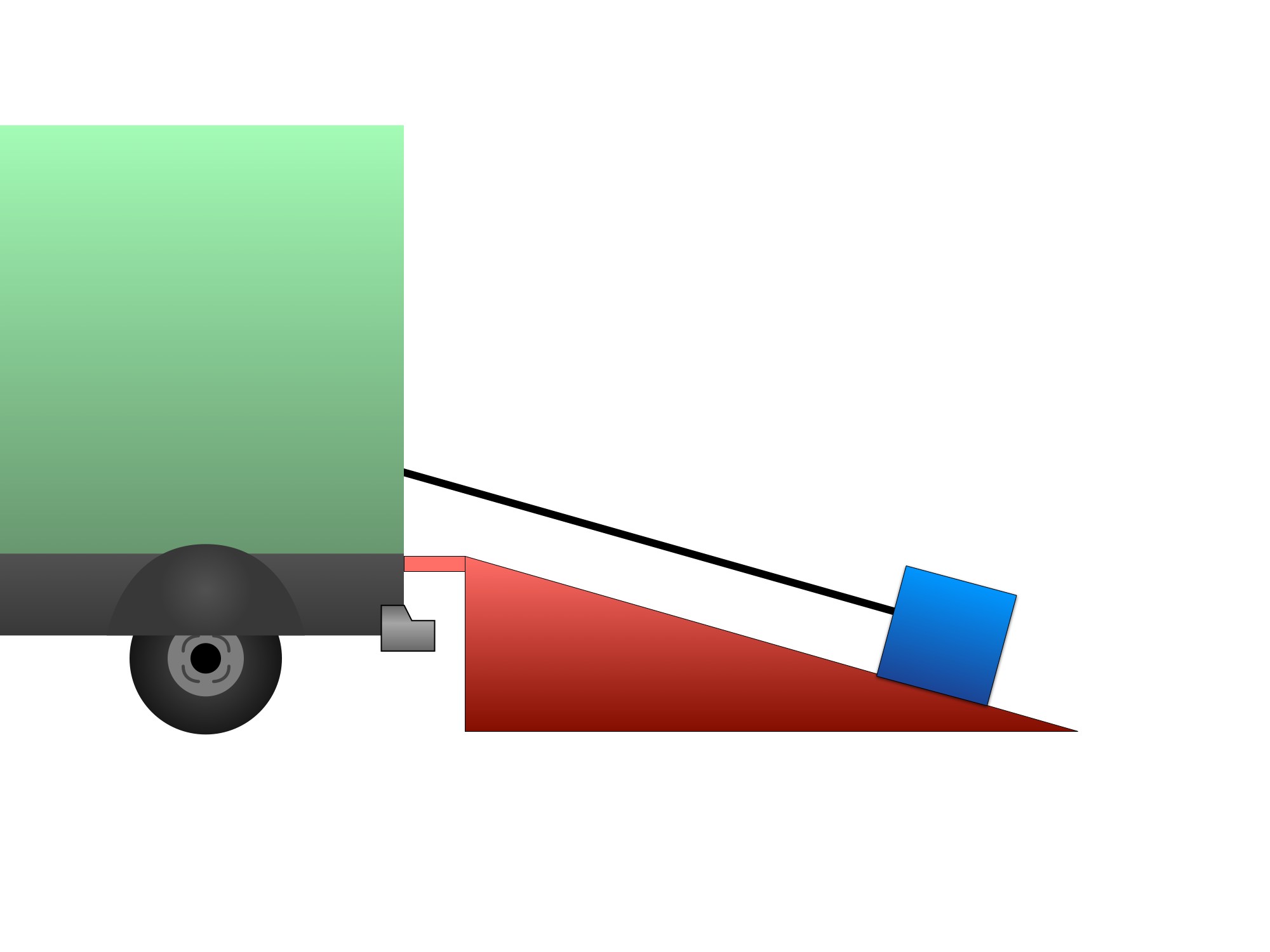
A box being pulled up a ramp by a truck.
A 50 kg box moves 5 m uphill on an 18° ramp under a 200 N winch pull parallel to the ramp, then returns 5 m downhill with no winch force. Use μₖ = 0.2 and g = 9.81 m/s². Compute work over this prescribed pair of path segments. The stated pull cannot start this uphill motion from rest; a real rope-break history may include extra coasting not included here.
Step 1: Free Body Diagram
First things first, we start out with an FBD, just like normal. In this case we have to draw 2 FBDs, one for the box as it is being pulled up the ramp, and another for the box after it starts to fall.
Step 2: Find the values for the unknowns
In each FBD, the only unknowns are the normal force and friction. We start with the normal force. In this case, the normal force is only resisting gravity. Therefore, we need the component of gravity in the direction of the normal force. This turns out to be .
This makes friction .
Step 3: Calculate the work done one the box for the first half of the time
During this first situation, the winch is pulling the box up the ramp for .
Again, we need to find the angles between each force and the displacement. They are:
This makes the works during this leg of the box’s journey:
On the 5 m downhill segment: W_g = +757.86 J; W_friction = −466.49 J; W_normal = 0 J.
Step 5: Combine each segment of the entire displacement
To find the total work contributions, we merely need to add together each force’s work exertion during each part. This gives us:
For the prescribed round trip: W_g = 0 J, W_friction ≈ −932.99 J, W_winch = +1000 J and W_normal = 0 J. Thus net work is approximately +67.01 J.
To figure out the work done by each force, we can just use the usual approach.
The angles between each force and the displacement are:
On the 5 m uphill segment: W_g = −mg(5 sin 18°) = −757.86 J; W_friction = −μₖmg cos 18°(5) = −466.49 J; W_winch = +1000 J; W_normal = 0 J.
Step 4: Calculate the work done over the second half
For this, the winch force is not active, so the only forces present are the normal force, friction, and gravity.
Pop Quiz 2.4.2 Non-Conservative Work
Question 1 of 5 · 0 correct
AP Topic 3.3 · Read the worked solution
What is the work done by gravity on a box, if it is pulled up and then dropped back to its original position?
Read every full question without answers
Question 1
Question 2
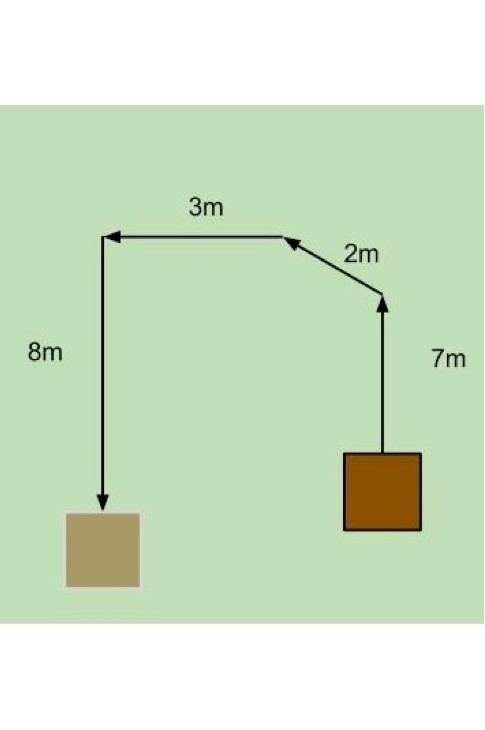
A 15 kg box slides along the 7 m, 2 m, 3 m and 8 m legs shown on a level floor. A horizontal pull keeps it moving, and μₖ = 0.24. Find the work done by friction. Use g = 9.81 m/s².
Question 3
Question 4
Question 5
Another way you might see non-conservative forces is by being given a graph showing the value of a force over a distance. If this graph has a y-axis depicting force and an x-axis showing distance x, then the work can be calculated very easily. Calculus students should already know this, from the previous equation.
The technique for solving for work done by a force, given the force vs. distance graph is very simple. You only need to calculate the area between the graph of the force’s value and the x-axis. If any part of that area is below the x-axis (i.e. if the force is negative for some duration along x), then that area is subtracted from the area above.
Of course, if you don’t know any calculus, this equation simply represents the area under the curve of a graph of force and distance. This process is outlined in the following Example problem.
If a force acts on an object with the relationship shown in the following graph (at an angle of ), what is the total work that force exerts over the total displacement? How much work did the force exert in moving the box from the 8th meter to the 10th?
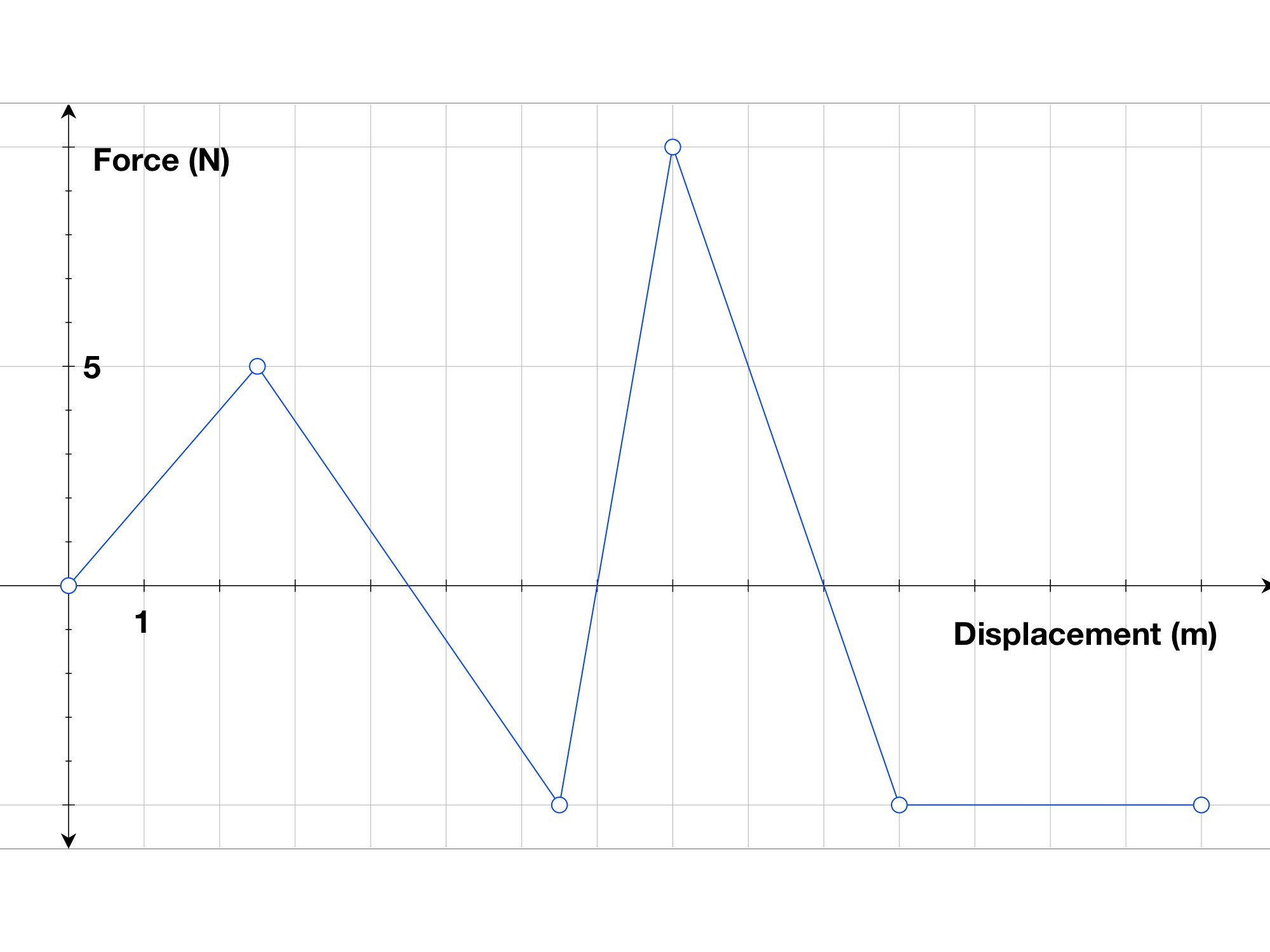
Step 1: Read the scales and vertices. Horizontal grid spacing is 1 m and vertical tick spacing is 1 N. The line joins (x, F) = (0, 0), (2.5, 5), (6.5, −5), (8, 10), (11, −5), and (15, −5), in metres and newtons.
Step 2: Count signed area. For each straight segment, W = ½(Fstart + Fend)Δx. Area above the axis contributes positive work; area below contributes negative work. The interior zero crossings are at 4.5 m, 7 m, and 10 m. The final point at 15 m is still at −5 N, not a zero crossing. For a shorter interval, split the graph at that interval’s endpoints. Units are N·m = J. Work reference.
Read every step and figure
Step 1
Step 1: Read the scales and vertices. Horizontal grid spacing is 1 m and vertical tick spacing is 1 N. The line joins (x, F) = (0, 0), (2.5, 5), (6.5, −5), (8, 10), (11, −5), and (15, −5), in metres and newtons.
Step 2: Count signed area. For each straight segment, W = ½(Fstart + Fend)Δx. Area above the axis contributes positive work; area below contributes negative work. The interior zero crossings are at 4.5 m, 7 m, and 10 m. The final point at 15 m is still at −5 N, not a zero crossing. For a shorter interval, split the graph at that interval’s endpoints. Units are N·m = J. Work reference.
Step 1: Calculate the total work
This approach is very simple. As we are given a graph of Force versus distance, we just need to find the total area under the curve. To do so, we just view the graph as one big conglomeration of different shapes, and then we find their areas.
We can separate the graph into triangles and squares to make it easier for us. As the graph crosses the x-axis at , , , we will find the areas under the curve from , , , and . We find that the shapes have an area of , , , and , respectively.
You might want to just add these numbers together and be done, but we can’t. The part of the graph where it is negative (from and ) results in negative work.
Therefore, we must subtract those from the total work instead of adding. This gives us a total work of :
Step 2: Calculate the work from
When you want to only find the work done in part of the graph, we just do the same approach that we did in step 1, except we limit our range to the prescribed area.
The work there is:
D = ½ρC_DAv², the drag-force magnitude; drag points opposite motion relative to the fluid. (Equation 2.1.1)
(Equation 2.3.1)
(Equation 2.3.2)
(Equation 2.4.1)
(Equation 2.4.2)
Pop Quiz 2.4.3 Work Graphs
Question 1 of 5 · 0 correct
AP Topic 3.2 · Read the worked solution
Read every full question without answers
Question 1
Question 2
Question 3
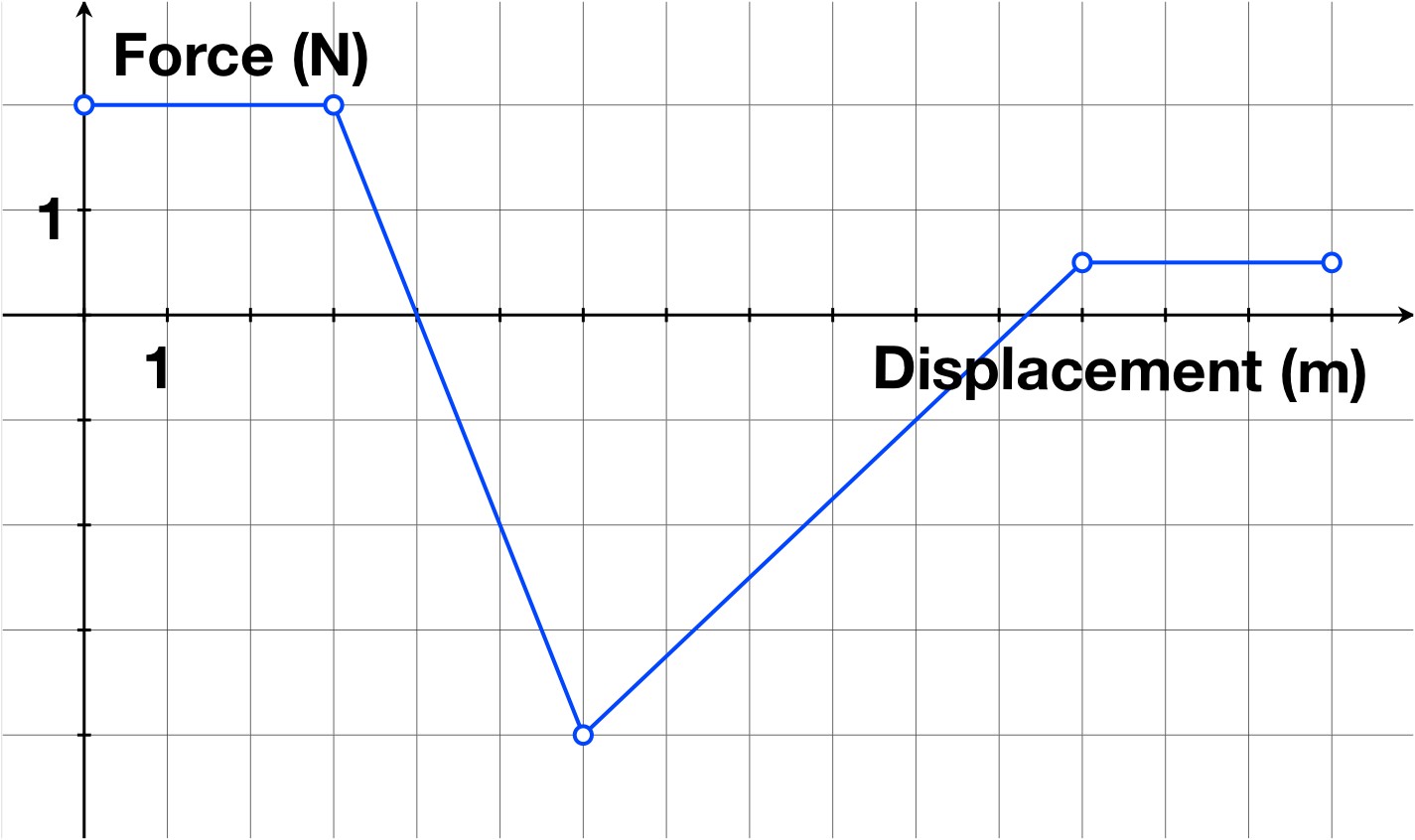
Question 4
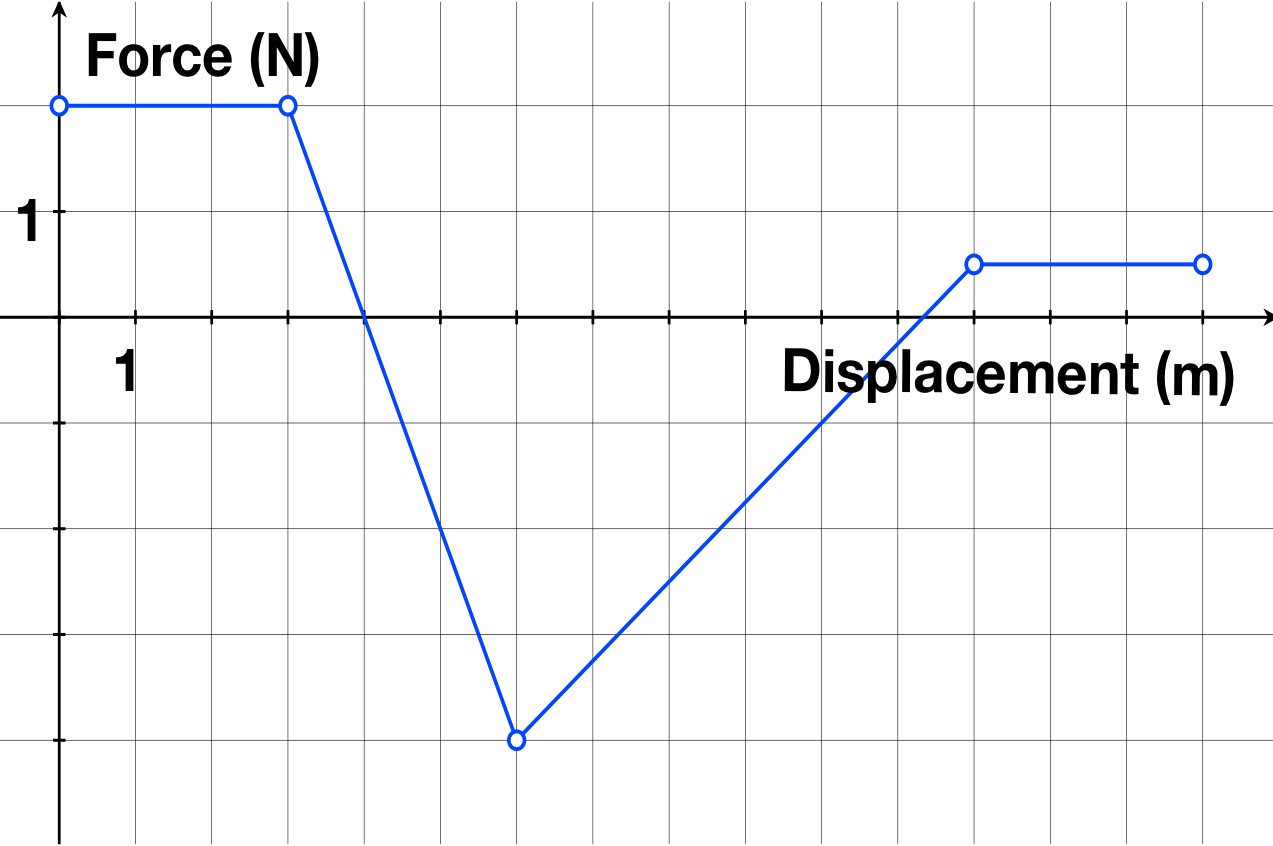
Question 5
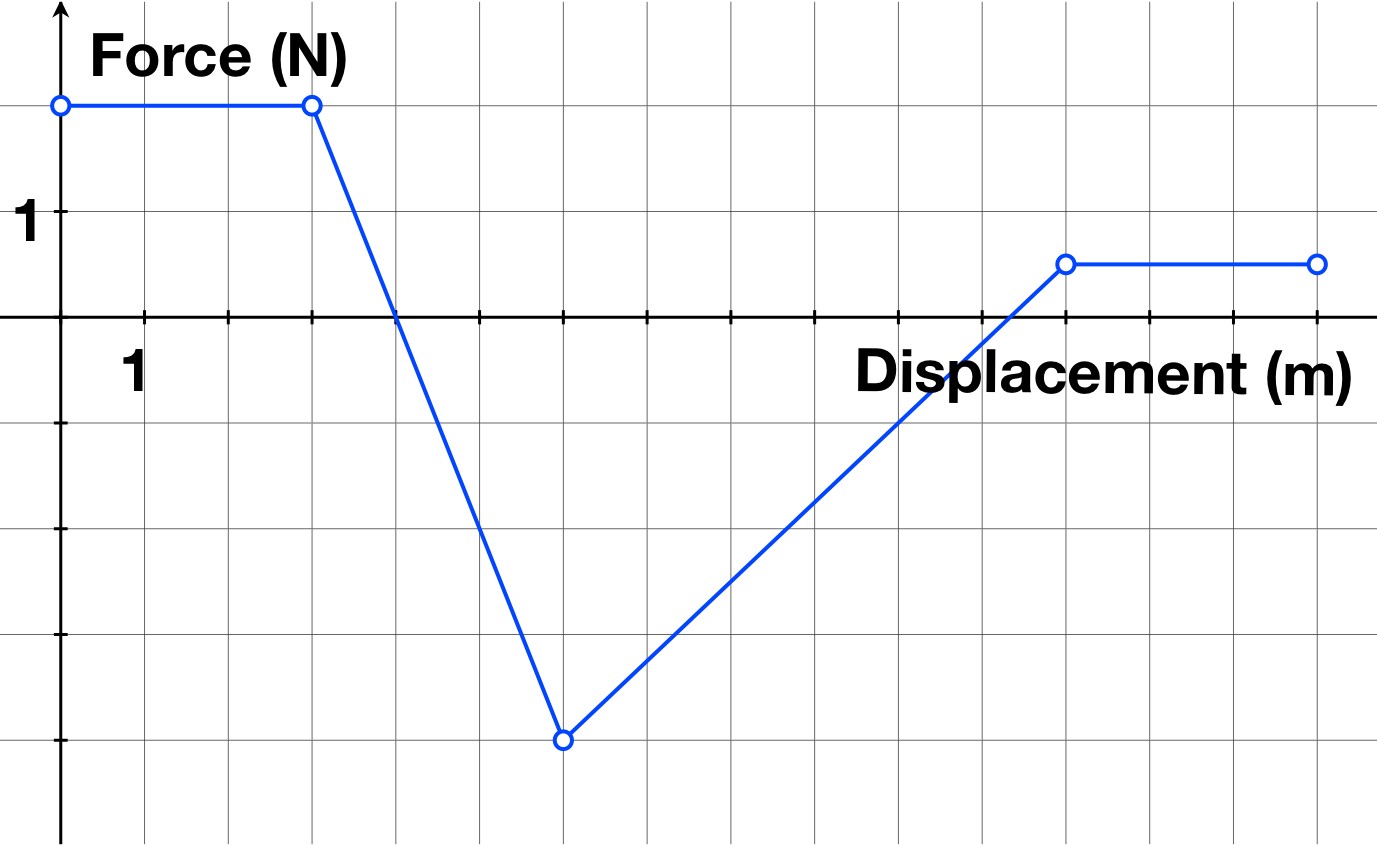
Original problem 2
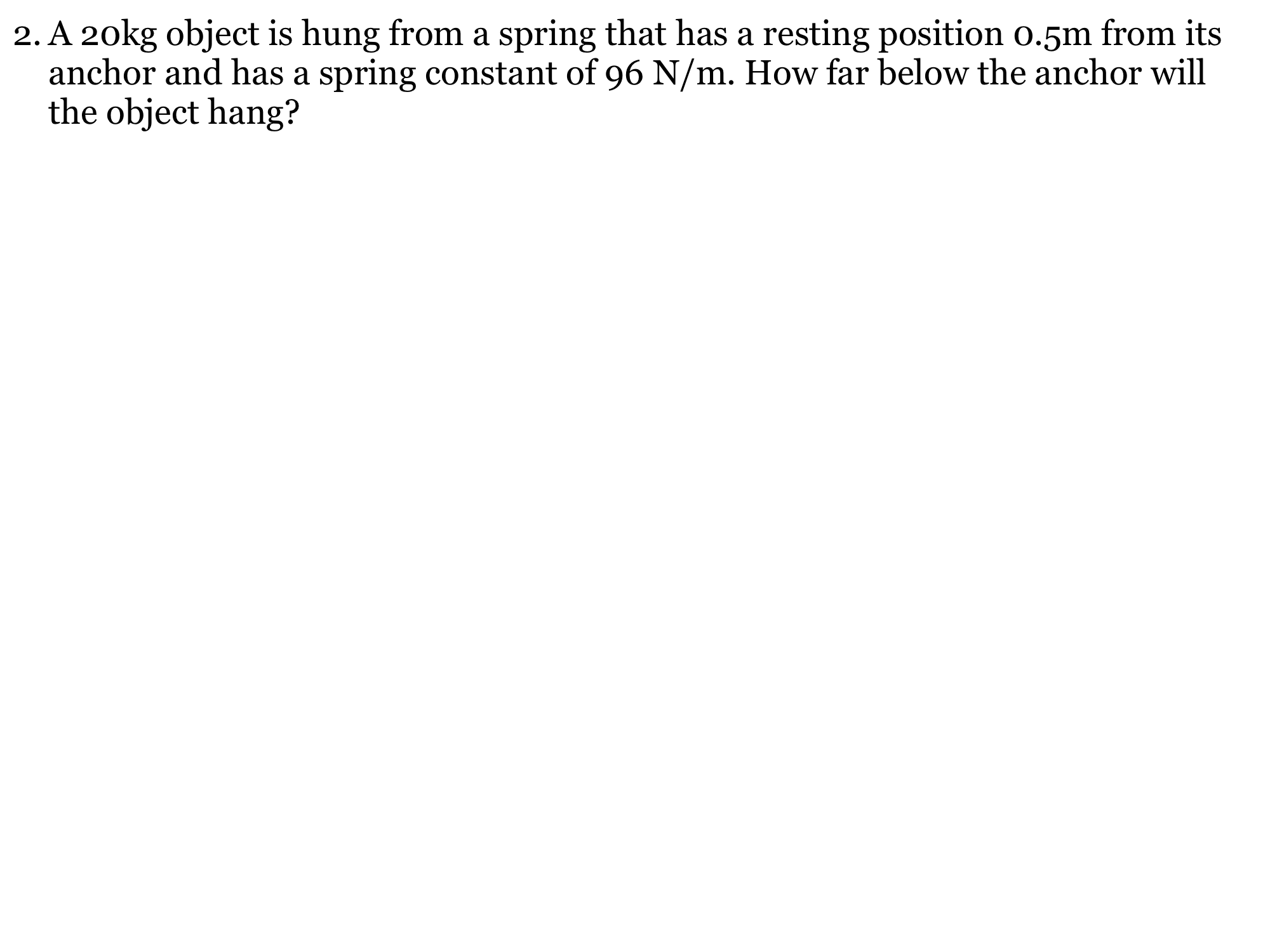
Problem text
A 20 kg object hangs at rest from an ideal vertical spring whose unstretched length is 0.50 m and whose spring constant is 96 N/m. How far below the anchor does the object hang? Use g = 9.8 m/s².
Drawing is temporarily unavailable. Work on paper if needed, then record your reasoning here.
Saving written working requires JavaScript. The problem remains available above; keep your work on paper or in your own notes.
Original problem 1
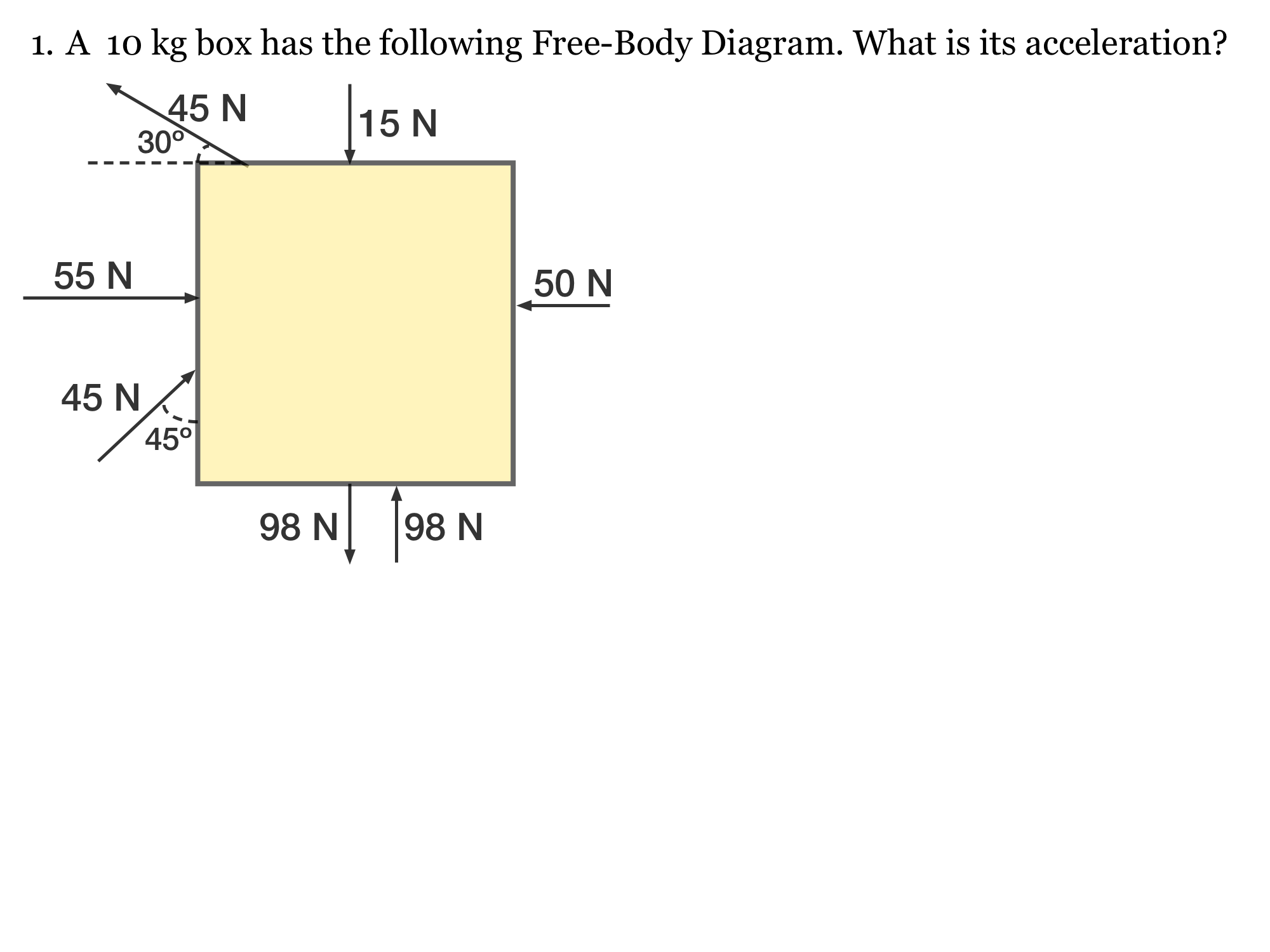
Treat every arrow as a prescribed force. The pair of 98 N arrows cancel; do not impose an additional vertical equilibrium condition.
Problem text
A 10 kg box experiences all the forces shown in the diagram: 55 N right, 50 N left, 15 N down, 98 N down, 98 N up, 45 N at 30° above the leftward horizontal, and 45 N at 45° above the rightward horizontal. Find its acceleration vector, magnitude and direction.
Drawing is temporarily unavailable. Work on paper if needed, then record your reasoning here.
Saving written working requires JavaScript. The problem remains available above; keep your work on paper or in your own notes.


Original problem 3
Problem text
A pirate commandeers a ship of mass 5.8 Mg. Each raised sail provides 11.6 kN of forward force. Neglect resistance. How many sails are needed to accelerate the ship at 6.0 m/s²?
Drawing is temporarily unavailable. Work on paper if needed, then record your reasoning here.
Saving written working requires JavaScript. The problem remains available above; keep your work on paper or in your own notes.
Original problem 4
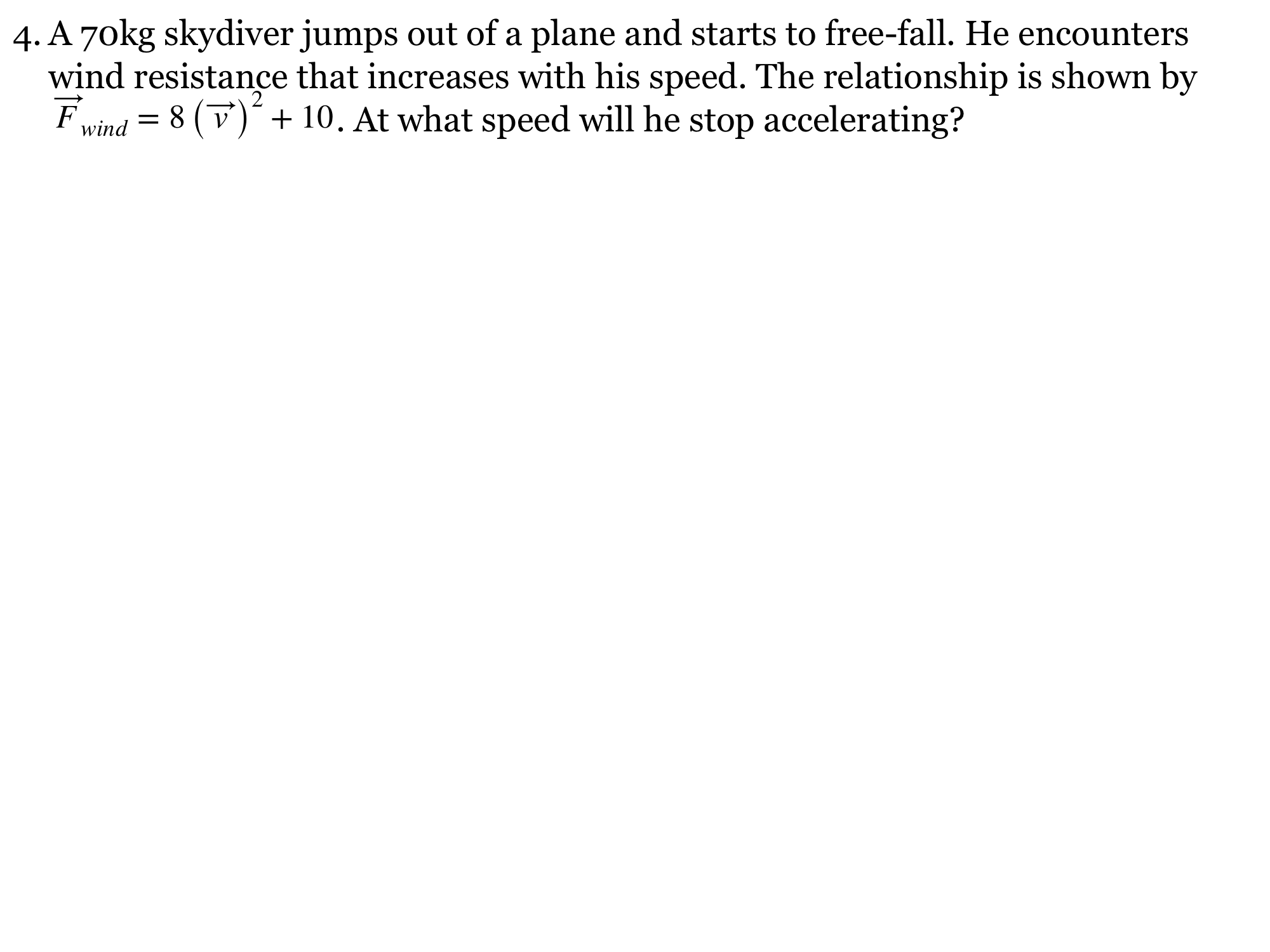
The original writes a squared vector. Read v as scalar speed, with coefficient 8 kg/m and constant force 10 N. This is a stated empirical model, including its nonzero value at v = 0.
Problem text
A 70 kg skydiver falls downward. The upward resistance-force magnitude is D = 8v² + 10 N when speed v is entered in m/s. At what terminal speed is the acceleration zero? Use g = 9.8 m/s².
Drawing is temporarily unavailable. Work on paper if needed, then record your reasoning here.
Saving written working requires JavaScript. The problem remains available above; keep your work on paper or in your own notes.
Original problem 5
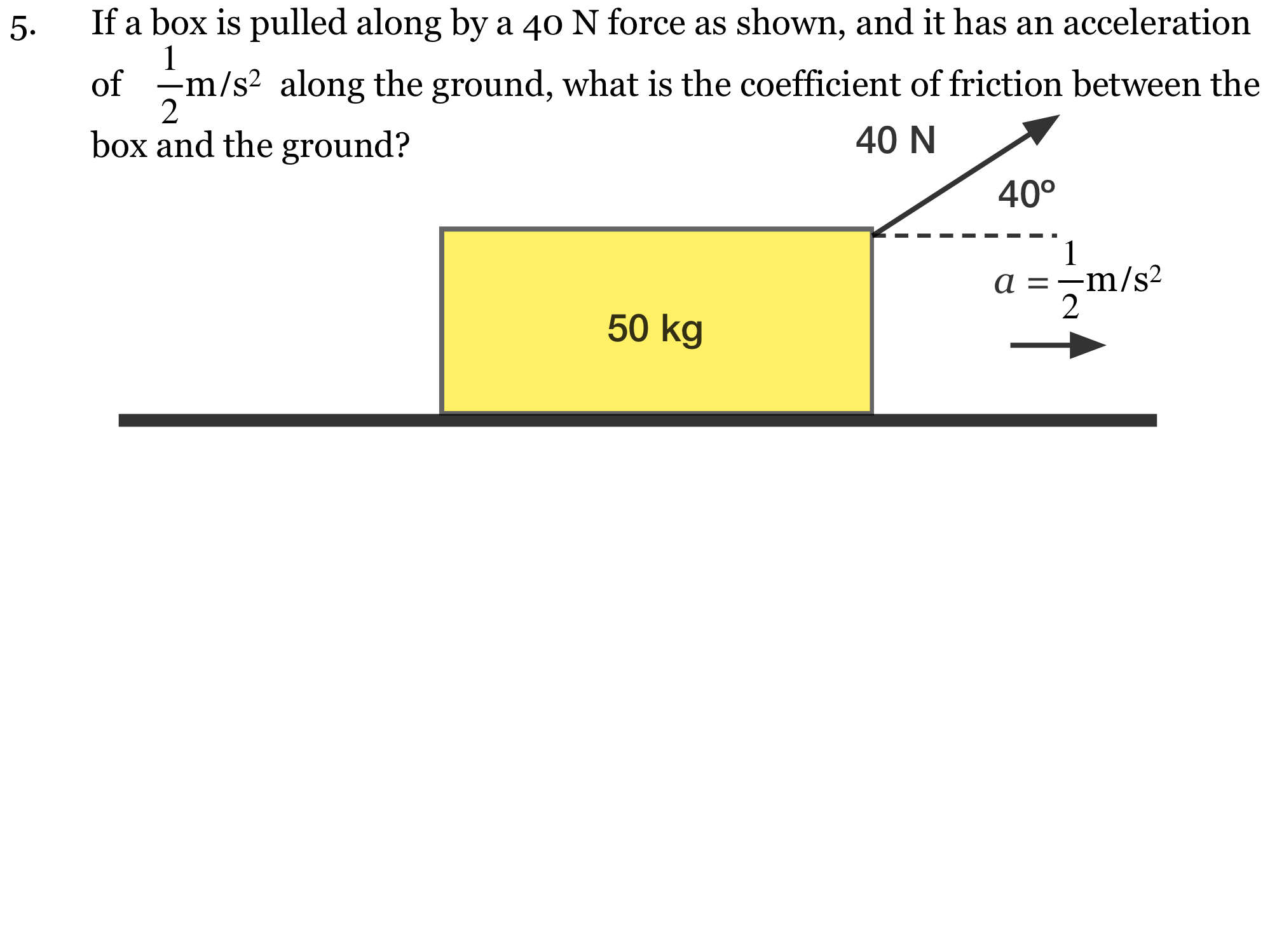
The diagram’s acceleration is 1/2 m/s², not an unreadable blank or 5 m/s².
Problem text
A 50 kg box slides to the right on a level floor. A 40 N pull acts at 40° above horizontal, and the horizontal acceleration is +0.50 m/s². Find the kinetic friction coefficient. Use g = 9.8 m/s².
Drawing is temporarily unavailable. Work on paper if needed, then record your reasoning here.
Saving written working requires JavaScript. The problem remains available above; keep your work on paper or in your own notes.
Original problem 6
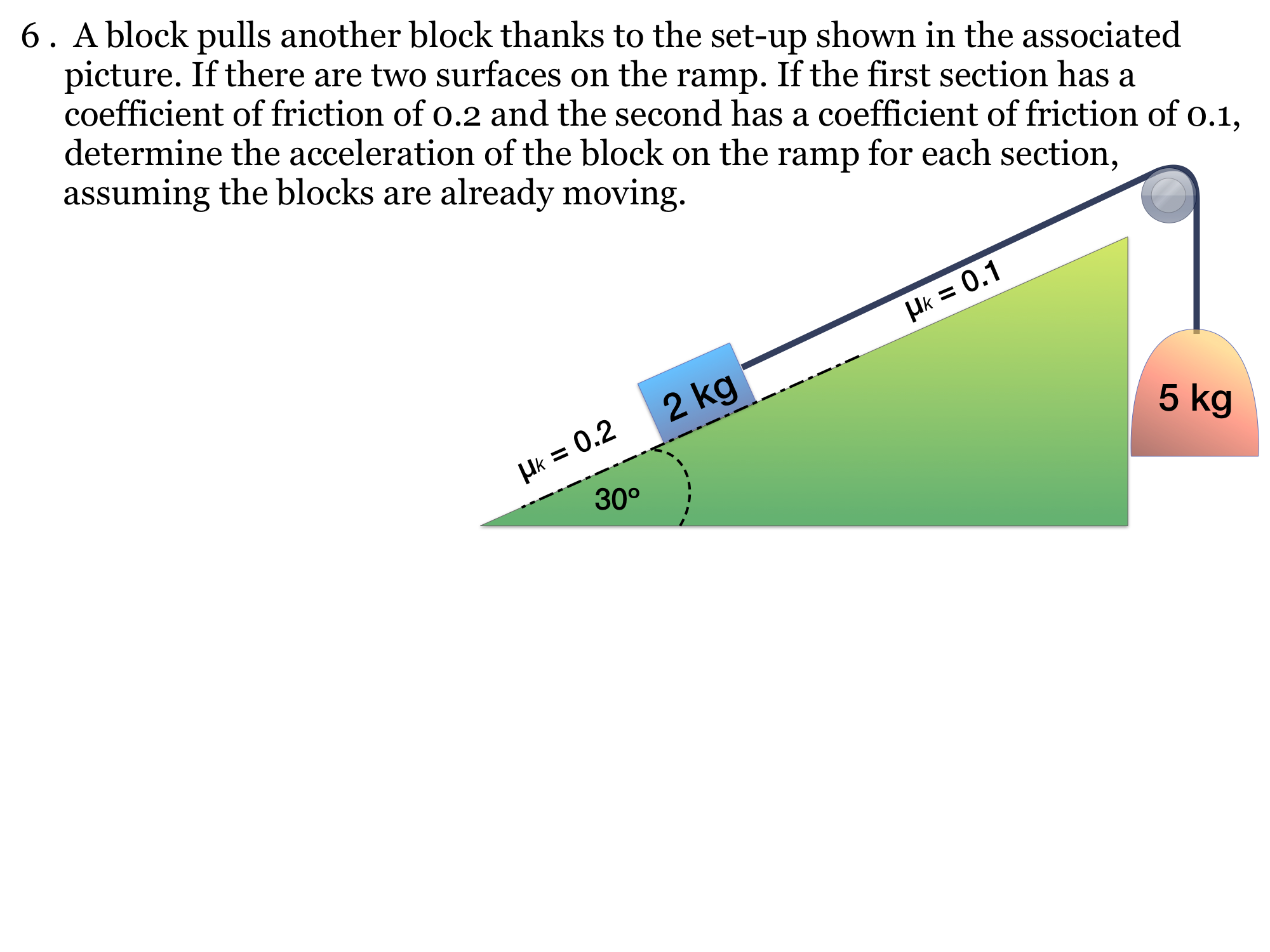
The original only says “already moving,” which does not specify the direction required to choose kinetic friction. Both directions are therefore treated explicitly.
Problem text
A 2 kg block on a 30° incline is linked by a light inextensible rope over an ideal fixed pulley to a hanging 5 kg block. The incline has sections with μₖ = 0.20 and μₖ = 0.10. Find the ramp block’s acceleration on each section if it is moving up the ramp. Also state how the answers change if it is moving down. Use g = 9.8 m/s².
Drawing is temporarily unavailable. Work on paper if needed, then record your reasoning here.
Saving written working requires JavaScript. The problem remains available above; keep your work on paper or in your own notes.
Original problem 7
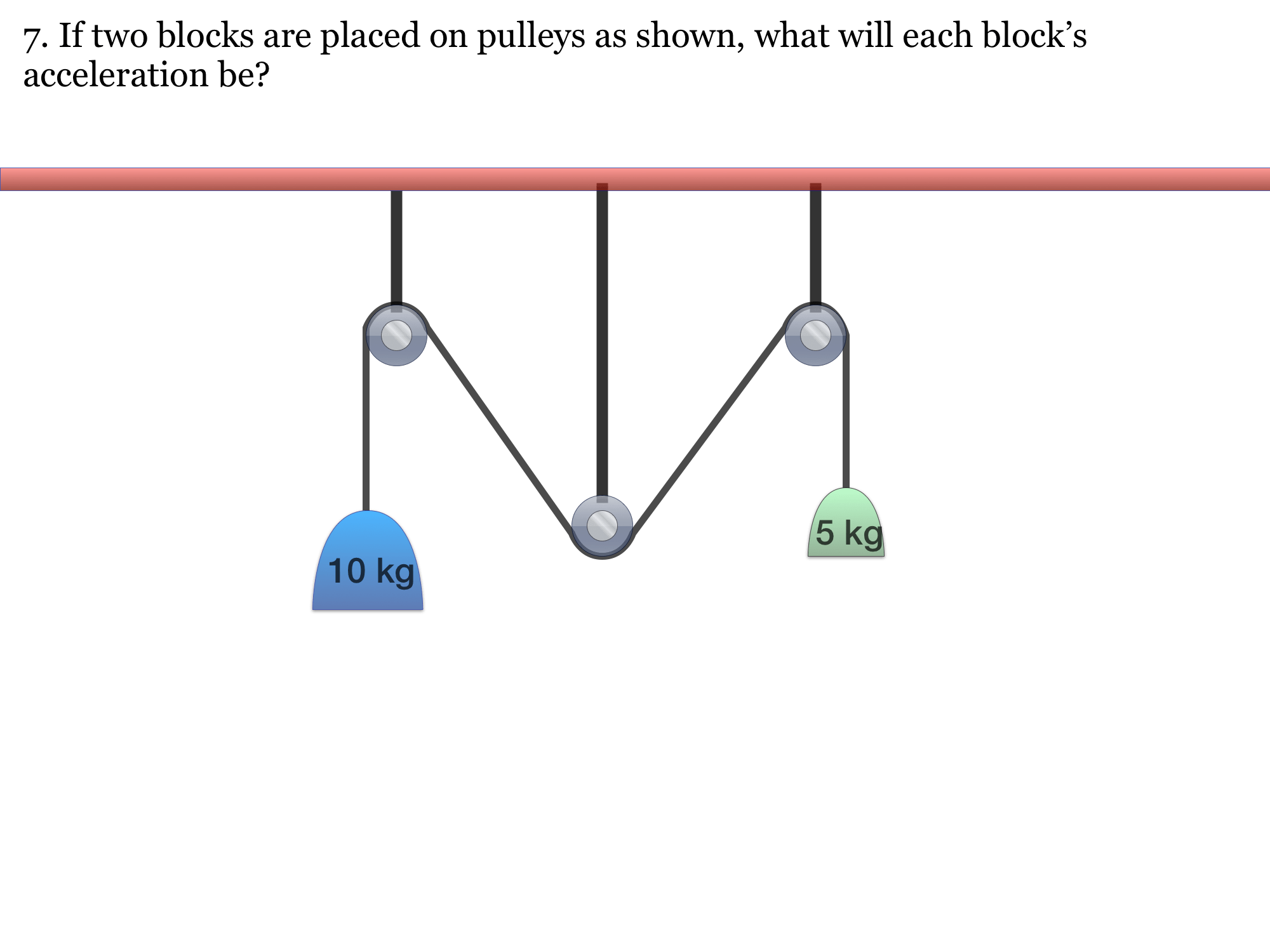
The center pulley is fixed by its visible ceiling support; it is not a movable pulley attached to either mass.
Problem text
A 10 kg mass and a 5 kg mass hang from opposite ends of one light rope routed over the three pulleys shown. All three pulley axles are fixed to the ceiling, including the lower central axle. Find each mass’s acceleration. Use g = 9.8 m/s².
Drawing is temporarily unavailable. Work on paper if needed, then record your reasoning here.
Saving written working requires JavaScript. The problem remains available above; keep your work on paper or in your own notes.
Original problem 8
Problem text
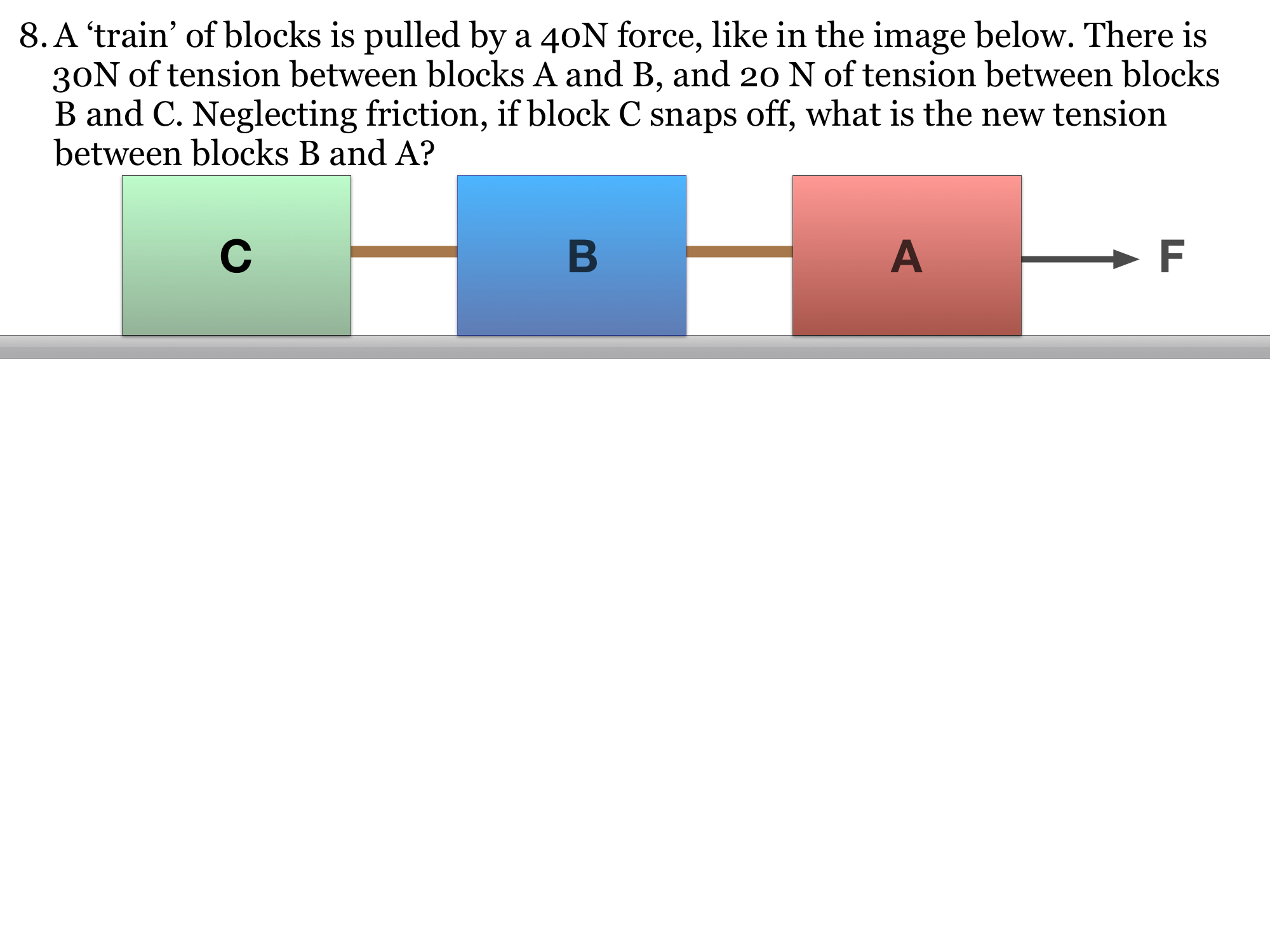
A frictionless train of blocks C–B–A is pulled to the right by a 40 N force applied to A. The A–B tension is 30 N and the B–C tension is 20 N. If C separates and the same 40 N pull continues on A, find the new A–B tension.
Drawing is temporarily unavailable. Work on paper if needed, then record your reasoning here.
Saving written working requires JavaScript. The problem remains available above; keep your work on paper or in your own notes.
Original problem 9
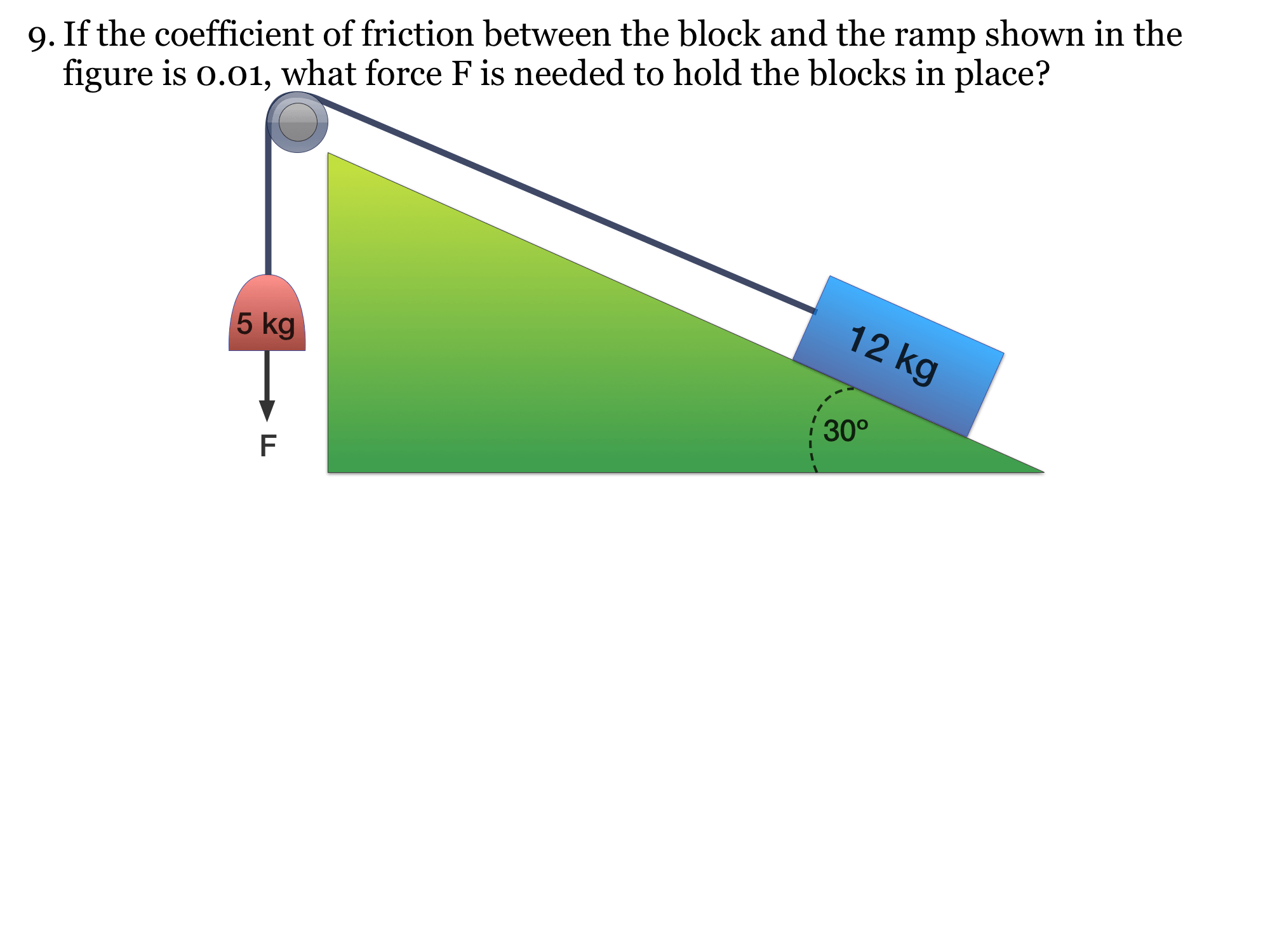
The original asks for one force although static friction adjusts within a range. No kinetic coefficient is appropriate for “hold in place.”
Problem text
A 12 kg block on a 30° ramp is connected over an ideal fixed pulley to a hanging 5 kg block. A downward external force F acts on the hanging block. Interpret the stated friction coefficient 0.010 as μₛ. Find the range of F that can hold both blocks at rest and the minimum required F. Use g = 9.8 m/s².
Drawing is temporarily unavailable. Work on paper if needed, then record your reasoning here.
Saving written working requires JavaScript. The problem remains available above; keep your work on paper or in your own notes.
Original problem 10
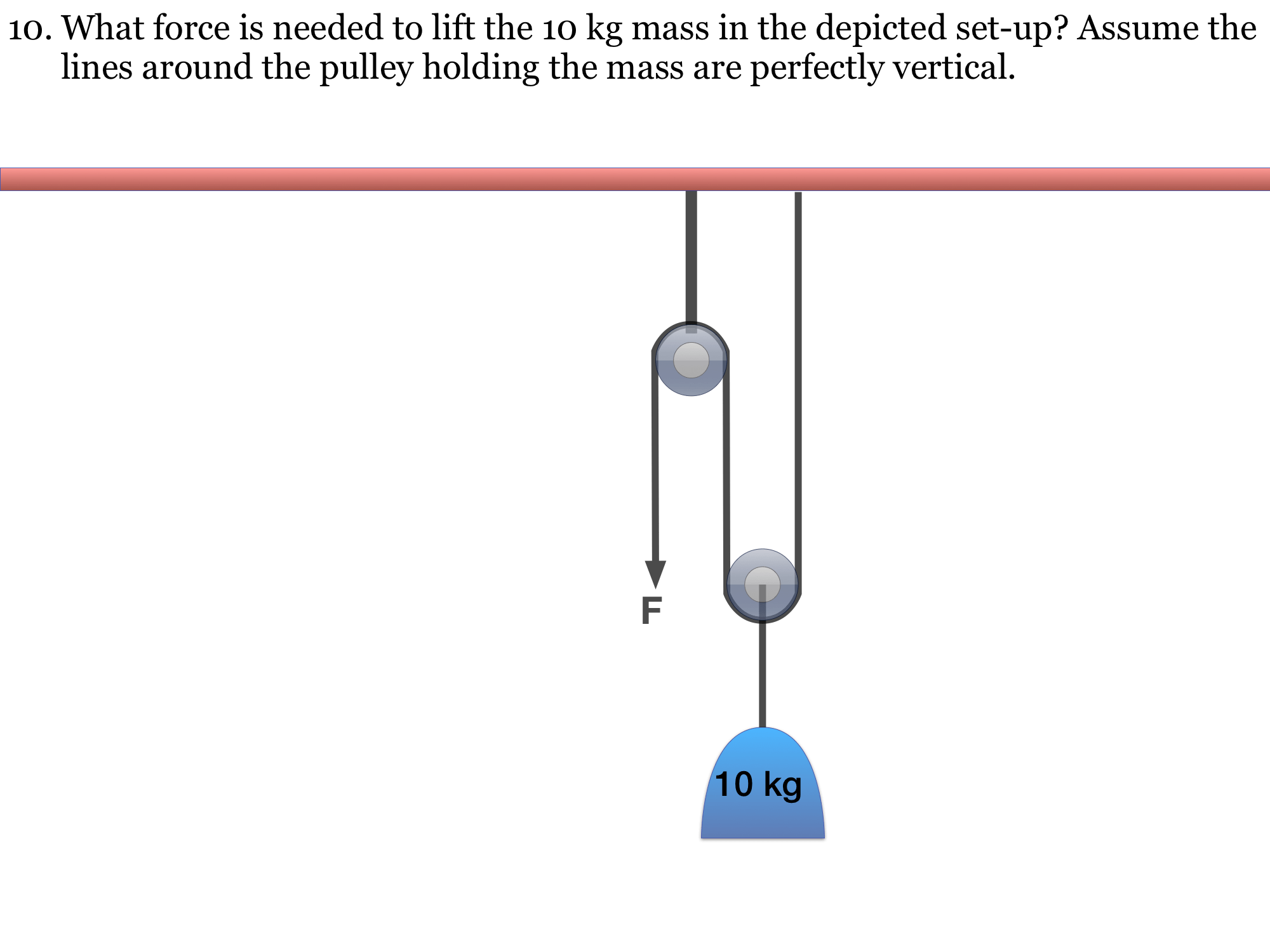
The original’s “lift” is interpreted as the threshold or steady lifting force; positive upward acceleration requires a larger force.
Problem text
An ideal movable pulley supports a 10 kg mass by two vertical segments of one light rope. A fixed upper pulley redirects the free end, where a downward force F is applied. Find F for steady upward lifting, and state the condition for upward acceleration. Use g = 9.8 m/s².
Drawing is temporarily unavailable. Work on paper if needed, then record your reasoning here.
Saving written working requires JavaScript. The problem remains available above; keep your work on paper or in your own notes.
Reviewed physics notes (21)
These corrections keep the original lesson’s purpose while fixing errors in the source edition.
- The source incorrectly calls the cosine formula a cross-product definition. — Reference 1
- Correct the definition and scope of mechanical work. — Reference 1
- A closed path involves motion despite zero net displacement. — Reference 1
- The source says friction work can use the definition only on straight paths. — Reference 1, Reference 2
- Force direction alone is not a criterion for conservative behavior. — Reference 1
- The source incorrectly uses force-direction change to classify forces. — Reference 1
- The source says only normal force and friction are involved. — Reference 1
- Use W, not a force symbol with units of joules. — Reference 1
- The original motion description omits the initial motion and possible coasting; make the work calculation conditional on the stated path. — Reference 1, Reference 2
- The source’s gravity work omits the 5 m path length. — Reference 1
- Correct gravity work and distinguish work symbols from forces. — Reference 1
- Correct the summed work and explicitly supply the requested net work. — Reference 1
- The source calls the work integral a definition of force. — Reference 1
- The integrand must be the force component along displacement. — Reference 1
- Use a scalar speed in the chapter summary. — Reference 1
- A 500 N weight requires 250 N along a frictionless 30° ramp; the source’s 50 N claim is incompatible with steady lifting. — Reference 1
- Direct lift and ideal ramp each require 2500 J; the ramp trades force for distance. — Reference 1
- Specify sliding friction and zero vertical component of the pull. — Reference 1
- Kinetic friction does negative work on each leg. — Reference 1
- Gravity gains work over the total drop; friction loses work on the ramp. — Reference 1
- Work is measured in joules, not newtons. — Reference 1
Glossary and deeper reading · 12 refreshers
These editorial refreshers supplement the reading. Definitions and examples are added guidance; original source wording and recorded answers remain in their original context.
-
Force
A force describes an interaction that can change an object’s momentum. It is a vector measured in newtons, so both size and direction matter when forces are added. For example, a rope can pull a cart while the floor exerts friction in another direction.
-
Displacement
Displacement is the vector change in position from the start of an interval to its end. It depends on those endpoints rather than the length or shape of the path traveled. For example, walking around a closed track and returning to the start gives zero displacement but a nonzero distance traveled.
-
Scalar
A scalar is a quantity described by a value and unit without a spatial direction. A scalar can have a sign when its definition or reference permits one; scalar does not mean always positive. For example, mass is a scalar, whereas the velocity of that mass also needs a direction.
-
Vector
A vector is a quantity with a magnitude and a direction, represented by an arrow or by components along chosen axes. Vectors add by adding corresponding components rather than simply adding their magnitudes. For example, an eastward displacement followed by a northward displacement produces a resultant pointing northeast. The zero vector has zero magnitude and no unique direction.
-
Vector component
A vector component describes the part of a vector along a chosen axis. Its signed value changes when the axes change, even though the physical vector remains the same. For example, a diagonal launch velocity can be resolved into horizontal and vertical components that share the same elapsed time.
-
Gravity
Gravity is the attractive interaction between masses in the Newtonian model. For spherical bodies or point-mass approximations, its strength decreases with the square of the separation between their centers. For example, Earth’s gravity provides the inward force that keeps a satellite in orbit.
-
Weight
Weight is the gravitational force exerted on an object by a specified attracting body. Near Earth’s surface its magnitude is approximately mass times the local gravitational field strength, and it is measured in newtons. For example, an astronaut has less weight on the Moon while retaining the same mass.
-
Nonconservative force
A nonconservative force can do work that depends on the path followed. Its effects cannot be described by a single configuration-dependent potential energy for that interaction alone. For example, sliding friction transfers more mechanical energy into thermal energy along a longer sliding path under the same conditions.
-
Conservative force
A conservative force does work that depends only on the starting and ending configurations. A potential-energy function can describe it, and its work around a closed path is zero. For example, near-Earth gravity does the same work between two heights whether a ball follows a vertical or a curved path.
-
Kinetic friction
Kinetic friction acts between surfaces that slide relative to one another. It opposes their relative slipping and is often modeled with magnitude equal to the kinetic-friction coefficient times the normal force. For example, a rapidly moving belt can exert forward kinetic friction on a slower box sliding on it.
-
Drag
Drag is a force from a fluid that opposes an object’s motion relative to that fluid. Its dependence on speed, shape, and fluid properties varies with the physical regime. For example, a parachute increases air drag by presenting a large area to the moving air.
-
Magnitude
Magnitude is the nonnegative size of a vector quantity. It does not specify direction, and it differs from a signed component. For example, a westward velocity can have a negative x component while its speed, the velocity magnitude, stays positive.