Inelastic Collisions
Original textbook reading.
An inelastic collision does not conserve the colliding system’s total kinetic energy. In ordinary impacts some kinetic energy becomes deformation, thermal energy, sound, or other internal energy. Total energy is still conserved when all transfers are included.
As we discussed in the previous section, we defined linear momentum to describe the magnitude of the movement of an object. Any object that has a mass and a velocity has momentum and we know that since it is a vector it has a magnitude and direction.
A body’s momentum changes when it receives a net external impulse. In the combined bat–ball system the mutual collision forces are internal; in the ball-only system the bat force is external. Translational kinetic energy may be redistributed or converted into other forms during the collision.
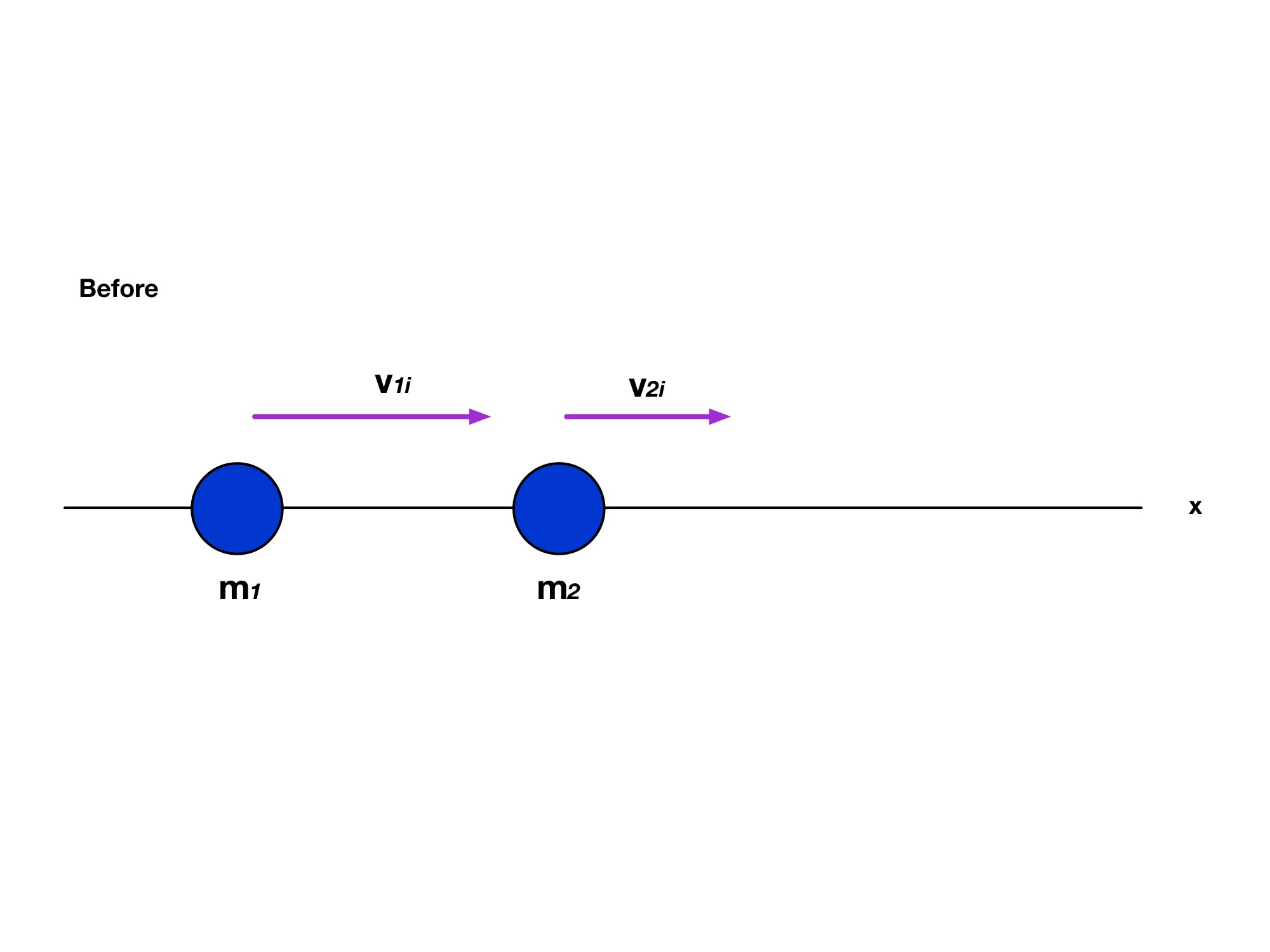
Notice that both particles with different masses are moving along the x-axis with their own respective initial velocities. This is the BEFORE COLLISION picture
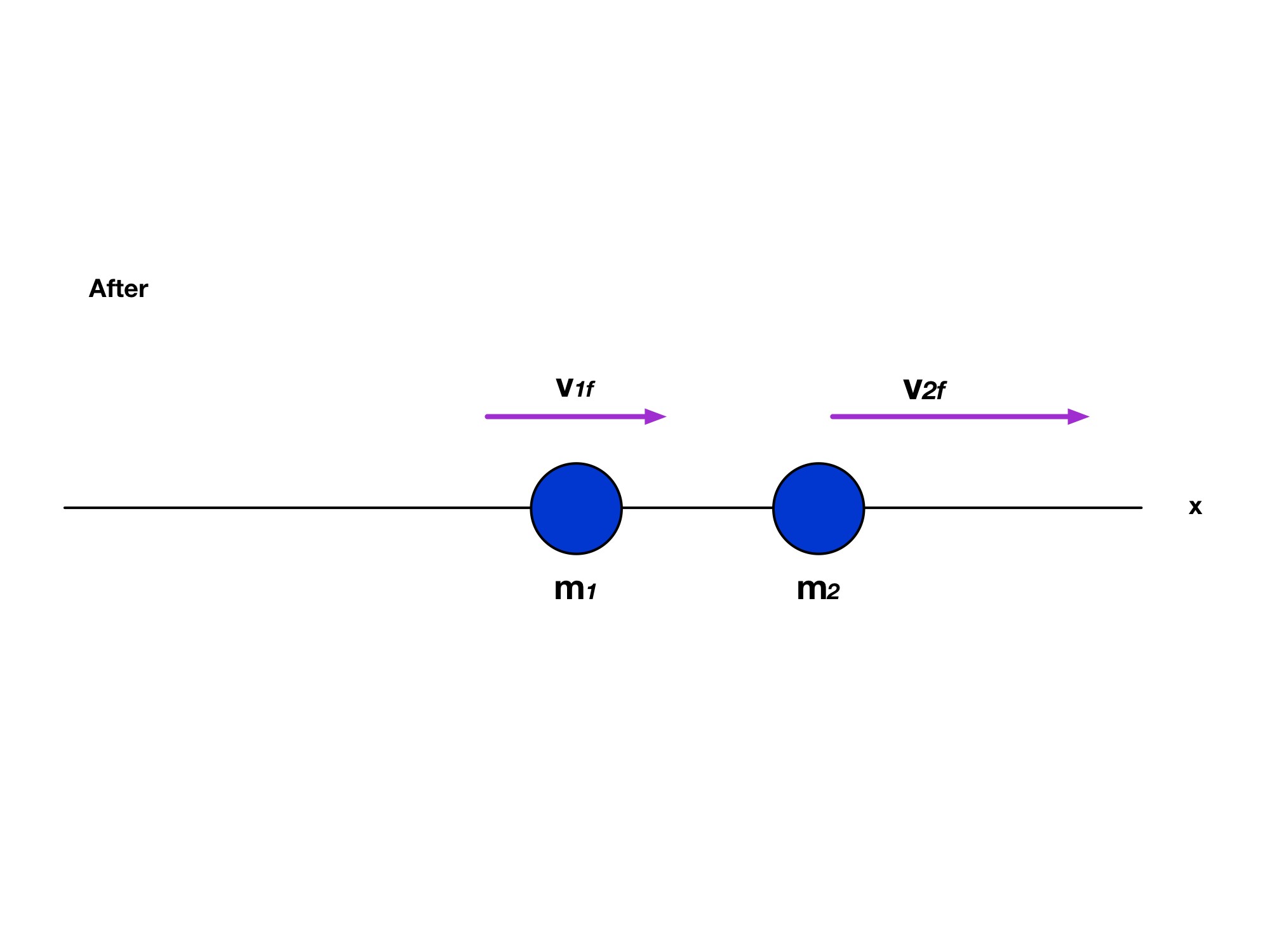
An inelastic collision has unequal total kinetic energies before and after; ordinary dissipative collisions decrease it, while a release of stored internal energy can increase it. A completely inelastic collision means the objects stick together. For fixed initial velocities and masses, sticking removes the maximum relative-motion kinetic energy.
Since we are assuming that this is a closed and isolated system, we can assume that the momentum of the two bodies are conserved, where the initial momentum is equal to the final momentum, which can be written as:
(Equation 4.2.1)
For a two-body problem, this becomes:
(Equation 4.1.2)
Since the particles are moving in only one direction (along the x-axis), we can drop the vector arrows. Knowing that , we rewrite this equation as:
(Equation 4.2.3)
If we know the masses of both objects as well as their initial velocities and the final velocity of one of the masses, we can solve for the other’s final velocity.
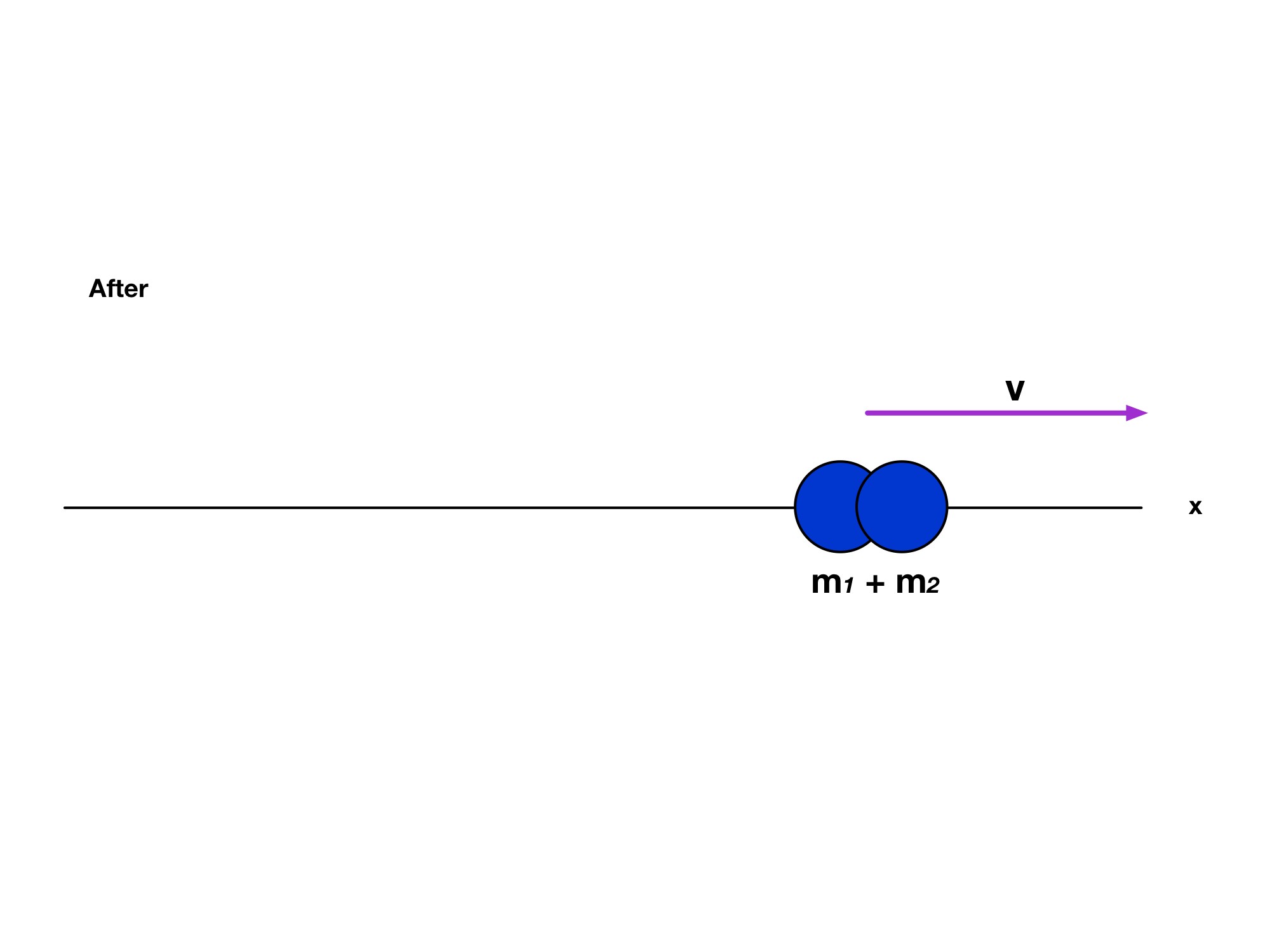
The two images shown in Gallery 4.2.2 above demonstrate the concept behind complete inelastic collisions in which the two particles, after collision, stick to each other. When stuck together, the two particles move as one, thus having the same velocity . Therefore, since they share the same final velocity, and the 2nd particle has no velocity () we can rewrite the momentum equation as:
(Equation 4.2.4)
Where we can solve for the final velocity of the collided (stuck) objects as:
Rarely does this happen in life as most collisions are just inelastic, but it is important to know that this type of collision can occur.
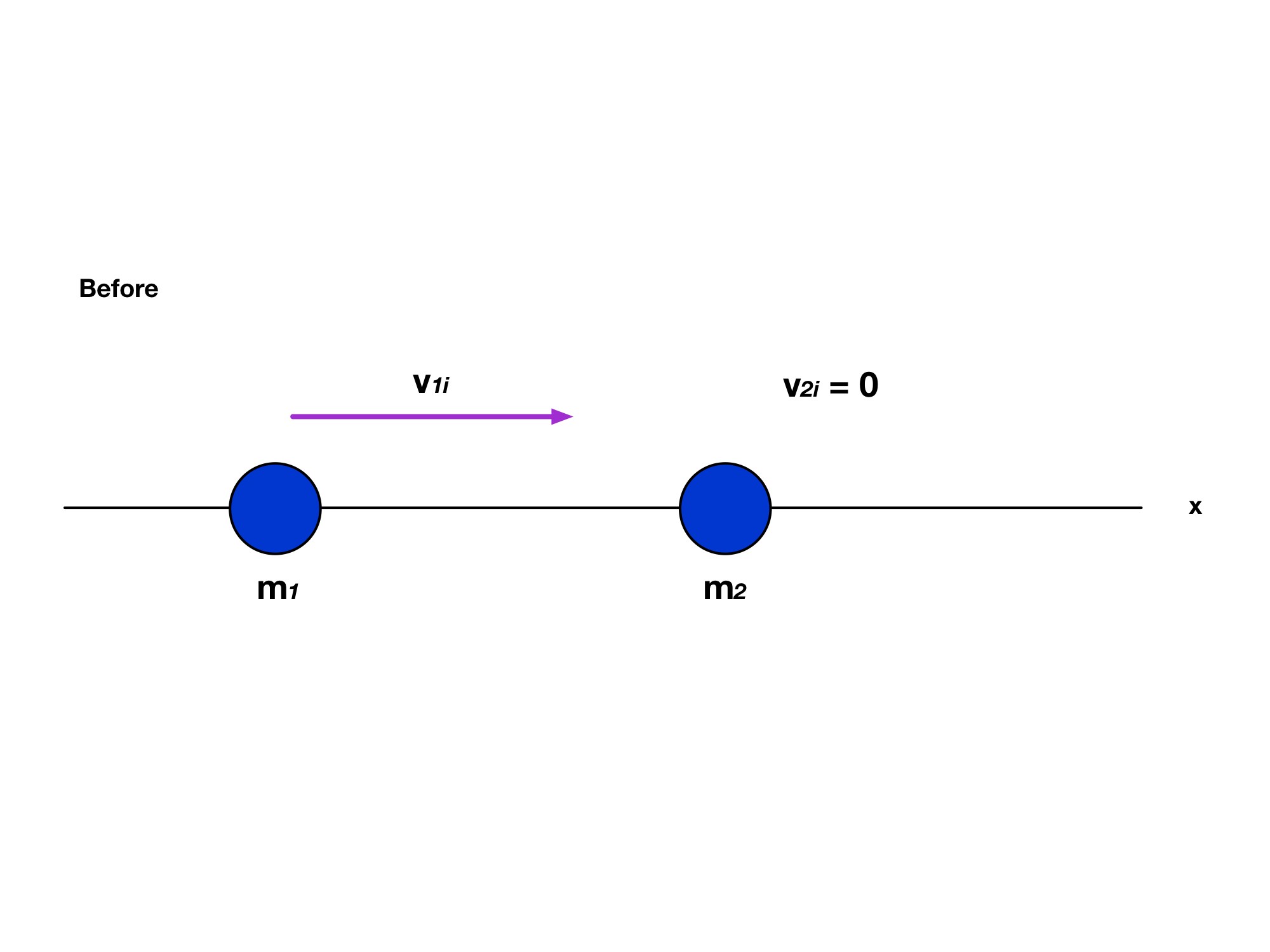
Here there are two masses, both lying along the x-axis, but what is different is that mass 2 has an initial velocity of zero. This is the BEFORE COLLISION
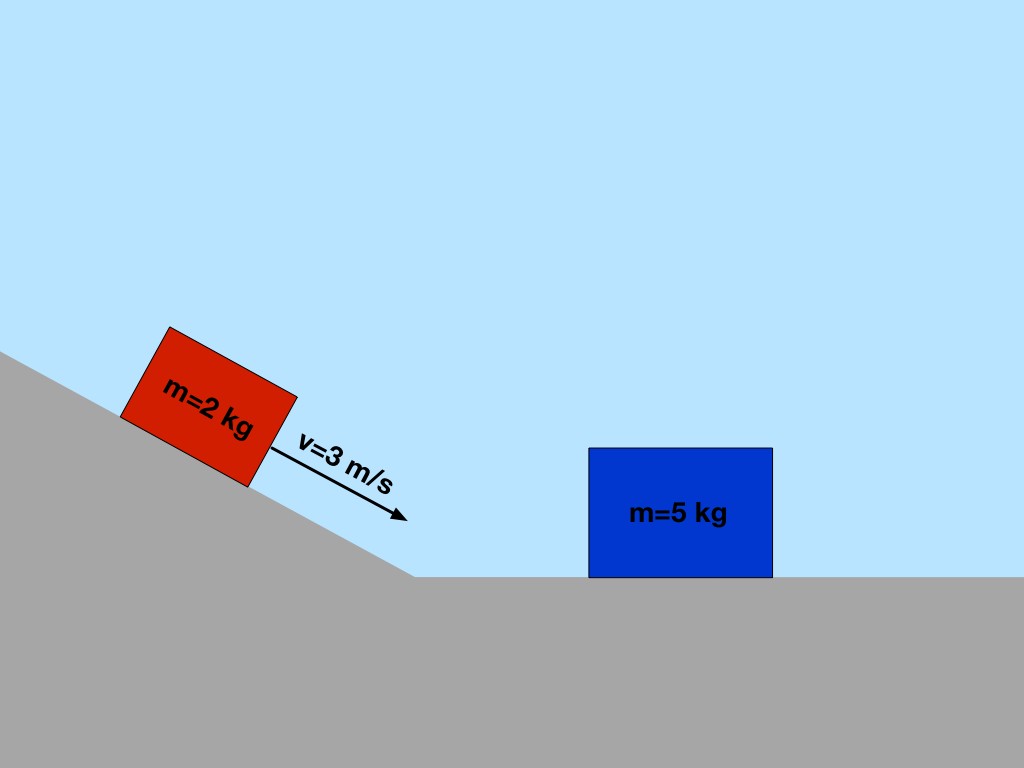
Red block is traveling down an inclined plane with a velocity of 3 m/s while the blue block is at rest.
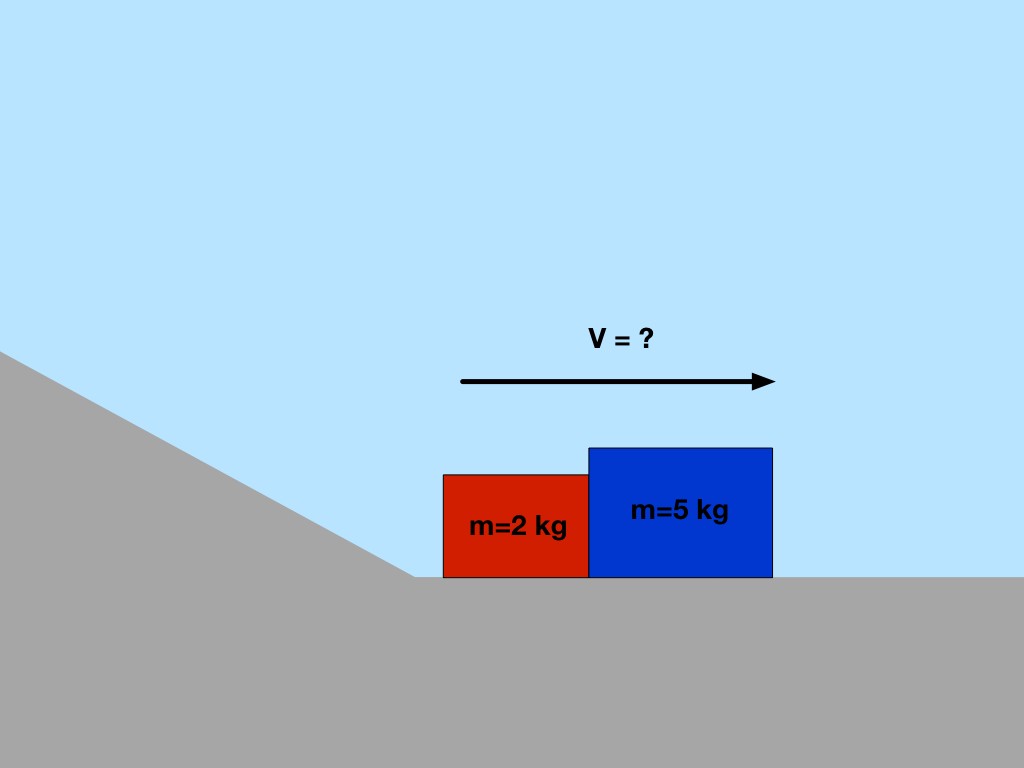
With these equations in mind, let’s look at an example of inelasticity.
A 2 kg block A moves at 3 m/s on a frictionless surface and collides with a stationary 5 kg block B. They stick together. After the short collision, a braking force gives their combined mass a constant acceleration of −2 m/s², opposite their motion, until they stop. Neglect external impulse during impact. Find their speed immediately after impact and their subsequent stopping distance.
Step 1: Realize that this is a complete inelastic collision
The revised prompt explicitly says the blocks stick together; that establishes a completely inelastic collision. Simply referring to both blocks as a system does not establish that they stick.
Step 2: Solve for the velocity of the block A + block B System
Now that we have identified this collision as completely inelastic, we can solve for the velocity of the blocks after they collide with one another. Let’s use the velocity equation:
Now, we need to plug in what we know.
Our givens are:
We have all the values necessary to solve for the velocity so let’s just use them.
Doesn’t seem like the block is moving very fast, which makes sense because the only kinetic energy is supplied by the smaller block.
Step 3: Solve for distance traveled
This means that this is a kinematics question. To pick the right equation, we need to look at what we have to work with.
Pop Quiz 4.2.1 Inelastic Collisions
Question 1 of 5 · 0 correct
AP Topic 4.4 · Read the worked solution
A ice hockey goalie catches a puck moving at . With what speed does the goalie return back, if no energy is lost to friction?
Read every full question without answers
Question 1
Question 2
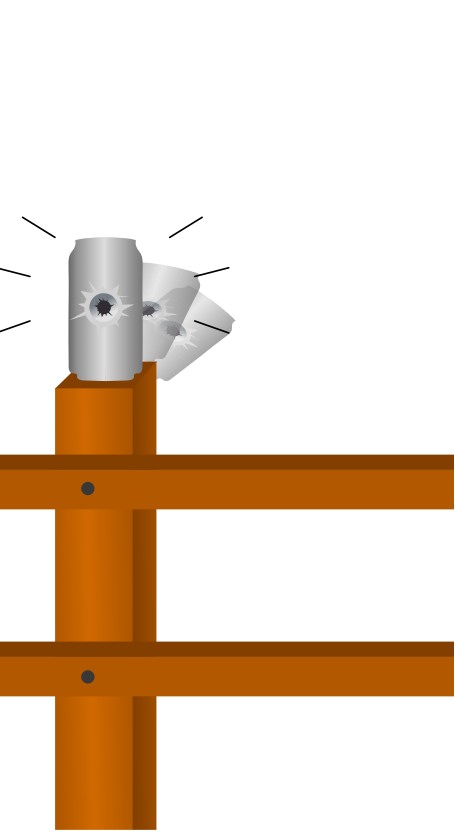
A driver attempts to slow a runaway truck by getting in front of it and braking. If the driver is going and the truck is going , how much slower does the truck go once it hits the car in front of it, before braking? Assume they stick together in a brief collision with negligible external horizontal impulse.
Question 3
Question 4
Question 5
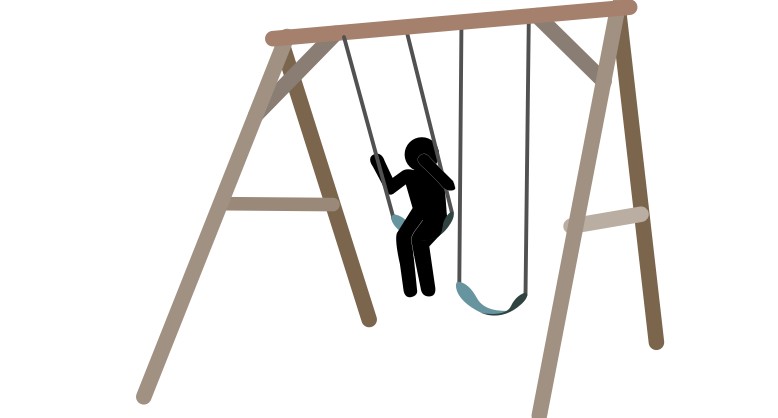
A small child runs and jumps onto a swing. If the child is moving at and leaps onto the swing, how fast does the child start to swing?


Reviewed physics notes (9)
These corrections keep the original lesson’s purpose while fixing errors in the source edition.
- Energy is converted, not destroyed. — Reference 1, Reference 2
- Correct system boundary and energy language. — Reference 1, Reference 2
- Avoid claiming every inelastic interaction necessarily loses energy without qualification. — Reference 1
- The source does not state sticking, acceleration sign, or stopping condition and misuses postcollision kinematics. — Reference 1, Reference 2
- “System” alone does not imply common final velocity. — Reference 1
- Postcollision speed is the initial speed of the subsequent braking stage. — Reference 1
- Correct sign and stage initial conditions. — Reference 1
- Distance happens to resemble the source value but derivation was invalid. — Reference 1
- Ordinary inelastic collisions need not produce common velocity. — Reference 1
Glossary and deeper reading · 8 refreshers
These editorial refreshers supplement the reading. Definitions and examples are added guidance; original source wording and recorded answers remain in their original context.
-
Kinetic energy
Kinetic energy is energy associated with motion relative to a chosen reference frame. For a nonrelativistic translating object it is one half of its mass times speed squared. For example, doubling a cart’s speed quadruples its translational kinetic energy when its mass stays fixed.
-
Internal energy
Internal energy is energy associated with the microscopic motion and configuration of a system’s constituents. It excludes the kinetic energy of the whole system’s bulk motion and depends on the thermodynamic state. For example, a stationary solid can gain internal energy as its atomic vibrations become more energetic.
-
Magnitude
Magnitude is the nonnegative size of a vector quantity. It does not specify direction, and it differs from a signed component. For example, a westward velocity can have a negative x component while its speed, the velocity magnitude, stays positive.
-
Velocity
Velocity describes how position changes with time and includes direction. Instantaneous velocity describes one moment, while average velocity is displacement divided by elapsed time. For example, a car turning a corner can change velocity while maintaining the same speed.
-
Linear momentum
Linear momentum is a vector describing an object’s motion and equals mass times velocity in the nonrelativistic model. The vector sum of momenta is conserved when the net external impulse on the system is zero. For example, two identical carts moving equally fast in opposite directions have zero total linear momentum but nonzero total kinetic energy.
-
Impulse
Impulse is the change in linear momentum produced by a force over a time interval. It equals the signed vector area under a force-versus-time graph and is measured in newton-seconds. For example, a padded landing spreads the stopping impulse over more time, reducing the average force for the same momentum change.
-
Isolated system
An isolated system exchanges neither energy nor matter with its surroundings. In a momentum problem, conservation of total momentum specifically requires zero net external impulse over the interval analyzed. For example, two colliding carts can be treated as momentum-isolated horizontally when the external horizontal impulse is negligible.
-
Vector
A vector is a quantity with a magnitude and a direction, represented by an arrow or by components along chosen axes. Vectors add by adding corresponding components rather than simply adding their magnitudes. For example, an eastward displacement followed by a northward displacement produces a resultant pointing northeast. The zero vector has zero magnitude and no unique direction.