Elastic Collisions
Original textbook reading.
In the previous section we talked about most everyday collisions are inelastic, that is, the object loses some kinetic energy when they come in contact with another object.
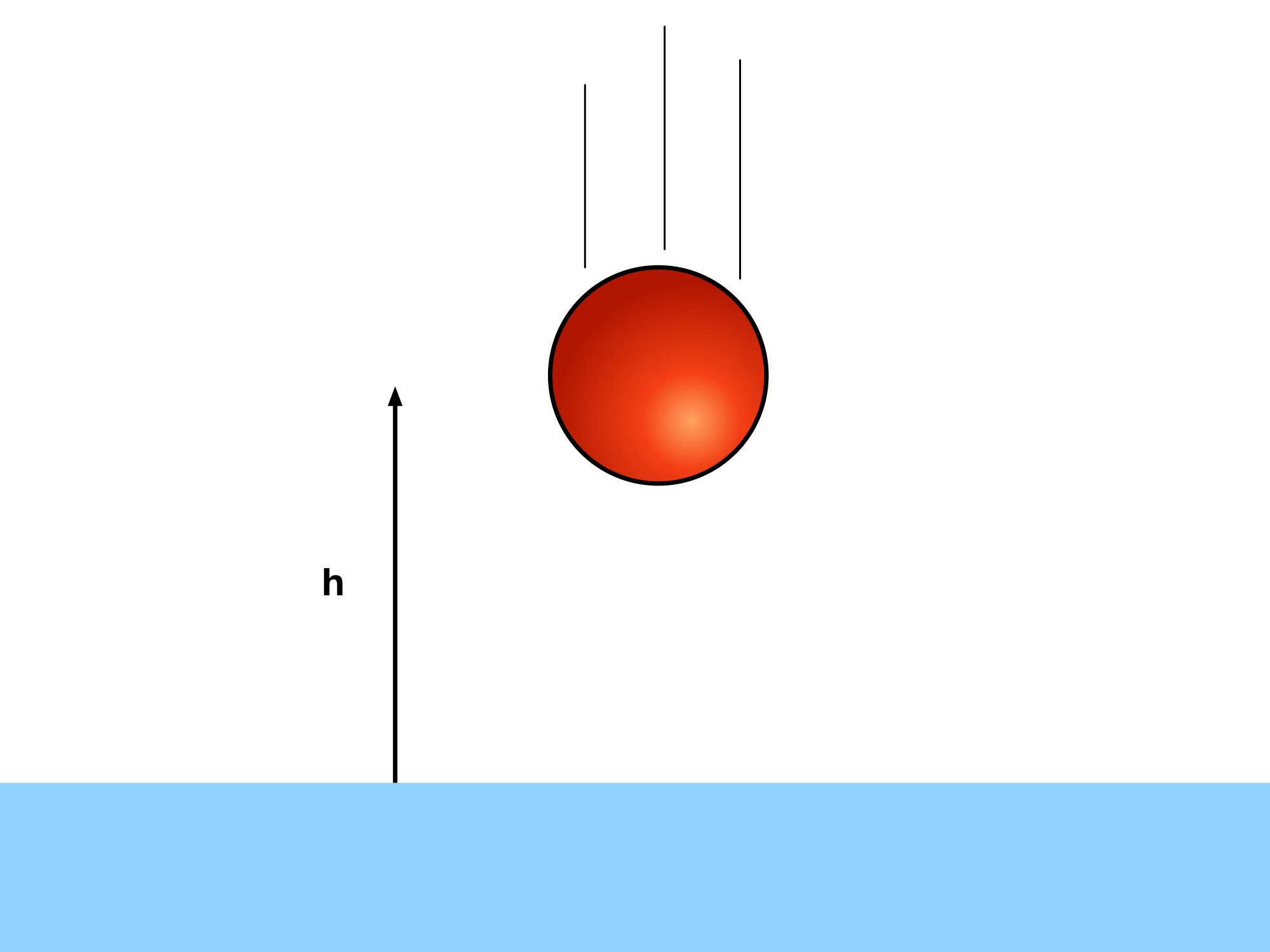
Here the ball is falling towards the floor with an initial velocity.
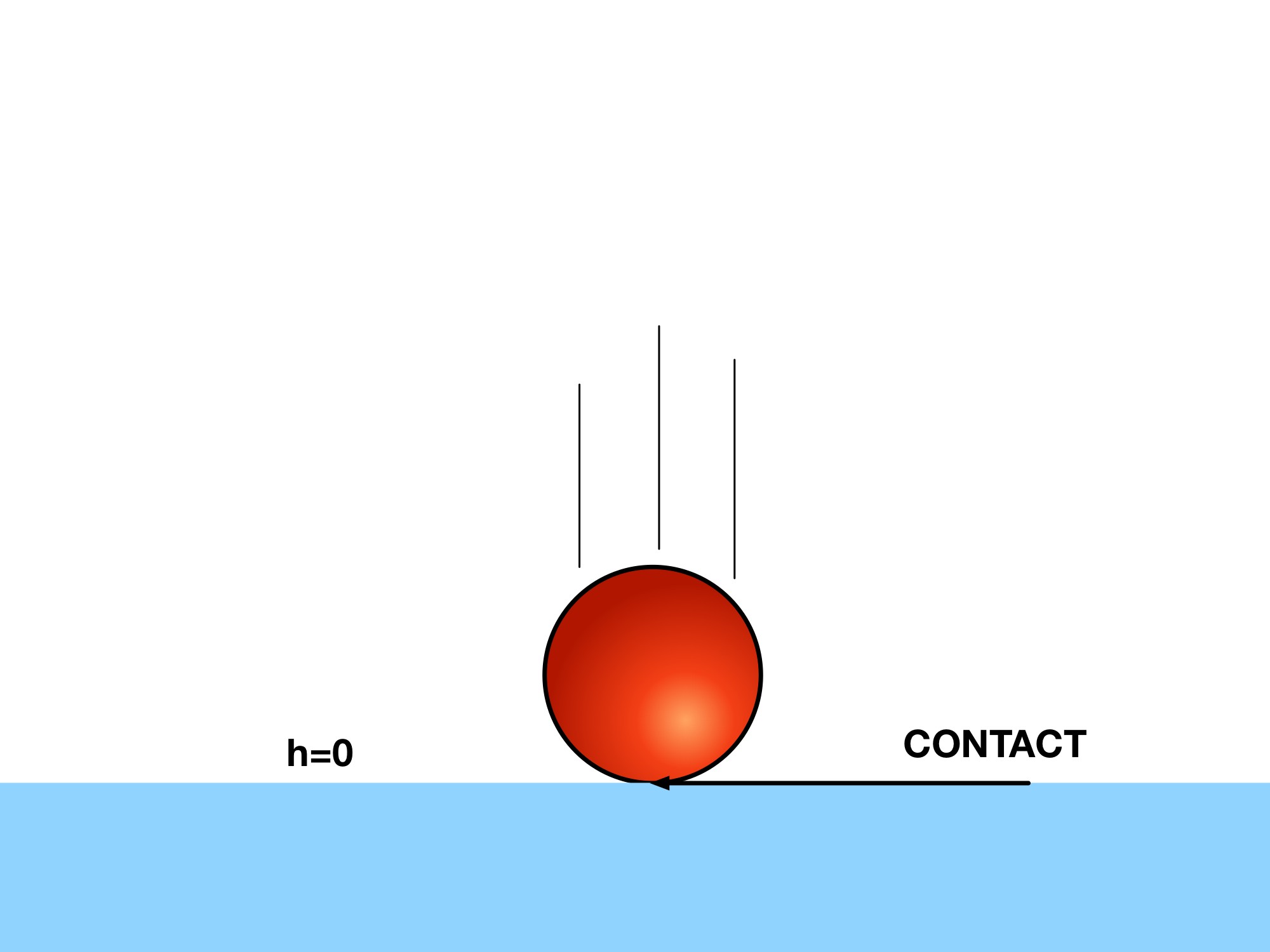
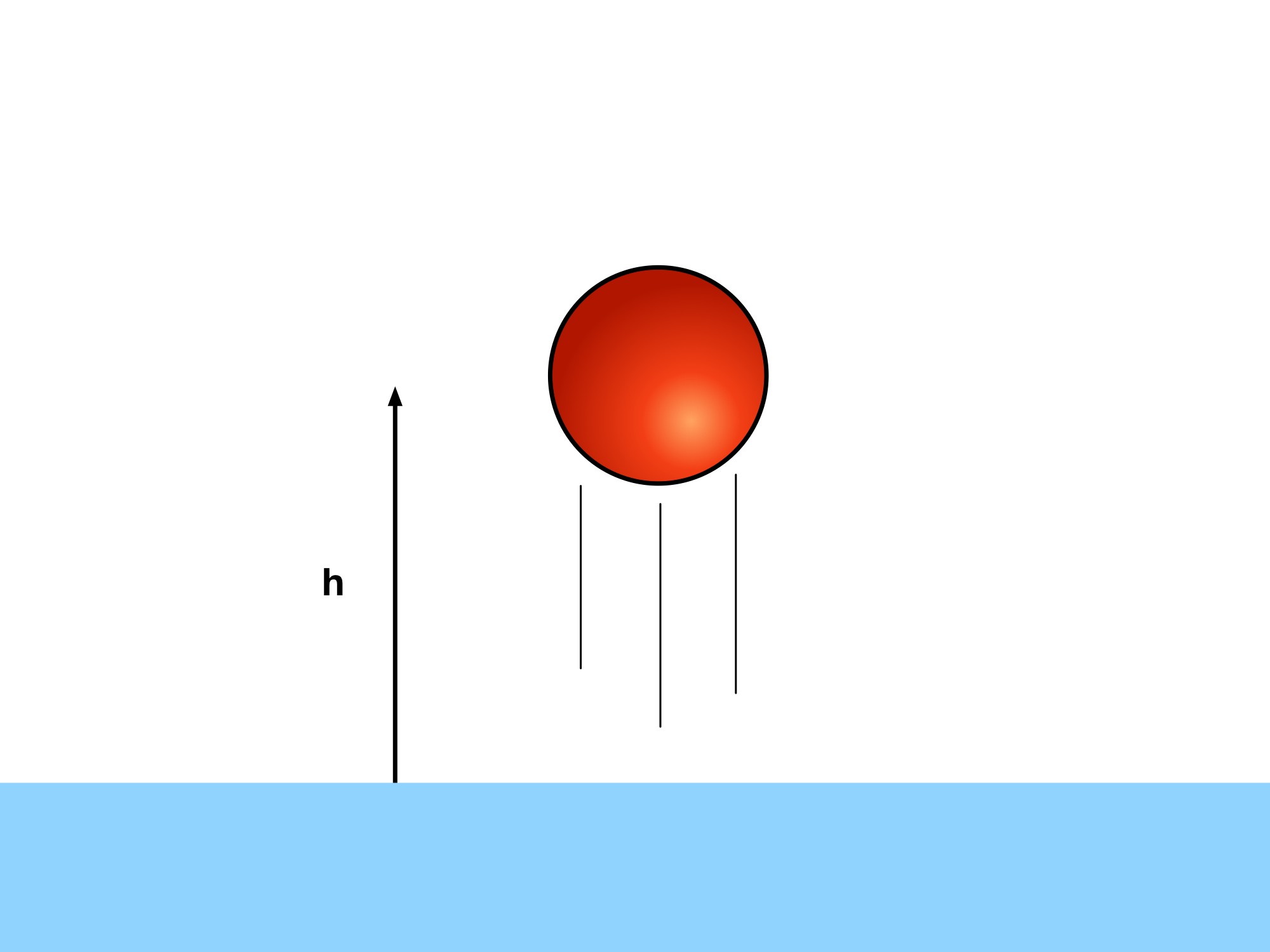
In this section, we will divert our attention to systems where no energy is lost and is instead conserved. These are known as Elastic Collisions. This is best displayed here in Gallery 4.3.1. An elastic system means that the kinetic energy between is conserved. This does not mean that the kinetic energy cannot change. This just means the total kinetic energy before the collision is the same as the total kinetic energy after the collision.
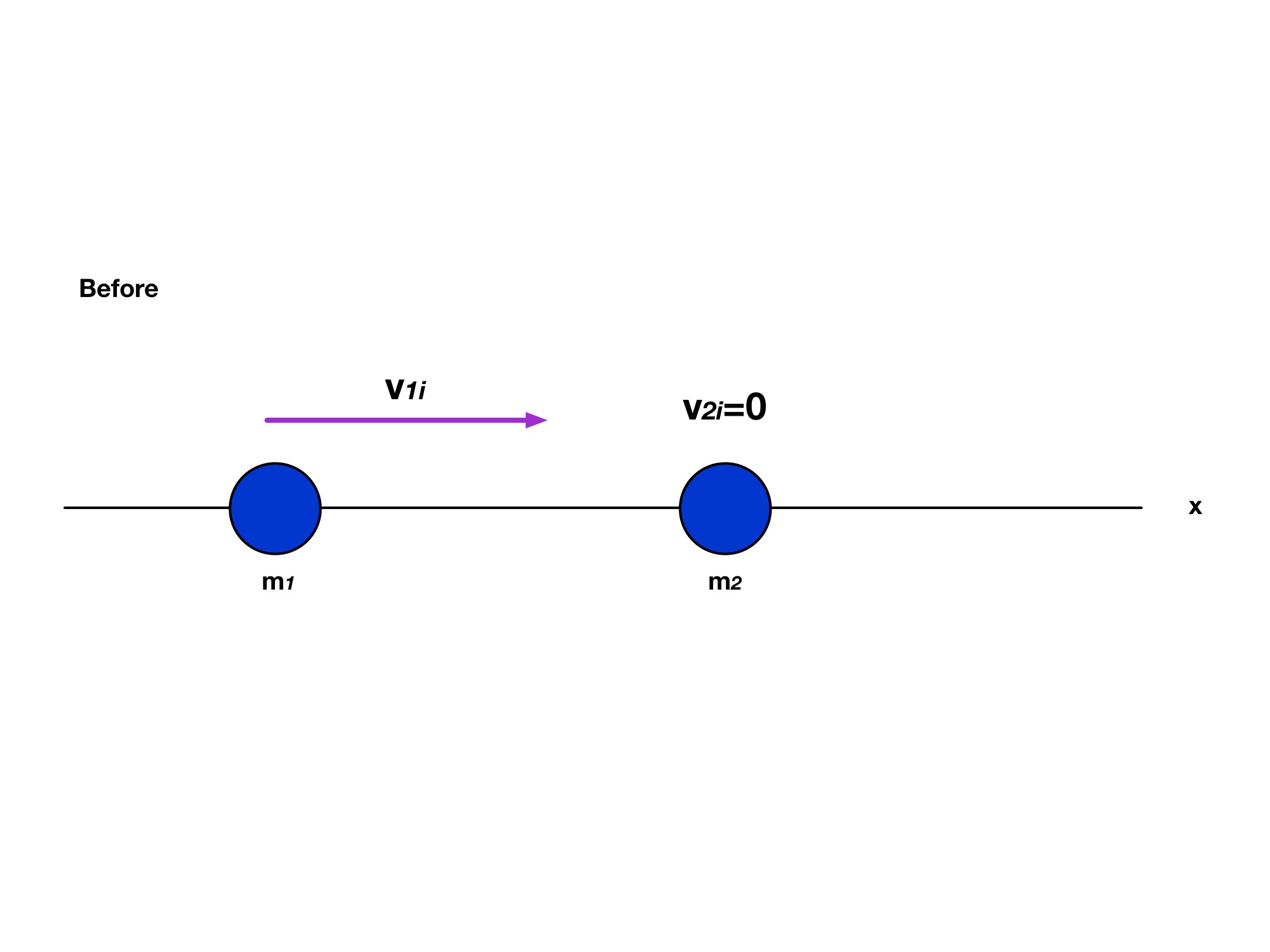
Target at rest with a particle with an incoming velocity.
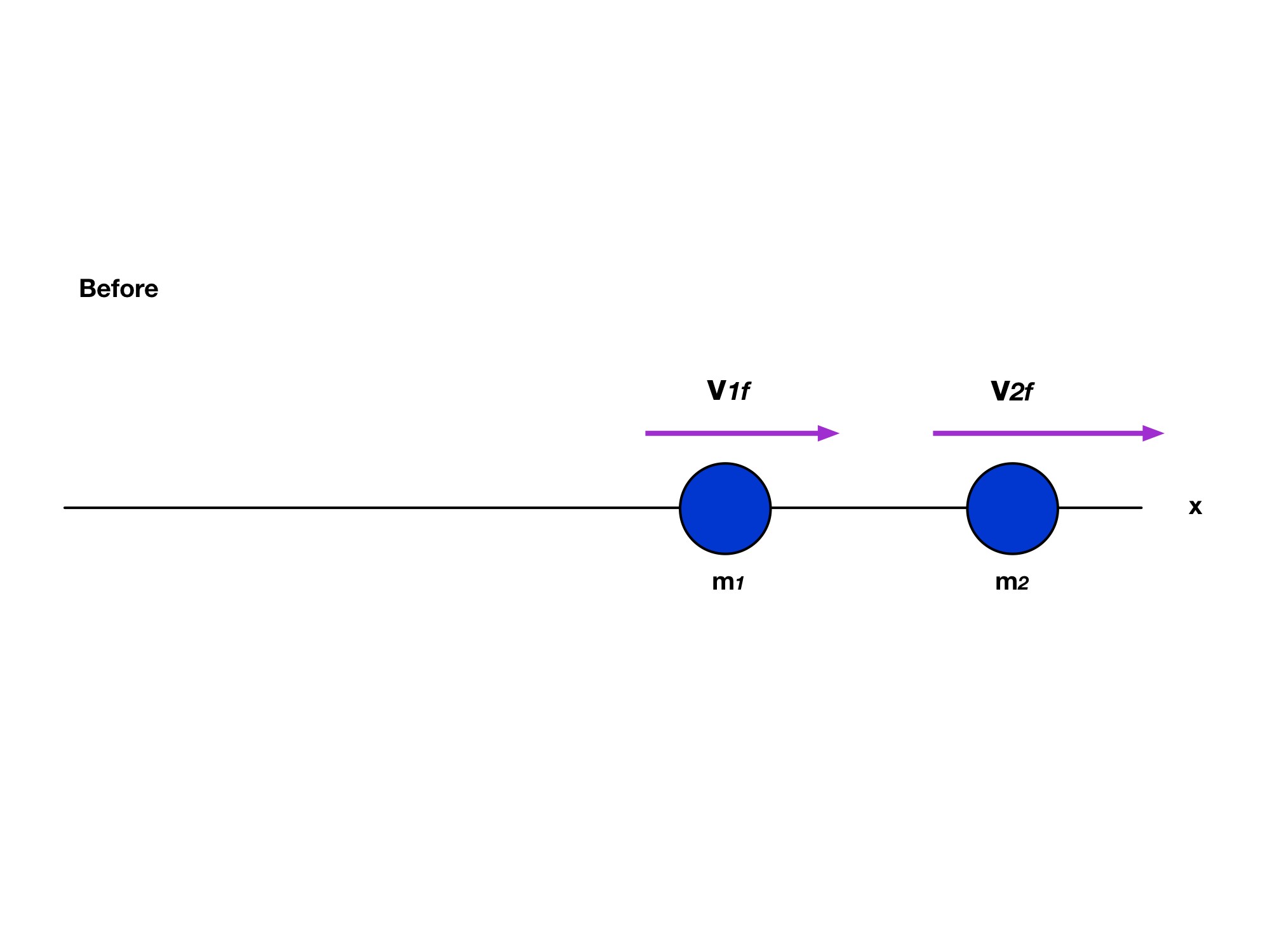
As we stated before, most collisions are inelastic but we can choose to approximate collisions to be elastic if we deem that the loss of energy is negligible. The most classic example is when you’re playing pool, or billiards. When the cue ball collides with another ball head on, we can assume that almost all the kinetic energy is transferred to the ball that was hit (although in reality, some energy was probably lost from the sound that was made, but again we choose to neglect that and assume elastic).
Keep in mind that this loss of energy can be to anything, be it kinetic, heat transfer, sound energy, etc.
We are assuming that this is a closed and isolated system so momentum is conserved, and since this is elastic, the two bodies lose no kinetic energy, so they do not stick. With this in mind, since the 2nd particle is initially at rest (), we can write the momentum equation as:
(Equation 4.3.1) And since it is elastic, the kinetic energy is conserved as well so we can write that conservation as:
(Equation 4.3.2)
These expressions below apply to a one-dimensional elastic collision with body 2 initially at rest. For an oblique collision, use momentum components and kinetic-energy conservation separately.
(Equation 4.3.3)
and
(Equation 4.3.4)
With these equations in mind, let’s take a look at some unique scenarios.
If this statement is true then the final velocity can be simplified to:
(Equation 4.3.5)
and
For a head-on elastic collision of equal masses with one initially at rest, the incoming object stops and the target takes its velocity. In an oblique elastic collision with equal masses, a stationary target, and negligible spin, the two nonzero outgoing velocity vectors are perpendicular. If the target was initially moving, that 90° result need not hold in the laboratory frame.
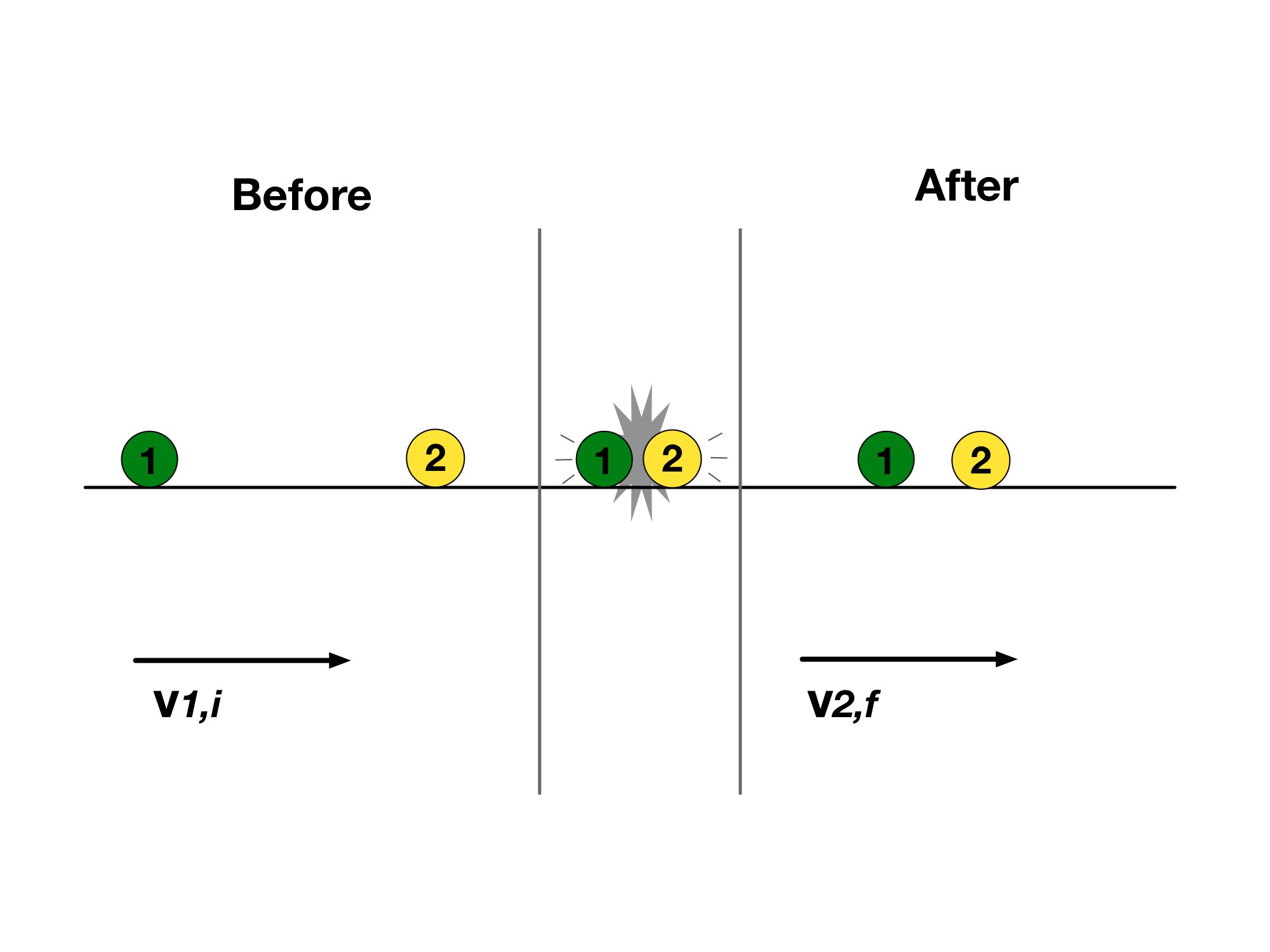
In a one-dimensional head-on elastic collision of equal masses with a stationary target, the incoming object stops and the target takes its original velocity.
Read every step and figure
Step 1
In a one-dimensional head-on elastic collision of equal masses with a stationary target, the incoming object stops and the target takes its original velocity.
Step 2
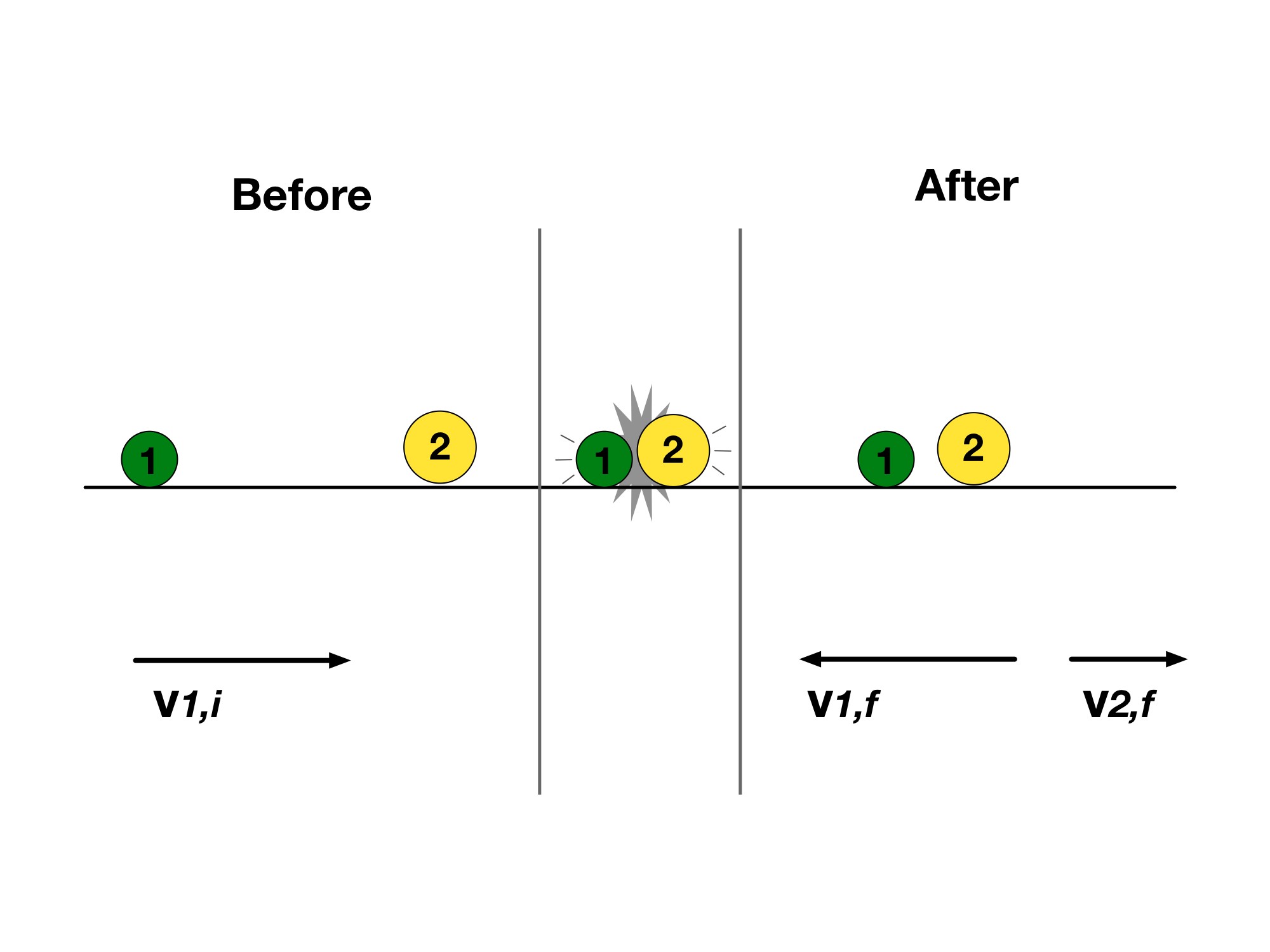
If a small object hits a second object, initially stationary, but with a much higher mass, then that first object will rebound with about its initial speed, just in the opposite direction.
Step 3
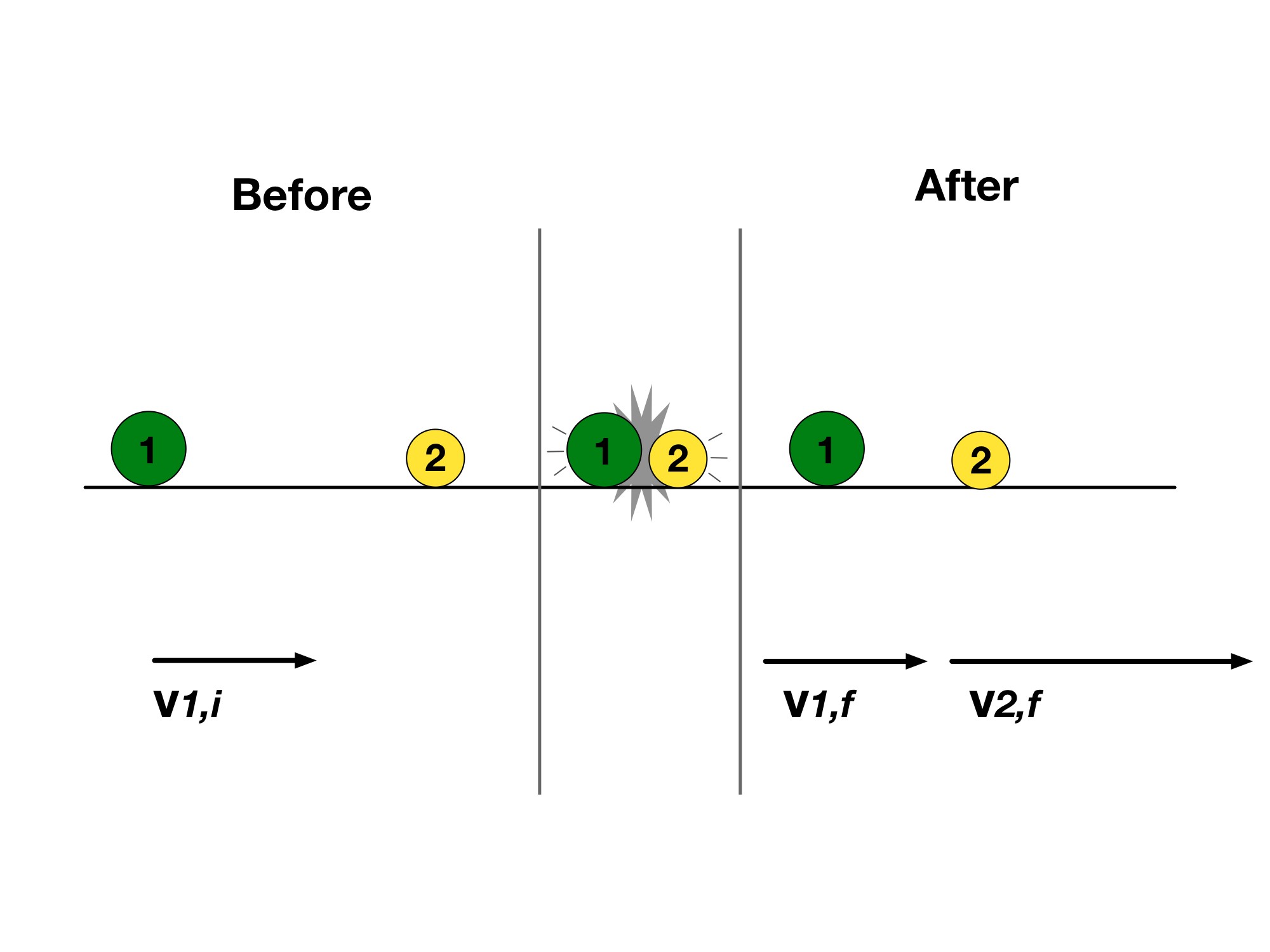
This states that the mass of the second object is much greater than the mass of the first. Meaning that we can basically neglect the first object’s mass. Rewriting our equations would result in:
(Equation 4.3.7)
and
(Equation 4.3.8)
An example can be seen if you throw a ping pong ball at a bowling ball. It just means that the ping pong ball will bounce back with the same velocity but in the opposite direction, while the bowling ball will still have some velocity, but with a very very small change.
Meaning that the mass of the projectile is much larger the the mass of the target, so we can assume that the target’s mass is very small, almost negligible (though it still has a mass). Rewriting the velocity equations gives:
(Equation 4.3.9)
and
Still using the ping pong and bowling ball example, only this time the bowling ball is being thrown. If the bowling ball were to hit the ping pong ball, then the equations above show that the bowling ball will lose just about zero velocity, while the ping pong ball gains twice the velocity! That is, of course, assuming the bowling ball doesn’t simply crush the ping-pong ball.
Key Point: These are very important situations to consider because when analyzing certain problems, it can simplify the problem if you can characterize it into one of these scenarios.
Example Problem 4.3.1
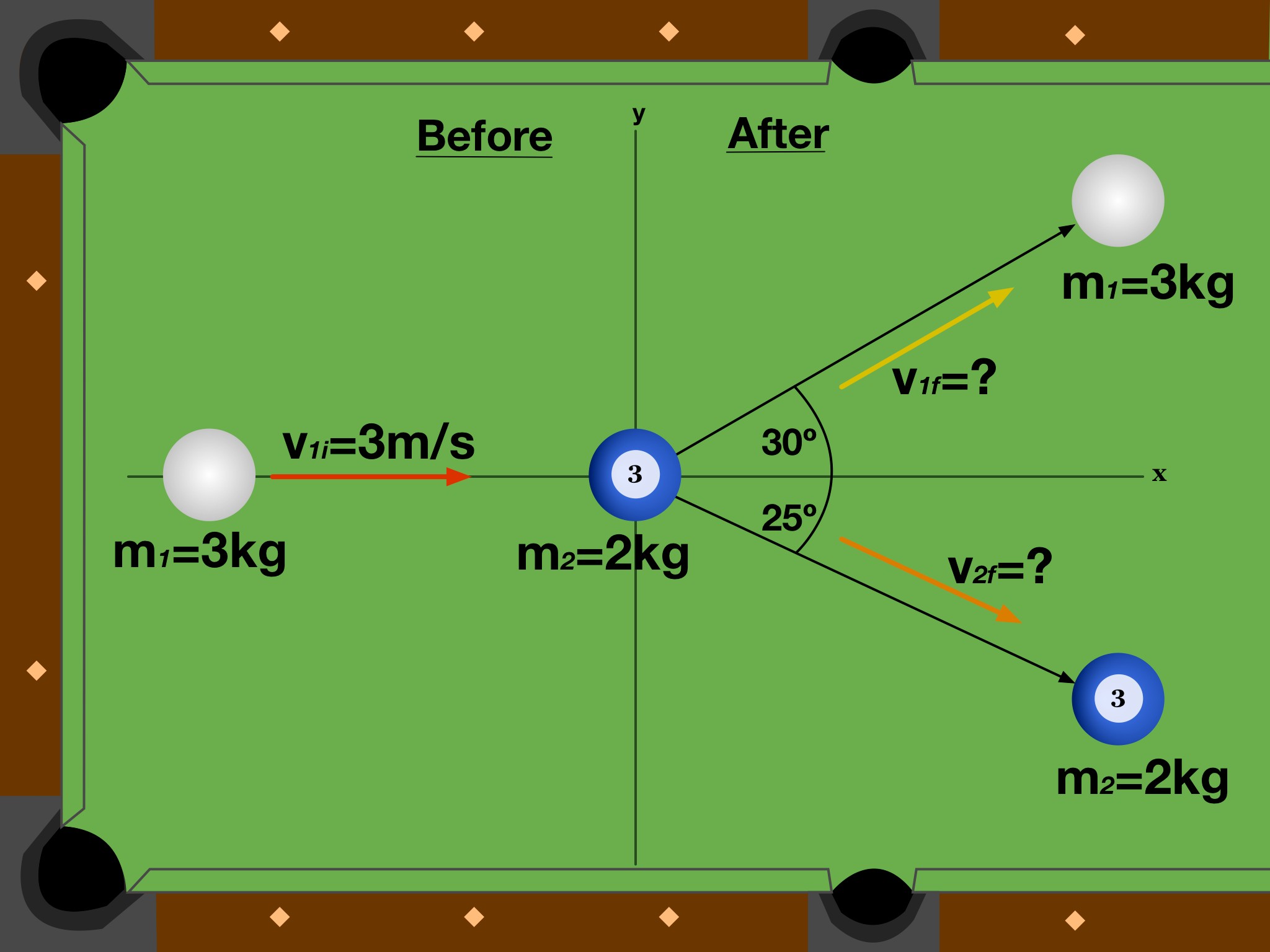
A 3 kg cue ball moving at 3 m/s along +x strikes a stationary 2 kg ball. After collision the cue ball moves 30° above +x and the target 25° below +x. Neglect external impulse. Find both outgoing velocities using momentum components, then check whether the stated data describe an elastic collision.
Step 1: Break this down into components
Since this is a collision problem, we are dealing with the law of conservation of linear momentum. Only difference is that there are x and y components since we have angles. We have to take these into account since there will be momentum conserved in the x-direction and momentum conserved in the y-direction. With that in mind, we can write the equation for the x-direction:
And knowing the conservation of momentum we can rewrite this for the momentum conserved in the x-direction with this equation (remember that we have angles so we have to take that into account):
Momentum is conserved in y-direction so the equation for that will be:
which can be rewritten as:
Notice here how there is a minus sign. This is to indicate that ball two is moving in the negative direction.
Step 2: Start eliminating variables
What I mean by this, is let’s try and see if we can simplify our equations. In the x-direction, as shown in Figure 4.3.1, the cue ball is moving along the x axis, while the 3 ball is said to be stationary. This means that the velocity of the 3 ball is zero.
Step 3: Start substituting to solve for final velocities
Now we can solve for the final velocities, but we need to do some algebra first. Solving for final velocity of the 3 ball gives us:
Plugging this in gives us:
m₁v₁i = v₁f[m₁cosθ₁ + m₁sinθ₁cosθ₂/sinθ₂].
Now solving for the final velocity of the cue ball gives us:
Step 4: Plug in all known values
From here we can plug in all the values, since they are all known.
Plugging this value in gives us:
So our final velocities are:
Cue ball: 1.548 m/s at +30°. Target: 2.747 m/s at −25°. The initial kinetic energy is 13.50 J and final kinetic energy 11.14 J, a decrease of 2.36 J. Thus the source’s angles and masses describe an inelastic collision, not an elastic one.
Example Problem 4.3.1 Given Image
Pop Quiz 4.3.1: Elastic Collisions
Question 1 of 5 · 0 correct
AP Topic 4.3 · Read the worked solution
For two particles with negligible net external impulse, which expression writes the final total momentum directly in terms of their final velocities?
Read every full question without answers
Question 1
Question 2
Question 3
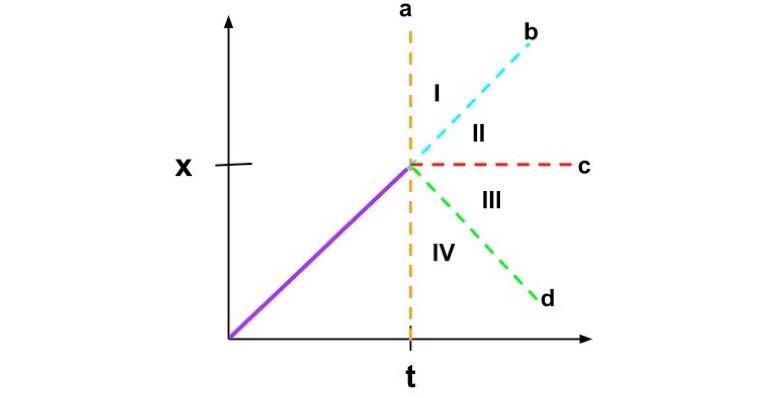
Ball A moving in +x undergoes a one-dimensional elastic collision with initially stationary ball B. In the position–time diagram, line b continues the original velocity and line d has its negative. Which section or line describes A after collision when m_A > m_B?
Question 4
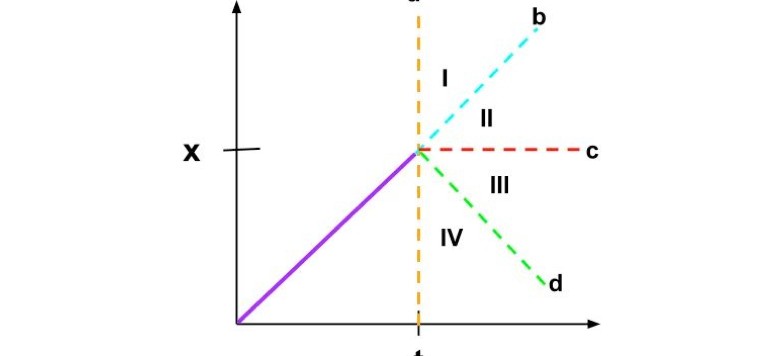
Ball A moving in +x undergoes a one-dimensional elastic collision with initially stationary ball B. In the position–time diagram, line b continues the original velocity and line d has its negative. Which section or line describes A after collision when m_A = m_B?
Question 5
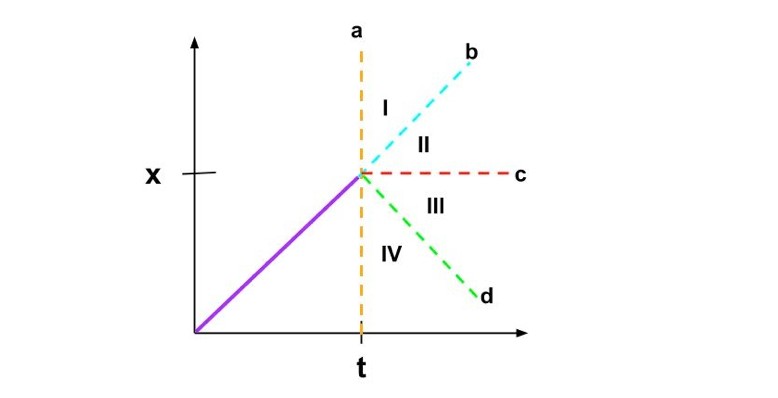
Ball A moving in +x undergoes a one-dimensional elastic collision with initially stationary ball B. In the position–time diagram, line b continues the original velocity and line d has its negative. Which section or line describes A after collision when 0 < m_A < m_B?


Reviewed physics notes (18)
These corrections keep the original lesson’s purpose while fixing errors in the source edition.
- 1D formulas were described with general vector notation. — Reference 1, Reference 2
- The source overgeneralizes the equal-mass and 90° cases. — Reference 1, Reference 2
- Given masses and angles lead to a decrease in kinetic energy, contradicting the original “elastic” label. — Reference 1, Reference 2
- The printed substitution incorrectly places cosθ₂ outside the whole bracket. — Reference 1
- Add necessary consistency check instead of silently violating elastic energy conservation. — Reference 1, Reference 2
- Correct duplicate interactive-image elasticity claims. — Reference 1, Reference 2
- Missing stationary-target and 1D conditions. — Reference 1
- Existing question has two mathematically true alternatives and should select one unambiguously. — Reference 1
- Existing key requires a stationary target and head-on geometry. — Reference 1
- State initial target rest; positive slower slope is regionII, zero slope is linec, and negative slower-magnitude slope is regionIII. — Reference 1
- For 0<m_A<m_B, slope is negative with magnitude smaller than the incident slope; this is regionIII. — Reference 1
- The revised prompt specifically asks for final velocities; the initial-velocity expression is equivalent under conservation but is not the requested expression. — Reference 1
- A more massive projectile slows but continues forward, so regionI (faster than before) is excluded. — Reference 1
- v_Af/v_Ai=(m_A−m_B)/(m_A+m_B) lies strictly between 0 and 1. — Reference 1
- Equal masses with stationary target give v_Af=0, which is horizontal linec. — Reference 1
- The shown linec represents rest. — Reference 1
- Correct graph region. — Reference 1
- RegionIII is available after correction; none-of-above is false. — Reference 1
Glossary and deeper reading · 8 refreshers
These editorial refreshers supplement the reading. Definitions and examples are added guidance; original source wording and recorded answers remain in their original context.
-
Kinetic energy
Kinetic energy is energy associated with motion relative to a chosen reference frame. For a nonrelativistic translating object it is one half of its mass times speed squared. For example, doubling a cart’s speed quadruples its translational kinetic energy when its mass stays fixed.
-
Heat
Heat is energy transferred between systems because of a temperature difference. It describes a transfer rather than a substance or energy store contained in an object. For example, when a warmer mug transfers energy to a cooler hand, the mug loses internal energy and the hand gains it.
-
Isolated system
An isolated system exchanges neither energy nor matter with its surroundings. In a momentum problem, conservation of total momentum specifically requires zero net external impulse over the interval analyzed. For example, two colliding carts can be treated as momentum-isolated horizontally when the external horizontal impulse is negligible.
-
Linear momentum
Linear momentum is a vector describing an object’s motion and equals mass times velocity in the nonrelativistic model. The vector sum of momenta is conserved when the net external impulse on the system is zero. For example, two identical carts moving equally fast in opposite directions have zero total linear momentum but nonzero total kinetic energy.
-
Conservation of energy
Conservation of energy means total energy is unchanged when the full isolated system is considered. Energy can transfer between objects or change form, so one selected energy store need not remain constant. For example, friction can reduce a sliding block’s kinetic energy while increasing the thermal energy of the block and floor.
-
Velocity
Velocity describes how position changes with time and includes direction. Instantaneous velocity describes one moment, while average velocity is displacement divided by elapsed time. For example, a car turning a corner can change velocity while maintaining the same speed.
-
Vector
A vector is a quantity with a magnitude and a direction, represented by an arrow or by components along chosen axes. Vectors add by adding corresponding components rather than simply adding their magnitudes. For example, an eastward displacement followed by a northward displacement produces a resultant pointing northeast. The zero vector has zero magnitude and no unique direction.
-
Projectile motion
Projectile motion describes an object after launch when gravity is the only significant force in the chosen model. Near Earth, horizontal and vertical motion can be analyzed separately using the same time interval and approximately constant downward acceleration. For example, a ball rolling off a table continues horizontally while its downward velocity increases.