Angular Forces
Original textbook reading.
We know what happens to a body when a force is induced on it, but what if that body is attached to a point that it rotates around?
The simplest form of this scenario is probably a door. When you open a door, after turning the knob, you push on the door. That forward force causes the door to rotate.
Due to this situation, the door exhibits a rotation due to a straight force. The reason this rotation develops is because the force induces a moment or torque on the door.
A force produces torque about a reference point or axis according to its line of action and lever arm. Torque is a moment of force, with units N·m; it is a different physical quantity from force.
In this case, the refers to the position vector of the force in terms of the point of rotation. That is, how far away the force is being applied from where the object is rotating around. Gallery 6.3.1 shows a great example of this.
It is useful to realize that because the moment is the result of a cross product, the formula can be re-written as:
A force parallel or antiparallel to its position vector produces zero torque about the chosen origin. That force cannot change angular momentum about that origin, though the body may already be rotating.
Using our same example of the door, imagine an open door. If you push on the edge of the door, pushing towards the hinge, the door won’t rotate.
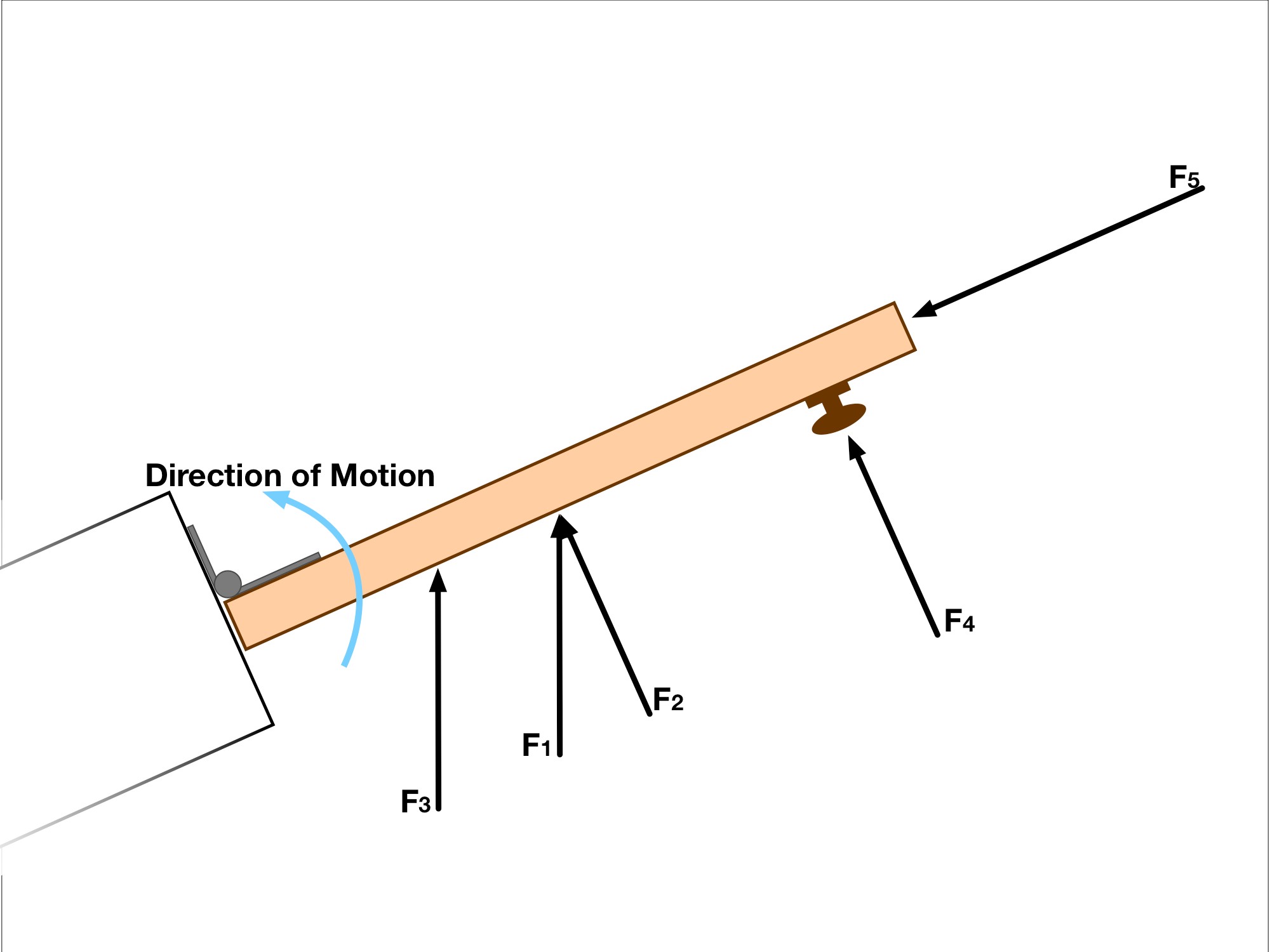
Now, the other big factor in working with moments is the magnitude of the moment. A moment’s magnitude is determined by both the force applied and the distance at which it is applied. To make sense of this, we can again return to our door. When you try to move the door, is it easier to push on the door near the doorknob or the hinge? Of course, it is near the doorknob. This is because the doorknob is further away from the point of rotation, and therefore it magnifies the moment the force induces.
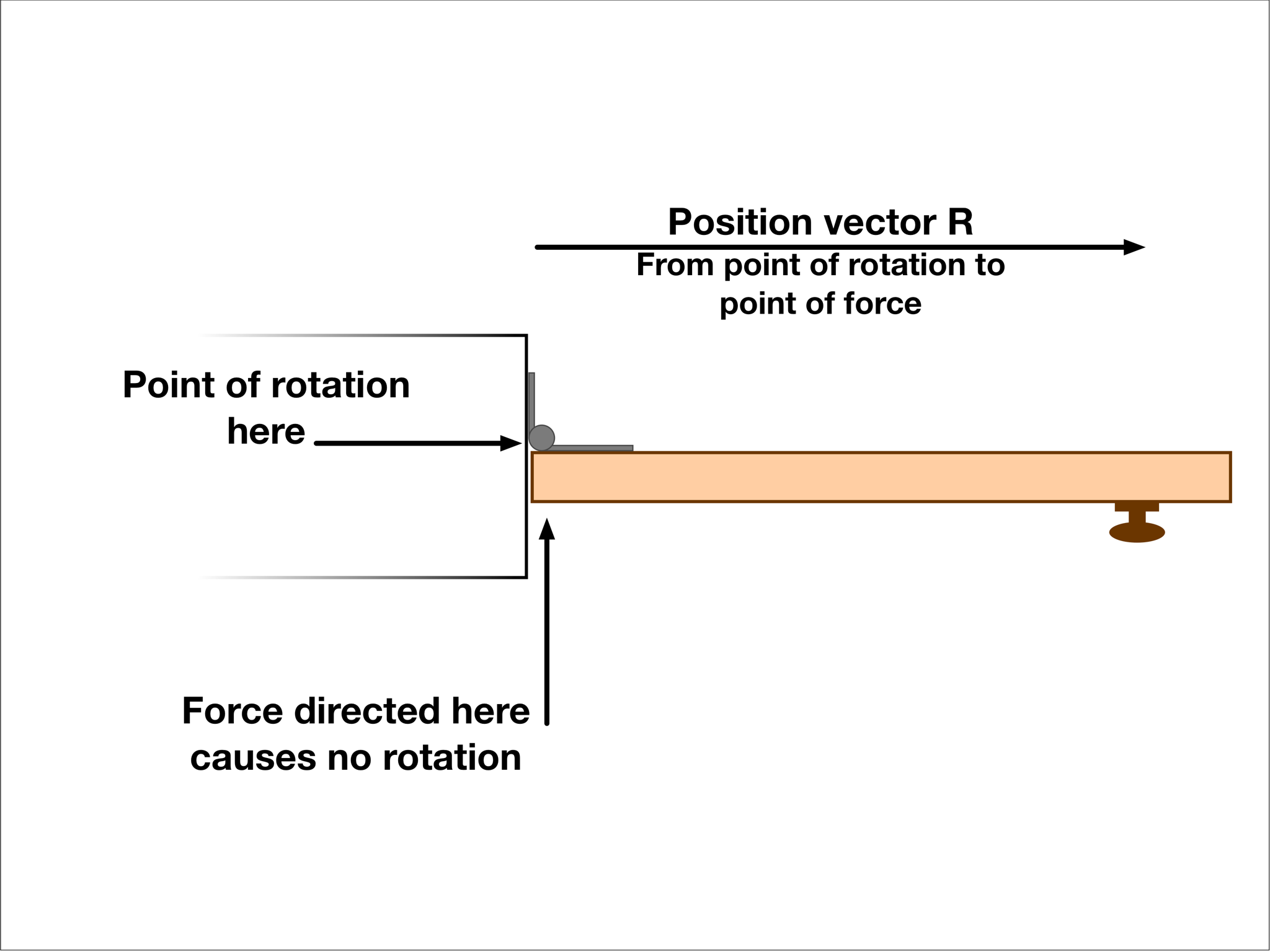
Here is you try pushing on the hinge which is the point of rotation, the door won’t move, but pushing at the knob will cause it to rotate.
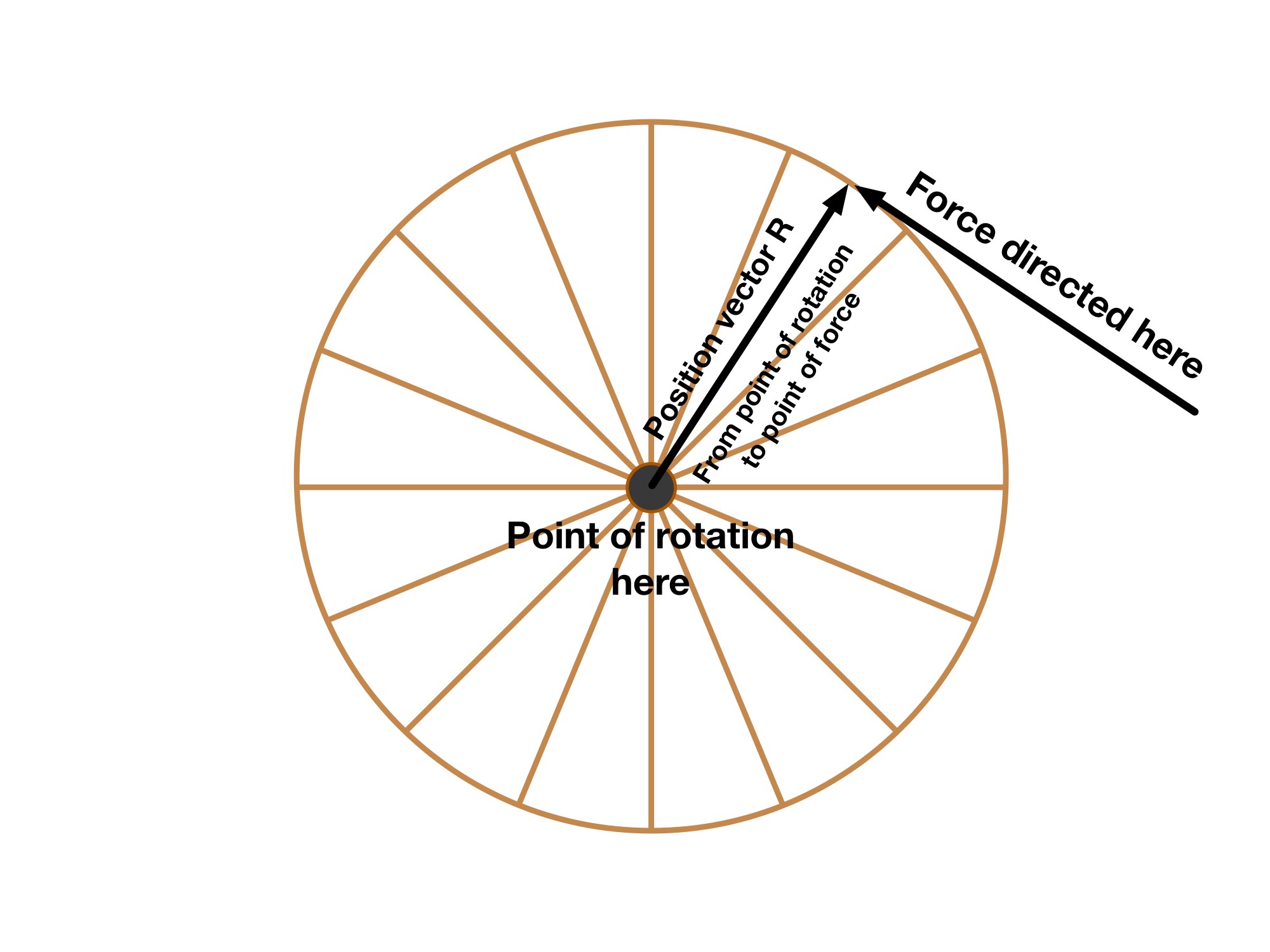
Figure 6.3.1 Torque/Moment Generation
Torque and moment of force refer to the same quantity. SI torque units are N·m; imperial values are commonly given in lbf·ft. A value in kg·m alone is not a force moment; kgf·m is a distinct force-based unit.
Generally, torque is thought of as the body being rotated directly by some moment, instead of a force inducing a moment.
For example, if you had a car wheel on an axle, the axle would exert a torque that would cause the wheel to rotate. If instead you had a force applied to the wheel that caused it to rotate (i.e. if you spun it yourself by pulling on the outside of the wheel) that would be a moment induced on the wheel that caused it to spin. The two are actually the same, and it is up to you to determine what you want to call it (or your professor if they decide either one is preferable). For the remainder of this section, we will refer to the idea as torque.
Given the set of forces below that all act on the bicycle wheel, what torque is generated to cause the bike wheel to spin ?
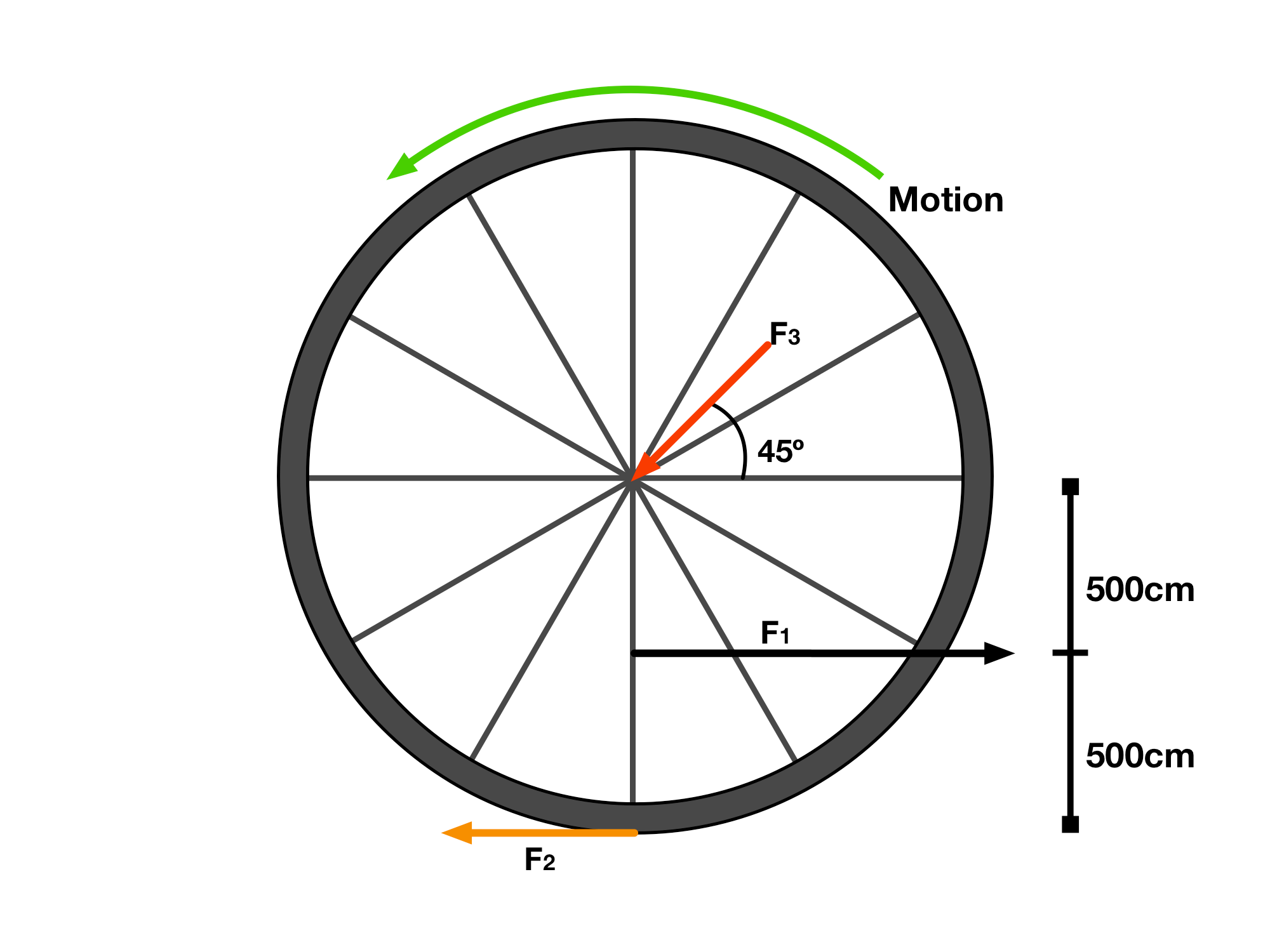
Three forces are acting on the wheel, what is the torque generated?
Step 1. Created a FBD
As we pretty much have one already, we just need to isolate the wheel from the rest of the bike.
Given this, we have 3 forces in question.
Step 2. Determine the torques generated by each force individually
We see that the force at the center of the wheel has no torque, as it’s line-of-action (the direction it acts in) goes through the center of the wheel. This leaves us with two forces to calculate. All forces are acting horizontally, so if we find their distances vertically, we have a component of . This makes the values:
Step 3. Combine the torques.
Now this is the tricky part, as we can’t just say that left is positive and right is negative. As these are moments, we need to determine their sign as a result of the induced rotation. It is by convention that we declare counter-clockwise rotation to be a positive torque, and clockwise rotation to be a negative torque. This makes the signs of the torques:
Therefore, the total torque on the bike wheel is given as:
For planar rotation about a fixed axis with constant moment of inertia, the signed net torque satisfies τ_net = Iα. In general, torque is the rate of change of angular momentum about a fixed inertial origin.
Angular acceleration α is the rate of change of angular velocity and is measured in rad/s². At perpendicular distance r from a fixed axis, the tangential-acceleration magnitude is a_t = αr.
This is the tangential acceleration only. A rotating point also has inward centripetal acceleration a_c = ω²r. The tangential-speed magnitude is v_t = ωr.
That odd w is the Greek letter omega, and that is the symbol used for angular velocity.
A fixed-axis wheel of diameter 0.50 m and moment of inertia 50 kg·m² starts from rest under a constant net torque of 500 N·m for 10 s. Find its angular speed and rim speed. Separately, if a tangential resisting force of 50 N acts at the rim, what driving torque maintains constant speed?
Step 1. Calculate the angular acceleration of the wheel.
For this problem, we are given a value of torque and a moment of inertia.
Therefore, by the following equation, we can solve for angular acceleration:
Step 2. Find the velocity
Rotational constant-acceleration kinematics use angular displacement θ, angular velocity ω and angular acceleration α in place of linear displacement x, velocity v and acceleration a.
Pop Quiz 6.3.1 Angular Forces and Moments
Question 1 of 5 · 0 correct
AP Topic 5.6 · Read the worked solution
A uniform solid disk wheel of mass 35.5 kg and diameter 0.75 m starts from rest and rolls without slipping 10 m in 10 s on level ground. A constant driving torque acts at its axle; rolling resistance is negligible. What driving torque is required?
Read every full question without answers
Question 1
Question 2
Question 3
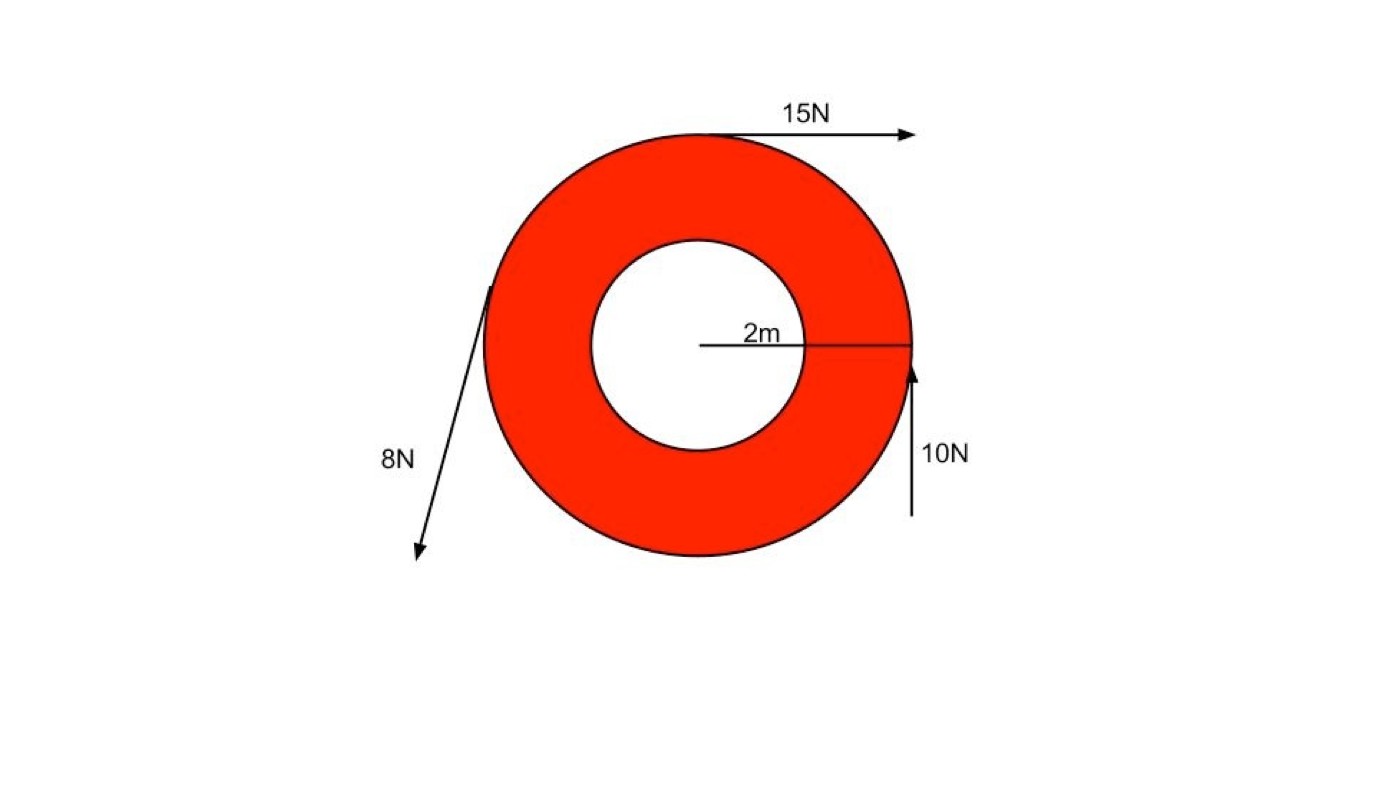
What torque is generated in the following set-up? Positive torque results in a Counter-Clockwise acceleration.
Question 4
Question 5


Reviewed physics notes (14)
These corrections keep the original lesson’s purpose while fixing errors in the source edition.
- Calling torque a rotational force conflates quantities with different dimensions. — Reference 1
- Zero applied torque does not imply zero angular motion. — Reference 1
- Correct the source dimensional unit claim. — Reference 1
- Moments are not polar forces, and τ = Iα needs fixed-axis assumptions. — Reference 1
- The source describes units as revolutions and calls αr the entire acceleration. — Reference 1
- Angular acceleration and tangential acceleration are perpendicular vectors, not related by a scalar-vector product in one direction. — Reference 1
- Correct the source statement that αr is normal acceleration. — Reference 1
- Angular and tangential velocities do not have the same vector direction. — Reference 1
- m⁴ is an area moment of inertia unit, not a mass moment of inertia unit; rest and net-torque assumptions are needed. — Reference 1
- The source incorrectly substitutes radius r for angular displacement and repeats acceleration symbol a. — Reference 1
- Specify mass distribution, constant acceleration, rolling constraint and driving torque. — Reference 1
- a = 2s/t² = 0.20 m/s²; τ_drive = (I + mR²)a/R = (3/2)mRa = 3.99375 N·m. — Reference 1
- A lever length alone does not fix torque without a force angle. — Reference 1
- The correct 14 m/s key assumes I = ½mR² and constant net torque. — Reference 1
Glossary and deeper reading · 6 refreshers
These editorial refreshers supplement the reading. Definitions and examples are added guidance; original source wording and recorded answers remain in their original context.
-
Lever arm
A lever arm is the perpendicular distance from a chosen rotation axis to a force’s line of action. It determines the torque magnitude for a given force and need not equal the distance to the point of application. For example, a force aimed directly toward a hinge has zero lever arm and produces no torque about that hinge.
-
Vector
A vector is a quantity with a magnitude and a direction, represented by an arrow or by components along chosen axes. Vectors add by adding corresponding components rather than simply adding their magnitudes. For example, an eastward displacement followed by a northward displacement produces a resultant pointing northeast. The zero vector has zero magnitude and no unique direction.
-
Force
A force describes an interaction that can change an object’s momentum. It is a vector measured in newtons, so both size and direction matter when forces are added. For example, a rope can pull a cart while the floor exerts friction in another direction.
-
Cross product
A cross product combines two vectors to form a vector perpendicular to both. Its magnitude depends on both magnitudes and the sine of their included angle, while reversing input order reverses its direction. For example, a force whose line of action passes through the pivot gives zero torque cross product about that pivot.
-
Angular momentum
Angular momentum describes motion about a specified point or axis. For rigid rotation about a fixed principal axis it can be written as rotational inertia times angular velocity; a translating particle can also have angular momentum about a point. For example, a ball moving past a pole has angular momentum about the pole even though the ball’s path is straight.
-
Magnitude
Magnitude is the nonnegative size of a vector quantity. It does not specify direction, and it differs from a signed component. For example, a westward velocity can have a negative x component while its speed, the velocity magnitude, stays positive.