FFR - Power
Original textbook reading.
Knowing the basic energy conversion from kinetic to potential is a nice way of working with energy, and useful in predicting many qualities for various problems in a theoretical sense, but in the real world, we don’t have perfect conversion between the two.
For a block sliding against a stationary surface, kinetic friction opposes the relative sliding and does negative work on the block. Mechanical energy can become internal thermal energy in the block and surface. Friction need not always do negative work on every possible system; a moving belt can accelerate an object through friction.
When friction takes energy out of an object, it typically is removed in the form of heat. That is, when an object loses energy due to friction, it generates heat. You have probably used this concept already without realizing it. On cold days, you might have rubbed your palms together to get warm. What you are actually doing is converting the kinetic energy of your hands moving into heat energy, which comes from friction between your palms.
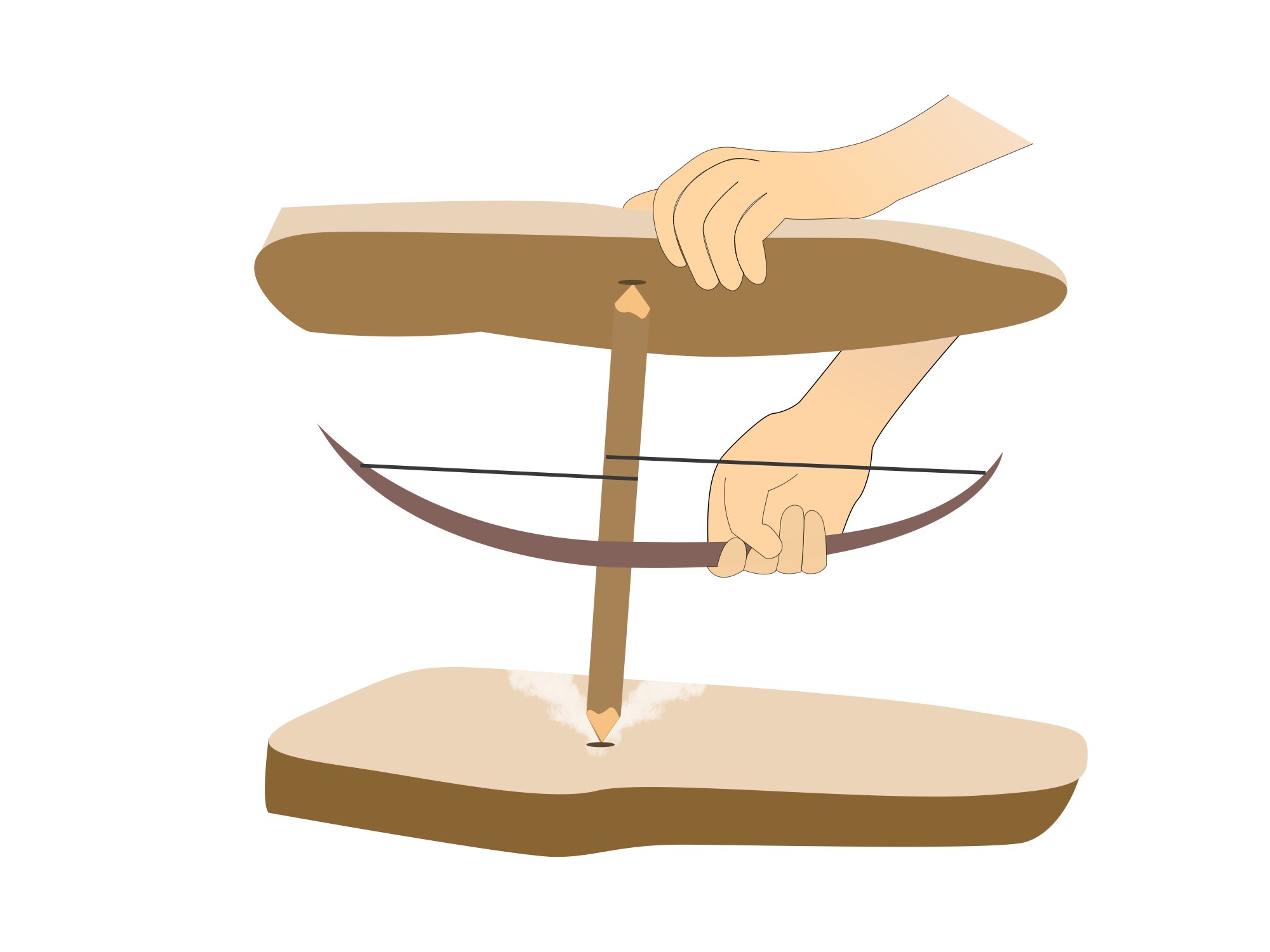
When starting a fire by using a bow and a stick, you impose so much friction that the heat generated starts to set the wood on fire.
Now, for the quantitative issue of heat loss, there are a couple different ways. As we say that heat loss comes from frictional forces, we can calculate the work done by those forces as:
For sliding against stationary surfaces, define HL≥0 as the mechanical energy converted to internal thermal energy. With constant friction magnitudes on each segment, HL=Σf_k,iℓ_i (Equation 5.4.1), while signed friction work is W_friction=−HL. The symbol Σ means sum. For the following kinetic-energy sum:
If we expand this for our example, we get:
This approach is the more robust definition of heat loss, as it can be used to calculate the loss due to heat if you can simply calculate the frictional forces involved. If you aren’t given that capability, instead you will either calculate heat loss as an energy loss, , or you will be given the value in the problem.
Now, what that equation gives us is simply a measurement of the sum of energy lost to friction. We still need to incorporate that into the energy balance that we know. This is done by introducing it on one side. As it is lost from the object as it moves from its initial to its final position, we can either subtract it from the initial state’s energy, or add it to the second states energy, as another component that must receive energy. This makes the equation:
Or
Whichever you want to use is fine, they both work just as well.
If a ball dropped from hits the ground and bounces up , determine how much energy was lost to heat, assuming that was the only source of energy loss in the situation.
Step 1 Pick a datum.
As the two states, are the initial position and the peak of the first bounce, we will pick the datum as the peak of the second bounce. This makes .
Step 2 Solve the energy balance
As we have no springs, the energy balance is:
We have no initial kinetic energy, nor final, as both points are stationary. We can also eliminate . as that is at the datum.
That was a simple problem, but now we will try and solve a more complicated problem, by solving for heat loss through a given frictional force.
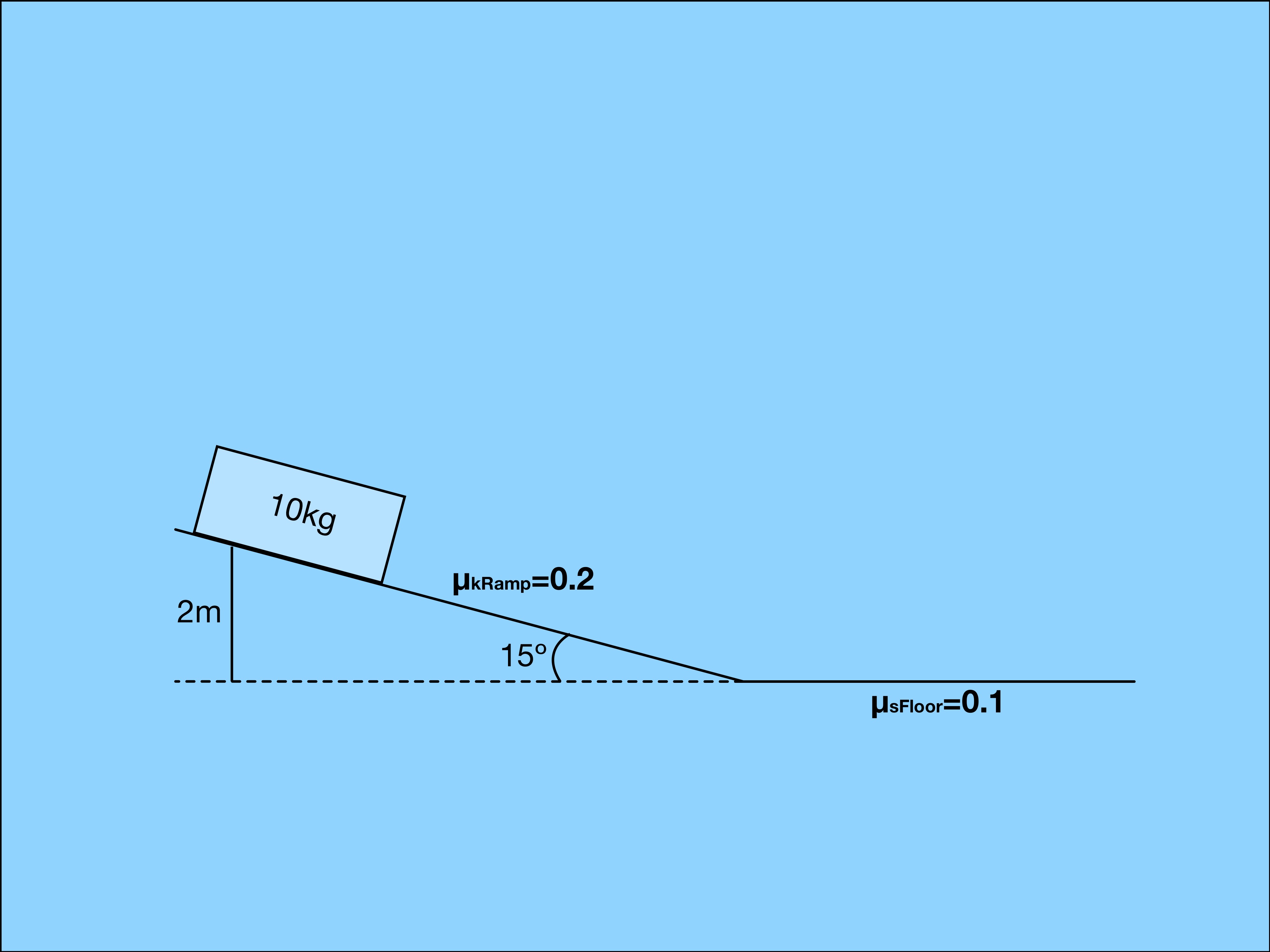
If a box is pushed down a ramp, giving it a velocity of down the ramp at the position shown in the picture, how far will the box slide past the end of the ramp? The box has a mass of , and the coefficient of friction between the box and the ramp is . The coefficient of friction between the box and the floor is .
Example Problem 5.4.2
Step 3: Determine the frictional force along the floor
Along the floor, the normal force is calculated the same way, except here the , making the normal force equal the gravitational force. This makes friction:
Step 4: Determine the length the box slides
Here we have an initial state of the box leaving the ramp with some total energy, and the second state of the box without any more energy, being stationary.
As the height does not change, .
At the end of the problem, the box has stopped. Therefore .
As there is no potential energy change, we can assume that all the energy left over at the end of the ramp is present in the kinetic energy here:
HL_floor=174.753 J.
And we know that this heat loss is from the work due to friction:
174.753 J=(9.81 N)d.
d=17.814 m≈17.8 m.
Step 1 Determine the friction force along the ramp
The normal force of the box derives from the gravitational force, and is found by the formula:
This makes the frictional force:
Step 2: Determine the energy of the box at the base of the ramp
At the shown height h=2 m on a 15° slope, ramp distance ℓ=2/sin 15°=7.7274 m. Base kinetic energy is K_base=½(10)(5²)+(10)(9.81)(2)−[0.2(10)(9.81)cos 15°]ℓ=174.753 J.
Now wasn’t that a very complicated problem? Heat loss introduces a whole new way of using energy balances to solve problems.
But wait. What if there are other forces involved besides friction? What if we have forces that add to the objects energy, instead of removing it? Again, we have to look at the work the forces do on the object between the states in question. In general, our new equation will be:
(Equation 5.4.3)
Include each energy transfer exactly once. HereHL denotes mechanical energy converted by friction; W_lost denotes any other outward work transfer. For a general balance one may instead combine them into a single signed nonconservative-work term.
A 5 kg flag is raised vertically 10 m at constant speed with negligible friction. Find the upward force and the work done by that force.
Step 1: Determine the datum
This problem is a very simple one, we can simply choose our datum to be the ground. This makes the and .
Step 2: Set up the energy equation
We can go ahead and eliminate , as the flag has the same speed in both states. Its initial and final kinetic energies are equal, so they cancel. We can also eliminate the , as friction is neglected. , due to it being level with the datum. The comes from the force added, so we need that. There is no force resisting the flag’s motion, except gravity, which is accounted for in the . so is eliminated.
As you’ve been dealing with energy, you might be a bit confused on one aspect. The energy that you most commonly deal with, electrical energy is distributed in kWh, or kilowatt-hours. You might be wondering where the time factor comes into play. If you haven’t questioned that yet, well, now you have.
One kilowatt hour is the energy given off by a force providing one kilowatt of power for one hour. It actually converts to joules:
This idea of power might be unfamiliar to you, but it actually relates directly to energy, if you haven’t gathered as such already.
Formally, power is the rate at which work changes over time. As you have already seen, work directly relates to energy, so you can also think of power as how fast energy is added or removed from a system. Take note that I said “added or removed.” Although energy is never created or destroyed, it can move from system to system. The system is simply an arbitrary judgment that we make when we set up a problem. For example, if we wanted to look at the energy change of a ball rolling down a hill, that ball is our system. Energy can be added to the ball from outside the system, by either a wind blowing, or a person rolling the ball. That doesn’t mean that the energy is created, it is simply moved into the system.
In equation form, power is written as:
(Equation 5.4.4)
The unit of power is the Watt, which is .
A 5 kg box is pulled at constant speed 10 m up a 20° ramp in 1 minute. The pull is parallel to the ramp; kinetic friction coefficient is 0.3. Find the average pulling power.
Step 1: Figure out the heat loss due to friction
The normal force in this case will be . This makes the frictional force .
As the box moves 10m along the ramp, we can find the heat loss by determining the work done by friction.
H_L = −W_friction = fₖℓ = (13.8 N)(10 m) = 138 J.
Notice the sign: friction points against the motion, so its work is negative. The mechanical energy transferred to thermal energy is positive.
Step 2: Set up the energy equation
Assuming the box is moving at a constant speed, the kinetic energies cancel. If we choose our datum to be at the initial position of the box, that makes :
.
This gives us:
Step 3: Determine the power needed.
As work that is added to move from the initial to final state, we just need to divide by time it took to reach the final state:
Pop Quiz 5.4.1 Power
Question 1 of 5 · 0 correct
AP Topic 3.5 · Read the worked solution
A elevator is lifted in at a constant speed. How much power does the lifting mechanism exert on the elevator?
Read every full question without answers
Question 1
Question 2
Question 3
Question 4
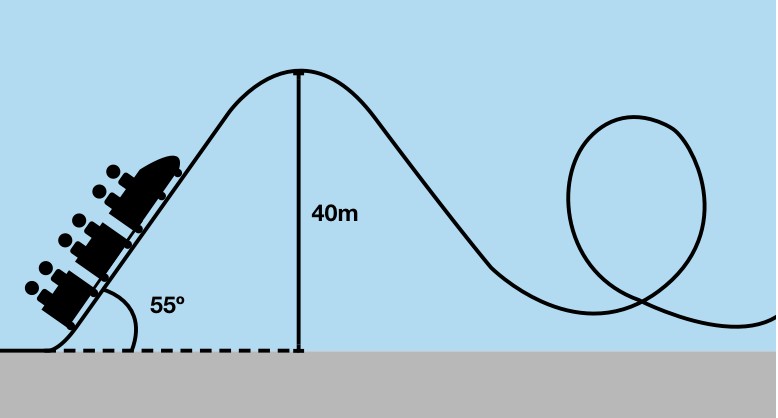
A roller coaster can ascend this high hill, with a slope in min at a constant speed. Neglecting friction, how much power does the lifting chain exert on the train?
Question 5
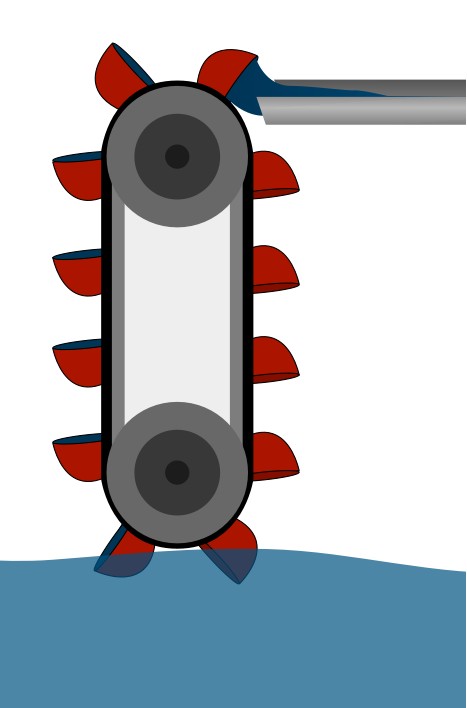
The pictured water lifter has five rising buckets, each containing 5 kg of water, all moving vertically at 1 m/s. Neglect empty-bucket mass, friction, and speed changes. Find the mechanical power required.
K_f=K_i+W_net. For a constant net force, ½m(v_f²−v_i²)=F_net·Δr; for a varying force use ∫F_net·dr.
U_g=mgh for signed height above a fixed datum. U_s=½kx² for deformation from the unloaded spring length. With only conservative forces doing work, K_i+U_g,i+U_s,i=K_f+U_g,f+U_s,f.
For friction magnitudef_k,i acting over pathlengthℓ_i, HL=Σf_k,iℓ_i≥0. Mechanical energy balance:K_i+U_i+W_added=K_f+U_f+HL +W_lost, counting each transfer once. Average powerP_avg=W/Δt.
Original problem 1
AP-017: Keep both charges stationary so this option illustrates configuration energy without an ambiguous kinetic-energy increase. Electric potential energy may be negative relative to infinite separation.
Problem text
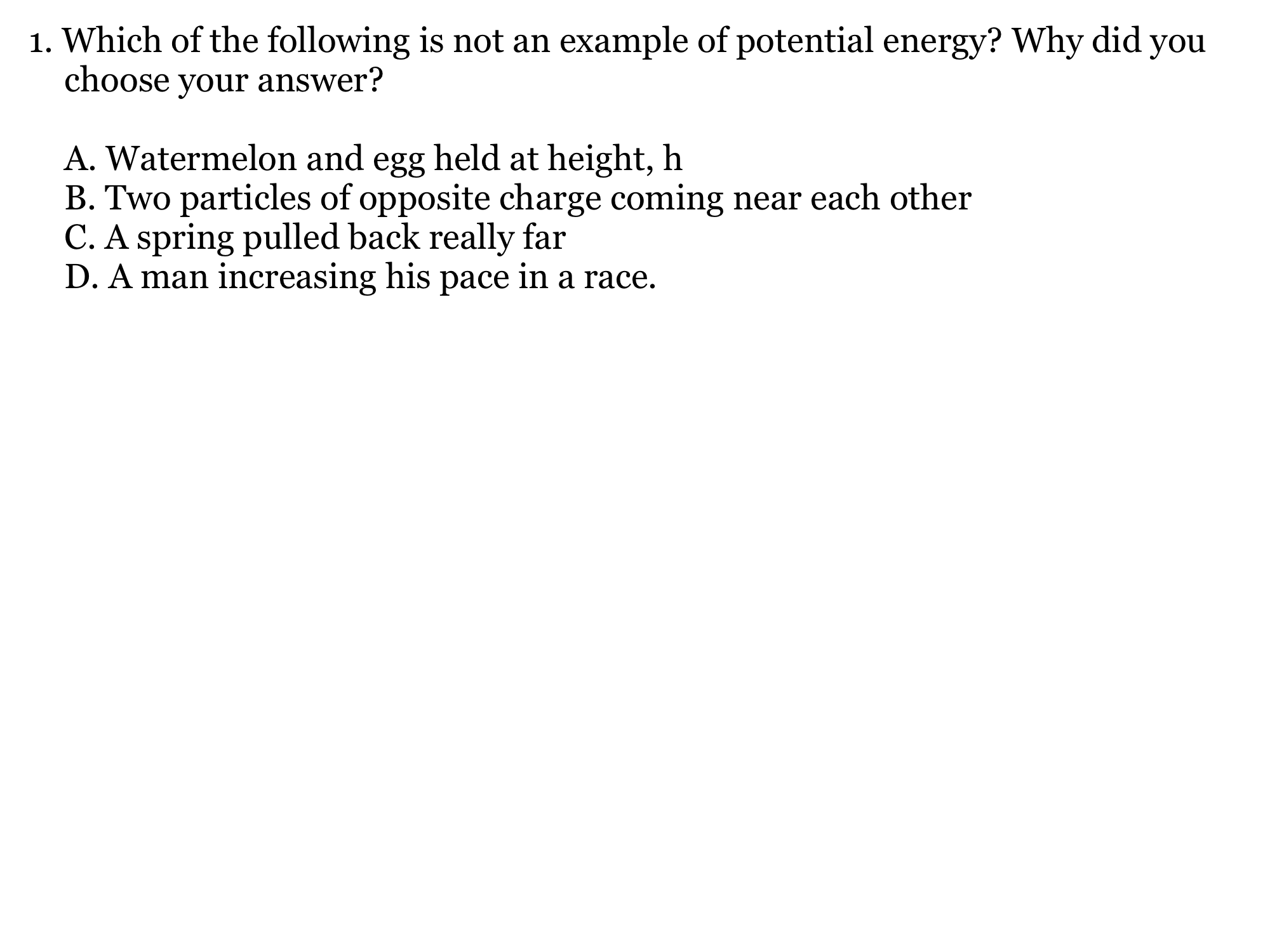
Which describes a kinetic-energy increase rather than a potential-energy example? A. A watermelon and egg held at height h. B. Two opposite charges held stationary at a fixed separation. C. A stretched spring. D. A runner increasing speed. Explain.
Drawing is temporarily unavailable. Work on paper if needed, then record your reasoning here.
Saving written working requires JavaScript. The problem remains available above; keep your work on paper or in your own notes.
Original problem 2
The result assumes negligible friction, air resistance, and rotational kinetic energy.
Problem text
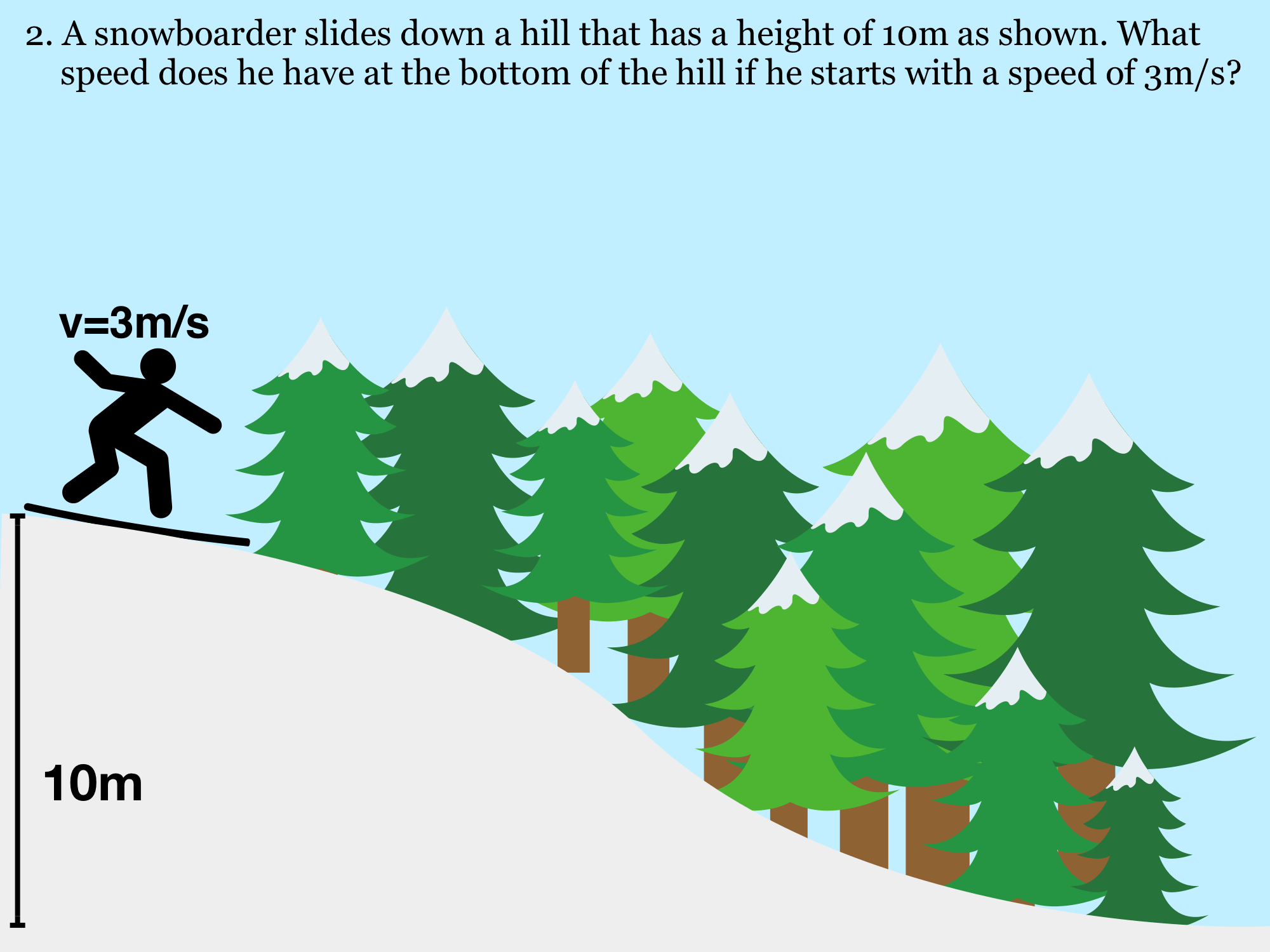
A snowboarder starts 10 m above the bottom at 3 m/s. Neglect friction and air drag and find the speed at the bottom. Use g = 9.81 m/s².
Drawing is temporarily unavailable. Work on paper if needed, then record your reasoning here.
Saving written working requires JavaScript. The problem remains available above; keep your work on paper or in your own notes.


Section breakdown
- Energy Loss
- Friction - the thief of energy
- Example 5.4.1 - The Bouncing Ball loses some Energy
- Example 5.4.2 - A Box begins its Adventure, only to be stopped by Friction
- Friction’s energy-thieving friends
- Example 5.4.3 - Raising the Flag
- Power
- Example 5.4.4 - Using a Ramp to more easily move a Box
- Chapter Equations
Original problem 3
The unspecified launcher’s acceleration duration is excluded. Calling 30 m the “maximum height” while retaining 2 m/s is inconsistent; this is a designated hill height, reached while still moving.
Problem text
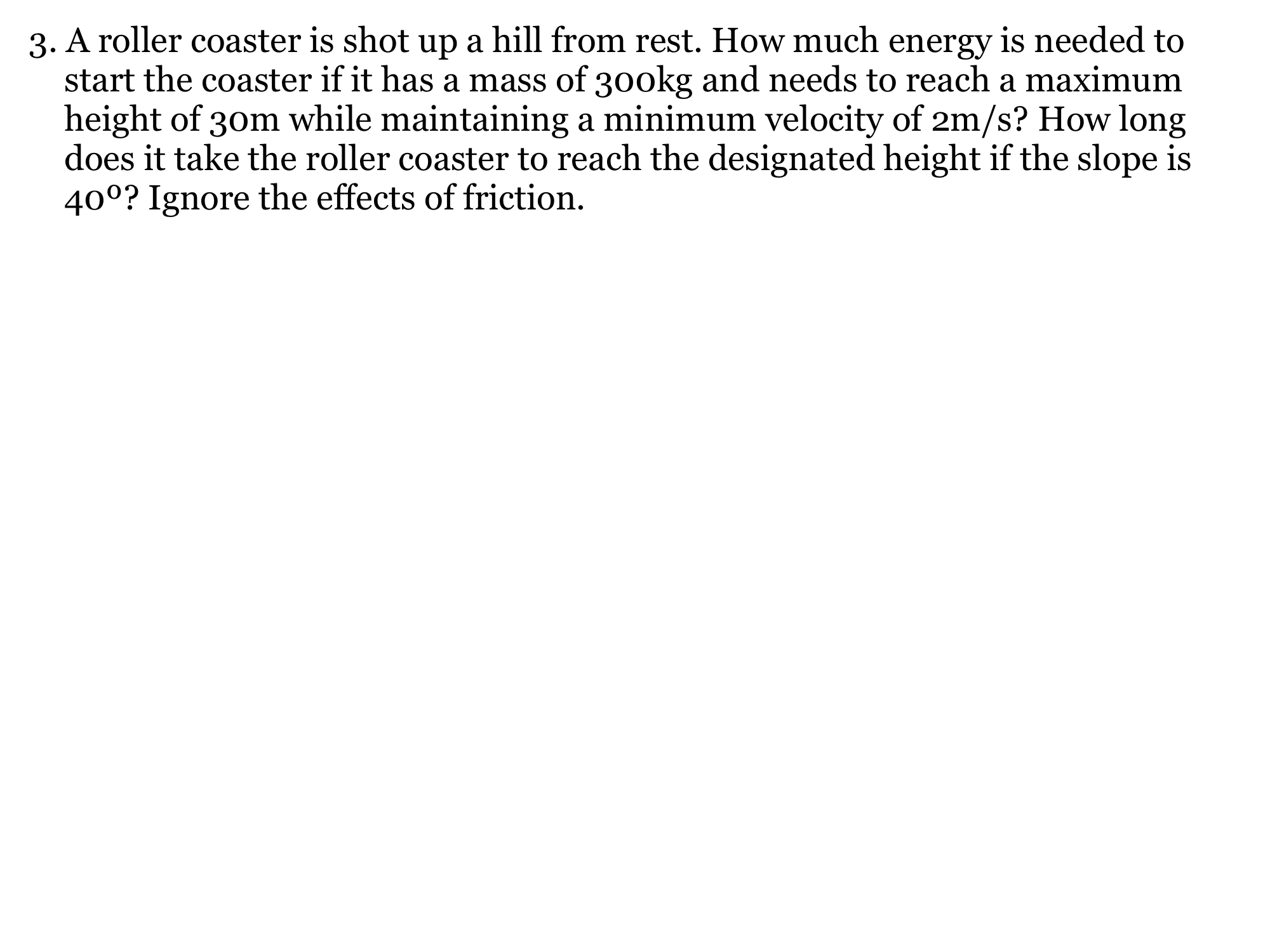
A 300 kg coaster receives an instantaneous launch at the bottom of a straight 40° frictionless hill. It must reach a point 30 m above the bottom with speed at least 2 m/s. Find the minimum launch energy and the uphill travel time after launch. Use g = 9.81 m/s².
Drawing is temporarily unavailable. Work on paper if needed, then record your reasoning here.
Saving written working requires JavaScript. The problem remains available above; keep your work on paper or in your own notes.
Original problem 4
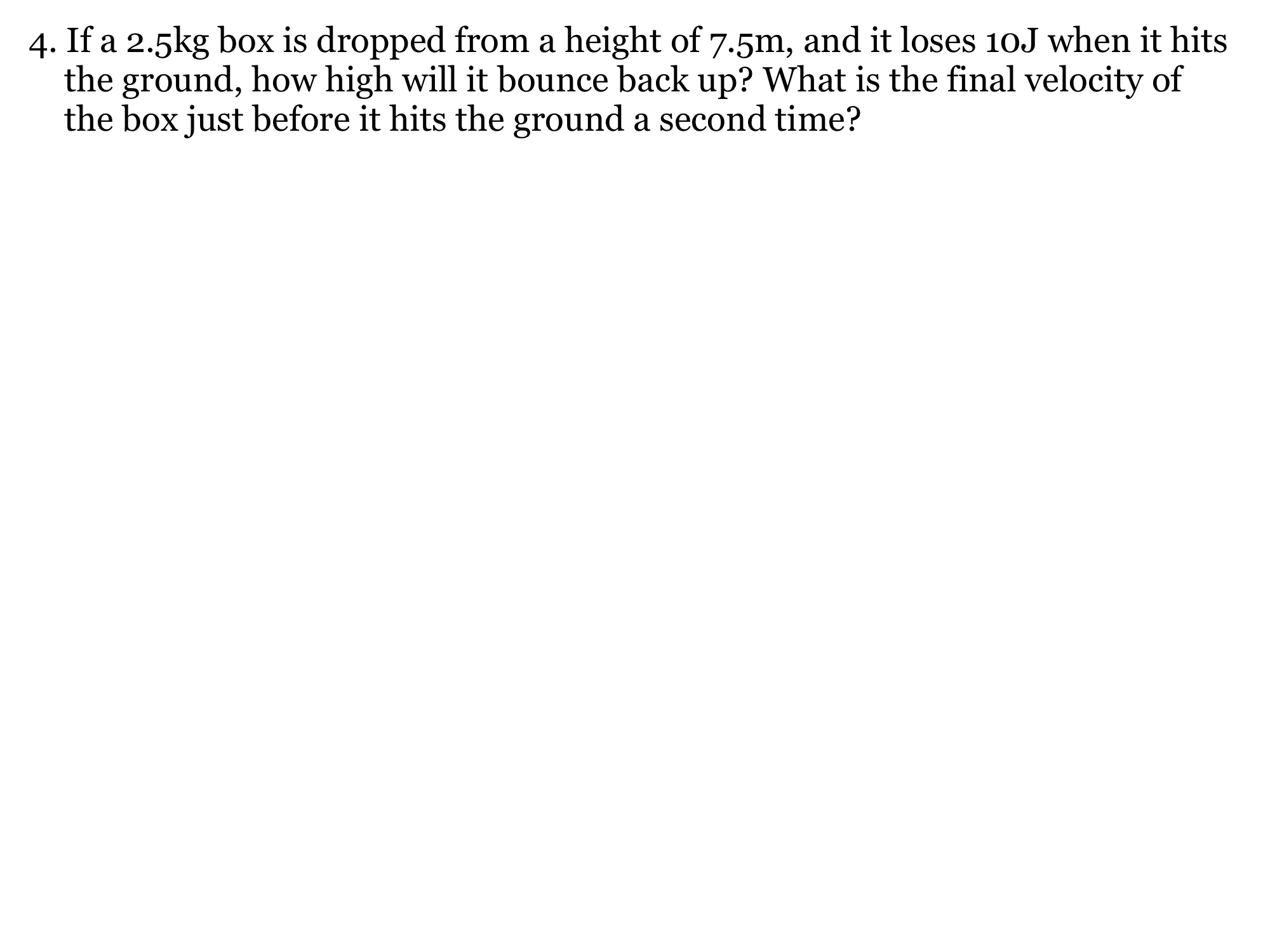
The 10 J loss occurs at the first impact; the second impact has not yet happened.
Problem text
A 2.5 kg box falls from rest from height 7.5 m. It loses 10 J of mechanical energy at its first impact with the ground. Neglect air resistance. Find its rebound height and its velocity immediately before its second impact. Use g = 9.81 m/s².
Drawing is temporarily unavailable. Work on paper if needed, then record your reasoning here.
Saving written working requires JavaScript. The problem remains available above; keep your work on paper or in your own notes.
Original problem 5
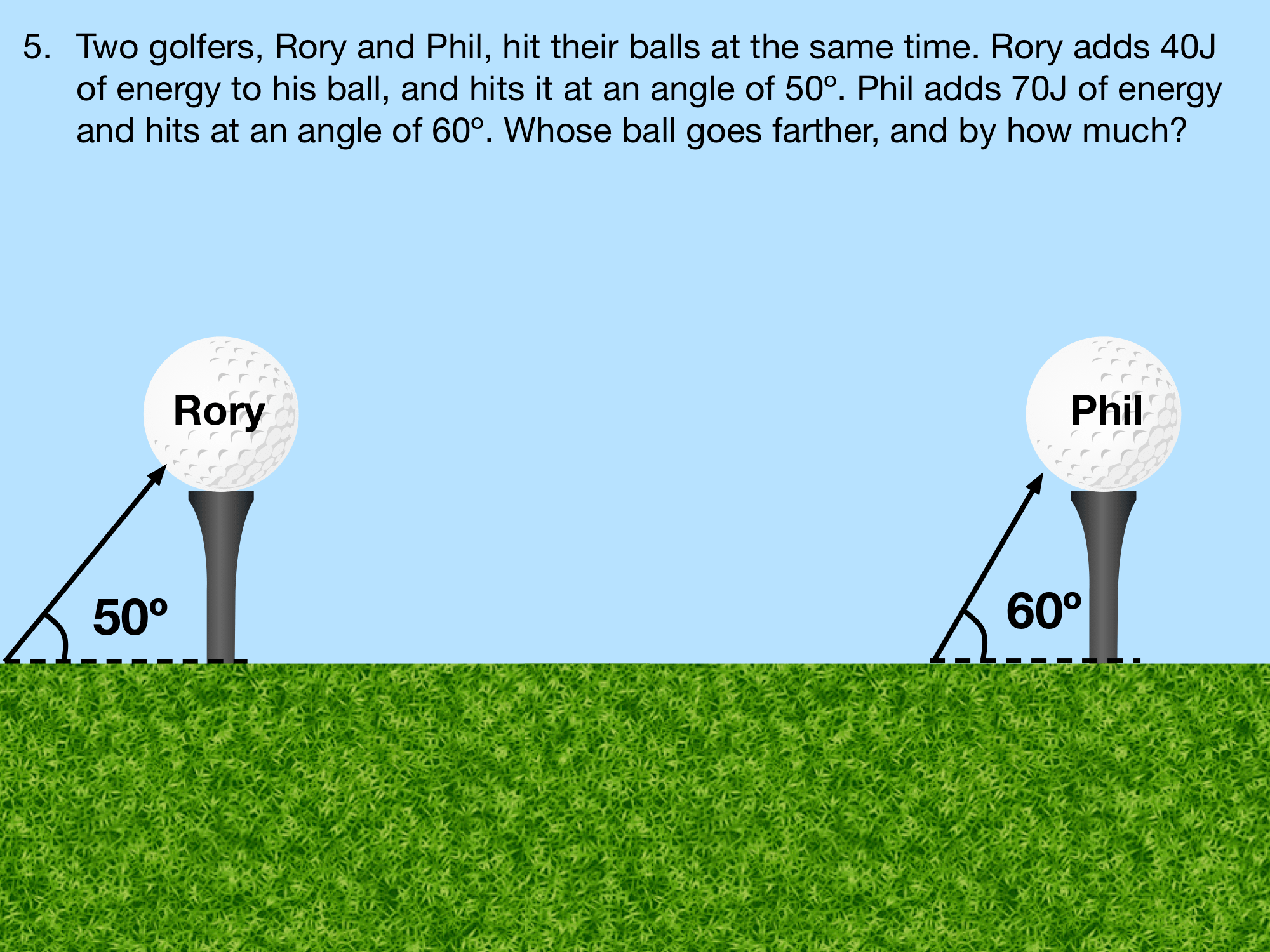
The original omits both masses. This is a consistency/model check and symbolic solution; no numerical mass is invented. Equal masses, no drag, and equal heights are explicit assumptions for the comparison.
Problem text
Rory supplies 40 J of launch kinetic energy to his ball at 50° above horizontal; Phil supplies 70 J at 60°. Whose ball goes farther, and by how much? First identify the missing data. Then solve in terms of a common mass m assuming equal masses, negligible air drag, and equal launch/landing heights.
Drawing is temporarily unavailable. Work on paper if needed, then record your reasoning here.
Saving written working requires JavaScript. The problem remains available above; keep your work on paper or in your own notes.
Original problem 6
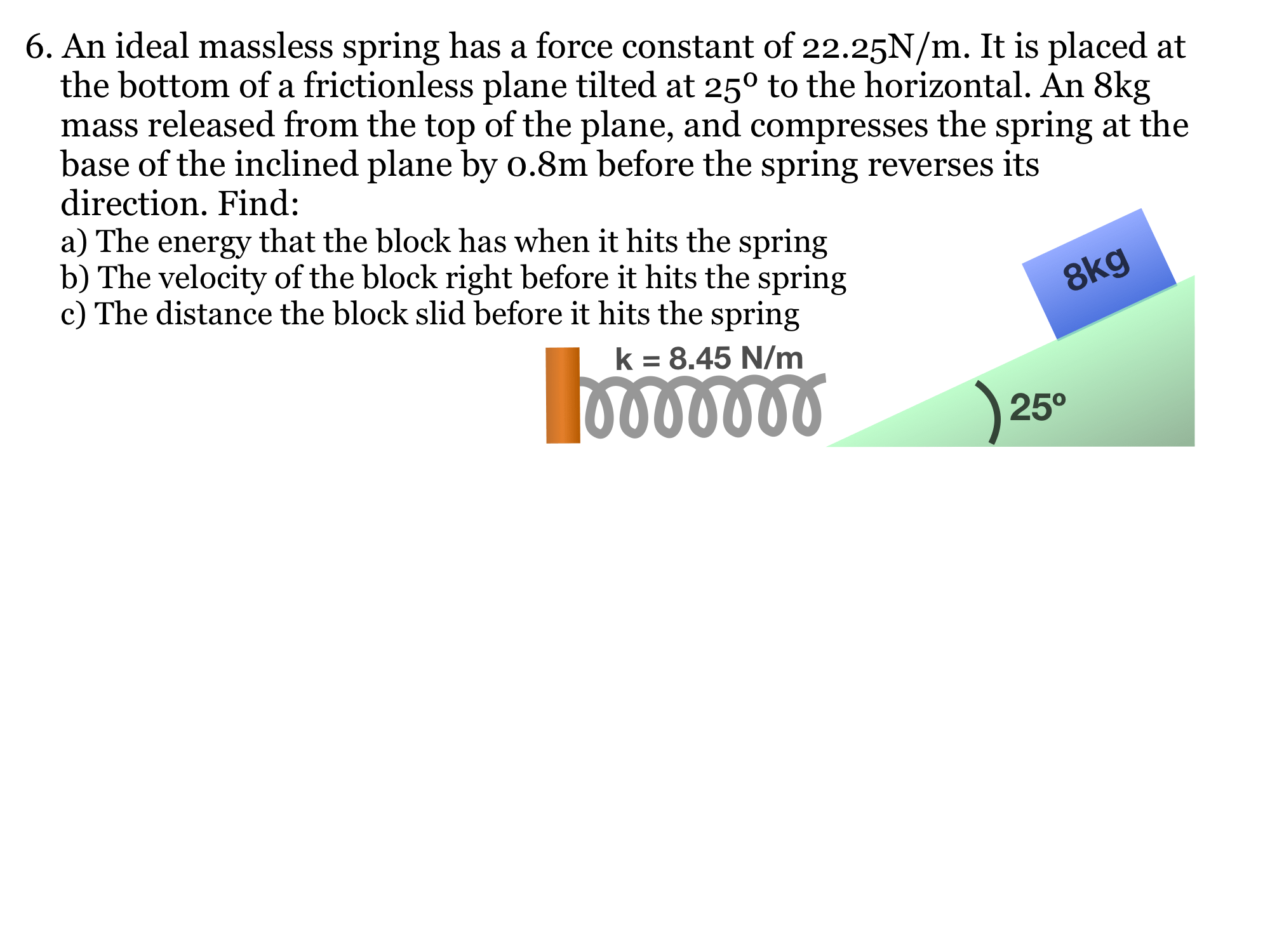
The text prints k = 22.25 N/m while the diagram prints 8.45 N/m. Retain the textual constant and explicitly state the horizontal spring model shown by the diagram. If instead the spring lies along the incline, K_contact = ½kx² − mgxsin25° = −19.41 J for k = 22.25 N/m (or −23.83 J for 8.45 N/m), which is impossible; that interpretation cannot be silently used.
Problem text
An 8 kg block starts from rest and slides down a frictionless 25° incline onto a level frictionless floor at the ramp base. It then compresses a horizontal ideal massless spring by 0.8 m before stopping. Use k = 22.25 N/m, as printed in the source text, instead of the conflicting diagram label 8.45 N/m. Find (a) its kinetic energy at spring contact, (b) its speed then, and (c) the distance it slid down the incline before reaching the spring. Use g = 9.81 m/s².
Drawing is temporarily unavailable. Work on paper if needed, then record your reasoning here.
Saving written working requires JavaScript. The problem remains available above; keep your work on paper or in your own notes.
Original problem 7
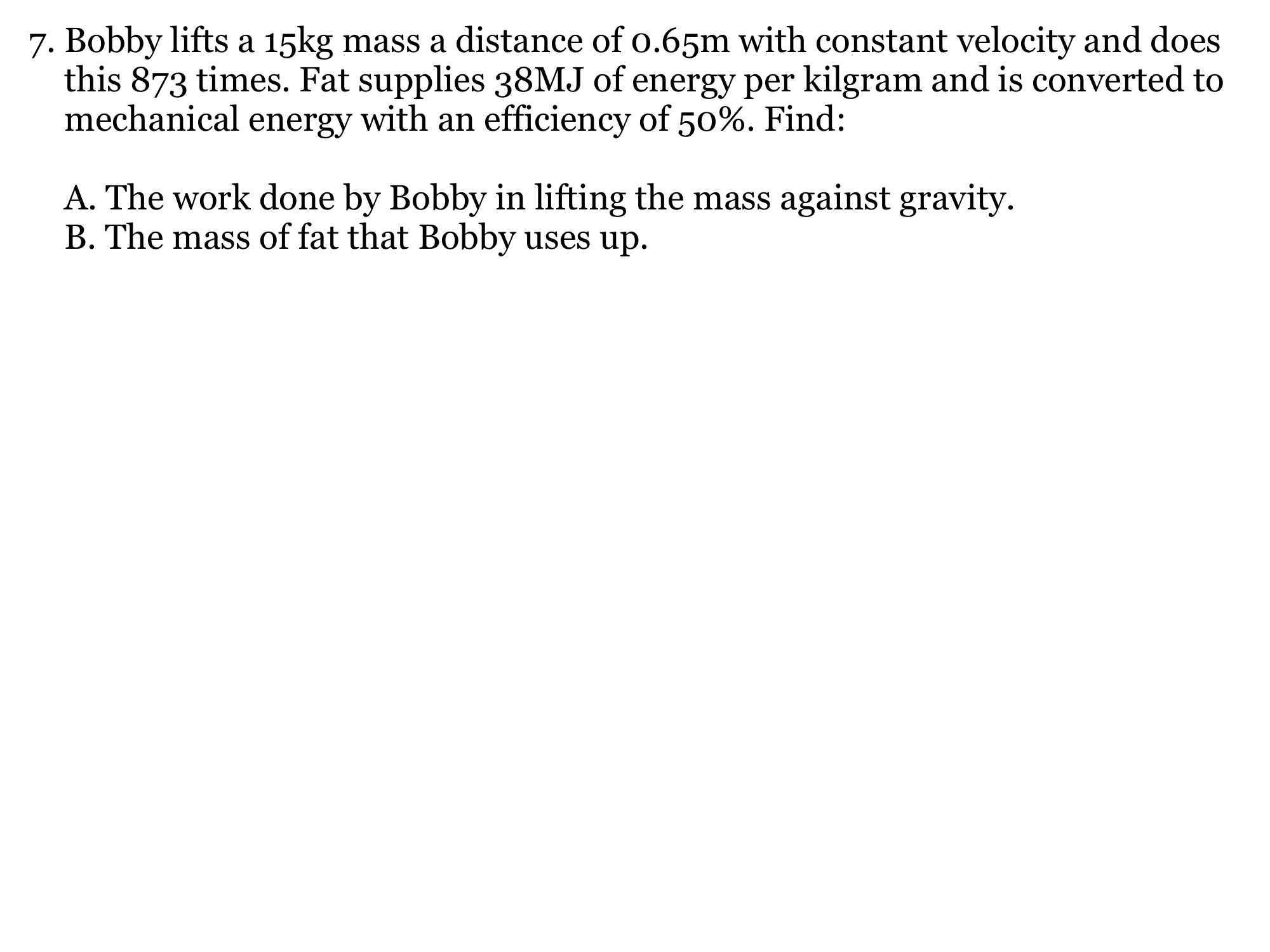
This model counts the specified upward lifting only; it excludes metabolism and work while lowering the load.
Problem text
Bobby lifts a 15 kg mass upward 0.65 m at constant speed 873 times. Fat provides 38 MJ/kg, with 50% conversion to mechanical work. Find total upward lifting work and the modeled fat mass used. Use g = 9.81 m/s²; count only the upward lifting work.
Drawing is temporarily unavailable. Work on paper if needed, then record your reasoning here.
Saving written working requires JavaScript. The problem remains available above; keep your work on paper or in your own notes.
Original problem 8
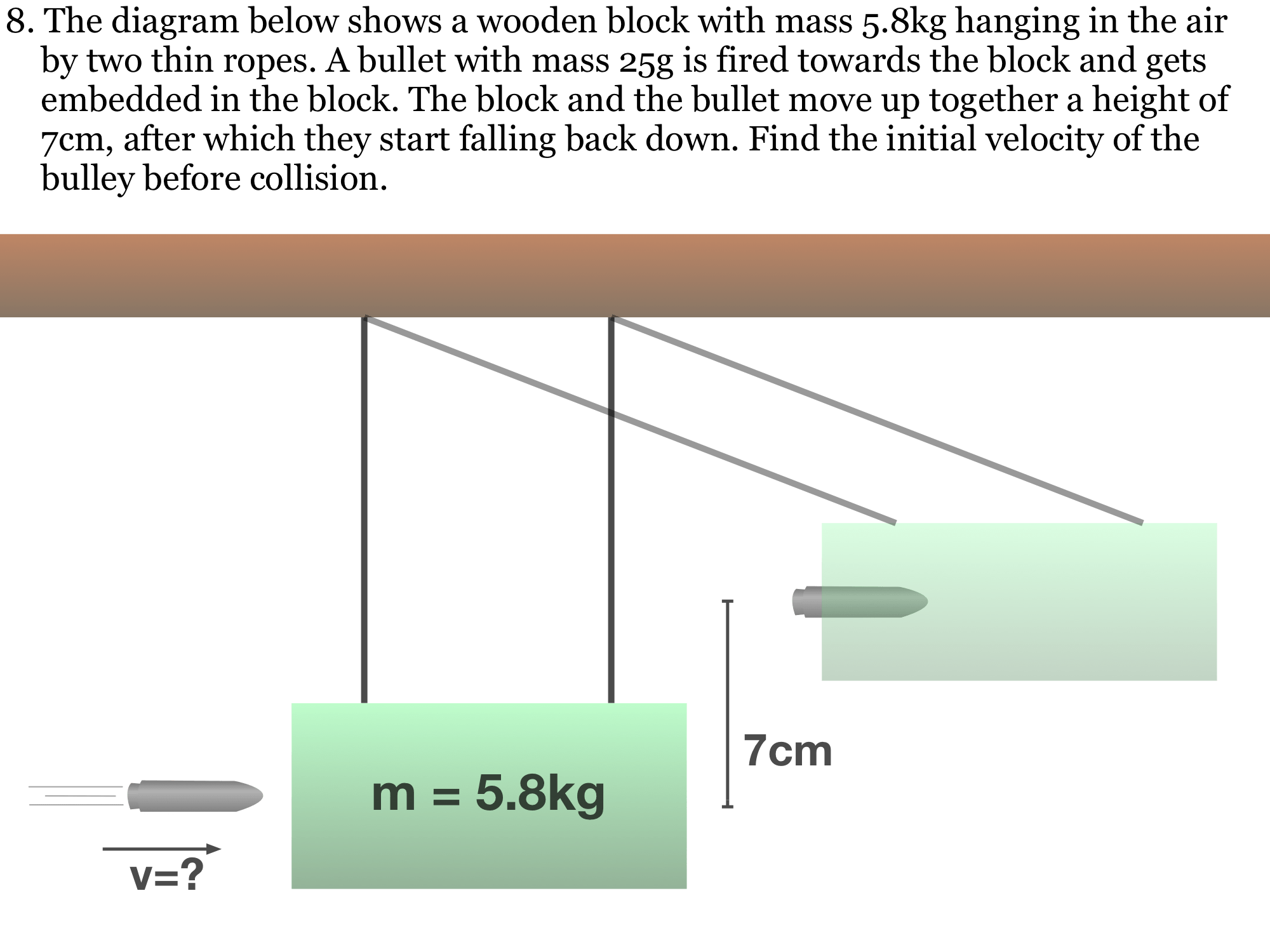
Ignore external horizontal impulse during embedding and air/rope losses during the swing. The 7 cm is a vertical rise, not the distance traveled along an arc.
Problem text
A 25 g bullet embeds in a stationary 5.8 kg block suspended by two thin ropes. The combined block and bullet subsequently rise 7 cm vertically. Neglect external horizontal impulse during embedding and losses during the swing. Find the bullet’s initial speed. Use g = 9.81 m/s².
Drawing is temporarily unavailable. Work on paper if needed, then record your reasoning here.
Saving written working requires JavaScript. The problem remains available above; keep your work on paper or in your own notes.
Original problem 9
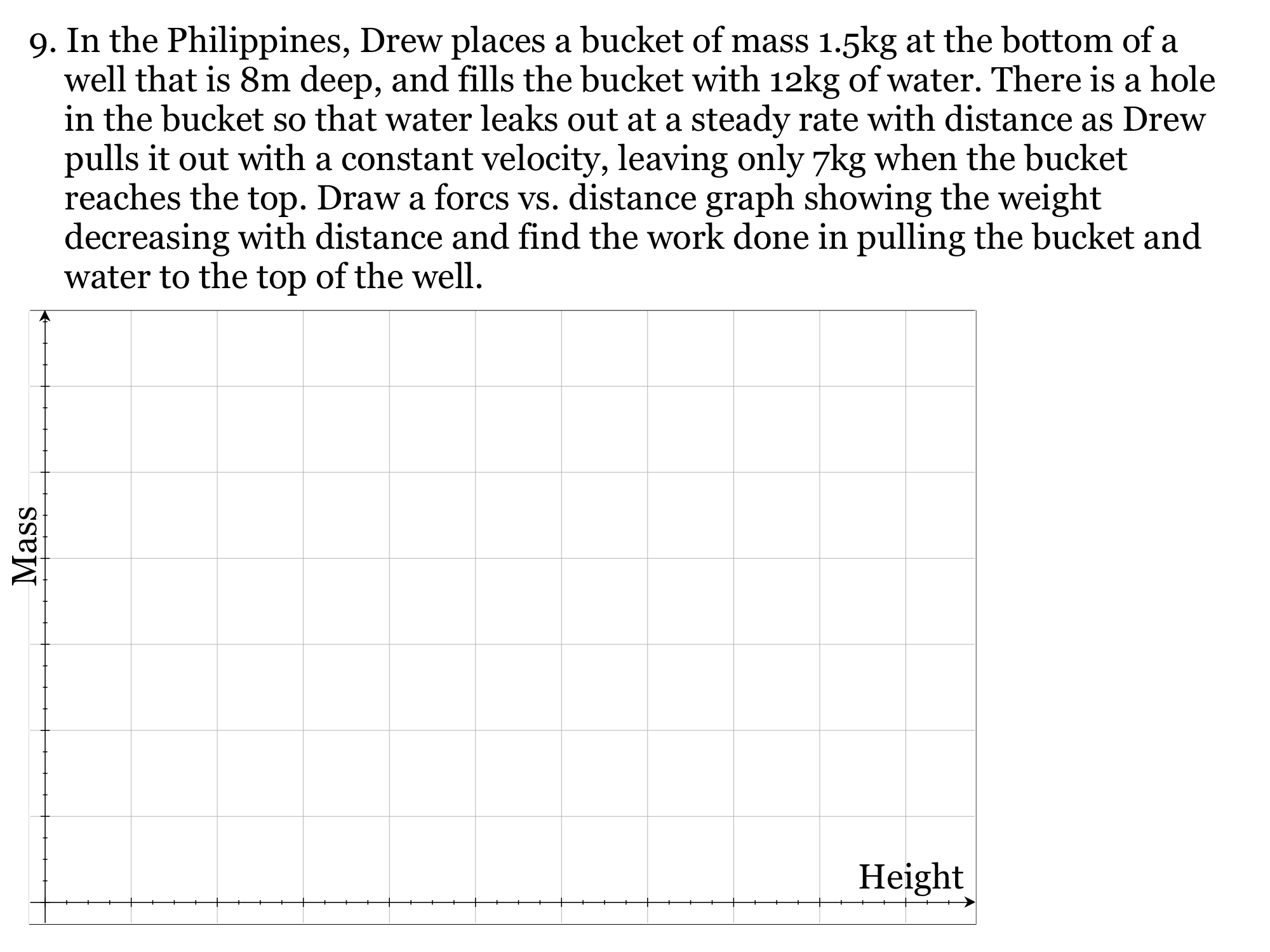
Assume leaking water leaves with the bucket’s instantaneous vertical velocity and contributes negligible relative-jet thrust. The force axis must show weight/force, not mass.
Problem text
A 1.5 kg bucket initially holds 12 kg of water at the bottom of an 8 m well. It is lifted at constant speed while water mass decreases linearly with height, leaving 7 kg at the top. Neglect thrust from the leak. Sketch lifting force versus upward distance and calculate the lifting work. Use g = 9.81 m/s².
Drawing is temporarily unavailable. Work on paper if needed, then record your reasoning here.
Saving written working requires JavaScript. The problem remains available above; keep your work on paper or in your own notes.
Original problem 10
Recovered question 10 repeats energy question 10. Original wording did not say where 2.5 m/s was measured. The clarified model puts it at the bottom before the 3 cm rise. If 2.5 m/s were instead the speed at the patch entrance, it would cross the patch with speed 0.603 m/s.
Problem text
A block starts at the bottom of a frictionless ramp at 2.5 m/s. It climbs to a horizontal rough patch 3 cm above the bottom. The patch is 0.6 m long and has kinetic friction coefficient 0.5; beyond it the path is frictionless. Find whether the block reaches the far end. If it does, find its exit speed; if it stops, find its travel distance on the patch. Use g = 9.81 m/s².
Drawing is temporarily unavailable. Work on paper if needed, then record your reasoning here.
Saving written working requires JavaScript. The problem remains available above; keep your work on paper or in your own notes.
Reviewed physics notes (16)
These corrections keep the original lesson’s purpose while fixing errors in the source edition.
- The claim that friction always resists absolute object motion is overgeneralized. — Reference 1, Reference 2
- Do not equate positiveheat transfer with a vectorforce multiplied by scalarposition; use pathlength and force magnitude. — Reference 1, Reference 2
- Count friction only once: HL covers frictional conversion and W_lost covers other outward work transfers. — Reference 1
- The original lacks an acceleration condition; the existing 49.05 N answer assumes constant velocity. — Reference 1, Reference 2
- The native solution assumesconstantspeed and ramp-parallelpull; nowexplicit. — Reference 1, Reference 2
- Correct equation summary signs andscalarconvention. — Reference 1, Reference 2, Reference 3
- The printed gravitational term lacks height, and the source rounds friction before calculating the energy. — Reference 1, Reference 2, Reference 3
- Carry the correctedbaseenergy. — Reference 1, Reference 2
- Carry the corrected energy consistently. — Reference 1, Reference 2
- Retain the rounded final answer with a corrected derivation. — Reference 1, Reference 2
- Energy removal per unit time also depends on speed; compare frictional work per unit distance. — Reference 1, Reference 2
- The existing 245.3 W key assumes five full rising buckets; state the count and idealizations. — Reference 1
- State the net force and constant-force limits in the repeated equation list. — Reference 1, Reference 2
- Correct scalar gravitational/spring energies and the mechanical-energy conservation condition in the summary. — Reference 1, Reference 2
- Equal nonzero kinetic energies cancel for constant speed; the flag need not be stationary. — Reference 1, Reference 2
- Positive thermal energy transfer is −W_friction, not the negative force-displacement dot product. The retained 138 J result is unchanged. — Reference 1, Reference 2
Glossary and deeper reading · 9 refreshers
These editorial refreshers supplement the reading. Definitions and examples are added guidance; original source wording and recorded answers remain in their original context.
-
Kinetic friction
Kinetic friction acts between surfaces that slide relative to one another. It opposes their relative slipping and is often modeled with magnitude equal to the kinetic-friction coefficient times the normal force. For example, a rapidly moving belt can exert forward kinetic friction on a slower box sliding on it.
-
Mechanical energy
Mechanical energy is the sum of the kinetic and potential energies included in a model. It stays constant when transfers to or from other energy stores and across the chosen boundary are absent. For example, a pendulum’s mechanical energy can remain approximately constant while energy shifts between motion and gravitational configuration.
-
Heat
Heat is energy transferred between systems because of a temperature difference. It describes a transfer rather than a substance or energy store contained in an object. For example, when a warmer mug transfers energy to a cooler hand, the mug loses internal energy and the hand gains it.
-
Kinetic energy
Kinetic energy is energy associated with motion relative to a chosen reference frame. For a nonrelativistic translating object it is one half of its mass times speed squared. For example, doubling a cart’s speed quadruples its translational kinetic energy when its mass stays fixed.
-
Force
A force describes an interaction that can change an object’s momentum. It is a vector measured in newtons, so both size and direction matter when forces are added. For example, a rope can pull a cart while the floor exerts friction in another direction.
-
Mechanical work
Mechanical work is energy transferred by a force through displacement of its point of application. For a constant force on a particle, it depends on the force component along the particle’s displacement, and it can be positive, negative, or zero. For example, a magnetic force perpendicular to a particle’s displacement does zero work on that particle.
-
Power
Power is the rate at which energy is transferred or converted. It is measured in watts, with one watt equal to one joule per second. For example, two motors can lift the same load through the same height but have different average powers if they take different times.
-
Net force
Net force is the vector sum of all forces acting on the object or system under consideration. For constant mass in an inertial frame, it equals mass times acceleration. For example, equal upward and downward forces give zero net force even though neither force is zero.
-
Conservative force
A conservative force does work that depends only on the starting and ending configurations. A potential-energy function can describe it, and its work around a closed path is zero. For example, near-Earth gravity does the same work between two heights whether a ball follows a vertical or a curved path.