AP Unit 7 Problems
Thirty problems for AP Unit 7. Try the problem before opening its separate solution. Write the mathematical setup and the reason your method applies.
Choose your next practice
Find the problems you need.
Mix the choices to focus your practice. Problem numbers and worked-solution links stay the same.
30 of 30 problems shown.
Selection: All topics and practice types.
Printing includes the currently visible selection. Reset filters first to print all 30 problems.
Problem 1
A tank’s inflow is 5 L/min. Outflow is proportional to its current volume V with coefficient 0.1 min⁻¹. Write a differential equation and find the rate when V=20 L.
Written working workspace
Drawing is temporarily unavailable. Work on paper if needed, then record your reasoning here.
Saving written working requires JavaScript. Keep your work on paper or in your own notes; the source problem above remains available.
Problem 2
A body’s temperature T moves toward a room temperature of 20°C at a rate proportional to the temperature difference, with positive coefficient k. Write the model and explain the sign when T=30.
Written working workspace
Drawing is temporarily unavailable. Work on paper if needed, then record your reasoning here.
Saving written working requires JavaScript. Keep your work on paper or in your own notes; the source problem above remains available.
Problem 3
A particle’s acceleration is 2t m/s² at time t seconds, and its initial velocity is 3 m/s. Write an initial-value problem for velocity.
Written working workspace
Drawing is temporarily unavailable. Work on paper if needed, then record your reasoning here.
Saving written working requires JavaScript. Keep your work on paper or in your own notes; the source problem above remains available.
Problem 4
Verify that y=3e^(2x) solves y′=2y and y(0)=3.
Written working workspace
Drawing is temporarily unavailable. Work on paper if needed, then record your reasoning here.
Saving written working requires JavaScript. Keep your work on paper or in your own notes; the source problem above remains available.
Problem 5
Does y=x²+1 solve y′=2x and y(0)=0?
Written working workspace
Drawing is temporarily unavailable. Work on paper if needed, then record your reasoning here.
Saving written working requires JavaScript. Keep your work on paper or in your own notes; the source problem above remains available.
Problem 6
Verify that y=Ceˣ is a family of solutions to y′=y. Which member satisfies y(0)=−2?
Written working workspace
Drawing is temporarily unavailable. Work on paper if needed, then record your reasoning here.
Saving written working requires JavaScript. Keep your work on paper or in your own notes; the source problem above remains available.
Problem 7
For y′=x−y, give slopes at (0,0), (1,2), and (2,−1), and describe the corresponding segments.
Written working workspace
Drawing is temporarily unavailable. Work on paper if needed, then record your reasoning here.
Saving written working requires JavaScript. Keep your work on paper or in your own notes; the source problem above remains available.
Problem 8
| y | −2 | −1 | 0 | 1 | 2 |
|---|---|---|---|---|---|
| slope | −2 | −1 | 0 | 1 | 2 |
Written working workspace
Drawing is temporarily unavailable. Work on paper if needed, then record your reasoning here.
Saving written working requires JavaScript. Keep your work on paper or in your own notes; the source problem above remains available.
Problem 9
For y′=x+y, where are the slope-field segments horizontal?
Written working workspace
Drawing is temporarily unavailable. Work on paper if needed, then record your reasoning here.
Saving written working requires JavaScript. Keep your work on paper or in your own notes; the source problem above remains available.
Problem 10
For y′=1/(x−y), can a slope-field segment be drawn at (1,1)? What is the slope at (1,0)?
Written working workspace
Drawing is temporarily unavailable. Work on paper if needed, then record your reasoning here.
Saving written working requires JavaScript. Keep your work on paper or in your own notes; the source problem above remains available.
Problem 11
For y′=2−y, identify the equilibrium and describe a solution starting at y(0)=1 for x≥0.
Written working workspace
Drawing is temporarily unavailable. Work on paper if needed, then record your reasoning here.
Saving written working requires JavaScript. Keep your work on paper or in your own notes; the source problem above remains available.
Problem 12
For y′=2−y, describe a solution starting at y(0)=3 for x≥0.
Written working workspace
Drawing is temporarily unavailable. Work on paper if needed, then record your reasoning here.
Saving written working requires JavaScript. Keep your work on paper or in your own notes; the source problem above remains available.
Problem 13
For y′=xy, find y′ and y″ at a solution point (1,2).
Written working workspace
Drawing is temporarily unavailable. Work on paper if needed, then record your reasoning here.
Saving written working requires JavaScript. Keep your work on paper or in your own notes; the source problem above remains available.
Problem 14
Find the general solution of y′=2xy, including any equilibrium lost by division.
Written working workspace
Drawing is temporarily unavailable. Work on paper if needed, then record your reasoning here.
Saving written working requires JavaScript. Keep your work on paper or in your own notes; the source problem above remains available.
Problem 15
Find the general solution of y′=x(1+y²).
Written working workspace
Drawing is temporarily unavailable. Work on paper if needed, then record your reasoning here.
Saving written working requires JavaScript. Keep your work on paper or in your own notes; the source problem above remains available.
Problem 16
Solve y′=3(1−y) generally, including its equilibrium.
Written working workspace
Drawing is temporarily unavailable. Work on paper if needed, then record your reasoning here.
Saving written working requires JavaScript. Keep your work on paper or in your own notes; the source problem above remains available.
Problem 17
Solve y′=xy with y(0)=2.
Written working workspace
Drawing is temporarily unavailable. Work on paper if needed, then record your reasoning here.
Saving written working requires JavaScript. Keep your work on paper or in your own notes; the source problem above remains available.
Problem 18
Solve y′=y² with y(0)=1 and give the largest interval containing 0 on which the solution is defined.
Written working workspace
Drawing is temporarily unavailable. Work on paper if needed, then record your reasoning here.
Saving written working requires JavaScript. Keep your work on paper or in your own notes; the source problem above remains available.
Problem 19
Solve y′=y/x with y(1)=3 and give a connected domain containing the initial point.
Written working workspace
Drawing is temporarily unavailable. Work on paper if needed, then record your reasoning here.
Saving written working requires JavaScript. Keep your work on paper or in your own notes; the source problem above remains available.
Problem 20
Give a solution to y′=e^(−x²), y(0)=2, using an accumulation function, and verify it.
Written working workspace
Drawing is temporarily unavailable. Work on paper if needed, then record your reasoning here.
Saving written working requires JavaScript. Keep your work on paper or in your own notes; the source problem above remains available.
Problem 21
Solve y′=−x/y with y(0)=2 and give the interval of this branch.
Written working workspace
Drawing is temporarily unavailable. Work on paper if needed, then record your reasoning here.
Saving written working requires JavaScript. Keep your work on paper or in your own notes; the source problem above remains available.
Problem 22
A population follows P′=kP, P(0)=100, P(3)=200, with t in hours. Find k and P(6).
Written working workspace
Drawing is temporarily unavailable. Work on paper if needed, then record your reasoning here.
Saving written working requires JavaScript. Keep your work on paper or in your own notes; the source problem above remains available.
Problem 23
A substance has half-life 4 days and starts at 80 g. Give its differential equation and its amount after 12 days.
Written working workspace
Drawing is temporarily unavailable. Work on paper if needed, then record your reasoning here.
Saving written working requires JavaScript. Keep your work on paper or in your own notes; the source problem above remains available.
Problem 24
For y′=0.05y with y(0)=100, use a calculator to find y(10) and the doubling time, to three decimals.
Written working workspace
Drawing is temporarily unavailable. Work on paper if needed, then record your reasoning here.
Saving written working requires JavaScript. Keep your work on paper or in your own notes; the source problem above remains available.
Problem 25
Use Euler’s method for y′=y, y(0)=1, with two steps of size 0.5 to estimate y(1).
Written working workspace
Drawing is temporarily unavailable. Work on paper if needed, then record your reasoning here.
Saving written working requires JavaScript. Keep your work on paper or in your own notes; the source problem above remains available.
Problem 26
For y′=x+y, y(1)=2, use one Euler step of size −0.2 to estimate y(0.8).
Written working workspace
Drawing is temporarily unavailable. Work on paper if needed, then record your reasoning here.
Saving written working requires JavaScript. Keep your work on paper or in your own notes; the source problem above remains available.
Problem 27
For y′=2x, y(0)=0, use two Euler steps of size 0.5 to estimate y(1). Compare with the exact solution.
Written working workspace
Drawing is temporarily unavailable. Work on paper if needed, then record your reasoning here.
Saving written working requires JavaScript. Keep your work on paper or in your own notes; the source problem above remains available.
Problem 28
A logistic population satisfies P′=0.01P(100−P), P(0)=20. Find the carrying capacity, initial rate, forward limit, and population at fastest growth.
Written working workspace
Drawing is temporarily unavailable. Work on paper if needed, then record your reasoning here.
Saving written working requires JavaScript. Keep your work on paper or in your own notes; the source problem above remains available.
Problem 29
A population follows P′=0.2P(1−P/500), P(0)=600. Find the carrying capacity, initial rate and limiting population.
Written working workspace
Drawing is temporarily unavailable. Work on paper if needed, then record your reasoning here.
Saving written working requires JavaScript. Keep your work on paper or in your own notes; the source problem above remains available.
Problem 30
For P′=kP(K−P), with k,K>0, compare future growth-rate behavior when P(0)=K/4, P(0)=3K/4, and P(0)=0.
Written working workspace
Drawing is temporarily unavailable. Work on paper if needed, then record your reasoning here.
Saving written working requires JavaScript. Keep your work on paper or in your own notes; the source problem above remains available.
More chapter problems
Try these problems before opening the solutions. Show your setup, the hypotheses behind your method, and what your answer means.
From a verbal culture law to a rate graph
A closed culture is modeled continuously. Its net rate of change is jointly proportional to its current population and its remaining capacity. The fixed carrying capacity is 800 organisms. Let P(t) count organisms and let t be in days. When P = 200, the instantaneous net increase is 18 organisms/day. Assume a positive constant of proportionality, unchanged resources and no external source of organisms. Do not begin with a supplied differential equation.
(a) Construct the differential equation from the verbal statement using an unknown constant k. Identify and explain both factors, explain why they multiply rather than add, and give the units of k. State the ordinary growth domain and how the signed net-rate model would interpret a population above capacity.
(b) Use the measured state to determine k. Rewrite your model as rP(1 − P/800), derive the relation between r and k and give r’s units. Calculate the rates at P = 400 and P = 600. Explain why the rate at 600 can equal the measured rate at 200 even though the population is three times as large.
(c) Construct a quantitative graph of net rate R(P) versus P for 0 ≤ P ≤ 1000 using your calibrated model. Label axes and units, both zeros, the maximum, the points P = 200 and 600, and the negative-rate point at P = 900. Use the graph to determine the population and rate of greatest future growth for separate initial populations P(0) = 100 and P(0) = 600, restricting future time to t ≥ 0. Explain the distinction between a maximum of the rate law and a maximum actually visited by a trajectory.
(d) Without solving the differential equation, determine the direction of motion and the limiting population as t → ∞ for separate initial values P(0) = 0, 200, 800 and 900. Explicitly state which limiting value is an exception to the assertion that every population approaches carrying capacity, and retain the signed net-rate extension for the 900-organism case.
Written working workspace
Drawing is temporarily unavailable. Work on paper if needed, then record your reasoning here.
Saving written working requires JavaScript. Keep your work on paper or in your own notes; the source problem above remains available.
Worked solution and rubric →Revisit the explanation →Revisit the explanation →Revisit the explanation →Revisit the explanation →Revisit the explanation →Read the relevant lesson →
Transfer a joint rate law across units and capacity
A lake fish population has a net rate jointly proportional to its current number of fish and the signed shortfall from a fixed capacity of 10000 fish. Time is in days. At a population of 2000 fish, the instantaneous net increase is 160 fish/day. Use a continuous model with fixed positive coefficients and no migration. Later, a separate fixed-capacity trial uses a capacity of 20000 fish. It starts anew at 2000 fish; the trial does not represent an instantaneous jump in a previously fixed carrying capacity.
(a) Starting from the verbal jointly proportional description, construct the differential equation in fish units using P(t). Explain the two factors, find the proportionality constant k and its units, and write the equivalent normalized form with coefficient r and its units. State the capacity and ordinary growth domain.
(b) Let Q(t) measure the same population in thousands of fish. Construct the corresponding jointly proportional rate equation in Q and explain the meaning of its two factors. Derive the transformed coefficient and its units by substituting P = 1000Q and relating the two derivatives. Check the prediction at Q = 2, and explain which coefficient, k or r, keeps its numerical value when only population units change.
(c) For the separate 20000-fish-capacity trial, first retain the same joint proportionality coefficient k in fish units. Construct the trial’s rate equation and calculate its rate at 2000 fish and its normalized coefficient r. Contrast an alternative trial that instead retains the original normalized coefficient r. Find its k and its rate at 2000 fish. Explain why changing carrying capacity alone does not specify which coefficient should stay fixed.
Written working workspace
Drawing is temporarily unavailable. Work on paper if needed, then record your reasoning here.
Saving written working requires JavaScript. Keep your work on paper or in your own notes; the source problem above remains available.
Worked solution and rubric →Revisit the explanation →Revisit the explanation →Revisit the explanation →Read the relevant lesson →
One rate measurement does not identify the verbal model
In a closed group of 600 people, P(t) is the number participating, modeled continuously for 0 ≤ P ≤ 600. The net participation rate is jointly proportional to the current participating population and the number still needed to reach 600. Time is in minutes. At P = 200, the measured instantaneous rate is 12 people/minute. Coefficients are positive constants over the modeled interval.
(a) Select the rate equation consistent with the verbal jointly proportional law, the measured rate and the coefficient units. Explain why both factors must remain present and why a normalized remaining-capacity fraction requires a changed coefficient.
Worked solution and rubric →Revisit the explanation →Revisit the explanation →Read the relevant lesson →
Estimate two members of a solution family
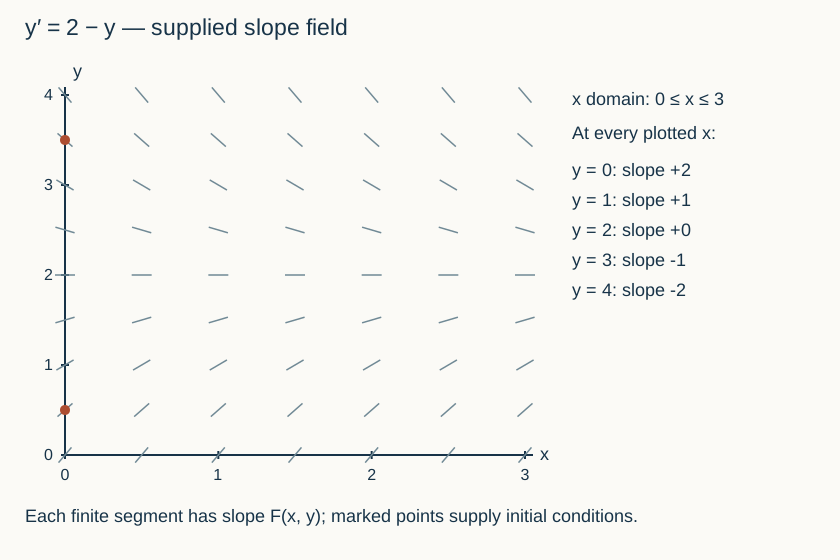
Inspect diagram labels
The diagram keeps its full size here. Focus the view and use the arrow keys, or scroll across it, to inspect every label.
Written working workspace
Drawing is temporarily unavailable. Work on paper if needed, then record your reasoning here.
Saving written working requires JavaScript. Keep your work on paper or in your own notes; the source problem above remains available.
Worked solution and rubric →Revisit the explanation →Revisit the explanation →Read the relevant lesson →
Follow a turning curve through a two-coordinate field
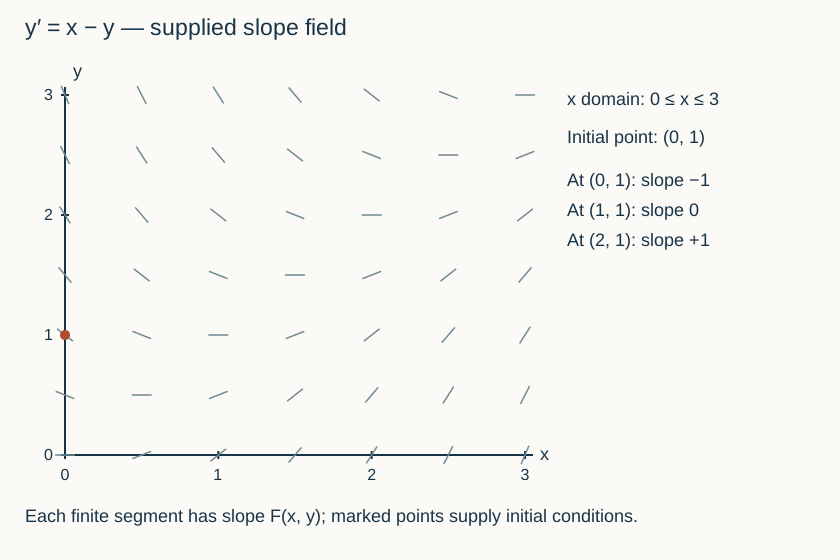
Inspect diagram labels
The diagram keeps its full size here. Focus the view and use the arrow keys, or scroll across it, to inspect every label.
Written working workspace
Drawing is temporarily unavailable. Work on paper if needed, then record your reasoning here.
Saving written working requires JavaScript. Keep your work on paper or in your own notes; the source problem above remains available.
Worked solution and rubric →Revisit the explanation →Revisit the explanation →Read the relevant lesson →