Sketching Slope Fields
Compute and draw local slope-field directions from both coordinates, leaving undefined locations unfilled.
College Board Topic 7.3 · CED p. 134 (PDF p. 139) · CED effective Fall 2020; project course outline 2026–27.
For y′=F(x,y), a slope field places a short line segment at selected points (x,y), with slope F(x,y). Calculate the slope from both coordinates, then draw the segment through the point. A segment shows local direction, not a displacement arrow or an entire solution. Horizontal segments indicate zero slope.
If F depends only on y, each horizontal row repeats; if it depends only on x, each vertical column repeats. If F=x−y, equal slopes lie on diagonal lines x−y=constant. Mark undefined points rather than inventing a slope. A curve following the field must be tangent to those local directions.
Let's work through it
- For y′=x−y at (1,2), compute 1−2=−1. Reason: Substitute both point coordinates.
- Draw a short segment falling one unit for each unit to the right. Reason: A slope of −1 describes the segment’s direction.
- At (2,2), draw a horizontal segment. Reason: The derivative is 2−2=0 there.
Follow directions to estimate a function
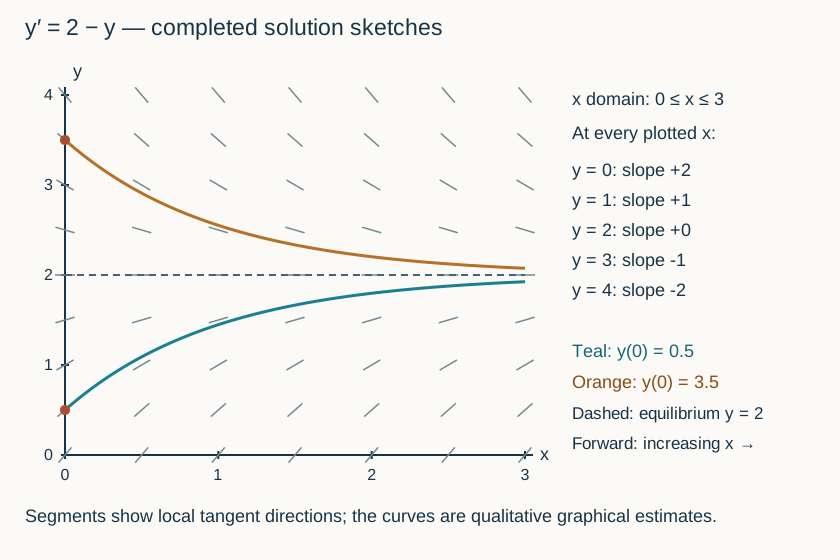
Inspect diagram labels
The diagram keeps its full size here. Focus the view and use the arrow keys, or scroll across it, to inspect every label.
Check direction and concavity before estimating height
Inspect diagram labels
The diagram keeps its full size here. Focus the view and use the arrow keys, or scroll across it, to inspect every label.
Answer and check
Try it from memory
Pause & retrieve
Try it before you peek.
Write your answer and the reason from memory. Then compare with the worked answer. Your self-assessment is a study decision, not an automatically graded score.
Question 1
For y′=y, do horizontal or vertical rows repeat slopes?
See every recall question with its answer
These references preserve each prompt and its answer for direct evidence links. Try the interactive questions above before opening the worked reasoning.
Retrieval 1
For y′=y, do horizontal or vertical rows repeat slopes?
Worked answer and reason
Horizontal rows.
Every point with the same y has the same slope.
Retrieval 2
What does a horizontal segment mean?
Worked answer and reason
The solution’s instantaneous derivative is zero there.
Slope is derivative, not necessarily the function’s value.
Catch the tempting mistake
- A slope field consists of a collection of solution points.
- It supplies directions at selected points. A solution curve must follow those directions and pass through its initial point.
Calculator workspace and limits
For calculus, set the angle selector to Radians. This scientific calculator evaluates arithmetic and functions. It does not graph arbitrary functions, find numerical roots, evaluate numerical derivatives, or compute definite integrals. Those tasks need an approved graphing tool; the May 2027 exam permits approved handheld graphing calculators and Bluebook’s built-in Desmos on calculator-required parts. A graph or decimal estimate helps you check a conclusion; your setup, hypotheses, units and justification still do the explaining.
Scientific calculator
This calculator requires JavaScript. Use the physics formula sheets and show your working manually.
+ − * / ^ ! · pi · e · sqrt · sin, cos, tan · asin, acos, atan · atan2(y,x) · ln, log · abs · exp · hypot(x,y). Use * between factors. Keep units in your written working.
Put it to work
- Unit 7 problem 7 · No calculator · analytic
- Unit 7 problem 8 · No calculator · graphical
- Unit 7 problem 9 · No calculator · analytic
- Unit 7 problem 10 · No calculator · analytic
Explain and apply the mathematics
Try these problems before opening the solutions. Show your setup, the hypotheses behind your method, and what your answer means.
Estimate two members of a solution family
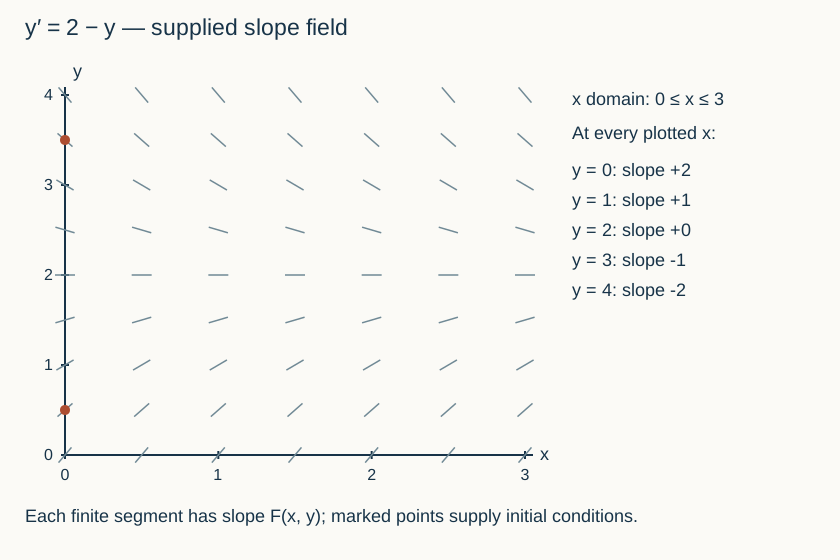
Inspect diagram labels
The diagram keeps its full size here. Focus the view and use the arrow keys, or scroll across it, to inspect every label.
Written working workspace
Drawing is temporarily unavailable. Work on paper if needed, then record your reasoning here.
Saving written working requires JavaScript. Keep your work on paper or in your own notes; the source problem above remains available.
Worked solution and rubric →Revisit the explanation →Revisit the explanation →
For the teacher
- Provide a textual slope table alongside the SVG. Let students compute several segments by hand before using a visual field. Check undefined locations explicitly.
Glossary and deeper reading · 5 refreshers
These editorial refreshers supplement the reading. Definitions and examples are added guidance; original source wording and recorded answers remain in their original context.
-
Function
A mathematical function assigns exactly one output to each input in its domain. Inputs can share an output, but one input cannot have two different outputs. For example, f(x)=x² assigns the output 9 to both 3 and −3. Function notation names the rule and its input; f(3) means the output when the input is 3.
-
Derivative
A derivative gives the instantaneous rate of change of a function with respect to its input. At a point, it is the finite limit of the difference quotient when that limit exists. For example, the derivative of x² is 2x, so the tangent slope at x=3 is 6. A derivative function collects those rates across the inputs where the function is differentiable.
-
Concavity
Concavity describes how a graph’s slope changes as the input increases. A graph is concave up where its derivative increases and concave down where its derivative decreases. For example, x² is concave up because its derivative 2x increases. A positive second derivative establishes concave-up behavior on an interval, while a negative one establishes concave-down behavior.
-
Differential equation
A differential equation relates an unknown function to one or more of its derivatives. A solution is a function that makes the equation true throughout an appropriate interval. For example, y′=2x has solutions y=x²+C. An initial condition can select a particular member of a family of solutions.
-
Initial condition
An initial condition specifies a solution’s value at a particular input. It can determine the constant in a family of solutions to a differential equation. For example, y′=2x with y(0)=3 selects y=x²+3. The solution must satisfy both the equation and the stated condition on a suitable interval.