FFR - Kinetic Energy
Original textbook reading.
In section 2.4, you learned about something called work. If you recall, work was given by the equation:
(Equation 2.4.1)
If we look at the units here, we can figure out what a joule is.
Now if we look at momentum, in , we can figure out how to get to energy.
Look familiar?
For a nonrelativistic particle of constant mass, K = ½p·v = ½m|v|² (Equation 4.4.1). Dimensional analysis shows that momentum times speed has energy units, but it does not derive the factor ½. Kinetic energy describes energy of motion; the force of an impact also depends on the stopping process.
If you use the definition of momentum, we can rewrite the Kinetic Energy definition as:
(Equation 4.4.2)
c
If you are really curious, and want to know why the constant in the equation is , it’s because of the calculus involved.
Just like we can write the work equation in integral form, we can write the kinetic energy equation in integral form:
ΔK = ∫ from v₁ to v₂ mv dv = ½m(v₂²−v₁²), for one-dimensional motion of constant mass.
There we go, a nice, simple way of solving a basic integral.
Now how does this relate to kinetic energy? Take a look at our integral solution for .
ΔK = ∫ from v₁ to v₂ mv dv = ½m(v₂²−v₁²), for one-dimensional motion of constant mass.
Here the integration variable is speed/velocity component u, the power is 1, and the constant coefficient is mass m.
K(v)=m∫₀ᵛu du=m[v²/2−0]=½mv².
Re-writing that, we have:
Work is energy transferred by a force acting through displacement. Positive net work increases a particle’s kinetic energy; negative net work decreases it.
Mechanical energy is the sum of kinetic and potential energies. Work is a way energy crosses a system boundary, not another name for mechanical energy.
The following problem shows an interesting relationship.
For a particle of constant mass moving along one axis, with v₂ ≠ v₁, find ΔK/Δp using signed scalar velocities and momentum components.
Step 1: Define both terms individually and simplify
To determine this ratio, we must first transform both variables into forms with as many parts in common. In this case, momentum and velocity will be our desired variables. For kinetic energy we use the kinetic energy definition in tandem with the momentum definition:
Up next, we have a calculus-based Example problem.
Example Problem 4.4.2
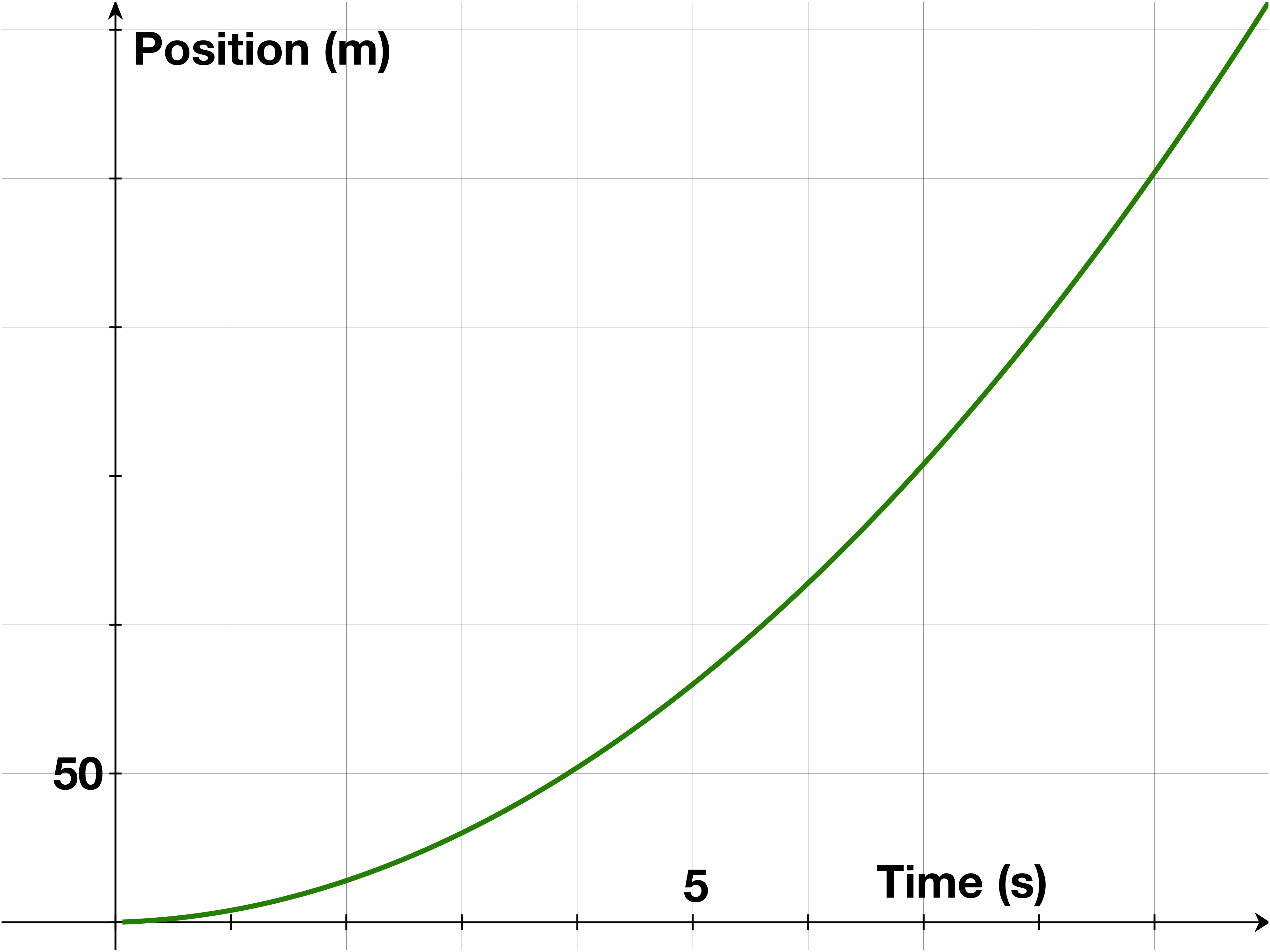
If the position function of a block is given by the formula , determine the increase in kinetic energy of the ball from to .
Step 1: Investigate the kinetic energy question to see what is needed
The kinetic energy increase can be given by:
ΔK = ∫ from v₁ to v₂ mv dv = ½m(v₂²−v₁²), for one-dimensional motion of constant mass.
As we know mass and we are given a position function, we can find the velocity function by differentiating the position function:
Now we have a definition of velocity as a function of time. This allows us to solve for Kinetic Energy as a function of time, instead of velocity.
Step 2: Plug the velocity equation into the integral and solve
ΔK = ∫ from v₁ to v₂ mv dv = ½m(v₂²−v₁²), for one-dimensional motion of constant mass.
Using v(t)=6t+1 m/s and a=6 m/s², ΔK=∫ from t=1 s to t=2 s m v(t)a dt.
Now we need to figure out three things, v1, v2, and dv. We find the v’s through the velocity equation, v1 is 7m/s and v2 is 13m/s. We can find dv from the acceleration equation:
is therefore .
Now we can solve the integral.
Pop Quiz 4.4.1 Kinetic Energy
Question 1 of 5 · 0 correct
AP Topic 3.1 · Read the worked solution
Read every full question without answers
Question 1
Question 2
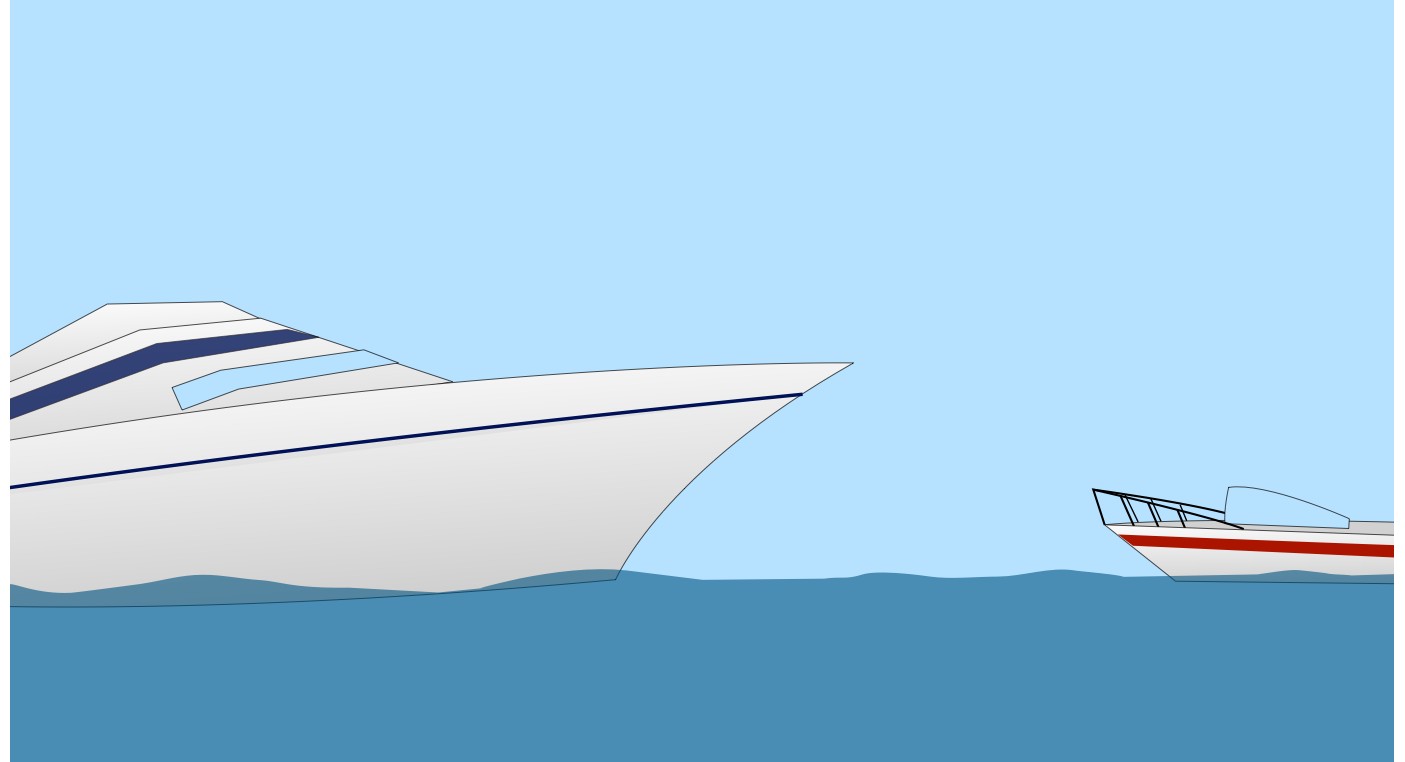
A completely inelastic collision occurs between two boats. The larger boat has a mass of , and is initially moving at before hitting the smaller, boat, which is initially at rest. What is the combined kinetic energy of the two boats after colliding?
Question 3
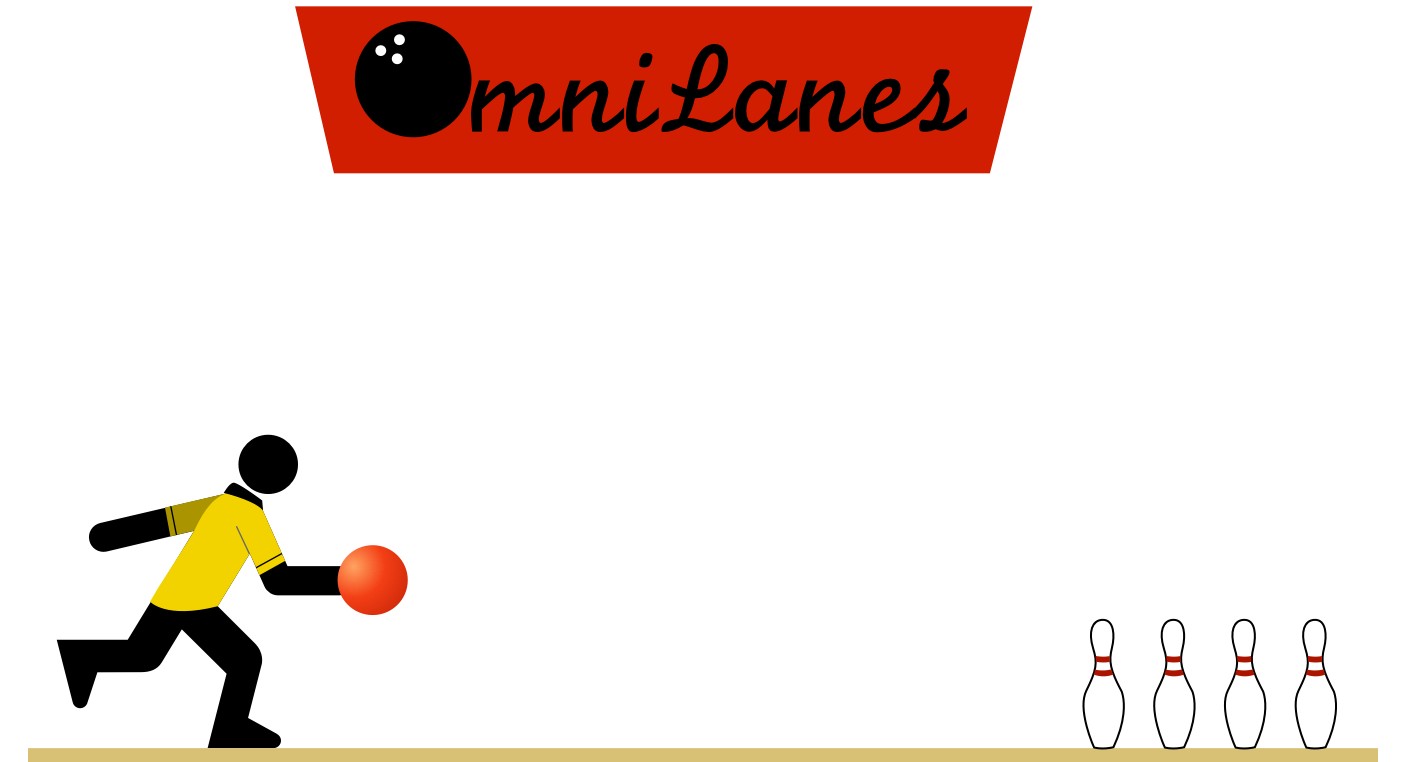
A 5 kg bowling ball moving at 5 m/s collides head-on and elastically with an initially stationary 1.53 kg pin. Treat them as particles and ignore spin. What is the pin’s kinetic energy afterward?
Question 4
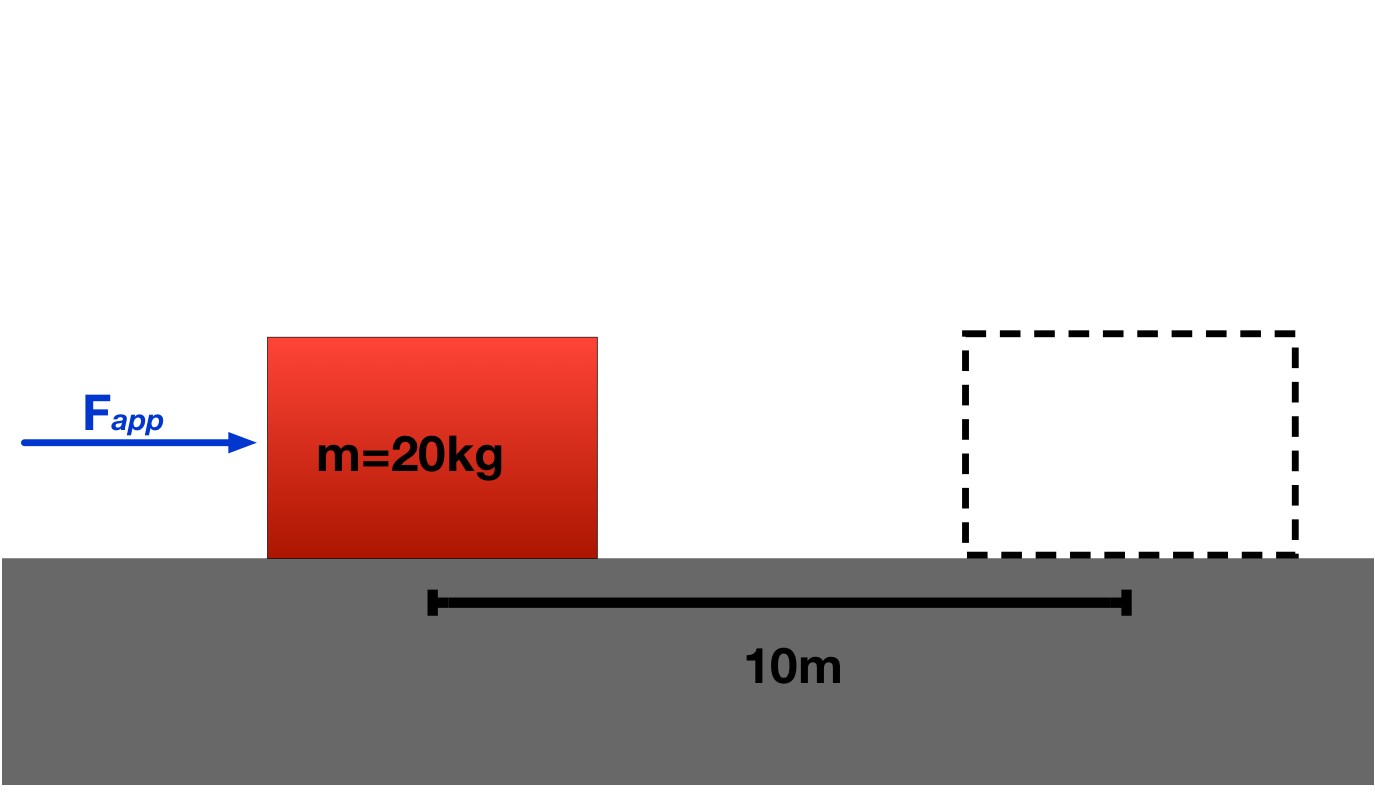
The source omits the box’s mass and initial speed. For an explicitly repaired classroom version, assume a 20 kg box starts from rest on a frictionless horizontal surface and a 5 N horizontal force pushes it through 10 m. What is its speed when the push ends?
Question 5
An asteroid collides with a planet, releasing an exorbitant amount of energy in doing so. If the asteroid weighs and is moving at a rate of , and of its energy is lost during approach, what energy is contained in the impact (after the energy loss)?

p = mv. For zero net external impulse, p₁i+p₂i=p₁f+p₂f. Net impulse J=p_f−p_i=∫F_net dt=F_net,avg Δt, hence F_net,avg=Δp/Δt.
(Equation 4.2.1) (Equation 4.2.3)
(Equation 4.2.4)
(Equation 4.2.5)
(Equation 4.3.1)
(Equation 4.3.2)
(Equation 4.3.3)
(Equation 4.3.4)
(Equation 4.3.5)
(Equation 4.3.6)
(Equation 4.3.7)
(Equation 4.3.8)
(Equation 4.3.9)
(Equation 4.3.10)
K = ½p·v = ½m|v|². In one dimension ΔK = ∫ from v₁ to v₂ mv dv = ½m(v₂²−v₁²). For n≠−1, ∫₀ᵃCxⁿdx = Caⁿ⁺¹/(n+1) where that integral exists.
Original problem 1
Transcription checked; SI units and model stated.
Problem text
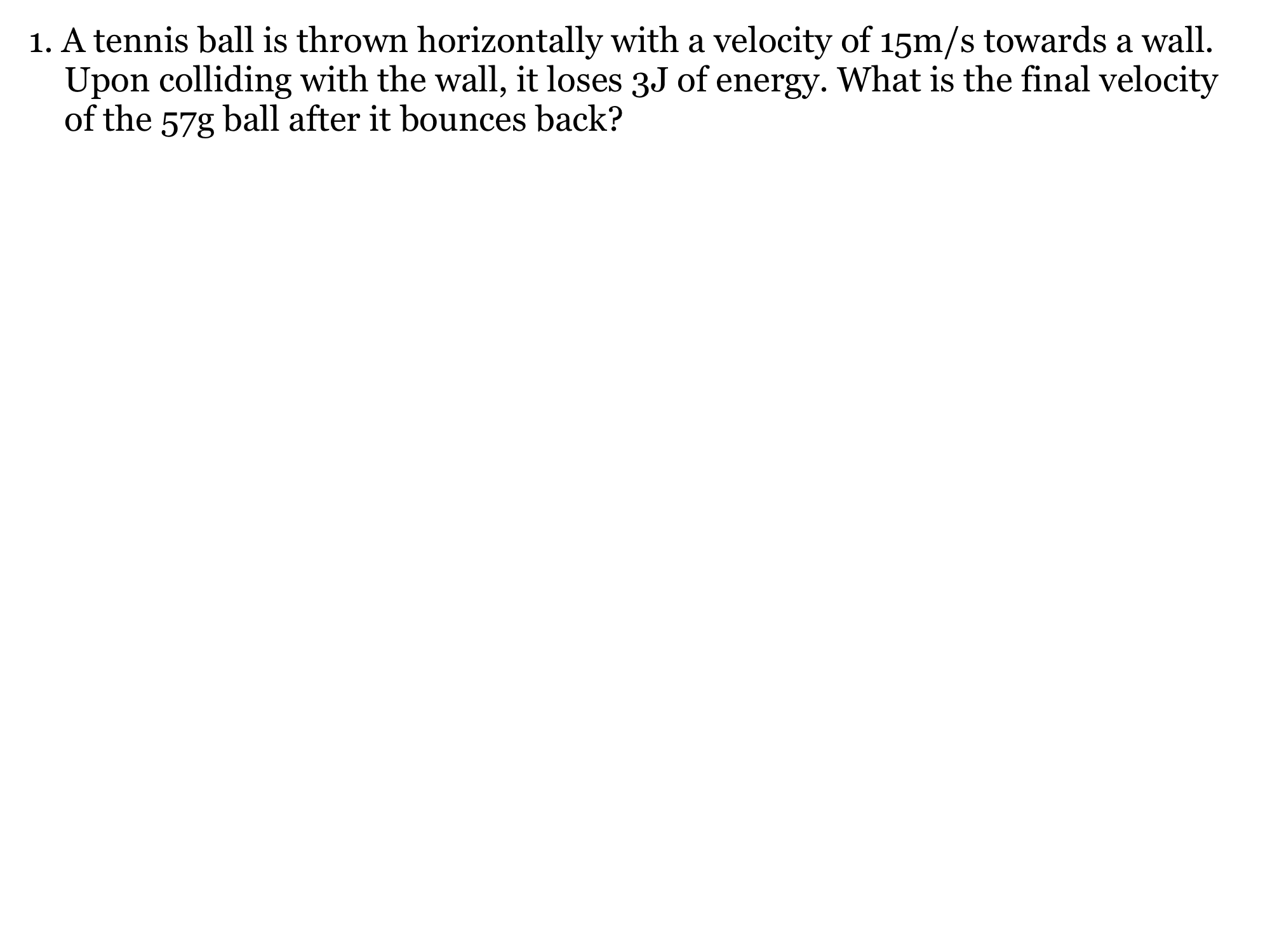
A 57 g tennis ball travels horizontally toward a wall at 15 m/s. Its collision reduces its kinetic energy by 3 J. Find its velocity after it rebounds, taking motion toward the wall as positive.
Drawing is temporarily unavailable. Work on paper if needed, then record your reasoning here.
Saving written working requires JavaScript. The problem remains available above; keep your work on paper or in your own notes.
Original problem 2
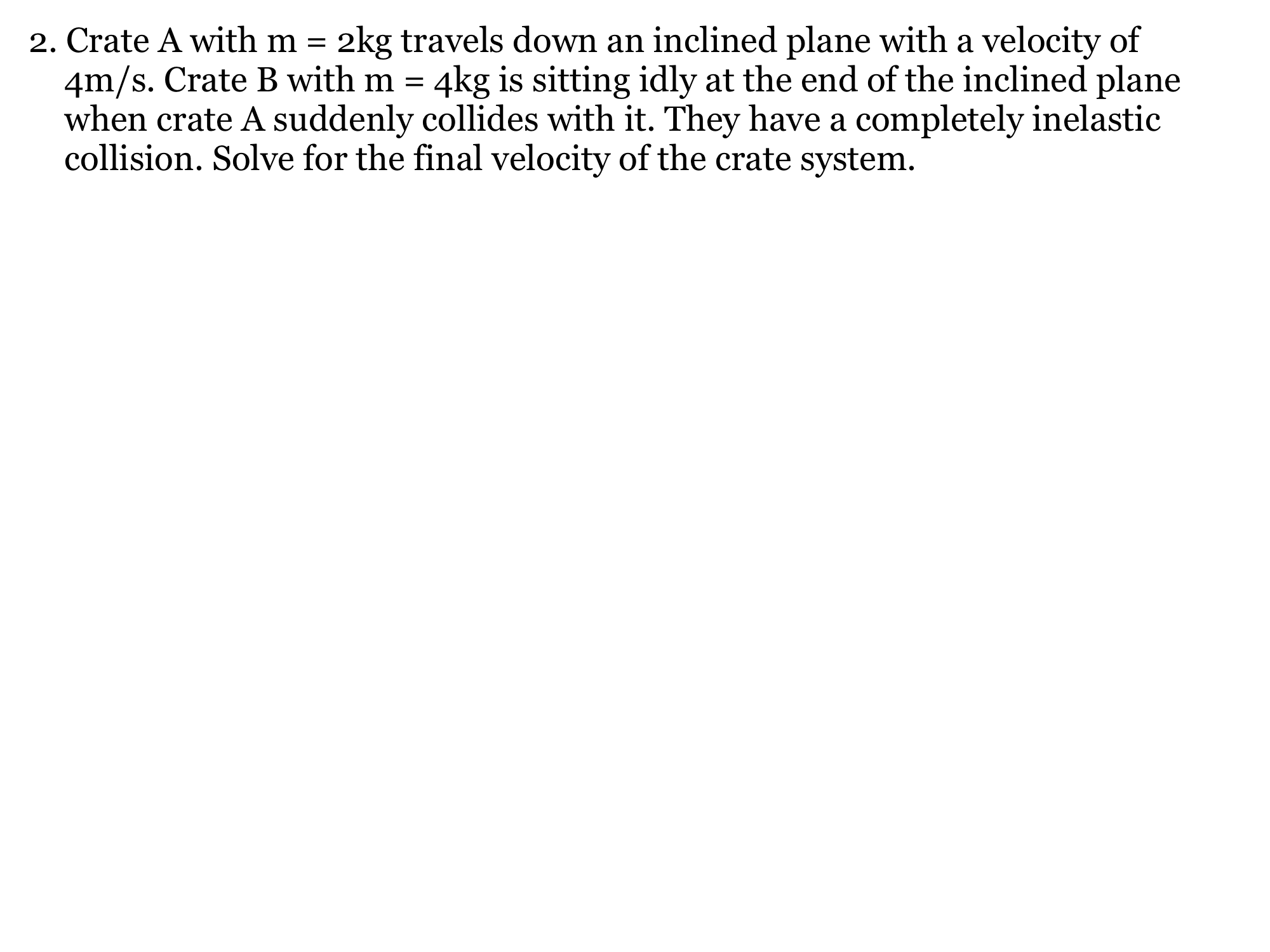
The stated 4 m/s is the speed immediately before impact. The formula requires a common collision axis; if the ramp redirects motion during impact, its external impulse must be included.
Problem text
A 2 kg crate A approaches a stationary 4 kg crate B at 4 m/s along the same collision axis. They stick together. Neglect external impulse along that axis during impact and find their common final velocity.
Drawing is temporarily unavailable. Work on paper if needed, then record your reasoning here.
Saving written working requires JavaScript. The problem remains available above; keep your work on paper or in your own notes.
Original problem 7
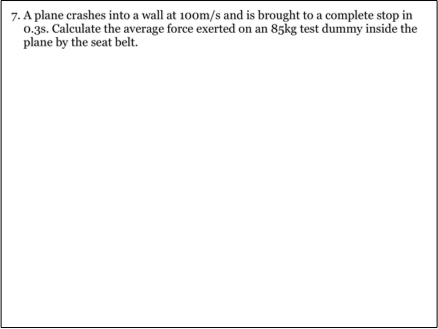
Recovered from the original low-resolution preview, which clearly shows 0.3 s and 85 kg after white-backed magnification. The foreground widget incorrectly repeats question 5.
Problem text
A plane crashes into a wall at 100 m/s and stops in 0.3 s. Calculate the average horizontal force exerted by the seat belt on an 85 kg test dummy, assuming the belt supplies the stopping impulse.
Drawing is temporarily unavailable. Work on paper if needed, then record your reasoning here.
Saving written working requires JavaScript. The problem remains available above; keep your work on paper or in your own notes.
Original problem 8
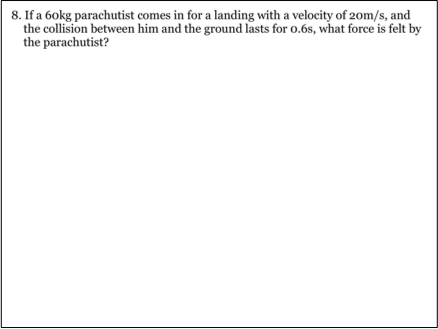
Recovered intended question 8. “Force felt” refers to the contact force; Δp/Δt alone gives the net force. Gravity is included in the stated answer.
Problem text
A 60 kg parachutist lands with downward speed 20 m/s and comes to rest over 0.6 s. Find both the average net vertical force and the average upward ground contact force. Use g = 9.81 m/s².
Drawing is temporarily unavailable. Work on paper if needed, then record your reasoning here.
Saving written working requires JavaScript. The problem remains available above; keep your work on paper or in your own notes.
Original problem 9
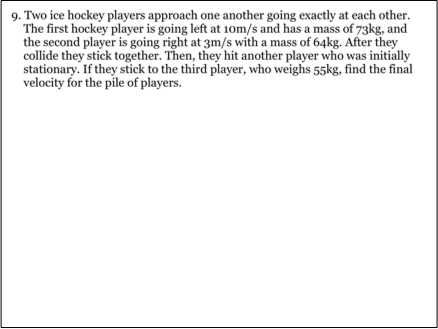
Recovered intended question 9. Assume external horizontal impulse is negligible in both collisions.
Problem text
A 73 kg hockey player moves left at 10 m/s and a 64 kg player moves right at 3 m/s. They collide and stick, then collide and stick with a stationary 55 kg player. Neglect external horizontal impulse and find the final velocity of all three.
Drawing is temporarily unavailable. Work on paper if needed, then record your reasoning here.
Saving written working requires JavaScript. The problem remains available above; keep your work on paper or in your own notes.
Original problem 10
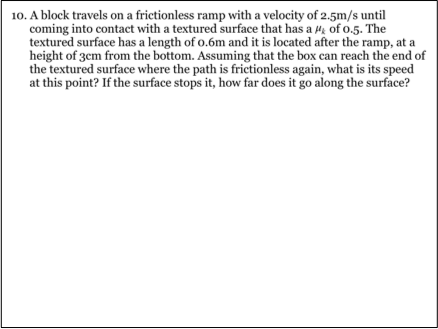
Recovered question 10 repeats energy question 10. Original wording did not say where 2.5 m/s was measured. The clarified model puts it at the bottom before the 3 cm rise. If 2.5 m/s were instead the speed at the patch entrance, it would cross the patch with speed 0.603 m/s.
Problem text
A block starts at the bottom of a frictionless ramp at 2.5 m/s. It climbs to a horizontal rough patch 3 cm above the bottom. The patch is 0.6 m long and has kinetic friction coefficient 0.5; beyond it the path is frictionless. Find whether the block reaches the far end. If it does, find its exit speed; if it stops, find its travel distance on the patch. Use g = 9.81 m/s².
Drawing is temporarily unavailable. Work on paper if needed, then record your reasoning here.
Saving written working requires JavaScript. The problem remains available above; keep your work on paper or in your own notes.


Original problem 3
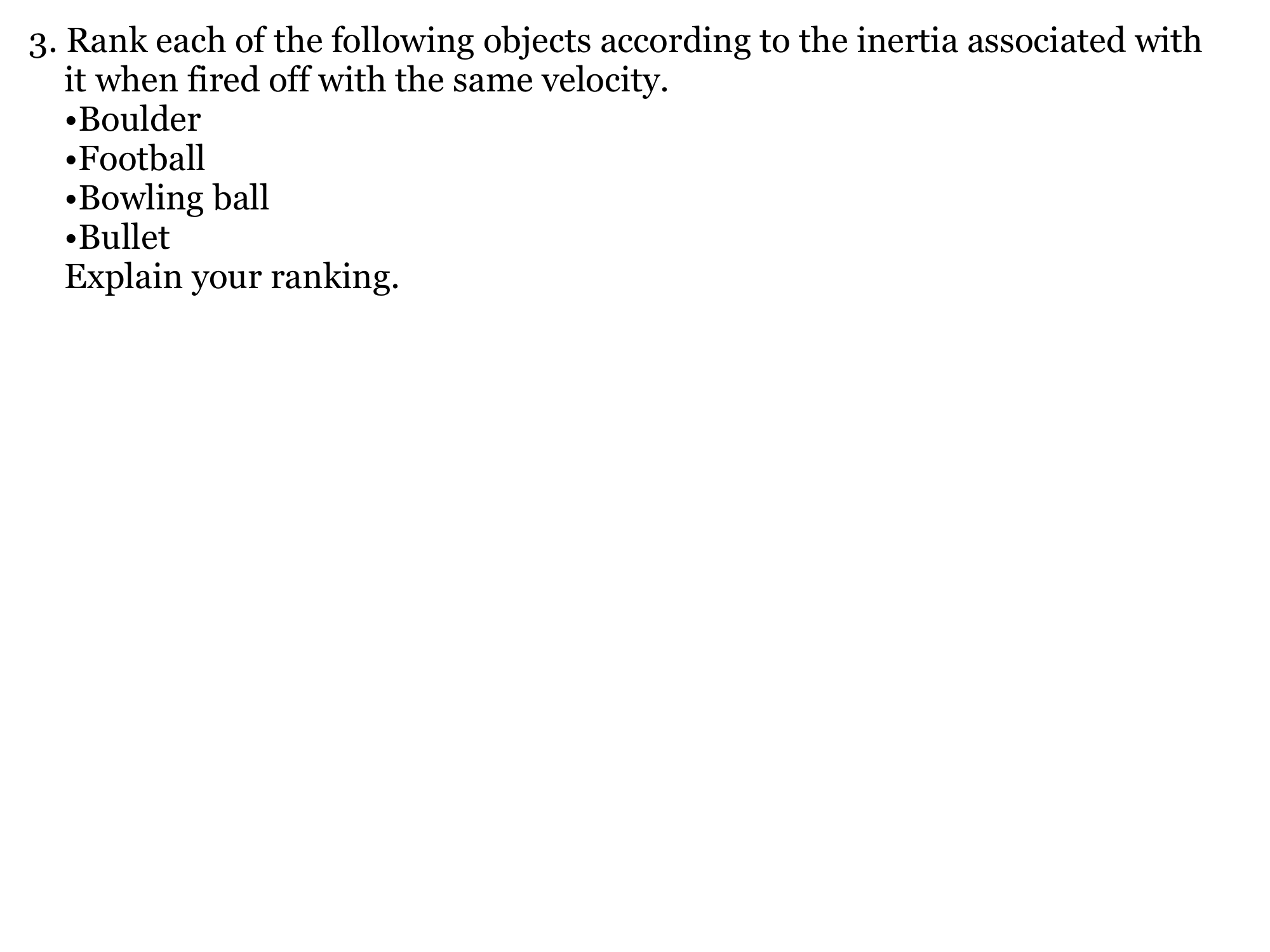
No masses are supplied. This ranking assumes ordinary objects of these types; unusual masses could change it.
Problem text
Using typical masses, rank a boulder, football, bowling ball, and bullet by inertia when each has the same velocity. Explain what inertia depends on and how their momentum magnitudes compare.
Drawing is temporarily unavailable. Work on paper if needed, then record your reasoning here.
Saving written working requires JavaScript. The problem remains available above; keep your work on paper or in your own notes.
Original problem 4
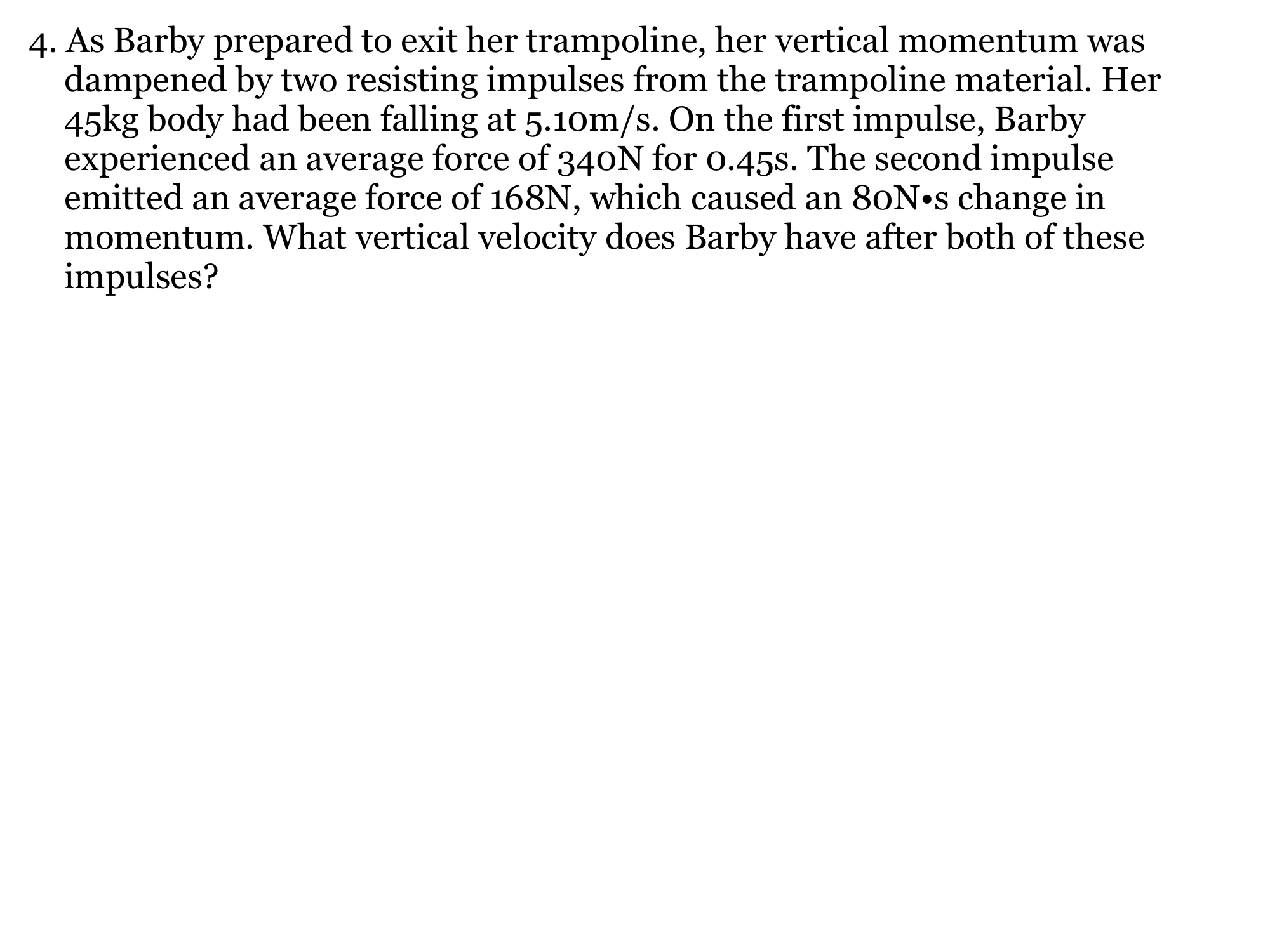
Editorial clarification: the given impulses are NET impulses, including gravity. If 340 N and 168 N instead mean upward trampoline forces alone acting successively, Δt_total = 0.45 + 80/168 = 0.9262 s; including gravity then gives v_f = −9.008 m/s. The original wording did not distinguish these models.
Problem text
Barby, mass 45 kg, is initially falling at 5.10 m/s. Two upward net impulses oppose her motion: the first has average net force 340 N for 0.45 s; the second has impulse 80 N·s and average net force 168 N. Find her velocity after both impulses. The net forces already include gravity.
Drawing is temporarily unavailable. Work on paper if needed, then record your reasoning here.
Saving written working requires JavaScript. The problem remains available above; keep your work on paper or in your own notes.
Original problem 5
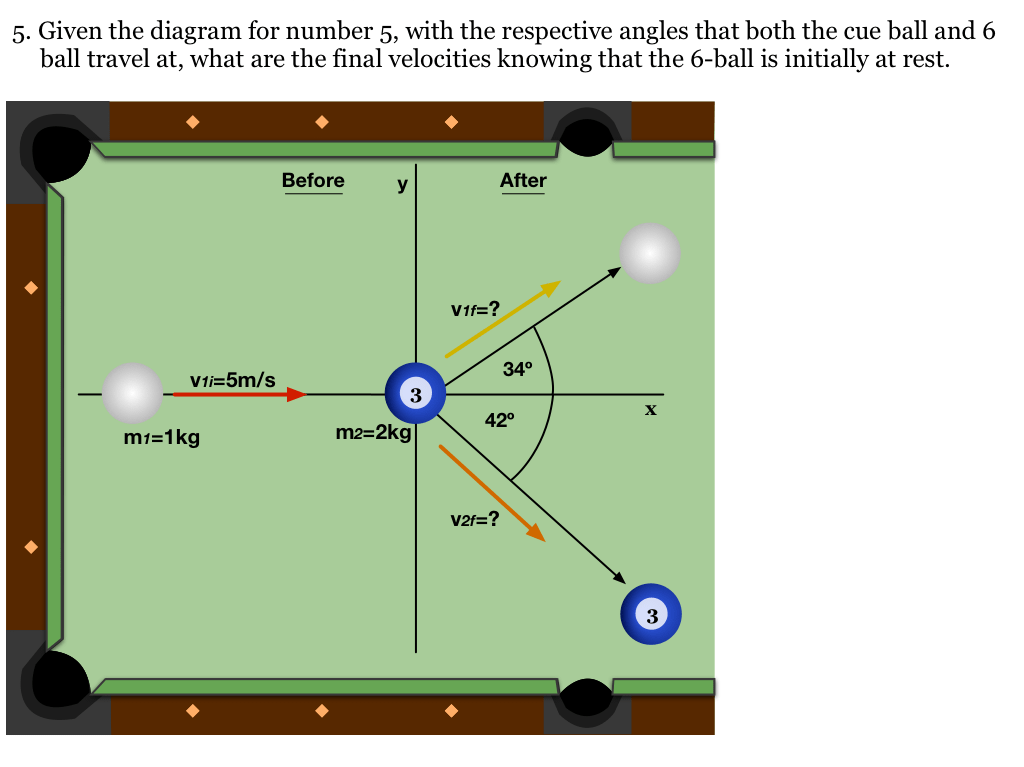
The diagram gives different masses and angles. Do not impose elastic kinetic-energy conservation; those values would be incompatible with that additional assumption.
Problem text
A 1 kg cue ball moves at 5 m/s along +x toward a stationary 2 kg ball. After collision the cue ball moves 34° above +x and the target ball 42° below +x. Neglect external impulse and find both final velocities.
Drawing is temporarily unavailable. Work on paper if needed, then record your reasoning here.
Saving written working requires JavaScript. The problem remains available above; keep your work on paper or in your own notes.
Original problem 6
Neglect external horizontal impulse during the collision.
Problem text
A 45 kg matador moving east at 4 m/s collides head-on with a 125 kg bull moving west at 8 m/s. They move together afterward. Neglect external horizontal impulse and find their common velocity.
Drawing is temporarily unavailable. Work on paper if needed, then record your reasoning here.
Saving written working requires JavaScript. The problem remains available above; keep your work on paper or in your own notes.
Reviewed physics notes (20)
These corrections keep the original lesson’s purpose while fixing errors in the source edition.
- Energy is a scalar dot product, and dimensions alone do not establish the coefficient. — Reference 1, Reference 2
- Work is transfer rather than a stored form of energy. — Reference 1, Reference 2
- Correct the source’s categorization of work. — Reference 1, Reference 2
- Division by a vector is not defined; the average-velocity ratio is a 1D result. — Reference 1
- The bounded integral gives kinetic-energy change, not absolute kinetic energy. — Reference 1
- Use an explicit integration dummy variable and appropriate zero limit. — Reference 1
- The source says C=m then incorrectly sets it to 1. — Reference 1
- Correct bounds and derivation. — Reference 1
- Correct dimensional/vector qualification. — Reference 1
- Changing integration variable requires changing limits to time. — Reference 1
- The source used velocity limits 7 and 13 as time limits. — Reference 1
- Correct integration bounds. — Reference 1
- Use time values rather than velocity values in the time antiderivative. — Reference 1
- Replace source 21,960 J with correct 600 J. — Reference 1
- Correct final answer. — Reference 1
- Correct equation list scalar product, energy-change notation, and power-law integration condition. — Reference 1
- Combined velocity 23600/6700 m/s givesK=23600²/(2·6700)=41564.18 J; source 83.1 kJ omits½. — Reference 1, Reference 2
- The 1D formula needs head-on, particle conditions. — Reference 1, Reference 2
- Original omitted mass, initial speed, and other forces;20 kg is inferred from existing 2.24 m/s key and explicitly labels this repaired classroom model. — Reference 1
- Carry the net/average force and isolation conditions into the chapter equation list. — Reference 1, Reference 2
Glossary and deeper reading · 8 refreshers
These editorial refreshers supplement the reading. Definitions and examples are added guidance; original source wording and recorded answers remain in their original context.
-
Linear momentum
Linear momentum is a vector describing an object’s motion and equals mass times velocity in the nonrelativistic model. The vector sum of momenta is conserved when the net external impulse on the system is zero. For example, two identical carts moving equally fast in opposite directions have zero total linear momentum but nonzero total kinetic energy.
-
Kinetic energy
Kinetic energy is energy associated with motion relative to a chosen reference frame. For a nonrelativistic translating object it is one half of its mass times speed squared. For example, doubling a cart’s speed quadruples its translational kinetic energy when its mass stays fixed.
-
Force
A force describes an interaction that can change an object’s momentum. It is a vector measured in newtons, so both size and direction matter when forces are added. For example, a rope can pull a cart while the floor exerts friction in another direction.
-
Mechanical work
Mechanical work is energy transferred by a force through displacement of its point of application. For a constant force on a particle, it depends on the force component along the particle’s displacement, and it can be positive, negative, or zero. For example, a magnetic force perpendicular to a particle’s displacement does zero work on that particle.
-
Displacement
Displacement is the vector change in position from the start of an interval to its end. It depends on those endpoints rather than the length or shape of the path traveled. For example, walking around a closed track and returning to the start gives zero displacement but a nonzero distance traveled.
-
Mechanical energy
Mechanical energy is the sum of the kinetic and potential energies included in a model. It stays constant when transfers to or from other energy stores and across the chosen boundary are absent. For example, a pendulum’s mechanical energy can remain approximately constant while energy shifts between motion and gravitational configuration.
-
Potential energy
Potential energy describes energy associated with the configuration of interacting parts of a system. Its numerical zero is a chosen reference, while differences in potential energy determine physical energy changes. For example, separating Earth and a ball changes their gravitational potential energy even though the energy belongs to their interaction.
-
Impulse
Impulse is the change in linear momentum produced by a force over a time interval. It equals the signed vector area under a force-versus-time graph and is measured in newton-seconds. For example, a padded landing spreads the stopping impulse over more time, reducing the average force for the same momentum change.