Access this content offline
Omniguides
Skip to the reading

Chapter 4 Solutions

Worked solutions to all thirty problems, with the reason for each step. These explanations were added for this edition; the chapter answer key and original worked examples follow below.

Chapter problems → · Chapter answer key → · Original worked examples →

Problem 1

Original problem · added worked solution

a) Implicitly differentiate the equation y=x⋅y⋅ex+1 ​
b) Write its derivative as a function of just
x.

Authored worked explanation for the original source problem.

Source review note: Source part (a) is consistent; source part (b) contains a factor 1−e^x where the explicit equation requires 1−xe^x.

  1. Differentiating the original equation gives y′=yex+xy′ex+xyex.

    Why: The three factors x, y, and e^x each contribute a product-rule term.

  2. Collect y′: (1-xex)y′=yex(1+x).

    Why: Move the derivative term before dividing.

  3. The original equation gives y=1/(1-xex), so substitute to get the final x-only expression.

    Why: This substitution also states the denominator restriction.

Reviewed answer: y′=ex(1+x)/(1-xex)2 where 1-xex≠0.

Takeaway: An explicit rewrite can check an implicit derivative.

Final answer

y′=ex(1+x)/(1-xex)2 where 1-xex≠0.

Problem 2

Original problem · added worked solution

Differentiate f(x)=tanxx2-4

Authored worked explanation for the original source problem.

Source review note: The source numerator uses tan x·sec x rather than sec²x for the derivative of tan x.

  1. Set u=tan x and v=x²−4, with u′=sec²x and v′=2x.

    Why: The denominator requires a quotient rule.

  2. Use (u′v-uv′)/v2 and keep x≠±2 and cos x≠0.

    Why: Both the original function and its derivative retain the original exclusions.

Reviewed answer: [(x2-4)sec2x-2xtanx]/(x2-4)2.

Takeaway: The derivative of tangent is secant squared.

Final answer

[(x2-4)sec2x-2xtanx]/(x2-4)2.

Problem 3

Original problem · added worked solution

Find the derivative of y=ex-4xsin2x

Authored worked explanation for the original source problem.

Source review note: The source incorrectly factors both quotient-rule terms using e^x−4, replacing the original e^x−4x in the second term.

  1. The numerator derivative is e^x−4; the denominator derivative is 2sinxcosx.

    Why: Use the chain rule for sin²x.

  2. The quotient numerator is (ex-4)sin2x-(ex-4x)2sinxcosx.

    Why: The second term uses the original numerator, not its derivative.

  3. Cancel one sine factor to get the answer, valid for sin x≠0.

    Why: Cancellation cannot add excluded inputs.

Reviewed answer: [(ex-4)sinx-2(ex-4x)cosx]/sin3x.

Takeaway: In the quotient rule, one numerator stays undifferentiated.

Final answer

[(ex-4)sinx-2(ex-4x)cosx]/sin3x.

Problem 4

Original problem · added worked solution

Using the equation (x-4)225+(y+1)216=1, find the slope of the tangent line at x=1 in the first quadrant .

Authored worked explanation for the original source problem.

Source review note: The source gives 48/55. At the first-quadrant point (1,11/5), y+1=16/5, so the denominator is 80 and the slope is 3/5.

  1. At x=1, (y+1)2/16=1-9/25=16/25, so the first-quadrant point has y=11/5.

    Why: The positive y-coordinate selects the upper ellipse branch.

  2. Differentiate: 2(x-4)/25+2(y+1)y′/16=0.

    Why: The y-term needs the chain rule.

  3. y′=-16(x-4)/(25(y+1)); at the point this is 48/80=3/5.

    Why: Evaluate using y+1, not y alone.

Reviewed answer: 3/5

Takeaway: The point must satisfy the curve before its slope is evaluated.

Final answer

3/5

Problem 5

Original problem · added worked solution

Differentiate y=xy+3exy2

Authored worked explanation for the original source problem.

Source review note: The source numerator omits the y term from differentiating xy.

  1. Multiply by y² to write y3=xy+3ex.

    Why: Clear the fraction while keeping its original y≠0 restriction.

  2. Differentiate to get 3y2y′=y+xy′+3ex.

    Why: The derivative of xy includes the undifferentiated y term.

  3. Collect y′ and divide by 3y²−x.

    Why: Isolate the derivative only where that coefficient is nonzero.

Reviewed answer: y′=(y+3ex)/(3y2-x), where the original y≠0 and the displayed denominator is nonzero.

Takeaway: Clearing fractions often simplifies implicit work.

Final answer

y′=(y+3ex)/(3y2-x), where the original y≠0 and the displayed denominator is nonzero.

Problem 6

Original problem · added worked solution

Differentiate y=xsiny+2cos(2x2)x3

Authored worked explanation for the original source problem.

Source review note: The source derivative drops a term involving y and gives a different sign/factor for the cos(2x²) contribution. The reviewed expression follows the cleared equation directly.

  1. Clear the x³ denominator: x3y=xsiny+2cos(2x2), keeping x≠0.

    Why: Multiplying first reduces the number of quotient-rule terms.

  2. Differentiate: 3x2y+x3y′=siny+xcosy·y′-8xsin(2x2).

    Why: The derivative of the inner 2x² is 4x, and the outside cosine derivative contributes a minus sign.

  3. Collect derivative terms to obtain the displayed expression.

    Why: The left product's 3x²y term must be included.

Reviewed answer: y′=(siny-3x2y-8xsin(2x2))/(x3-xcosy).

Takeaway: Label each product contribution before moving terms.

Final answer

y′=(siny-3x2y-8xsin(2x2))/(x3-xcosy).

Problem 7

Original problem · added worked solution

Differentiate y=x2⋅siny⋅ecosx

Authored worked explanation for the original source problem.

  1. Differentiate x², sin y, and e^(cos x) in separate product contributions.

    Why: A three-factor product rule changes one factor at a time.

  2. y′=2xsinyecosx+x2cosy·y′ecosx-x2sinyecosxsinx.

    Why: The sin y derivative includes y′; the exponential's inside derivative is −sin x.

  3. Move the y′ term left and divide by its nonzero coefficient.

    Why: Implicit differentiation solves for the derivative after all chain-rule terms are included.

Reviewed answer: y′=[2xsiny·ecosx-x2siny·ecosxsinx]/[1-x2cosy·ecosx].

Takeaway: An exponential of a function carries its inner derivative.

Final answer

y′=[2xsiny·ecosx-x2siny·ecosxsinx]/[1-x2cosy·ecosx].

Problem 8

Original problem · added worked solution

Using the equation given below, find the slope of its tangent line at x=π4 (Ref: Unit Circle):y2+1=y⋅sinx+y⋅cos(2x)+sinxy +cos2xy-sin2xy

Authored worked explanation for the original source problem.

Source review note: The source gives a general implicit derivative consistent with the relation but does not evaluate the requested slope at x=π/4.

  1. Multiply the source equation by y, retaining y≠0, and use cos2x-sin2x=cos(2x).

    Why: The two reciprocal terms combine using a double-angle identity.

  2. The result is y3+y=(y2+1)(sinx+cos(2x)), or (y2+1)(y-sinx-cos(2x))=0.

    Why: Factor before differentiating if it reveals the real branch.

  3. Since y2+1>0 for real y, y=sinx+cos(2x). Hence y′=cosx-2sin(2x).

    Why: The factor cannot vanish, so the second factor determines y.

  4. At π/4, y=√2/2≠0 and the slope is √2/2−2.

    Why: The point remains in the original domain.

Reviewed answer: y′(π/4)=2/2-2.

Takeaway: Algebra can simplify an implicit relation more than a large derivative formula.

Final answer

y′(π/4)=2/2-2.

Problem 9

Original problem · added worked solution

Find the implicit derivative of xy+x2e2x=cos(4x2+1)sinyex

Authored worked explanation for the original source problem.

  1. Multiply both sides by e^(2x) to get xy+x2=excos(4x2+1)siny.

    Why: The exponential multiplier is never zero.

  2. Differentiate the left to y+xy′+2x and the right by the three-factor product rule.

    Why: The cos factor contributes −8x sin(4x²+1); sin y contributes cos y·y′.

  3. Move the y′ contributions to the left and all remaining terms to the right.

    Why: Their coefficient is the displayed denominator and must be nonzero for this formula.

Reviewed answer: y′=[excos(4x2+1)siny-8xexsin(4x2+1)siny-y-2x]/[x-excos(4x2+1)cosy].

Takeaway: A common nonzero multiplier can simplify implicit quotients.

Final answer

y′=[excos(4x2+1)siny-8xexsin(4x2+1)siny-y-2x]/[x-excos(4x2+1)cosy].

Problem 10

Original problem · added worked solution

Find the implicit derivative of y=xsin(ln(y))+xycosx

Authored worked explanation for the original source problem.

  1. Differentiate xsin(lny) to sin(lny)+xcos(lny)y′/y.

    Why: Product and chain rules both apply, and ln y requires y>0.

  2. Differentiate xysecx to ysecx+xy′secx+xysecxtanx.

    Why: Each of the three factors changes once.

  3. Collect y′ to obtain the displayed fraction, with cos x≠0 and a nonzero derivative coefficient.

    Why: The source's longer expression is algebraically equivalent after multiplying by y cos²x.

Reviewed answer: y′=[sin(lny)+ysecx+xysecxtanx]/[1-xcos(lny)/y-xsecx].

Takeaway: Choose a compact equivalent form once the derivative is isolated.

Final answer

y′=[sin(lny)+ysecx+xysecxtanx]/[1-xcos(lny)/y-xsecx].

Problem 11

Added problem and worked solution

Differentiate f(x)=(x2+1)(x-2).

Authored solution to an added practice problem.

  1. Set u=x²+1 and v=x−2, so u′=2x and v′=1.

    Why: The product rule differentiates one factor at a time.

  2. f′=2x(x-2)+(x2+1)=3x2-4x+1.

    Why: Both contributions are needed.

Reviewed answer: 3x2-4x+1

Takeaway: The derivative of a product is a sum, not a product of derivatives.

Final answer

3x2-4x+1

Problem 12

Added problem and worked solution

Differentiate f(x)=x2sinx.

Authored solution to an added practice problem.

  1. The derivatives of x² and sin x are 2x and cos x.

    Why: Use one derivative in each contribution.

  2. f′=(2x)sinx+x2cosx.

    Why: The other factor remains unchanged each time.

Reviewed answer: 2xsinx+x2cosx

Takeaway: Mark which factor changed in each term.

Final answer

2xsinx+x2cosx

Problem 13

Added problem and worked solution

Differentiate f(x)=xexsinx.

Authored solution to an added practice problem.

  1. In xexsinx, differentiate x, then e^x, then sin x while holding the other two factors fixed.

    Why: The three-factor rule has three contributions.

  2. Add the contributions shown in the answer.

    Why: Differentiation is linear across those contributions.

Reviewed answer: exsinx+xexsinx+xexcosx

Takeaway: A product of three functions needs three terms.

Final answer

exsinx+xexsinx+xexcosx

Problem 14

Added problem and worked solution

Differentiate f(x)=(2x-1)/(x+2).

Authored solution to an added practice problem.

  1. Use u=2x−1, v=x+2, with derivatives 2 and 1.

    Why: The quotient rule is (u′v−uv′)/v².

  2. The numerator is 2(x+2)-(2x-1)=5.

    Why: Keep the subtraction around the whole numerator.

Reviewed answer: 5/(x+2)2, x≠−2.

Takeaway: Simplifying the quotient-rule numerator can expose a constant.

Final answer

5/(x+2)2, x≠−2.

Problem 15

Added problem and worked solution

Differentiate f(x)=sinx/x.

Authored solution to an added practice problem.

  1. The numerator derivative is cos x and the denominator derivative is 1.

    Why: Use the quotient rule in the original domain.

  2. The result is (xcosx-sinx)/x2.

    Why: The denominator is squared and the second term is subtracted.

Reviewed answer: [xcosx-sinx]/x2, x≠0.

Takeaway: The order in the quotient rule determines the sign.

Final answer

[xcosx-sinx]/x2, x≠0.

Problem 16

Added problem and worked solution

Differentiate f(x)=(x2+3)10.

Authored solution to an added practice problem.

  1. The outside tenth power gives 10(x2+3)9.

    Why: Differentiate the outside while keeping its input.

  2. Multiply by the inside derivative 2x.

    Why: The chain rule accounts for the changing inner input.

Reviewed answer: 20x(x2+3)9

Takeaway: Every nested function contributes its own derivative.

Final answer

20x(x2+3)9

Problem 17

Added problem and worked solution

Differentiate f(x)=sin3(2x).

Authored solution to an added practice problem.

  1. The cube gives 3sin2(2x).

    Why: Begin with the outermost function.

  2. The sine gives cos(2x), and the inner 2x gives 2.

    Why: Multiply every layer's derivative.

Reviewed answer: 6sin2(2x)cos(2x)

Takeaway: Work inward one layer at a time.

Final answer

6sin2(2x)cos(2x)

Problem 18

Added problem and worked solution

Differentiate f(x)=e-x2.

Authored solution to an added practice problem.

  1. The outside exponential keeps e-x2.

    Why: The derivative of e^u is e^u times u′.

  2. The inside derivative is −2x.

    Why: Keep the negative sign from the inner exponent.

Reviewed answer: -2xe-x2

Takeaway: The exponent's derivative supplies the multiplier.

Final answer

-2xe-x2

Problem 19

Added problem and worked solution

Find the derivative and its domain for f(x)=3x+1.

Authored solution to an added practice problem.

  1. Write f as (3x+1)1/2.

    Why: The power form identifies the outside derivative.

  2. Differentiate to (1/2)(3x+1)-1/2·3.

    Why: The inside linear expression contributes its slope 3.

Reviewed answer: 3/(23x+1), x>−1/3.

Takeaway: The derivative's domain may exclude a radical's endpoint.

Final answer

3/(23x+1), x>−1/3.

Problem 20

Added problem and worked solution

Find the tangent line to x2+y2=25 at (3,4).

Authored solution to an added practice problem.

  1. Differentiate x2+y2=25 to 2x+2yy′=0.

    Why: The y² term needs the chain rule.

  2. At (3,4), solve y′=−3/4 and use point-slope form.

    Why: The point satisfies the circle equation and y is nonzero.

Reviewed answer: y′=-x/y; at (3,4), slope −3/4 and line y-4=-(3/4)(x-3).

Takeaway: Use the given point only after the general derivative is found.

Final answer

y′=-x/y; at (3,4), slope −3/4 and line y-4=-(3/4)(x-3).

Problem 21

Added problem and worked solution

Find dy/dx for x2+xy+y2=7.

Authored solution to an added practice problem.

  1. Differentiate to 2x+y+xy′+2yy′=0.

    Why: The xy term uses the product rule.

  2. Collect y′(x+2y)=-(2x+y) and divide where x+2y≠0.

    Why: Separate the terms that contain the unknown derivative.

Reviewed answer: y′=-(2x+y)/(x+2y).

Takeaway: A cross term contributes both a y term and an x y′ term.

Final answer

y′=-(2x+y)/(x+2y).

Problem 22

Added problem and worked solution

Differentiate sin(xy)=x implicitly.

Authored solution to an added practice problem.

  1. Differentiate sin(xy)=x to cos(xy)(y+xy′)=1.

    Why: The inside product xy changes with x in two ways.

  2. Solve for y′ by subtracting y cos(xy) and dividing by x cos(xy).

    Why: Keep the coefficient restriction in the answer.

Reviewed answer: y′=(1-ycos(xy))/(xcos(xy)), where the denominator is nonzero.

Takeaway: Nested implicit functions require both chain and product rules.

Final answer

y′=(1-ycos(xy))/(xcos(xy)), where the denominator is nonzero.

Problem 23

Added problem and worked solution

Find f′(0) for f(x)=(x+1)e2xcosx.

Authored solution to an added practice problem.

  1. f′(x)=e2xcosx+2(x+1)e2xcosx-(x+1)e2xsinx.

    Why: Differentiate each factor of (x+1)e^(2x)cos x.

  2. At 0, the three contributions are 1, 2, and 0, so the derivative is 3.

    Why: e⁰=1, cos0=1, and sin0=0.

Reviewed answer: f′(0)=3.

Takeaway: Evaluate after writing all contributions.

Final answer

f′(0)=3.

Problem 24

Added problem and worked solution

At x=2, a table gives f=3, f′=-1, g=5, and g′=2. Find the derivative of h=fg there.

Authored solution to an added practice problem.

  1. For h=fg, h′(2)=f′(2)g(2)+f(2)g′(2).

    Why: The rule uses both original heights and slopes.

  2. Substitute to get (-1)(5)+3(2)=1.

    Why: The table has all four needed values.

Reviewed answer: h′(2)=1.

Takeaway: A derivative can be found without explicit function formulas.

Final answer

h′(2)=1.

Problem 25

Added problem and worked solution

At x=2, f=3, f′=-1, g=5, and g′=2. Find the derivative of h=f/g there.

Authored solution to an added practice problem.

  1. For h=f/g, use h′=(f′g-fg′)/g2.

    Why: The denominator is nonzero at the point.

  2. Using f=3, f′=−1, g=5, g′=2 gives (-5-6)/25=-11/25.

    Why: Square the function's denominator value, not its derivative.

Reviewed answer: h′(2)=-11/25.

Takeaway: The same data give different answers for a product and a quotient.

Final answer

h′(2)=-11/25.

Problem 26

Added problem and worked solution

If g(1)=4, g′(1)=4, and f′(4)=-3, find the derivative of h(x)=f(g(x)) at 1.

Authored solution to an added practice problem.

  1. h′(1)=f′(g(1))g′(1) for h=f∘g.

    Why: The outer derivative is evaluated at the inner output.

  2. Use g(1)=4, f′(4)=−3, and g′(1)=4 to get −12.

    Why: Using f′(1) would look up the wrong input.

Reviewed answer: h′(1)=-12.

Takeaway: The inside output determines the outer derivative's input.

Final answer

h′(1)=-12.

Problem 27

Added problem and worked solution

A student says the derivative of sin(3x2) is cos(3x2). Diagnose the error.

Authored solution to an added practice problem.

  1. The outside sine contributes cos(3x²).

    Why: Keep its original inside expression.

  2. The inside derivative of 3x² is 6x, so multiply by 6x.

    Why: The proposed answer omitted the chain-rule multiplier.

Reviewed answer: Correct derivative 6xcos(3x2).

Takeaway: A nested derivative is incomplete without the inside derivative.

Final answer

Correct derivative 6xcos(3x2).

Problem 28

Added problem and worked solution

What happens to the tangent of x2+y2=1 at (1,0)?

Authored solution to an added practice problem.

  1. The circle derivative is y′=-x/y wherever y≠0.

    Why: It comes from 2x+2y y′=0.

  2. At (1,0), the implicit derivative equation would require 2+0·y′=0, impossible for a finite y′.

    Why: A zero derivative coefficient can indicate a vertical tangent.

  3. The circle's rightmost point has a vertical tangent x=1.

    Why: Geometry supplies the line even when slope-intercept form fails.

Reviewed answer: At (1,0), no finite dy/dx; the tangent line is x=1.

Takeaway: Not every tangent can be represented by a finite dy/dx.

Final answer

At (1,0), no finite dy/dx; the tangent line is x=1.

Problem 29

Added problem and worked solution

Find the second derivative of f(x)=ex2.

Authored solution to an added practice problem.

  1. First f′=2xex2 by the chain rule.

    Why: The inner square contributes 2x.

  2. Differentiate that product: f′′=2ex2+2x·ex2·2x.

    Why: The first derivative contains two changing factors.

  3. Factor out e^(x²) to get the answer.

    Why: Combining terms makes positivity visible.

Reviewed answer: f′′(x)=(4x2+2)ex2.

Takeaway: A first chain derivative can become a product in the second pass.

Final answer

f′′(x)=(4x2+2)ex2.

Problem 30

Added problem and worked solution

Find the slope of x+y+xy=3 at (1,1).

Authored solution to an added practice problem.

  1. Differentiate x+y+xy=3 to 1+y′+y+xy′=0.

    Why: The mixed product supplies both y and x y′.

  2. (1+x)y′=-(1+y), so at (1,1) y′=−2/2=−1.

    Why: Check first that the point satisfies the original equation.

Reviewed answer: y′=-1 at (1,1).

Takeaway: Collect the unknown slope before inserting coordinates.

Final answer

y′=-1 at (1,1).

Chapter answer key and worked steps

Answers and worked steps for the original problems, including verified corrections where needed.

  1. Corrected answer

    y′=ex(1+x)/(1-xex)2 where 1-xex≠0.
    Problem 1 →
  2. Corrected answer

    [(x2-4)sec2x-2xtanx]/(x2-4)2.
    Problem 2 →
  3. Corrected answer

    [(ex-4)sinx-2(ex-4x)cosx]/sin3x.
    Problem 3 →
  4. Corrected answer

    3/5
    Problem 4 →
  5. Corrected answer

    y′=(y+3ex)/(3y2-x), where the original y≠0 and the displayed denominator is nonzero.
    Problem 5 →
  6. Corrected answer

    y′=(siny-3x2y-8xsin(2x2))/(x3-xcosy).
    Problem 6 →
  7. Original short answer

    dydx=2x⋅siny⋅ecosx-x2⋅siny⋅ecosx⋅sinx1-x2⋅cosy⋅ecosx
    Problem 7 →
  8. Checked answer

    y′(π/4)=2/2-2.
    Problem 8 →
  9. Original short answer

    dydx=ex⋅cos(4x2+1)⋅siny-8x⋅ex⋅sin(4x2+1)⋅siny-y-2xx-ex⋅cos(4x2+1)⋅cosy
    Problem 9 →
  10. Original short answer

    dydx=y(cos2x⋅sin(ln(y))+y⋅cosx+x⋅y⋅sinx)cosx(y⋅cosx-x⋅cosx⋅cos(ln(y))-x⋅y)
    Problem 10 →

Read the chapter answer key in the book →

Source worked examples

These are the book’s example problems and worked steps, with the original explanations.

Example Problem 4.1.1

The Product Rule →

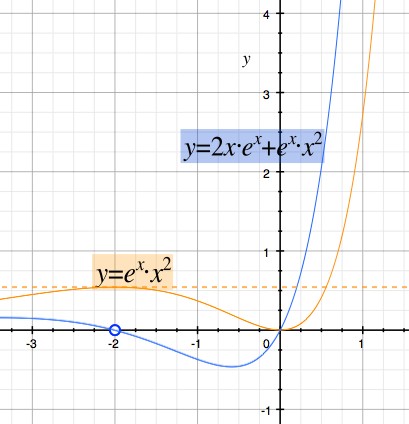
Find the slope of the tangent line at x=−2 of  F(x)=ex⋅x2

Given the function F(x)=ex⋅x2, for the sake of using the product rule we can say f(x)=ex and g(x)=x2 , giving us f′(x)=ex and g′(x)=2x. Now that we know these values, let’s plug them into our formula.

F′(x)=f′(x)⋅g(x)+f(x)⋅g′(x)=ex⋅x2+ex⋅2x​
This is the final derivative of the function. Plugging in x=-2 for this function gives us​
F′(x)=e-2⋅(2)2+e-2⋅2(-2)=0

Interactive 4.1.1 Example Problem 4.1.1
Interactive 4.1.1 Example Problem 4.1.1
Read all original figure notes

The Derivative Function

The blue function is the derivative function we calculated using the product rule. Note that it crosses y=0 (the x-axis) whenever the slope of a tangent line to the original function equals 0, namely at points x=-2 and x=0

The Original Function

The graph of the original function, y=ex•x2, is shown here. Note that it has a tangent line with a slope of 0 at x=-2 and x=0. Our point of interest is x=-2

Return to the original example →

Example Problem 4.1.2

The Product Rule →

Find the derivative function of F(x)=x32⋅sinx⋅cosx

For this case, let’s make a table:

f(x)=x32f′(x) =32x2g(x)=sinxg′(x)=cosxh(x)=cosxh′(x)=-sinx

Now let’s plug these values into our formula​
F′(x)=f′(x)⋅g(x)⋅h(x)+f(x)⋅g′(x)⋅h(x)+f(x)⋅g(x)⋅h′(x)

=32x2sinxcosx+x32cosxcosx+x32sinx(-sinx)

=32x2sinxcosx+x32cos2x-x32sin2x

=32x2sinxcosx+x32(cos2x-sin2x)

=34x2⋅2sinxcosx+x32(cos(2x))

=34x2⋅sin(2x)+x32cos(2x)

For the last two steps, refer to the double angle formulas

Return to the original example →

Example Problem 4.1.3

The Product Rule →

Find y’’ if y=cosxx

Let’s challenge ourselves with the first part of this problem and do it without making any tables, and doing the derivatives in our heads. When solving problems for exams, it really helps writing down the first derivative of each “product” function. This is just an exercise to increase our proficiency with the product rule.​
Here, we have
f(x) = cos(x) and g(x) = x. So,y′=cosx2x-sinxx​
A good shortcut to remember when taking the derivative of x is that it is equal to 12x. You can just as easily prove this shortcut using the power rule, since x=x12.

Here we may want to make a table.

f1(x)=cosxf1′(x) =-sin(x)g1(x)=x-12g1′(x)=-12x-32f2(x)=-sinxf2′(x) =-cosxg2(x)=xg2′(x)=12x-12

y′′=12(-sin(x)⋅x-12-12x-32⋅cosx)lll+(-cosxx+12x-12(-sinx)) ​
Now we add like terms and distribute.

y′′=-sinx⋅x-12-14cosx⋅x-32-cosxx

y′′=-sinx⋅x-12-cosx(14⋅x-32+x)

This is our final answer, that was so easy!

Return to the original example →

Example Problem 4.2.1

The Quotient Rule →

Prove that the derivative of sec(x) is sec(x)tan(x) using the reciprocal rule.

Here, we know two things that can help us:​
1) secx=1cosx

2) ddxcosx=-sinx​
Plugging these into the reciprocal rule formula gives us:

ddx1cosx=--sinxcos2x

=1cosx⋅sinxcosx

=secx⋅tanx

That’s it! Easy, huh.

Return to the original example →

Example Problem 4.2.2

The Quotient Rule →

Using the reciprocal rule, prove that the derivative of csc(x) is -csc(x)•cot(x)

We know that cscx=1sinx. Let’s plug this into the reciprocal rule to find its derivative.​
ddxcscx=-ddxsinxsin2x

ddxcscx=-cosxsin2x

ddxcscx=-cosxsinx⋅1sinx​
ddxcscx=-cotx⋅cscx​
We proved it! Now if you forget any of these trigonometric derivatives during an exam, you can go back and derive it with ease using the reciprocal rule.

Return to the original example →

Example Problem 4.2.3

The Quotient Rule →

Find the derivative of the functionF(x)=3x4+2x2+1xex

We must find the derivative using the quotient rule because one function is divided by another. First let’s write out the quotient rule.

ddxf(x)g(x)=f′(x)⋅g(x)-f(x)⋅g′(x)g(x)2​
In this case, f(x)=3x4+2x2+1x and g(x)=ex. =ddx(3x4+2x2+1x)⋅ex-(3x4+2x2+1x)⋅ddxex(ex)2

=(12x3+4x-1x2)⋅ex-(3x4+2x2+1x)⋅ex(ex)2​
Here, we can factor out an ex from the numerator since it is present in both terms, and divide it by one of the ex in the denominator.

=ex(3x4+12x3+2x2+4x+1x-1x2(ex)2

=3x4+12x3+2x2+4x+1x-1x2ex

Return to the original example →

Example Problem 4.2.4

The Quotient Rule →

Prove using the quotient rule that the derivative of cot(x) is -csc2(x).

We know that cot(x)=cosxsinx​
Here, let’s try to skip a step and do the derivatives in our heads.​
ddxcot(x)=sinx⋅(-sinx)-cosx⋅cosxsin2x​
=-sin2x-cos2xsin2x=-sin2x+cos2xsin2x​
=-1sin2x​
=-csc2x
. That was easy!

Return to the original example →

Example 4.3.1

The Chain Rule →

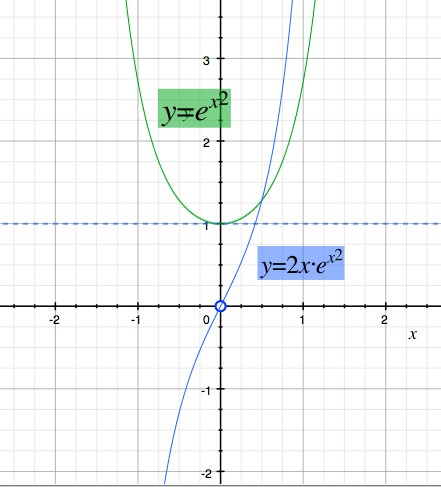
Find the derivative of y=ex2 using the chain rule .

Using the chain rule formula, we can rewrite this as y=eg(x). Therefore,

dydx=ddxeg(x)⋅ddxg(x). If we consider now that g(x)= x2, we can see that dydx=ex2⋅2x

The chain rule is probably the second-hardest derivative concept to grasp. So perhaps a picture will help convince you that this is indeed true. Refer to Interactive 4.3.1.

Interactive 4.3.1 Visualizing the Chain Rule
Interactive 4.3.1 Visualizing the Chain Rule
Read all original figure notes

Function approaches +∞

Notice that the function is approaching ∞ really fast! So fast that the derivative increases even faster than the base function. If we were to zoom out, this function would look something like a frog’s tongue, long and narrow.

Derivative = 0

Notice that when the slope of the tangent line to the parent function equals 0, the derivative function crosses the y-axis.

Return to the original example →

Example Problem 4.3.2

The Chain Rule →

Differentiate y=xcos(sin(x))

This one needs an extra tool: the exponent cos(sin x) changes with x, so the ordinary constant-exponent power rule does not apply. For x > 0, let y = xcos(sin x) and take natural logs: ln y = cos(sin x) ln x.

Differentiate both sides using the product and chain rules: y′/y = −sin(sin x) cos x ln x + cos(sin x)/x. The minus sign comes from differentiating cosine, and the second term comes from differentiating ln x.

Now multiply by y and replace y with the original expression. Both terms are needed because both the base and the exponent change.

y′=xcos(sin(x))(cos(sin(x))x−sin(sin(x))⋅cos(x)⋅ln(x)), for x > 0.

Return to the original example →

Example Problem 4.3.3

The Chain Rule →

Find the derivative of y=x⋅ecos(x2)sinx

This is probably going to be one of the hardest derivatives we have taken so far, combining the product, quotient, power, and chain rules all in one. Try to follow along very carefully. We start off with the quotient rule. We choose f(x)=x⋅ecos(x2) and g(x)=sinx, so that:

dydx=sinx⋅ddx(x⋅ecos(x2))-x⋅ecos(x2)⋅ddx(sinx)sin2x

One of the derivatives above we can easily do. The other one requires using both the product rule and chain rule. Let’s solve the harder one separately, starting out with the product rule.ddx(x⋅ecos(x2))=x⋅ddxecos(x2)+1⋅ecos(x2)=x⋅ecos(x2)ddxcos(x2)+ecos(x2)=x⋅ecos(x2)(-sin(x2))ddxx2+ecos(x2)=-2x2⋅ecos(x2)⋅sin(x2)+ecos(x2)

dydx=sinx⋅(-2x2⋅ecos(x2)⋅sin(x2)+ecos(x2))-x⋅ecos(x2)⋅(cosx)sin2x

Notice that ecos(x2) is present in all three terms in the numerator. We can factor this out.

dydx=ecosx2(sinx(-2x2sin(x2)+1)-xcosx)sin2x

Read all original image captions

Image 1

Image 2

Image 3

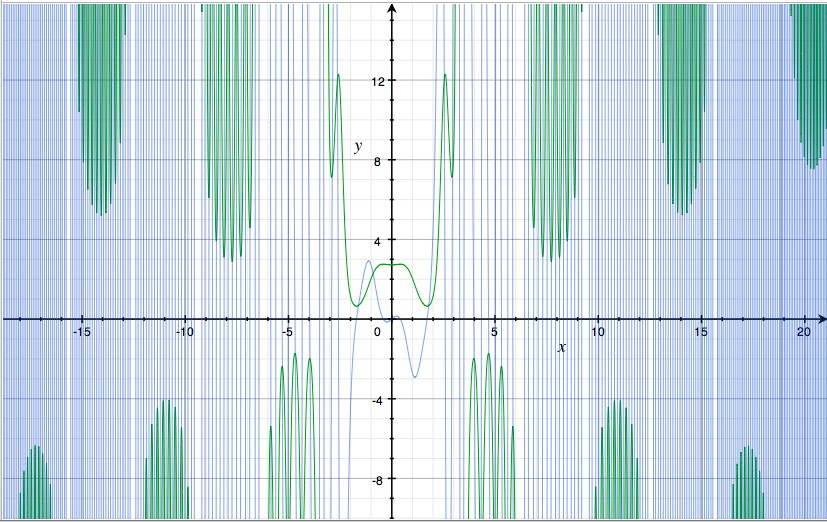
This is the same graph with a logarithmic scale on the y-axis to show the general trend.

Image 4

Here we have reached the limits of computer calculation. Floating point numbers are accurate to approximately 7 decimal points.

Interactive 4.3.2 The hardest derivative ever (so far)
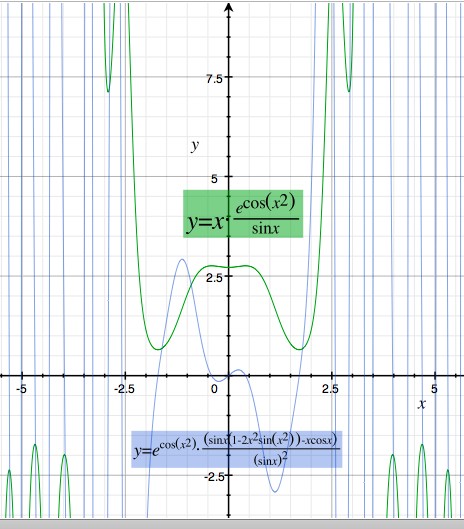
Interactive 4.3.2 The hardest derivative ever (so far)
Read all original figure notes

A hole with limit e

The original function F(x) = x ecos(x²)/sin(x) is undefined at x = 0 because its denominator is 0. But limx→0 x/sin(x) = 1 and ecos(x²) → e, so its limit is e ≈2.71828. If we explicitly define F(0) =e, we obtain a continuous extension. The value at the hole and the limit are different questions.

When is the derivative = 0?

Notice that the graph of the derivative function that we calculated crosses y=0 whenever the tangent line to the green function would have a slope of 0. This seems to be a pretty good indicator that we have the right derivative.

Return to the original example →

Example Problem 4.4.1

FFR - Implicit Differentiation →

Take the derivative of y=3xy+x2 using:

  1. conventional methods
  2. using implicit differentiation.

a) Let’s start by isolating y to one side so we can set x in terms of y, making the function explicit. We can accomplish this by first subtracting 3xy on both sides.

y-3xy=x2

y⋅(1-3x)=x2

y=x21-3x

Now we can take the derivative using the quotient rule.

y′=((1-3x)⋅ddxx2)-(x2⋅ddx(1-3x))(1-3x)2 y′=(1-3x)⋅2x-x2⋅(-3)(1-3x)2

y′=2x−3x2(1−3x)2. The numerator is 2x(1 − 3x) + 3x² = 2x − 3x².

b) We don’t need to set y in terms of x for part b. We can just differentiate implicitly using the chain rule.

y=x2+3xy​
dydx=2x+ddx3xy

using the product rule, we get

dydx=2x+3y+3x⋅1⋅dydx​
Here, we can isolate the derivative terms to one side to find out what the derivative function is.​
dydx-3x⋅dydx=2x+3y​
dydx(1-3x)=2x+3y

dydx=2x+3y1-3x

Normally this would be enough, but we want to compare our answer to part a, so let’s substitute y because we set it in terms of x explicitly earlier.

Substituting y=x21-3x gives:

dydx(1-3x)=2x+3x21-3x​
Let’s find a common denominator for the two terms on the right hand side before dividing through by (1-3x)

dydx(1-3x)=2x⋅(1-3x1-3x)+3x21-3x ​
dydx(1-3x)=2x-6x2+3x21-3x

Now we can divide by (1-3x) on both sides and we find that

dydx=2x-3x2(1-3x)2 We get the same answer! Amazing!

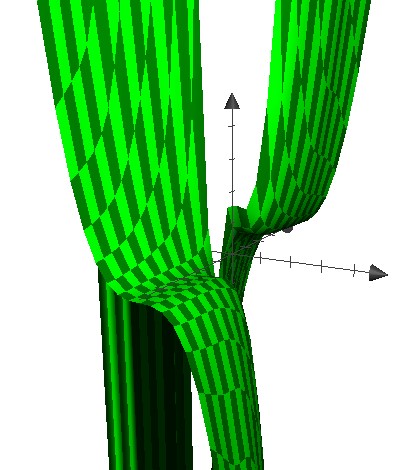
Despite what your intuition might tell you, the y-axis is the one in the back. The z-axis (representing dy/dx) is the one going up and down. As usual, the x-axis goes left and right. It takes a while getting accustomed to reading 3-D graphs so take a look at this one carefully.

Read all original image captions

Image 1

Despite what your intuition might tell you, the y-axis is the one in the back. The z-axis (representing dy/dx) is the one going up and down. As usual, the x-axis goes left and right. It takes a while getting accustomed to reading 3-D graphs so take a look at this one carefully.

Image 2

This view of the graph shows the x-axis pointing directly at us. It allows us to look at the y-z plane. Notice the function is undefined when y= 0. The curvy contour lines that we see on the surface of the graphs have a special name, a “family of functions” that differ only by a constant.

Image 3

This view of the graph shows the y-axis pointing away from us, which conveniently allows us to see the change in the derivative function with respect to the x-value. These graphs look really neat and show us how the derivative behaves, but do they tell the whole story?

Image 4

Hopefully some of you noticed that we were missing something while being distracted by the pretty 3-D graphs. The derivative function has no restrictions the way it is written, so it doesn’t tell the whole story. What do you think this new graph represents?

Image 5

Correct! It is our parent function, y2=sin(y)cos(y)+x4. This is the function viewed on the x-y plane, how we are probably used to looking at it in two dimensions. Notice that since it has no z-component, it extends infinitely in the z-drection because it is independent of its derivative.

Image 6

From this angle, we can see what the intersection of the two graphs looks like. The curves where the two graphs intersect represent the fulfillment of two conditions: 1) Their x and y coordinates represent actual solutions to our base function, and

Image 7

2) Their derivative at these points is represented by the z-coordinate.​
This view of the graph shows the x-axis moving away from us. You can compare the difference with the previous graph, which shows positive x-values. This curve represents negative x-values.

Return to the original example →

Example Problem 4.4.2

FFR - Implicit Differentiation →

Find the derivative of y2=sinxcosy+x4

We have no choice but to use implicit differentiation here because there is no simple way to isolate y. Remember that whenever we take the derivative of a term with “y” in it, we have to use the chain rule and multiply by dydx after we finish taking the derivative.

2y⋅dydx=ddx(sinxcosy)+4x3​
2y⋅dydx=cosxcosy+sinx⋅(-siny⋅dydx)+4x3​
Let’s get the dy/dx terms on one side. Notice the two sine functions have different arguments, so we cannot combine them.

2y⋅dydx+sinxsiny⋅dydx=cosxcosy+4x3

dydx⋅(2y+sinxsiny)=cosxcosy+4x3

Now we can solve for the derivative:

dydx=cosxcosy+4x32y+sinxsiny

Despite what your intuition might tell you, the y-axis is the one in the back. The z-axis (representing dy/dx) is the one going up and down. As usual, the x-axis goes left and right. It takes a while getting accustomed to reading 3-D graphs so take a look at this one carefully.

Read all original image captions

Image 1

Despite what your intuition might tell you, the y-axis is the one in the back. The z-axis (representing dy/dx) is the one going up and down. As usual, the x-axis goes left and right. It takes a while getting accustomed to reading 3-D graphs so take a look at this one carefully.

Image 2

This view of the graph shows the x-axis pointing directly at us. It allows us to look at the y-z plane. Notice the function is undefined when y= 0. The curvy contour lines that we see on the surface of the graphs have a special name, a “family of functions” that differ only by a constant.

Image 3

This view of the graph shows the y-axis pointing away from us, which conveniently allows us to see the change in the derivative function with respect to the x-value. These graphs look really neat and show us how the derivative behaves, but do they tell the whole story?

Image 4

Hopefully some of you noticed that we were missing something while being distracted by the pretty 3-D graphs. The derivative function has no restrictions the way it is written, so it doesn’t tell the whole story. What do you think this new graph represents?

Image 5

Correct! It is our parent function, y2=sin(y)cos(y)+x4. This is the function viewed on the x-y plane, how we are probably used to looking at it in two dimensions. Notice that since it has no z-component, it extends infinitely in the z-drection because it is independent of its derivative.

Image 6

From this angle, we can see what the intersection of the two graphs looks like. The curves where the two graphs intersect represent the fulfillment of two conditions: 1) Their x and y coordinates represent actual solutions to our base function, and

Image 7

2) Their derivative at these points is represented by the z-coordinate.​
This view of the graph shows the x-axis moving away from us. You can compare the difference with the previous graph, which shows positive x-values. This curve represents negative x-values.

Return to the original example →

Search lessons, terms and problems