FFR - Implicit Differentiation
This original textbook reading covers part of the AP topic. Follow the AP course outline for complete topic instruction and practice.
This reading includes verified answer corrections and explicitly stated clarifications.
We have so far only been learning to take explicit derivatives, y in terms of x. However, it is possible to take derivatives of functions where y is implied within the function. Often times, this is actually easier than taking the derivative through conventional means. For example, how would we differentiate the equation ? Conventionally, we might subtract both sides by 3xy, factor out a y, and divide by 1-3x on both sides to get y by itself. The final result would look something like this:
You can imagine that finding this function’s derivative would be pretty tedious, involving the use of the quotient rule.
What about equations like ? Differentiating that would be hopeless, even with the quotient and product rules. However, the chain rule lets us do something special with that function, known as implicit differentiation.
Since y is just some function of x, we can use the chain rule to write its derivative in a slightly different way. Suppose we have an equation, y= 3y2 + x2. We can take the derivative with respect to x on both sides of the equation to get:
We run into a problem here though. Since y is a function of x, !! That would be ignoring everything we have learned from the chain rule, which tells us that the derivative of that term would be equal to the derivative of the outside function, 3y2, times the derivative of the inside function, y. What’s the derivative of y with respect to x? It’s just ! So using the chain rule we see that
Another way of thinking about this is
Notice that the dy’s “cancel out” so that we are still taking the derivative with respect to x, except now we can also take the derivative of 3y2 with respect to y without breaking the laws of mathematics. Give it a while to sink in, and it will make sense. Let’s try some practice problems in the meantime.
Take the derivative of using:
- conventional methods
- using implicit differentiation.
You might be thinking: “My dear sir, would it not have been simpler to just take the derivative using the quotient rule after isolating y on one side?” And you would have a great point. Implicit differentiation is simply another tool in our arsenal that can help us solve derivatives. The point of this example problem was to show that it is one and the same thing as setting y explicitly in terms of x and then differentiating. Besides, would the quotient or product rule help you solve the next problem?
Example Problem 4.4.2
Find the derivative of
And this gives us our final answer, but there’s a conundrum! How would we graph this function, if it even is a function? We could try going back and isolating y, but that would be too tedious and not worth the effort. We could try something else though. Let’s create a three-dimensional graph. It’ll be just like real life! Refer to Gallery 4.4.1.
Interactive 4.4.1 3-D graph for problem 4.4.2
Loading the original 3D model…
Original preview and model
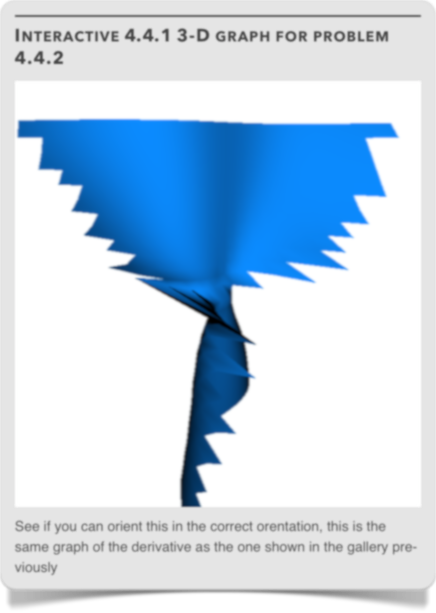
This viewer rotates the original source mesh. Lighting and controls are a web adaptation.
Download original COLLADA modelGallery 4.4.1 Graph of example 4.4.2
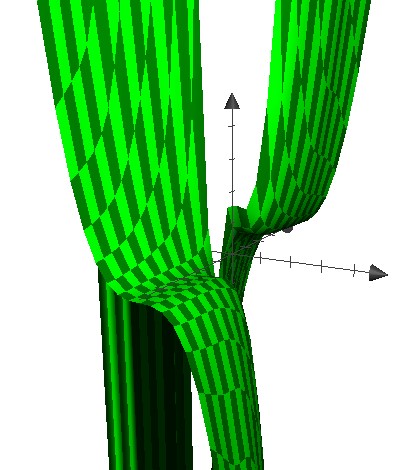
Read all original image captions
Image 1
Image 2
Image 3
Image 4
Image 5
Image 6
Image 7
Show your work for Problem 1
Drawing is temporarily unavailable. Work on paper if needed, then record your reasoning here.
Saving written working requires JavaScript. Keep your work on paper or in your own notes; the source problem above remains available.
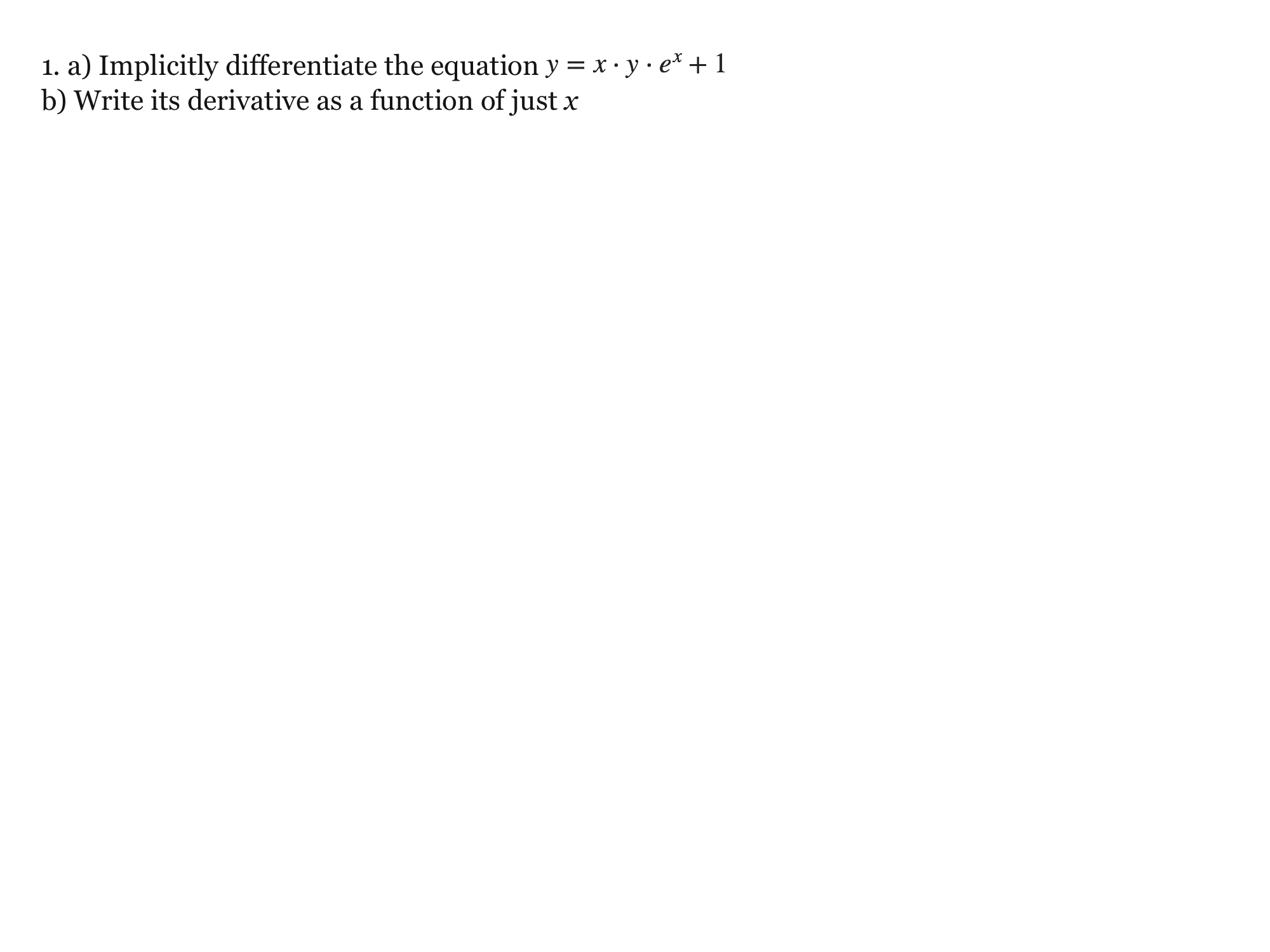
- a) Implicitly differentiate the equation
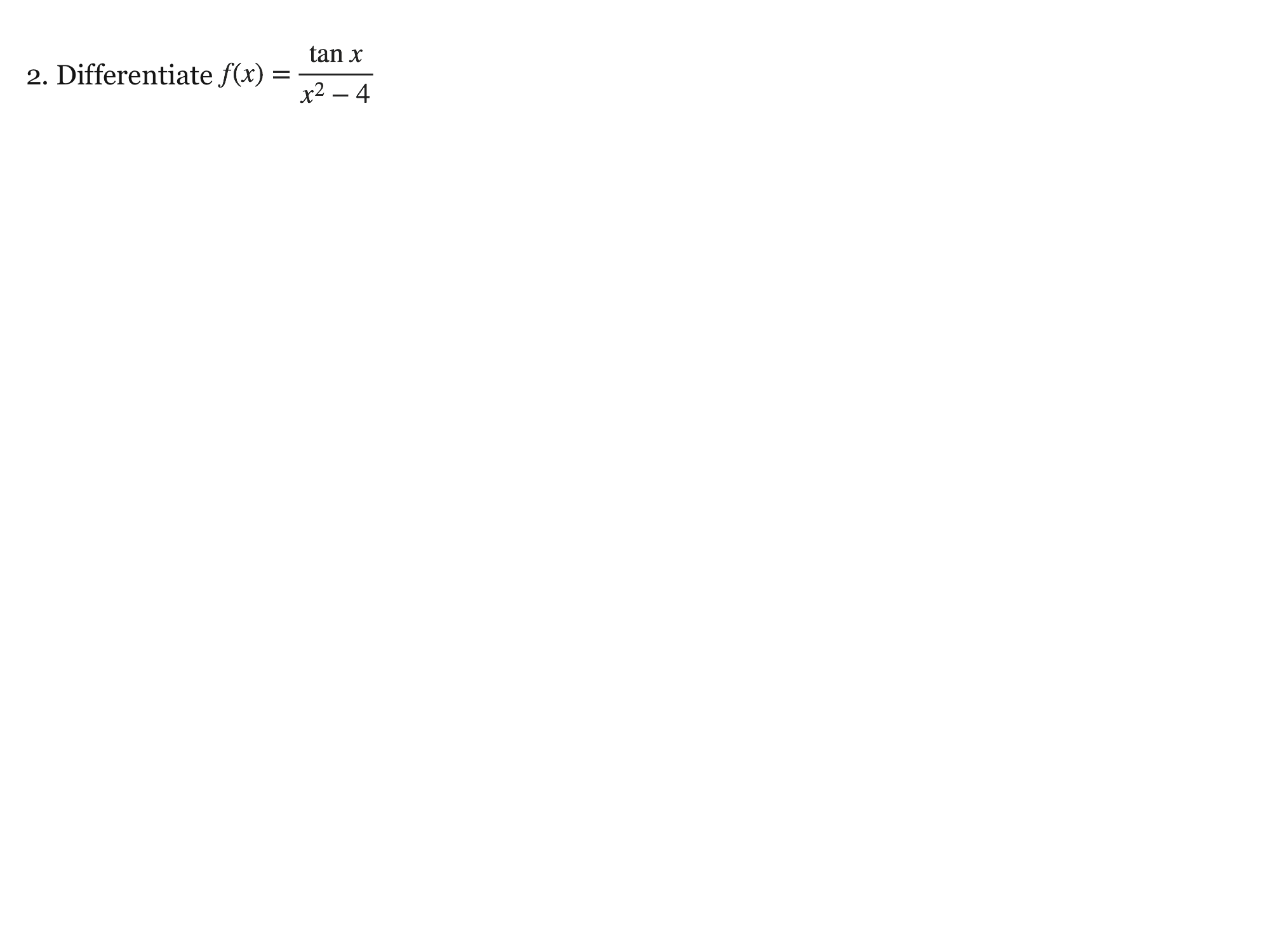
b) Write its derivative as a function of just x. - Differentiate
Show your work for Problem 2
Drawing is temporarily unavailable. Work on paper if needed, then record your reasoning here.
Saving written working requires JavaScript. Keep your work on paper or in your own notes; the source problem above remains available.
Show your work for Problem 3
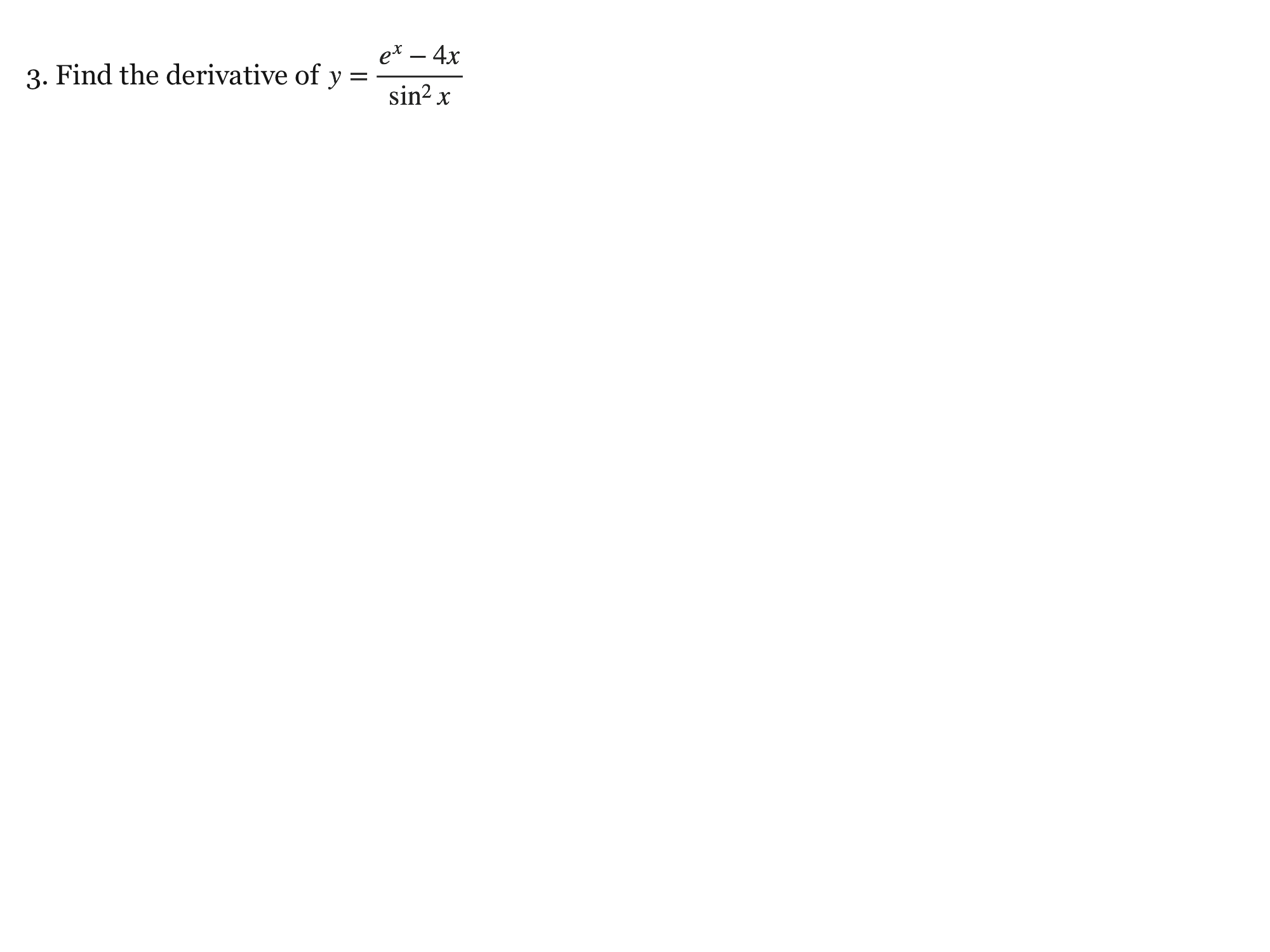
Drawing is temporarily unavailable. Work on paper if needed, then record your reasoning here.
Saving written working requires JavaScript. Keep your work on paper or in your own notes; the source problem above remains available.
Show your work for Problem 4
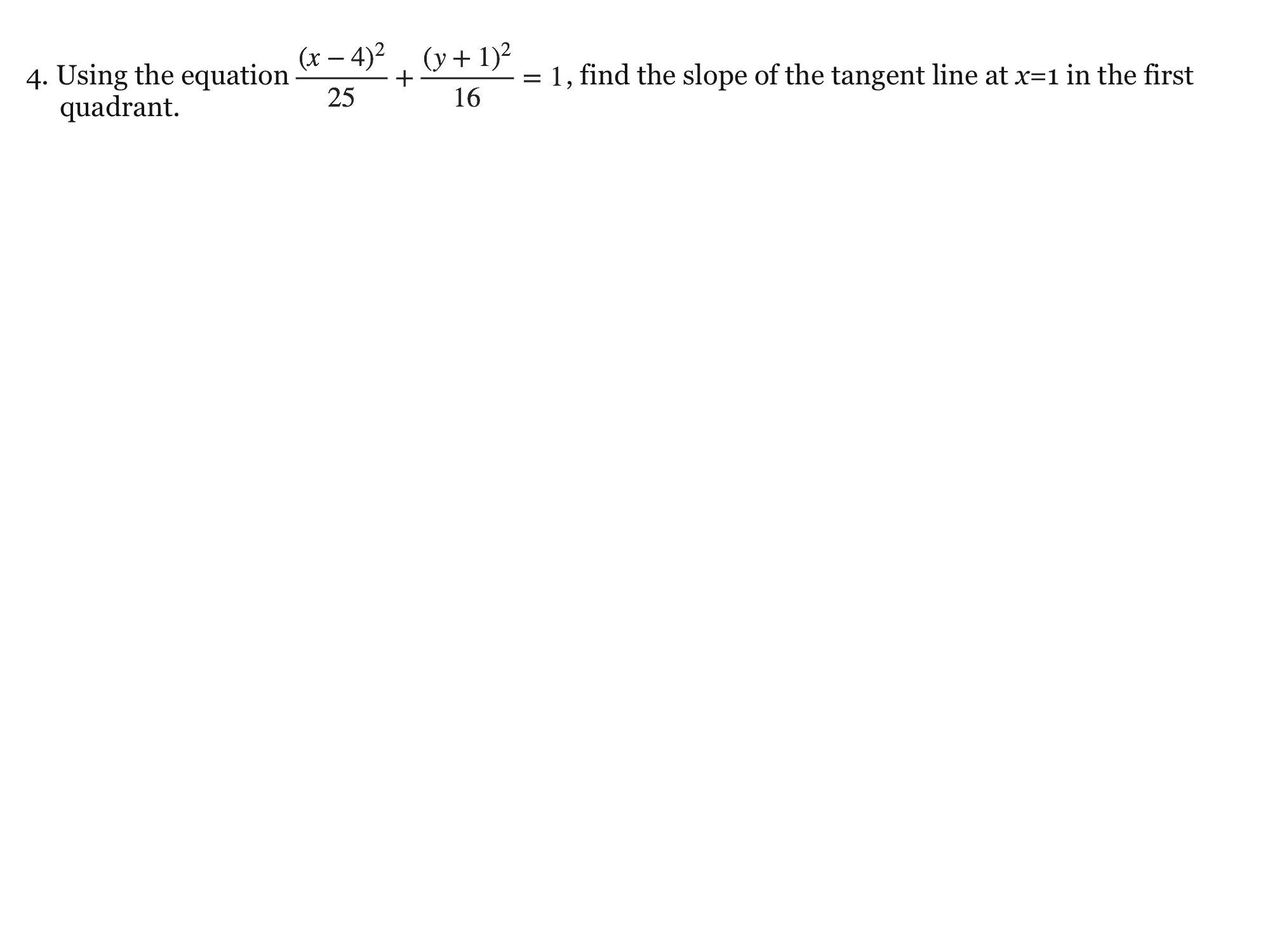
Drawing is temporarily unavailable. Work on paper if needed, then record your reasoning here.
Saving written working requires JavaScript. Keep your work on paper or in your own notes; the source problem above remains available.
Show your work for Problem 5
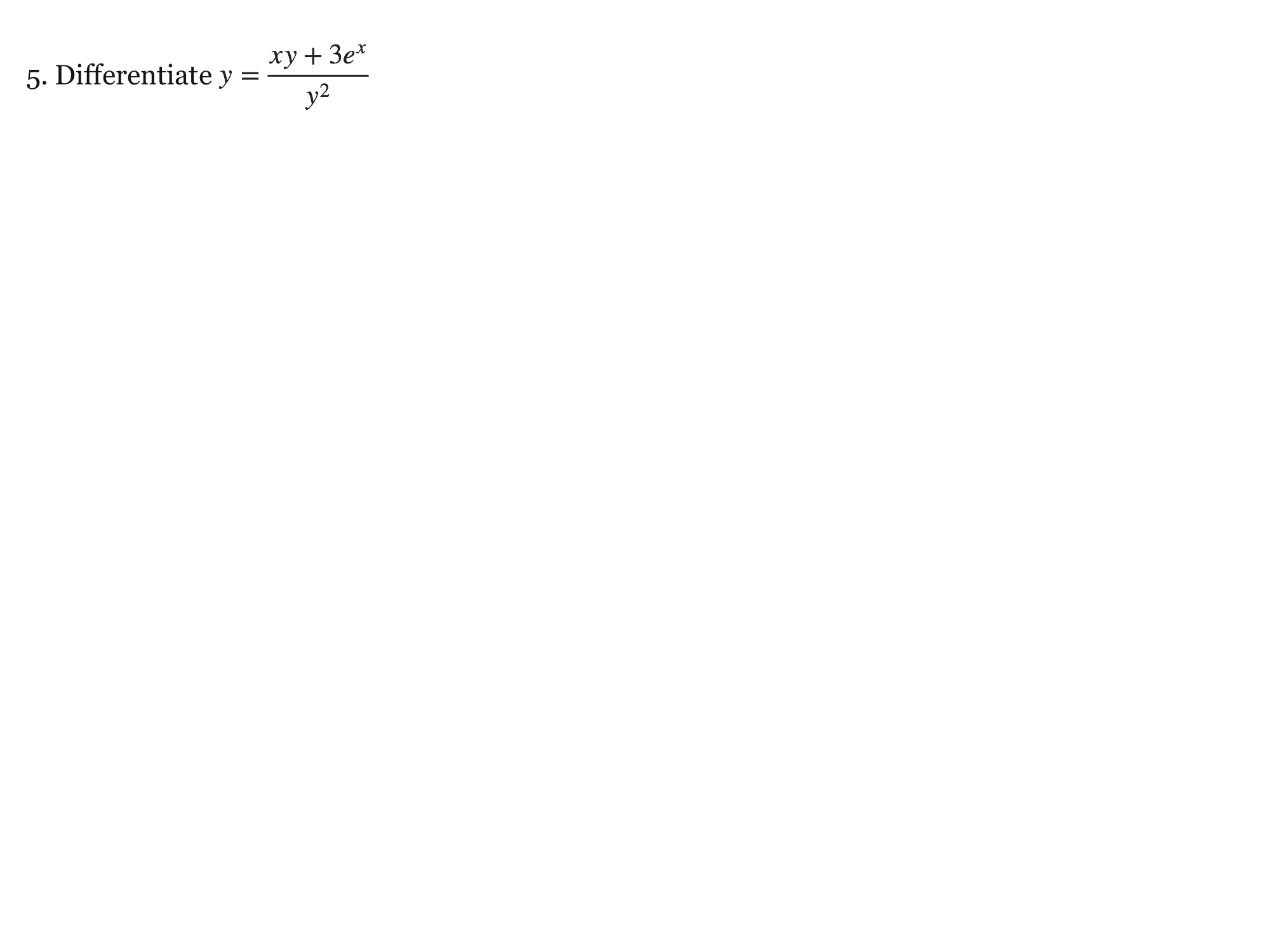
Drawing is temporarily unavailable. Work on paper if needed, then record your reasoning here.
Saving written working requires JavaScript. Keep your work on paper or in your own notes; the source problem above remains available.
Show your work for Problem 6
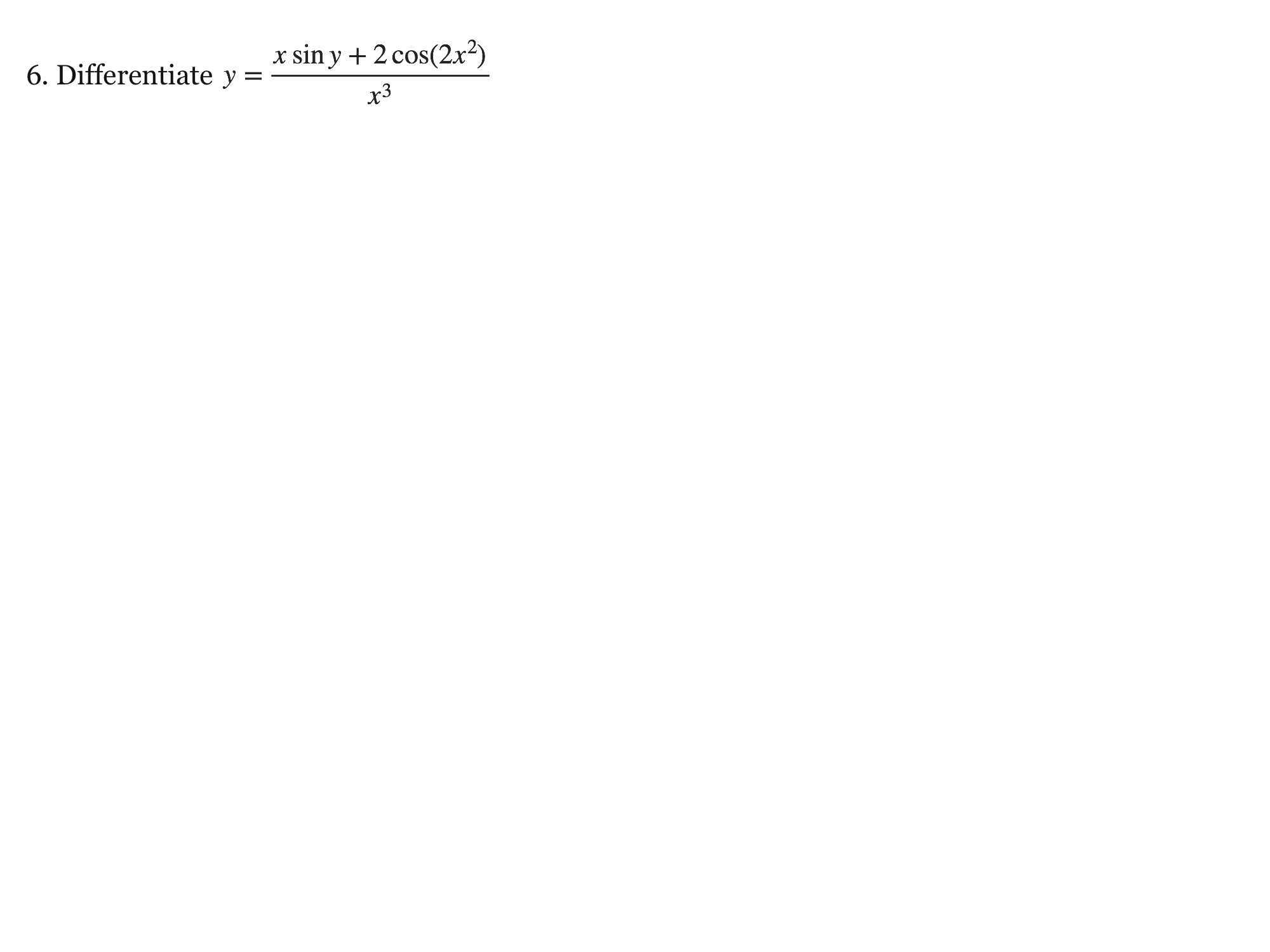
Drawing is temporarily unavailable. Work on paper if needed, then record your reasoning here.
Saving written working requires JavaScript. Keep your work on paper or in your own notes; the source problem above remains available.
Show your work for Problem 7
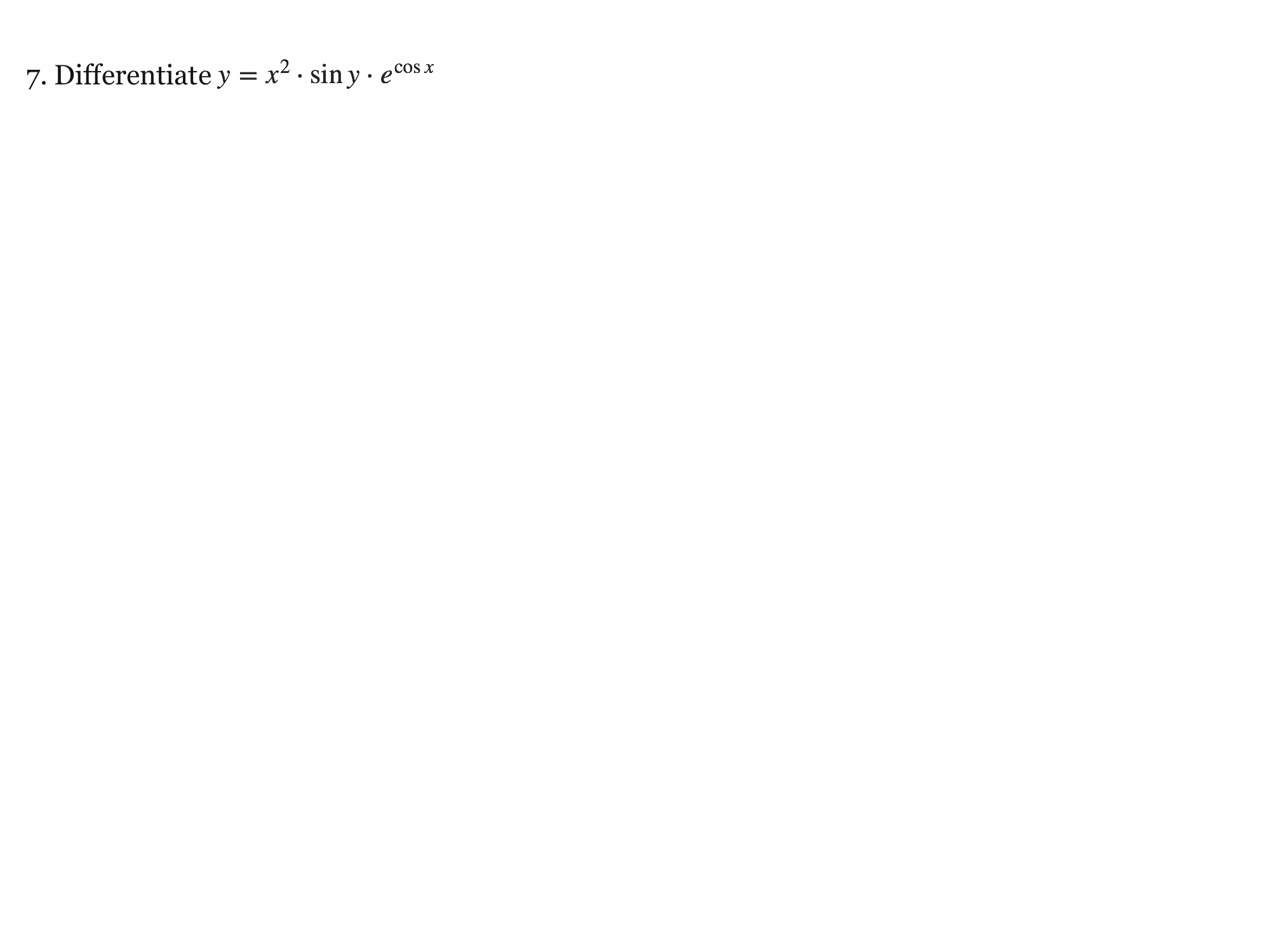
Drawing is temporarily unavailable. Work on paper if needed, then record your reasoning here.
Saving written working requires JavaScript. Keep your work on paper or in your own notes; the source problem above remains available.
Show your work for Problem 8
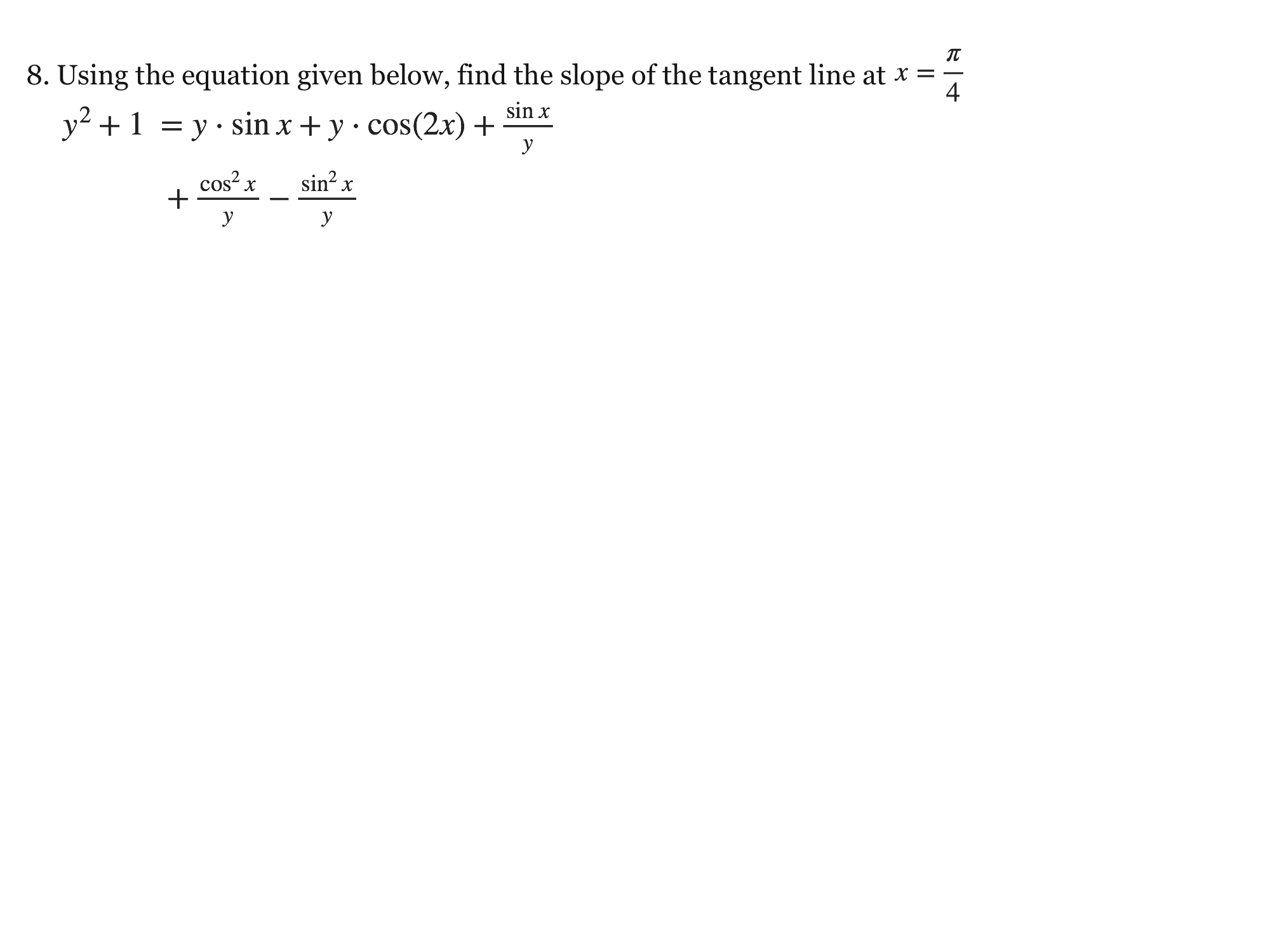
Drawing is temporarily unavailable. Work on paper if needed, then record your reasoning here.
Saving written working requires JavaScript. Keep your work on paper or in your own notes; the source problem above remains available.
- Differentiate
- Using the equation given below, find the slope of its tangent line at (Ref: Unit Circle):
Show your work for Problem 9
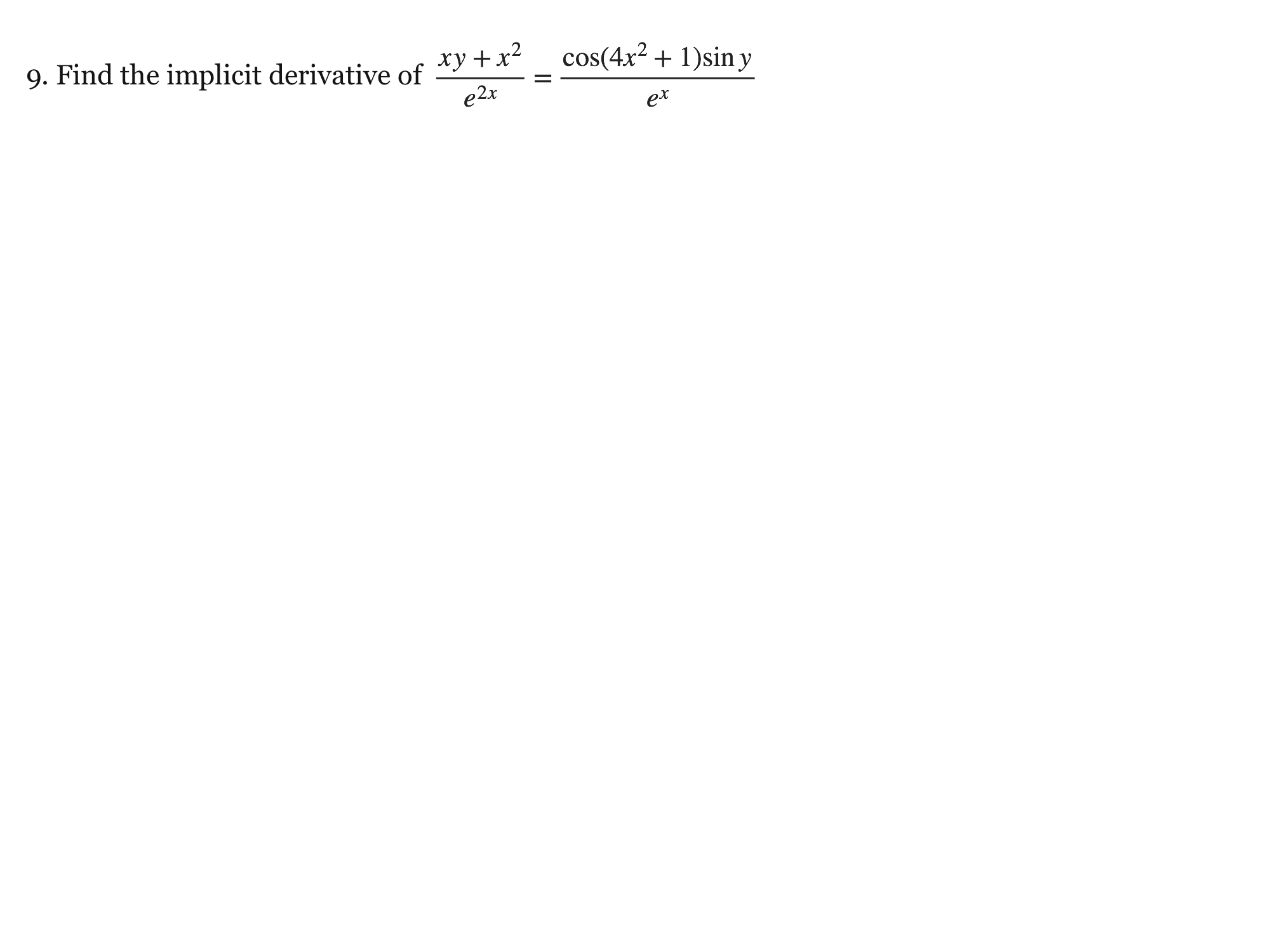
Drawing is temporarily unavailable. Work on paper if needed, then record your reasoning here.
Saving written working requires JavaScript. Keep your work on paper or in your own notes; the source problem above remains available.
Show your work for Problem 10
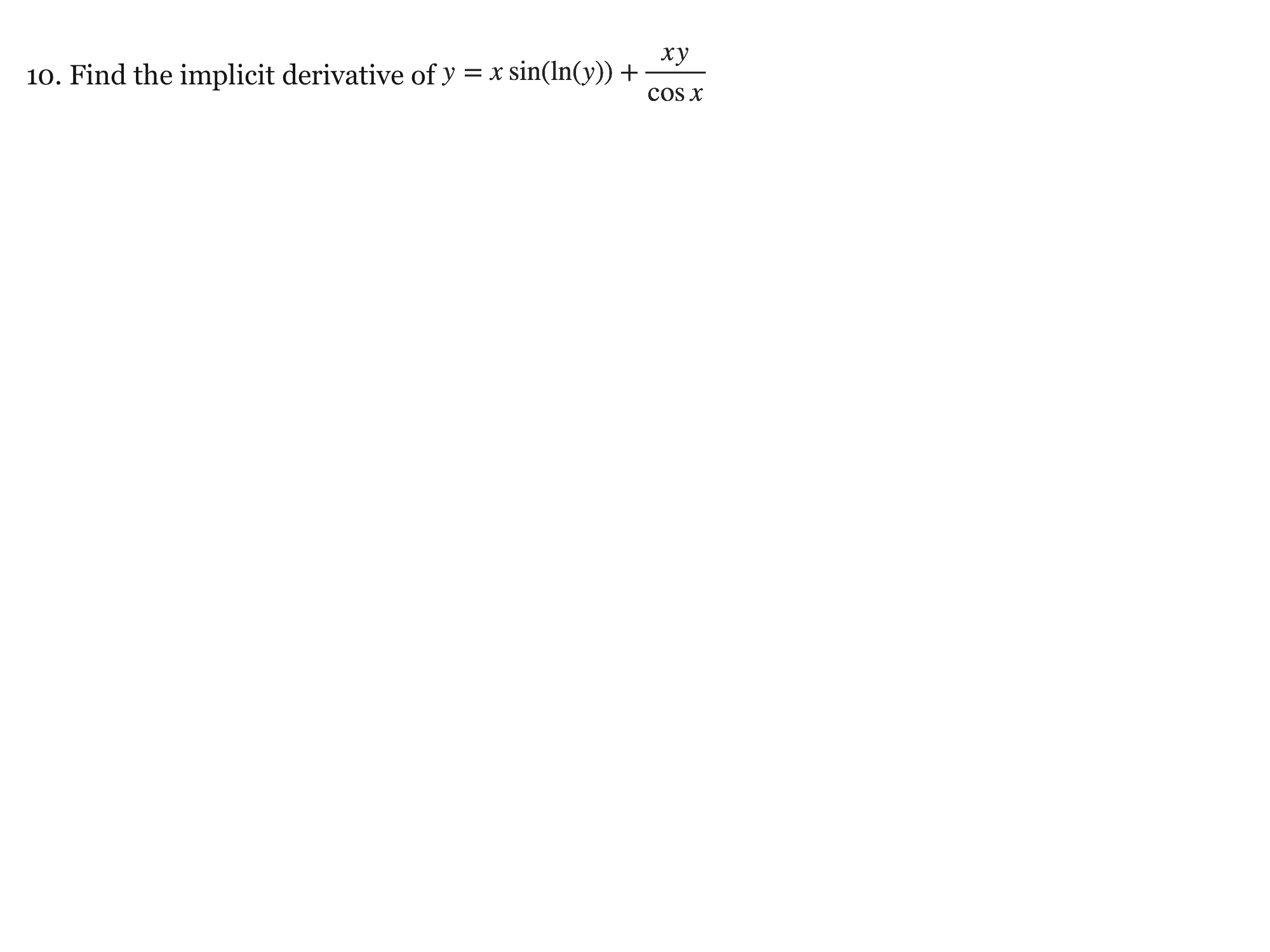
Drawing is temporarily unavailable. Work on paper if needed, then record your reasoning here.
Saving written working requires JavaScript. Keep your work on paper or in your own notes; the source problem above remains available.
- Find the implicit derivative of
- Find the implicit derivative of
Glossary and deeper reading · 3 refreshers
These editorial refreshers supplement the reading. Definitions and examples are added guidance; original source wording and recorded answers remain in their original context.
-
Derivative
A derivative gives the instantaneous rate of change of a function with respect to its input. At a point, it is the finite limit of the difference quotient when that limit exists. For example, the derivative of x² is 2x, so the tangent slope at x=3 is 6. A derivative function collects those rates across the inputs where the function is differentiable.
-
Function
A mathematical function assigns exactly one output to each input in its domain. Inputs can share an output, but one input cannot have two different outputs. For example, f(x)=x² assigns the output 9 to both 3 and −3. Function notation names the rule and its input; f(3) means the output when the input is 3.
-
Chain rule
The chain rule differentiates a composition by multiplying the outer derivative at the inner output by the inner derivative. For differentiable functions, (f(g(x)))′=f′(g(x))g′(x). For example, the derivative of sin(x²) is cos(x²)·2x. Nested compositions require a factor for each successive layer.