The Product Rule
This original textbook reading covers part of the AP topic. Follow the AP course outline for complete topic instruction and practice.
This reading includes verified answer corrections and explicitly stated clarifications.
The Product Rule
We can use the product rule in order to differentiate functions in the form of F(x) = f(x)•g(x). The formula for the product rule, written in various ways to help you remember, is:
These formulas give us the same method of finding the derivative, just different ways of writing it. Let’s practice through example, though.
Example Problem 4.1.1
Find the slope of the tangent line at
Interactive 4.1.1 Example Problem 4.1.1
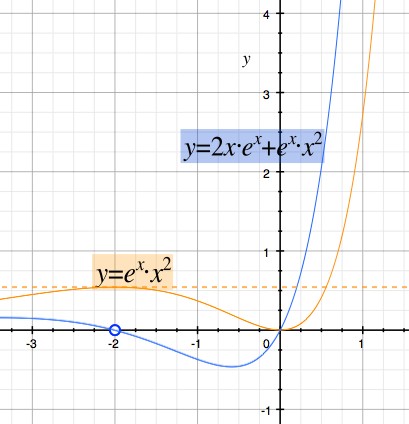
Read all original figure notes
The Derivative Function
The Original Function
Neat, huh? Let’s get some more practice in since this is a difficult formula to use. To show that I am not making up this rule, refer to interactive 4.1.1, which compares the derivative function to the original function.
There is a more advanced version of the product rule for three functions, which is written as:
For any function ,
This version of the book will not show you the proof of how the product rule is derived because its application is difficult enough without the theory. If you are interested, however, there are plenty of proofs using differentials and composed rectangles online to look at during your leisure time.
Example Problem 4.1.3
Find y’’ if
Physical Meaning of the Second Derivative: Let’s shift our gear into Physics for a few minutes. For any position function showing an object’s displacement changing with time, d(t), we can take that function’s derivative and get its velocity, v(t). We can also take its derivative again to get the change in velocity with respect to time, or the acceleration, a(t). Here are how the units for each of these terms works out, assuming distance is measured in meters, and time in seconds (these units can be replaced with km and hours, or miles and hours).
Notice how increasing the order of derivatives adds another “independent variable” term to the denominator of the units. This is why the second derivative is often expressed as .
Glossary and deeper reading · 2 refreshers
These editorial refreshers supplement the reading. Definitions and examples are added guidance; original source wording and recorded answers remain in their original context.
-
Product rule
The product rule differentiates a product of two differentiable functions. It gives (fg)′=f′g+fg′, changing one factor at a time and adding the results. For example, the derivative of x sin x is sin x+x cos x. The product of the two derivatives is generally not the derivative of the product.
-
Derivative
A derivative gives the instantaneous rate of change of a function with respect to its input. At a point, it is the finite limit of the difference quotient when that limit exists. For example, the derivative of x² is 2x, so the tangent slope at x=3 is 6. A derivative function collects those rates across the inputs where the function is differentiable.