An Overview of Trigonometry
This original textbook reading covers part of the AP topic. Follow the AP course outline for complete topic instruction and practice.
This reading includes verified answer corrections and explicitly stated clarifications.
There are many guides about Calculus out there, but few of them are interactive. The purpose of this guide is to introduce Calculus in a way that is interactive and enjoyable, with a large amount of resources available for the student studying Calculus. Although this guide contains a wide variety of information and practice problems, it is not intended to be a stand-alone material for an advanced Calculus course in college or at the University level, but rather a supplement.
Why Calculus?
Okay, I get it. You are probably reading this, wondering: “When am I ever going to use this stuff?” or “Just get to the Calculus already (see Chapter 2)” or “I wish I had a cheeseburger.” Calculus is important because whether you want to be an investment banker, an accountant, an engineer, a mathematician, a physicist, or even have to take a college-level course in any of those subjects, a knowledge about Calculus will get you far. Almost everything you see around you, from video games to this device you are holding, or the package you got in the mail the other day, involved using Calculus at some point in their creation. Here are some questions that Calculus can answer.
Banking and Accounting | How to choose the best investment based on interest rates |
Sports | What angle to throw a ball so it travels the farthest? |
Construction and Architecture | How to use the minimum amount of material while keeping building integrity? |
Driving | Is it worth taking the longer route because it has a higher speed limit? |
Economics | How to maximize revenues if marginal cost is changing? |
Physics | Too many examples |
What to expect from this Guide
Although this work is written in a relatively casual tone, its purpose is to teach Calculus as efficiently as possible, while allowing the reader to truly understand the content and its applications in a challenging way, similar to a college classroom atmosphere.
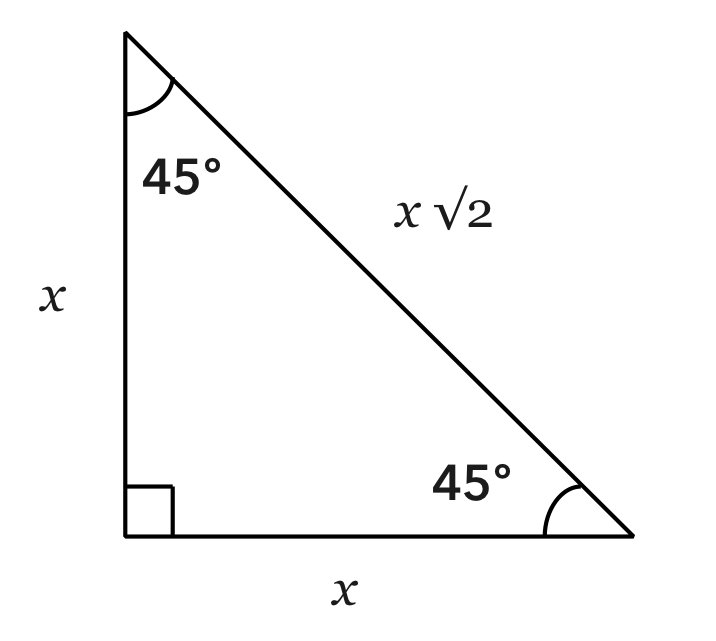
The ease of understanding the ideas in this text is offset by the often challenging difficulty of its practice and example problems. The next few sections will cover what you should have mastered in Mathematics up to this point, starting from the most important concepts. Most of these are from Geometry and Trigonometry. Let’s start with the special right triangles.
Gallery 1.1.1 The Special Right Triangles
Read all original image captions
Image 1
Image 2
Image 3
Image 4
Image 5
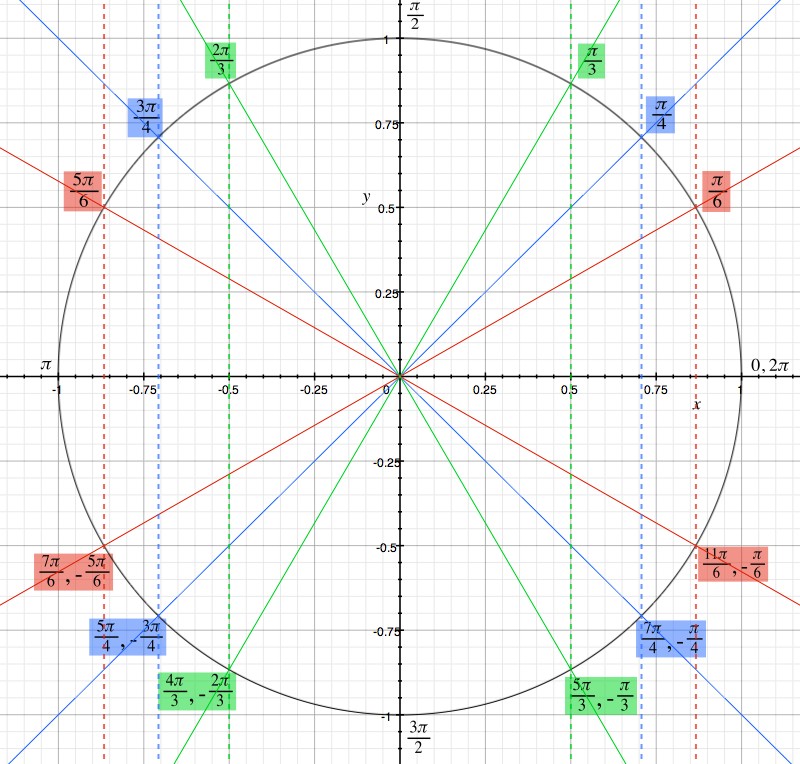
The special right triangles depicted previously transition readily into an important concept you learned in Trigonometry: the unit circle. It allows you to calculate values for a few trigonometric functions in your head. Although calculators are usually a better alternative, it also gives you a base method of approximating values of nearby angles. You may have been told to memorize all the values of the unit circle, but once you memorize the two simple right triangles above, memorizing the unit circle comes naturally.
The Unit Circle
Understanding the unit circle is critical to understanding trigonometric functions such as sine, cosine, and tangent, along with their behaviors. In much of mathematics, new knowledge builds upon previous knowledge, so you must become proficient with the unit circle, and how it determines the nature of trigonometric functions.
There is going to be a pop quiz coming up soon (surprise!), so in order to prepare you for it, here are some questions you might have. Even if you don’t have them, they are good preparation for what is to come.
Gallery 1.1.2 The Unit Circle
Read all original image captions
Image 1
Image 2
How do I calculate the value of inverse functions in my head?
Inverse trigonometric functions return a single angle in a chosen principal range. For example, arcsin(0) = 0 because the range of arcsin is [−π/2, π/2]. The equation sin(x) = 0 has many solutions, x = kπ for any integer k, but those are solutions to the equation, not multiple values of arcsin(0). Think of sine as the y-coordinate on the unit circle, then use the principal range to choose the inverse value.
What’s with the pi’s and the º symbols? Do I have to know both?
Degree values and radian values are both used for measuring angles. Both have different applications in the real world. Degrees are usually used for construction, architecture, and large-scale modeling, whereas radians are helpful for sciences such as physics, electrical engineering, and coastal modeling of waves. You should be familiar with how to use and interchange between both. The conversion factor is: π radians = 180º. The radians are often left out. If it is a unitless angle (i.e. there is no º symbol), assume it is in radians.
What else do I need to know?
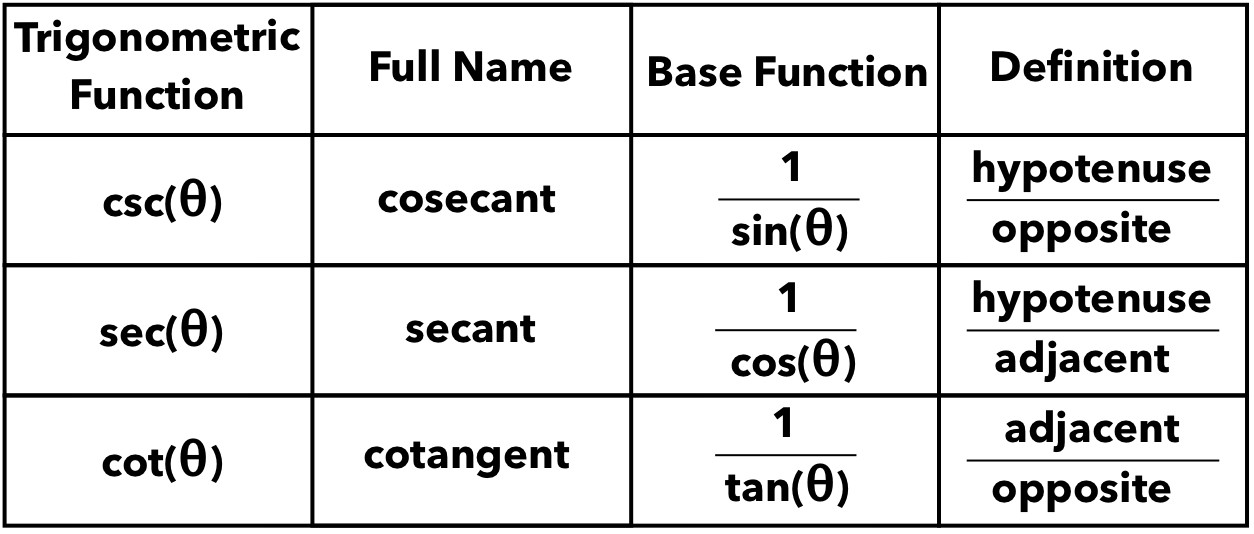
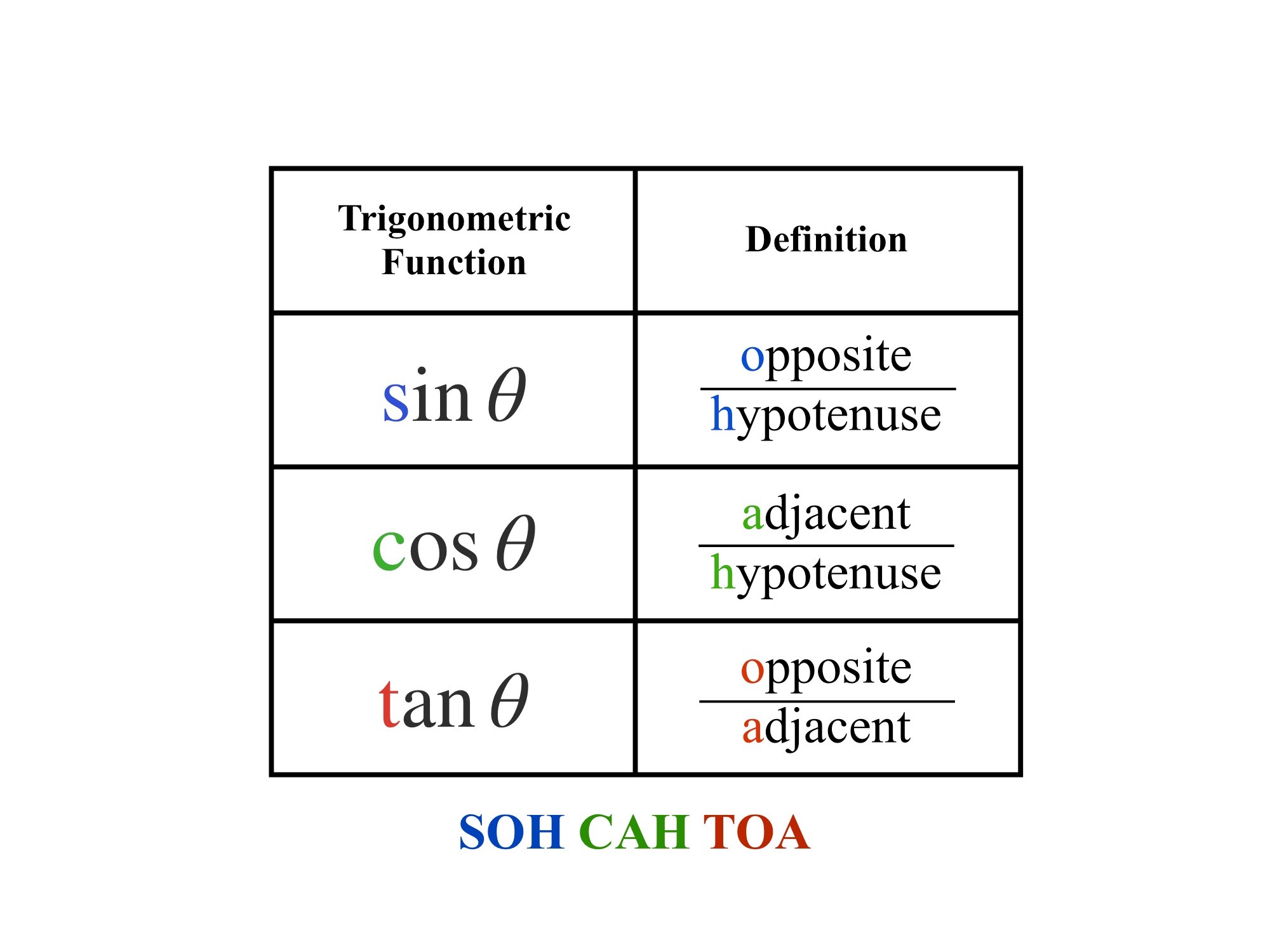
The following tables are worth memorizing.
Gallery 1.1.3 The six trigonometric functions and their definitions
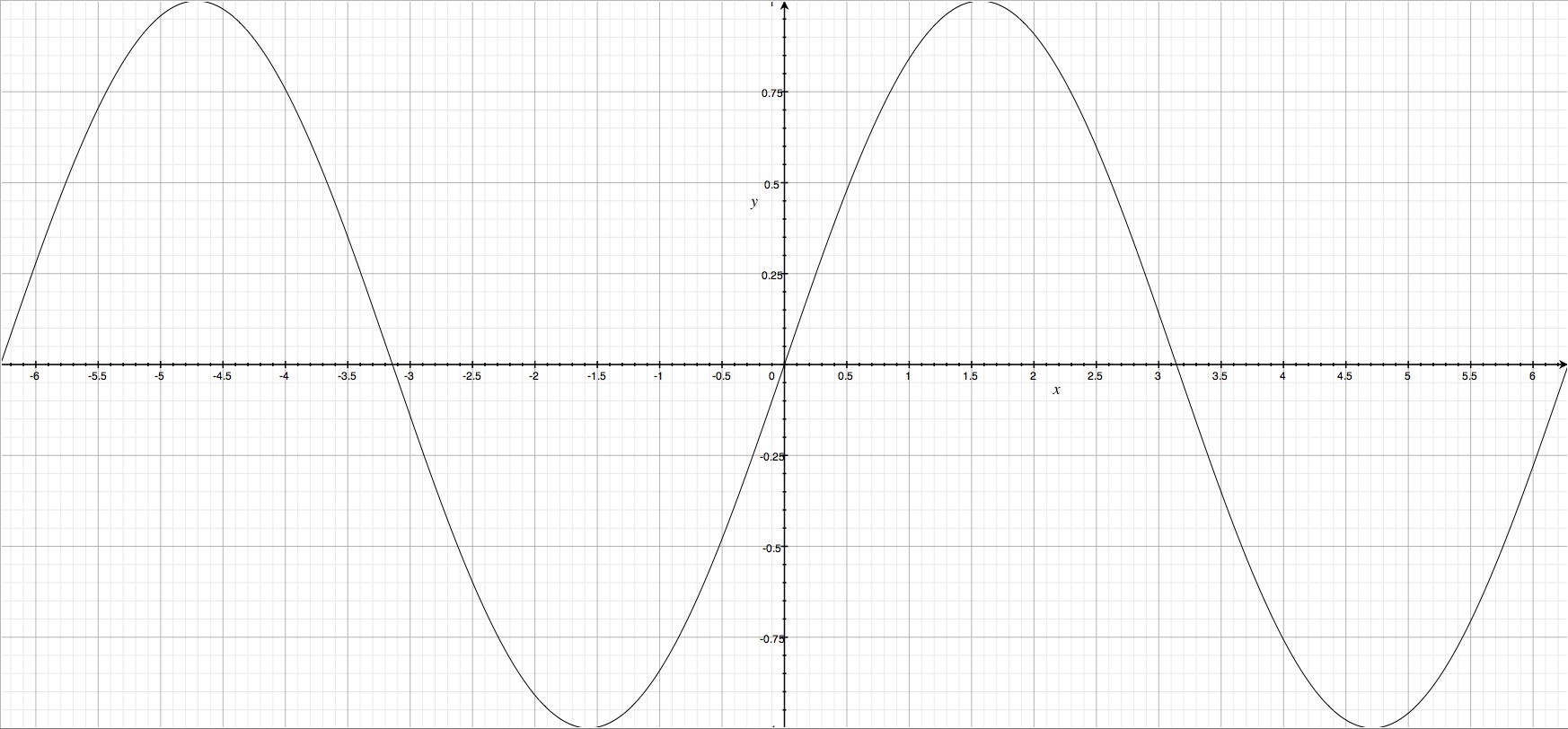
Gallery 1.1.2 Graphs of trigonometric functions
Read all original image captions
Image 1
Image 2
Image 3
Image 4
Image 5
Image 6
Note: While taking this quiz, you may want to reference the glossary definition of a unit circle to help solve many of the questions. Keep in mind which quadrant the angle is in when figuring out its value.
How do these trigonometric functions relate to each other? One of the most amazing set of formulas revealed by the unit circle is collectively known as the trigonometric identities. The first one is the most important. The other two are derived from the first trigonometric identity, which is:
Dividing both sides by gives
Whereas dividing the first formula by gives
Keep these formulas in mind. They will be covered throughout this book very frequently.
Note: writing sin2(x) is the same as writing (sin(x))2. You can see why we use the first form instead, because the second version has too many parentheses.
Angle addition formulas:
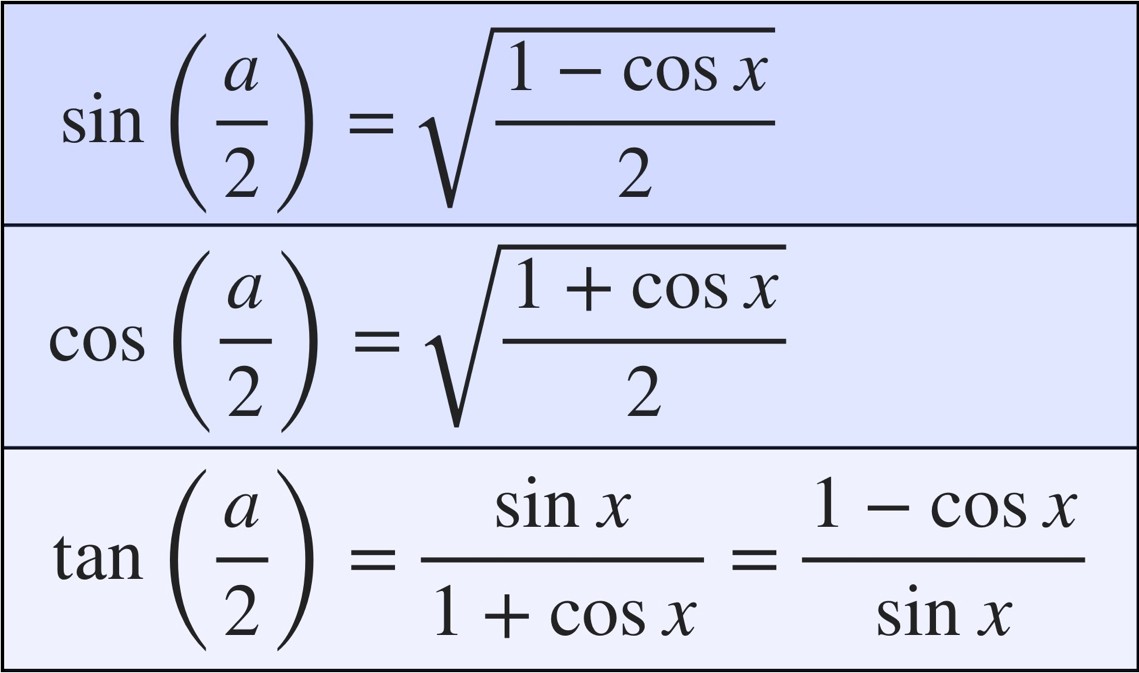
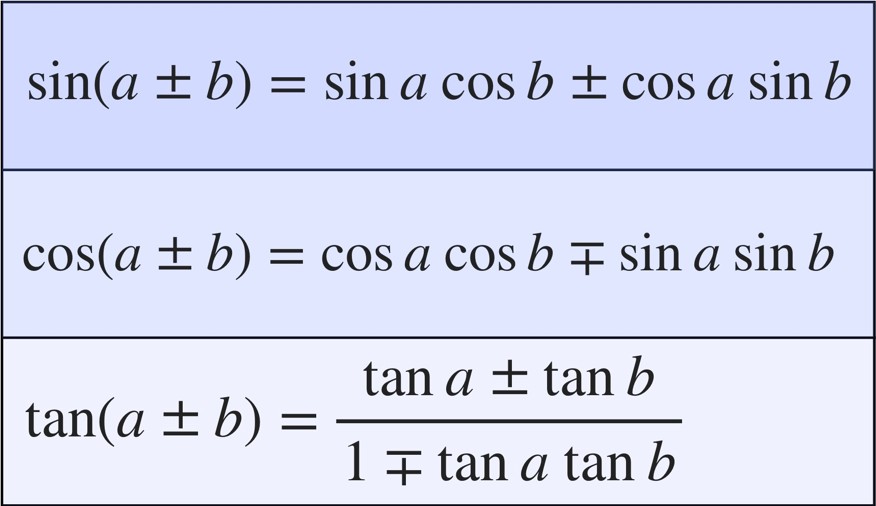 Half angle formulas:
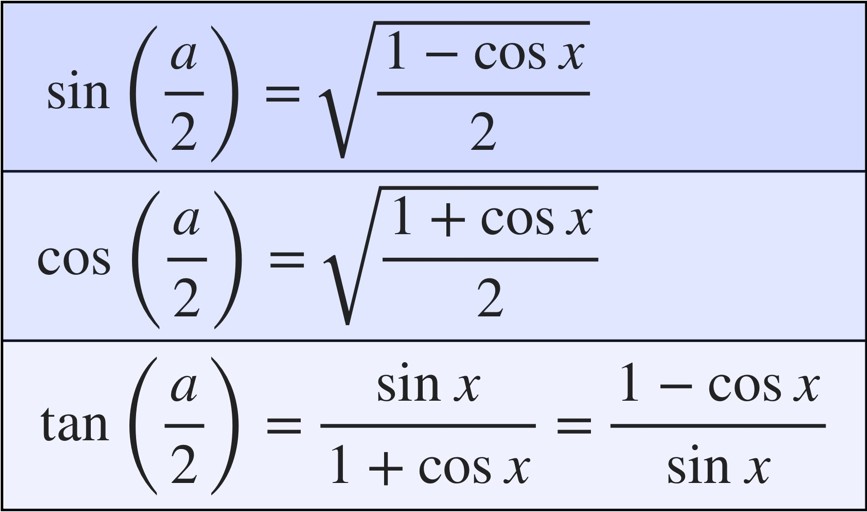
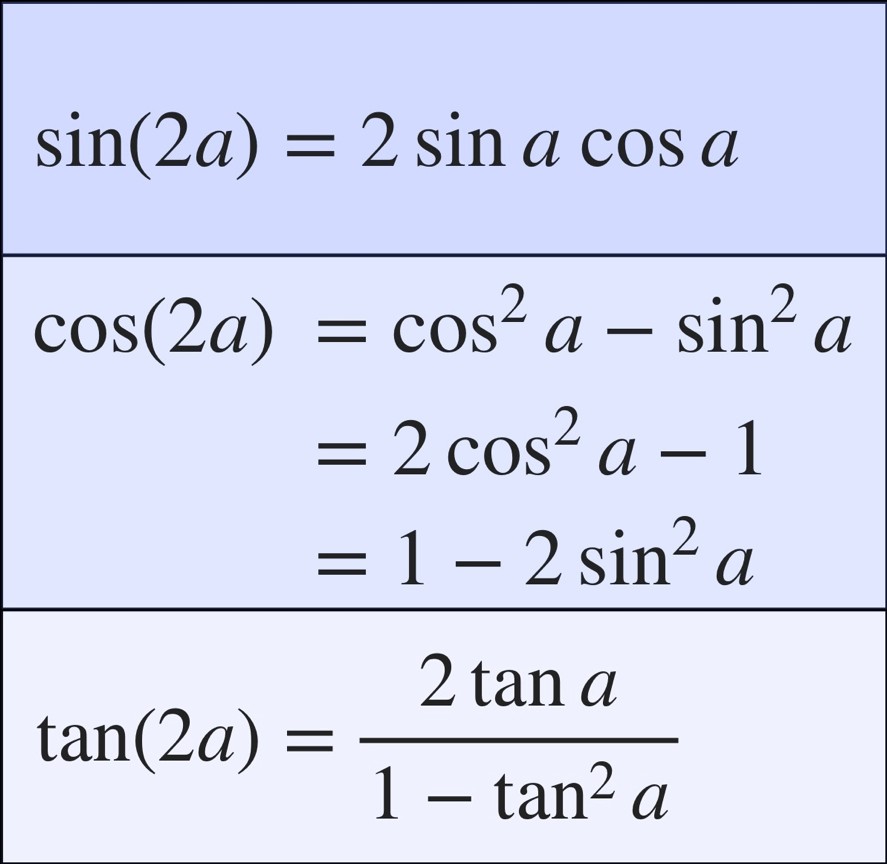
Double Angle Formulas:
Glossary and deeper reading · 6 refreshers
These editorial refreshers supplement the reading. Definitions and examples are added guidance; original source wording and recorded answers remain in their original context.
-
Unit circle
The unit circle is the circle of radius 1 centered at the origin. At angle θ measured from the positive horizontal axis, its point has coordinates (cos θ, sin θ). For example, θ=π/2 gives the point (0,1), so cosine is 0 and sine is 1. The circle also helps track signs and periodic behavior of trigonometric functions.
-
Function
A mathematical function assigns exactly one output to each input in its domain. Inputs can share an output, but one input cannot have two different outputs. For example, f(x)=x² assigns the output 9 to both 3 and −3. Function notation names the rule and its input; f(3) means the output when the input is 3.
-
Inverse function
An inverse function reverses another function’s input-output assignment. A function needs to be one-to-one on its chosen domain for an inverse function to exist. For example, x³ has inverse the cube-root function, while x² needs a domain restriction such as x≥0. The notation f⁻¹ denotes an inverse function rather than the reciprocal 1/f.
-
Inverse trigonometric function
An inverse trigonometric function returns a principal angle from a trigonometric output. The original trigonometric function is restricted to a one-to-one interval to define that inverse. For example, arcsin(1/2)=π/6 under the usual range [−π/2,π/2]. The notation sin⁻¹x means arcsin x, whereas the reciprocal of sine is cosecant.
-
Radian
A radian measures an angle by dividing the intercepted arc length by the circle’s radius. One full turn is 2π radians, so π radians equals 180 degrees. For example, an arc with length equal to its radius subtends an angle of one radian. The familiar derivative formulas for sine and cosine use radian inputs.
-
Trigonometric identity
A trigonometric identity is an equality that holds for every input where both sides are defined. Identities let you rewrite expressions without changing their values on that shared domain. For example, sin²θ+cos²θ=1 follows from the unit circle. Any division used while rewriting an identity can introduce domain restrictions.