Chapter 7 Problems
Thirty chapter problems: 10 from the original book and 20 added for more practice.
Read the chapter problems → · Chapter solutions →
-
Original problem
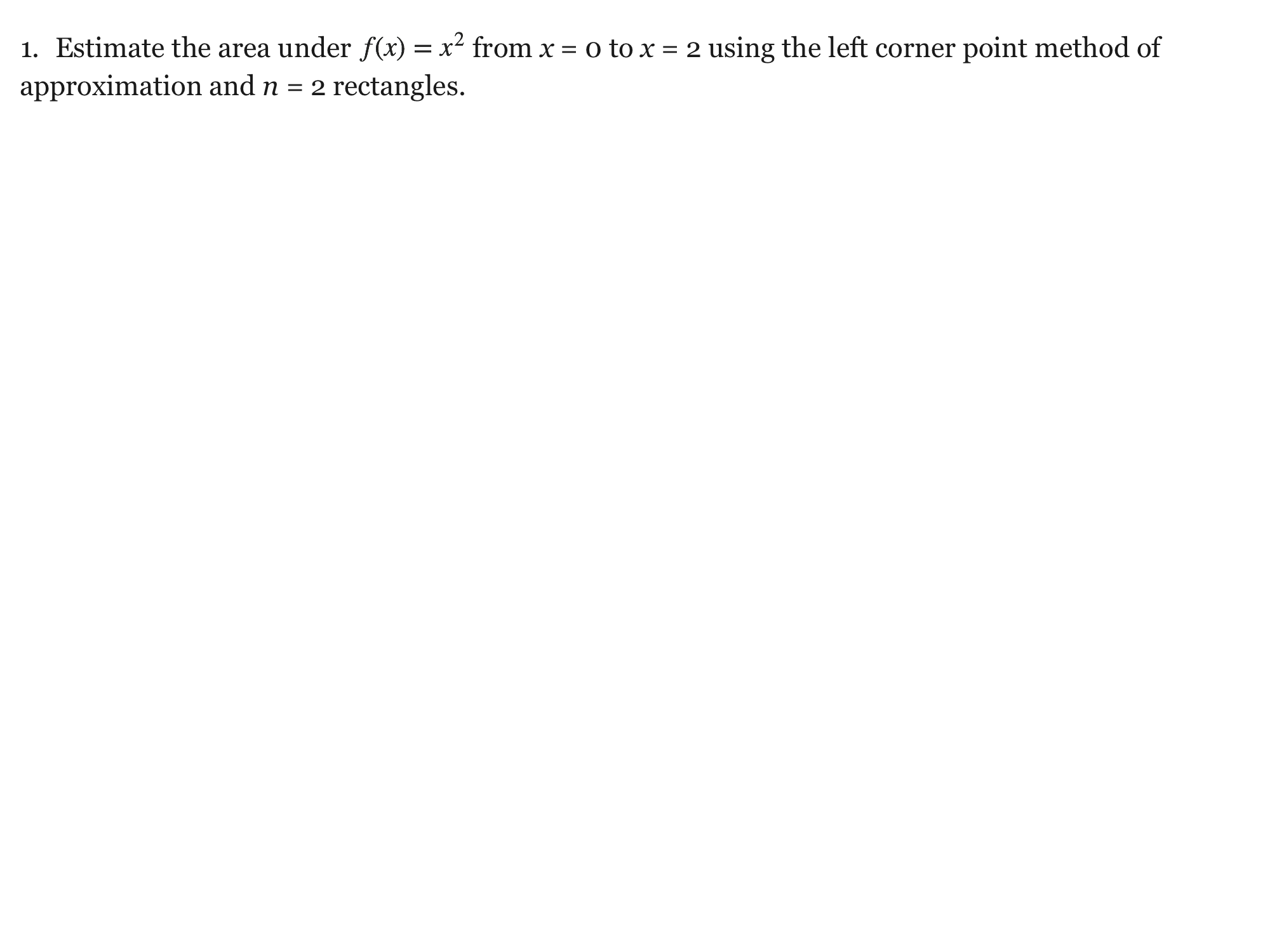
Estimate the area under from x = 0 to x = 2 using the left corner point method of approximation and n = 2 rectangles.Show your work for Problem 1
Original source problem image and any figures. Read it together with the accessible problem text and any figure description or source note alongside it. Open the source image at full size. Drawing is temporarily unavailable. Work on paper if needed, then record your reasoning here.
Saving written working requires JavaScript. Keep your work on paper or in your own notes; the source problem above remains available.
-
Original problem
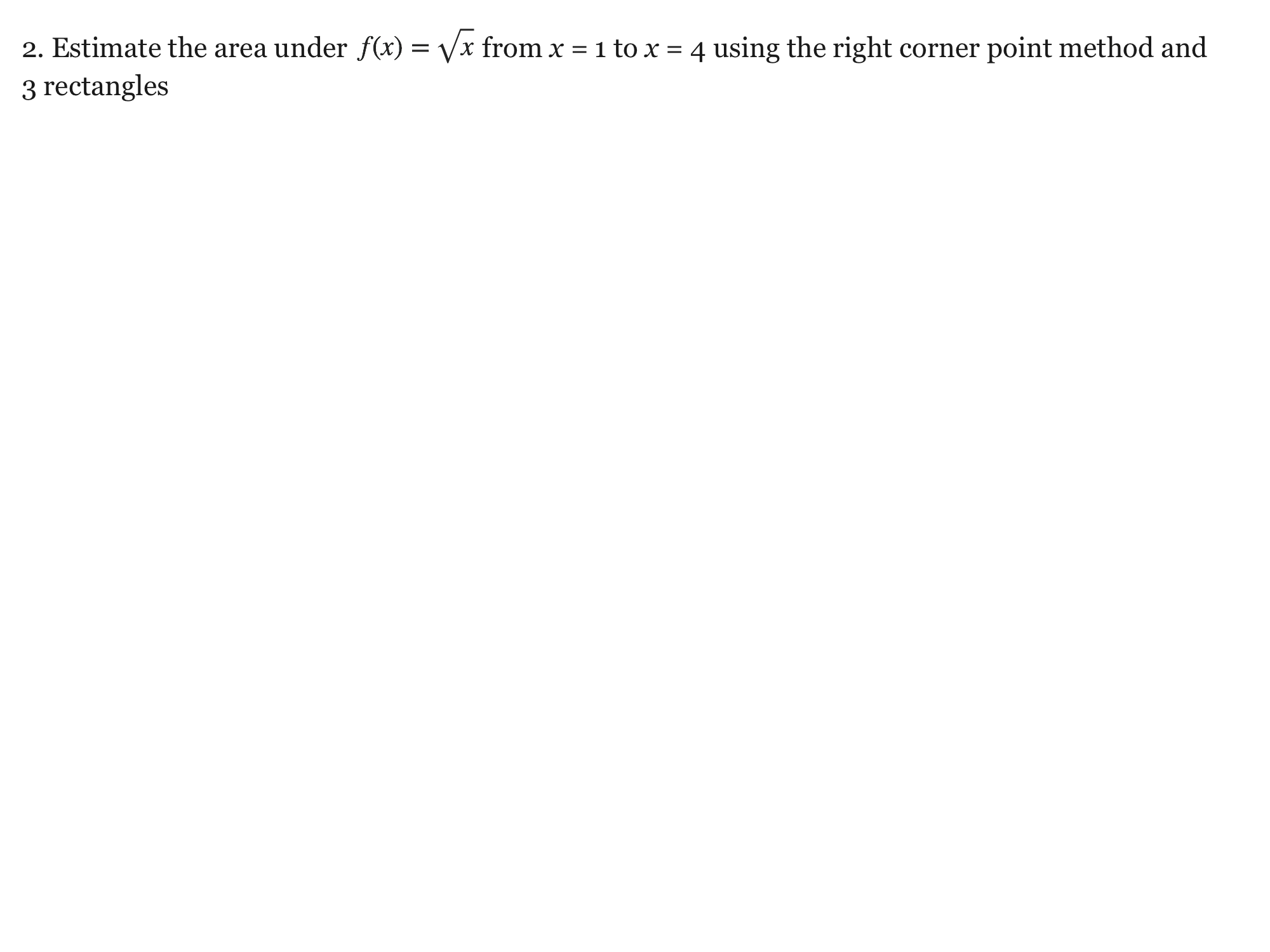
Estimate the area under from x = 1 to x = 4 using the right corner point method and 3 rectangles.Show your work for Problem 2
Original source problem image and any figures. Read it together with the accessible problem text and any figure description or source note alongside it. Open the source image at full size. Drawing is temporarily unavailable. Work on paper if needed, then record your reasoning here.
Saving written working requires JavaScript. Keep your work on paper or in your own notes; the source problem above remains available.
-
Original problem
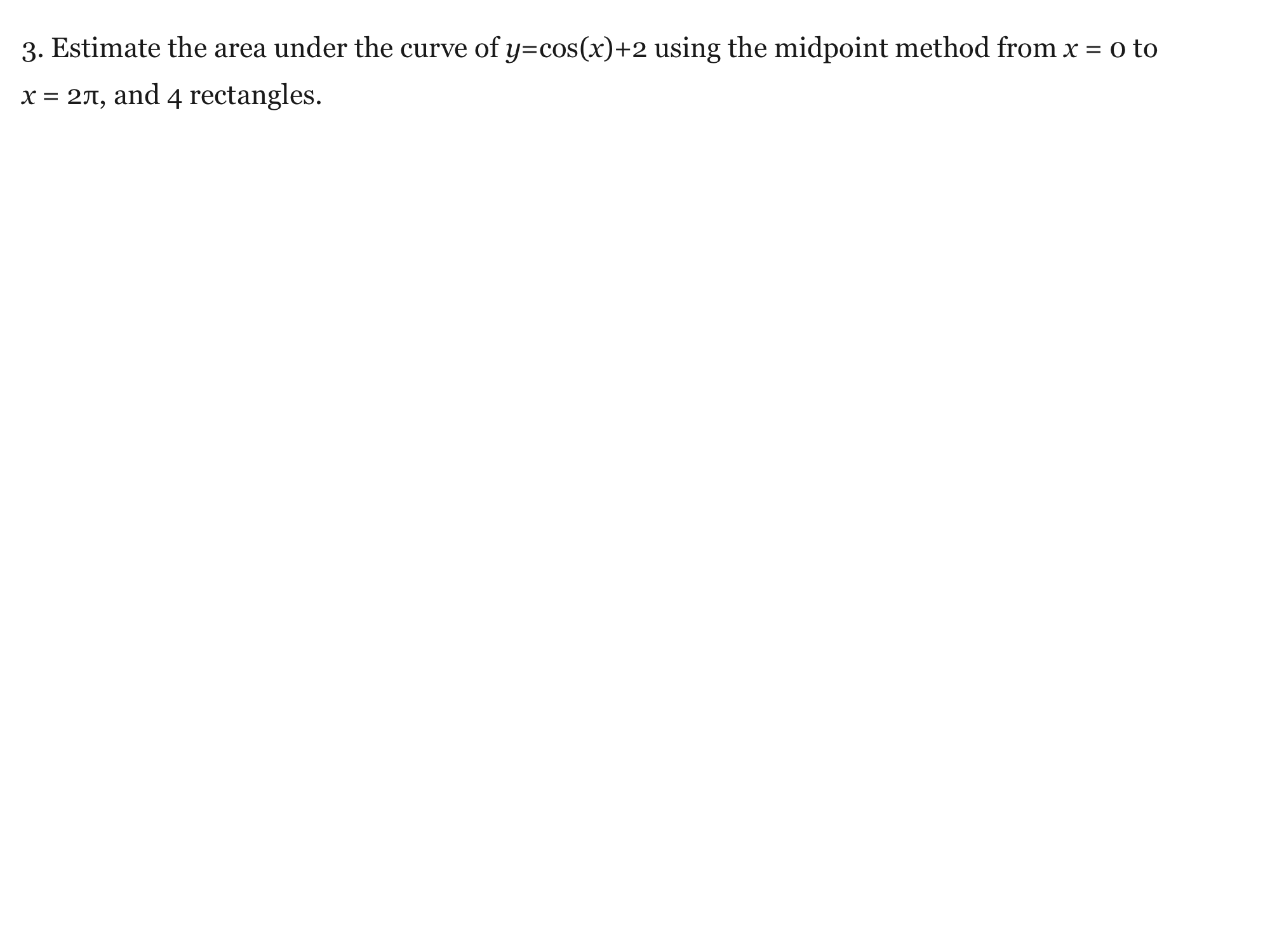
Estimate the area under the curve of using the midpoint method from x = 0 to x = 2π, and 4 rectangles.Show your work for Problem 3
Original source problem image and any figures. Read it together with the accessible problem text and any figure description or source note alongside it. Open the source image at full size. Drawing is temporarily unavailable. Work on paper if needed, then record your reasoning here.
Saving written working requires JavaScript. Keep your work on paper or in your own notes; the source problem above remains available.
-
Original problem
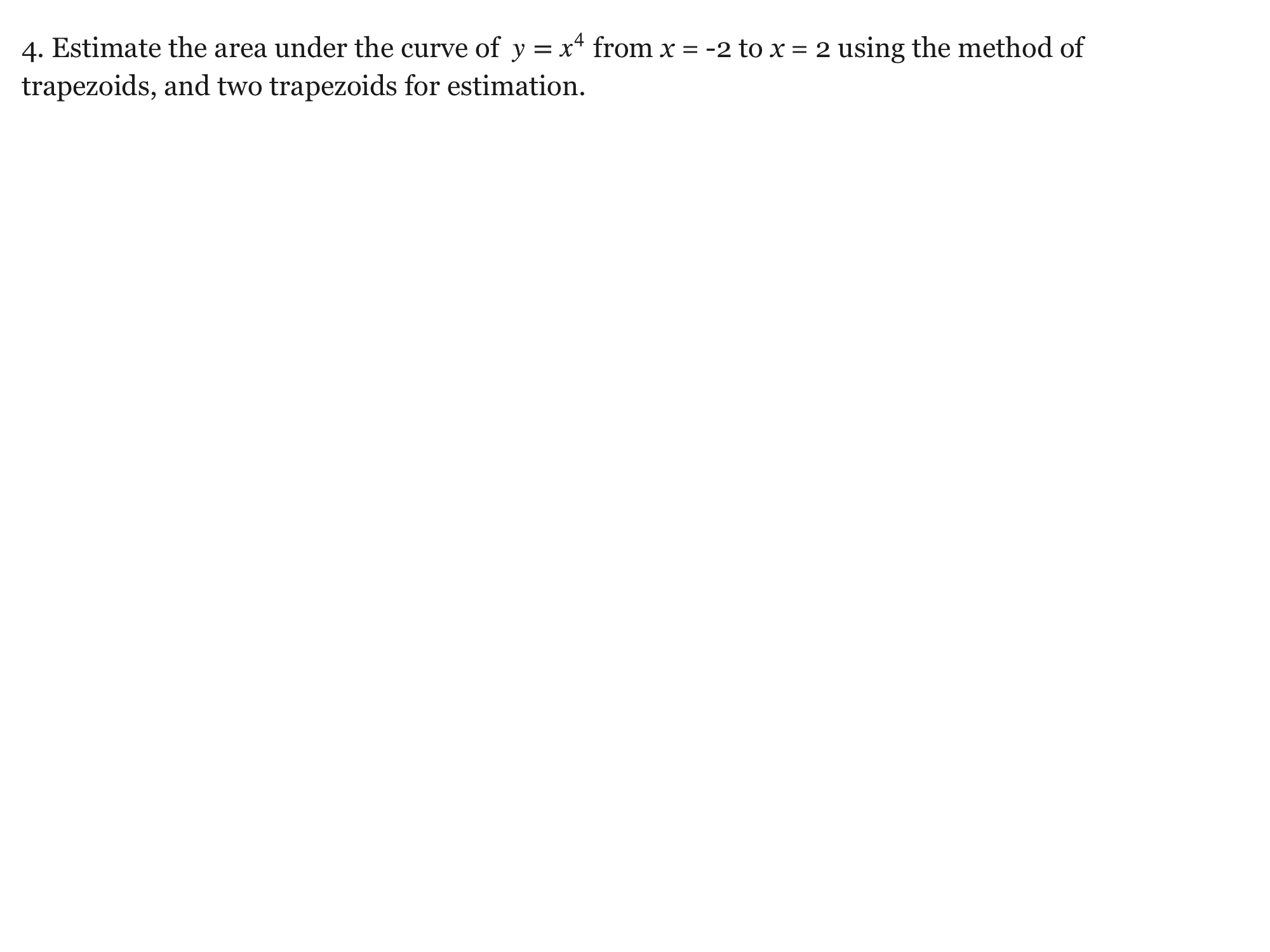
Estimate the area under the curve of from x = -2 to x = 2 using the method of trapezoids and 2 trapezoids for estimation.Show your work for Problem 4
Original source problem image and any figures. Read it together with the accessible problem text and any figure description or source note alongside it. Open the source image at full size. Drawing is temporarily unavailable. Work on paper if needed, then record your reasoning here.
Saving written working requires JavaScript. Keep your work on paper or in your own notes; the source problem above remains available.
-
Original problem
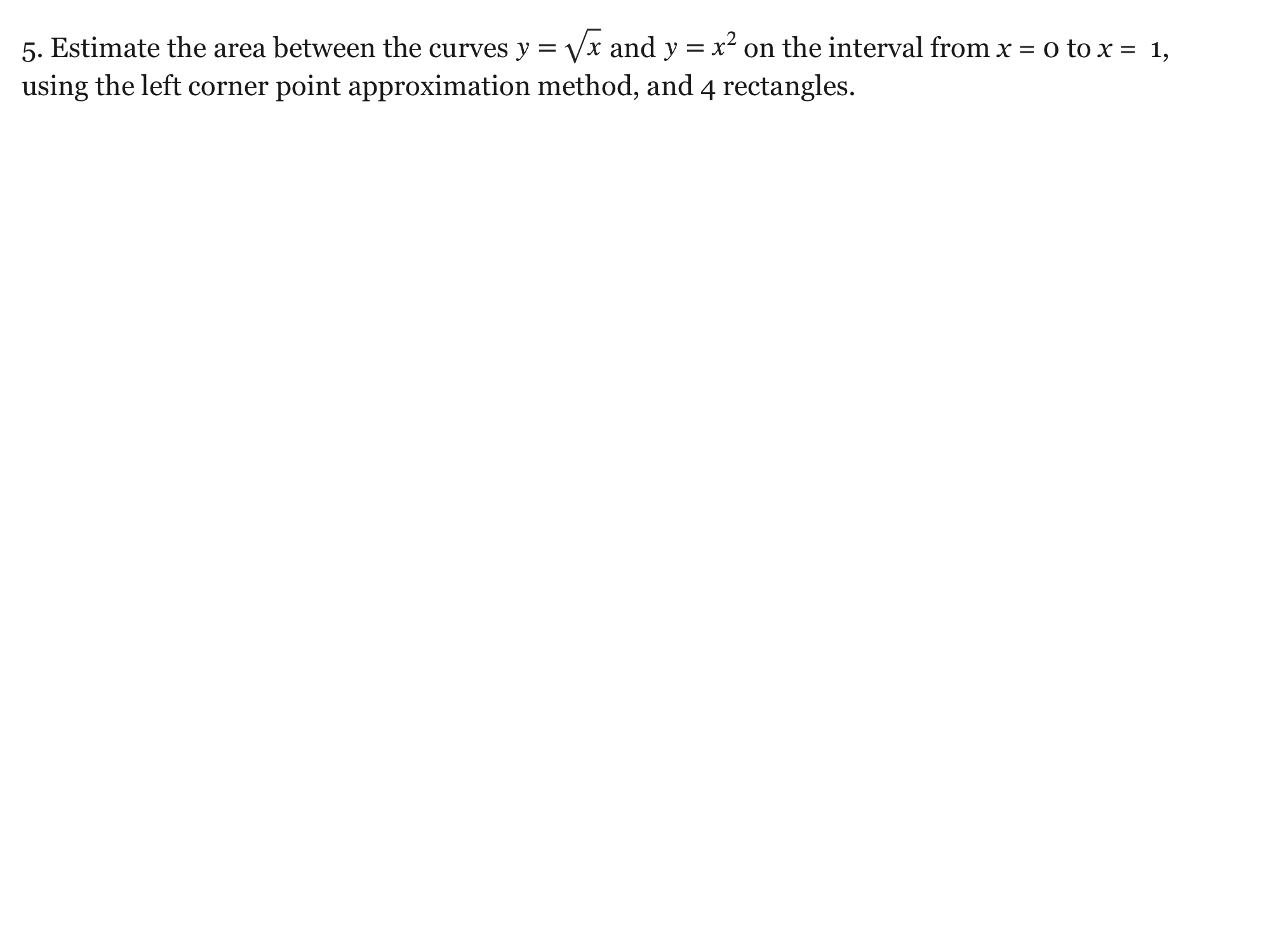
Estimate the area between the curves and on the interval from x = 0 to x = 1 using the left corner point approximation method and 4 rectangles.Show your work for Problem 5
Original source problem image and any figures. Read it together with the accessible problem text and any figure description or source note alongside it. Open the source image at full size. Drawing is temporarily unavailable. Work on paper if needed, then record your reasoning here.
Saving written working requires JavaScript. Keep your work on paper or in your own notes; the source problem above remains available.
-
Original problem
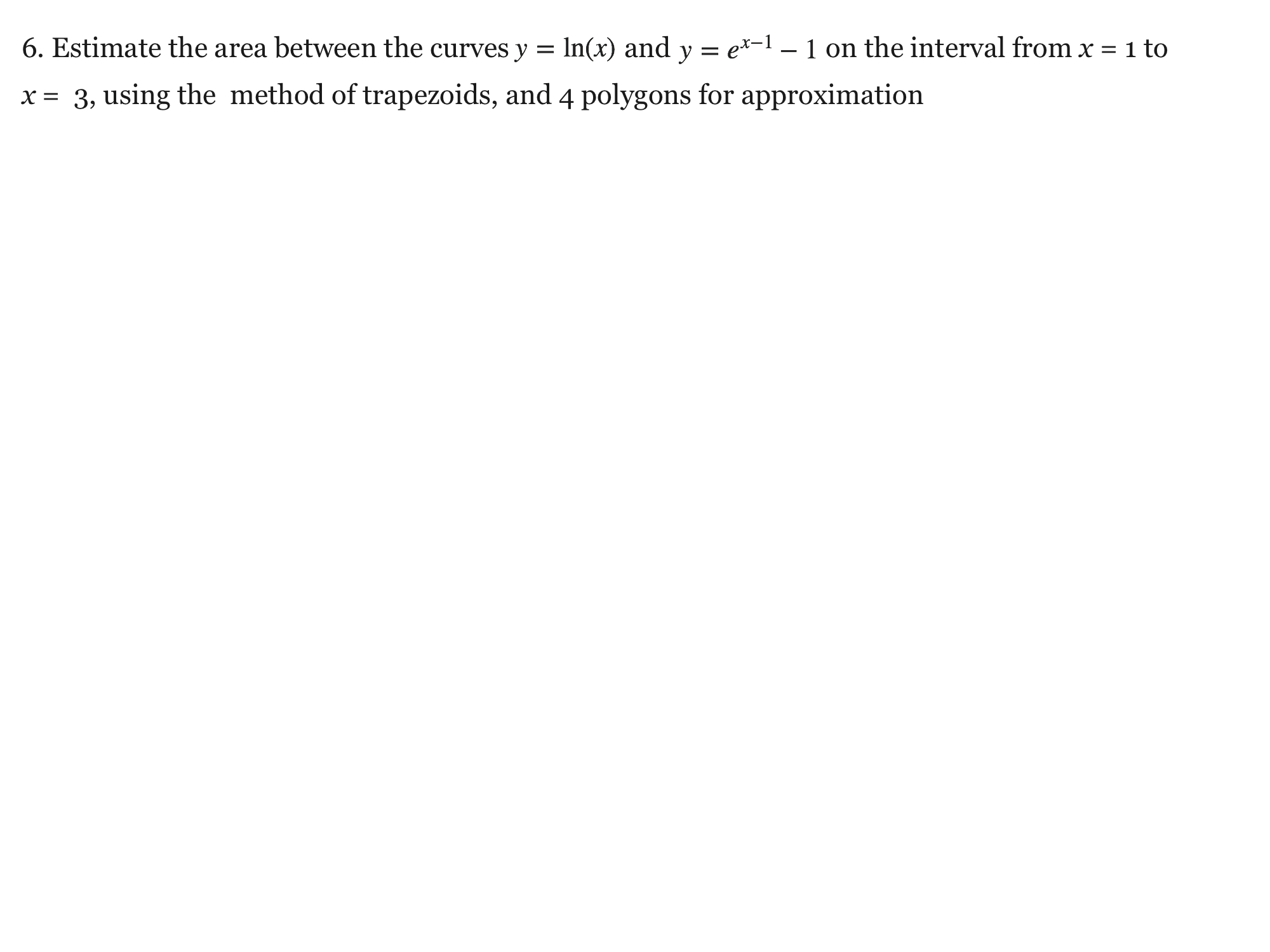
Estimate the area between the curves and from x = 1 to x = 3 using the method of trapezoids and 4 polygons for approximation.Show your work for Problem 6
Original source problem image and any figures. Read it together with the accessible problem text and any figure description or source note alongside it. Open the source image at full size. Drawing is temporarily unavailable. Work on paper if needed, then record your reasoning here.
Saving written working requires JavaScript. Keep your work on paper or in your own notes; the source problem above remains available.
-
Original problem · clarified
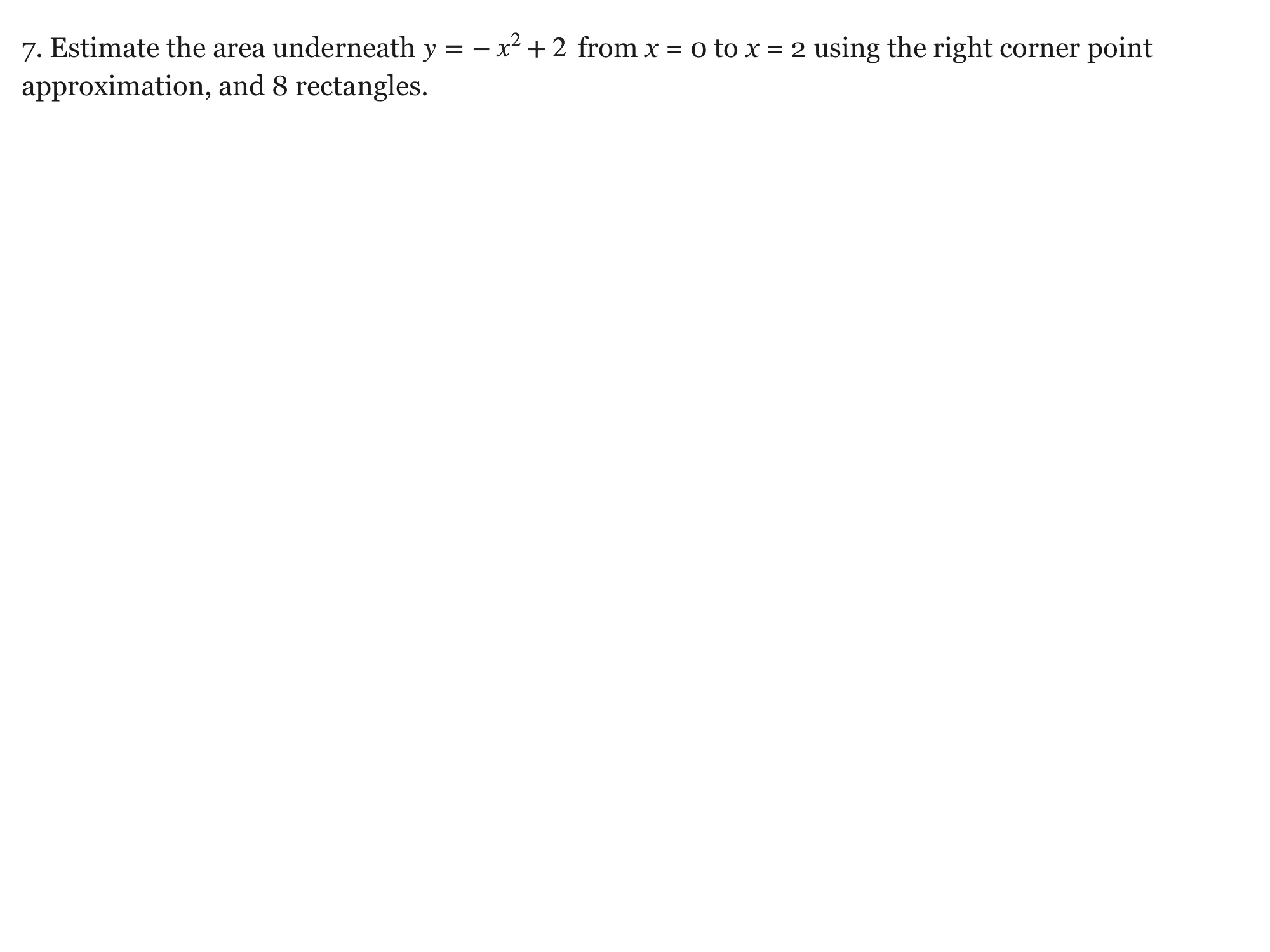
Estimate the area underneath from x = 0 to x = 2 using right corner point approximation and 8 rectangles.Clarification: Estimate geometric area between the curve and the x-axis, using the absolute value of each right-endpoint height.
Show your work for Problem 7
Original source problem image and any figures. Read it together with the accessible problem text and any figure description or source note alongside it. Open the source image at full size. Drawing is temporarily unavailable. Work on paper if needed, then record your reasoning here.
Saving written working requires JavaScript. Keep your work on paper or in your own notes; the source problem above remains available.
-
Original problem
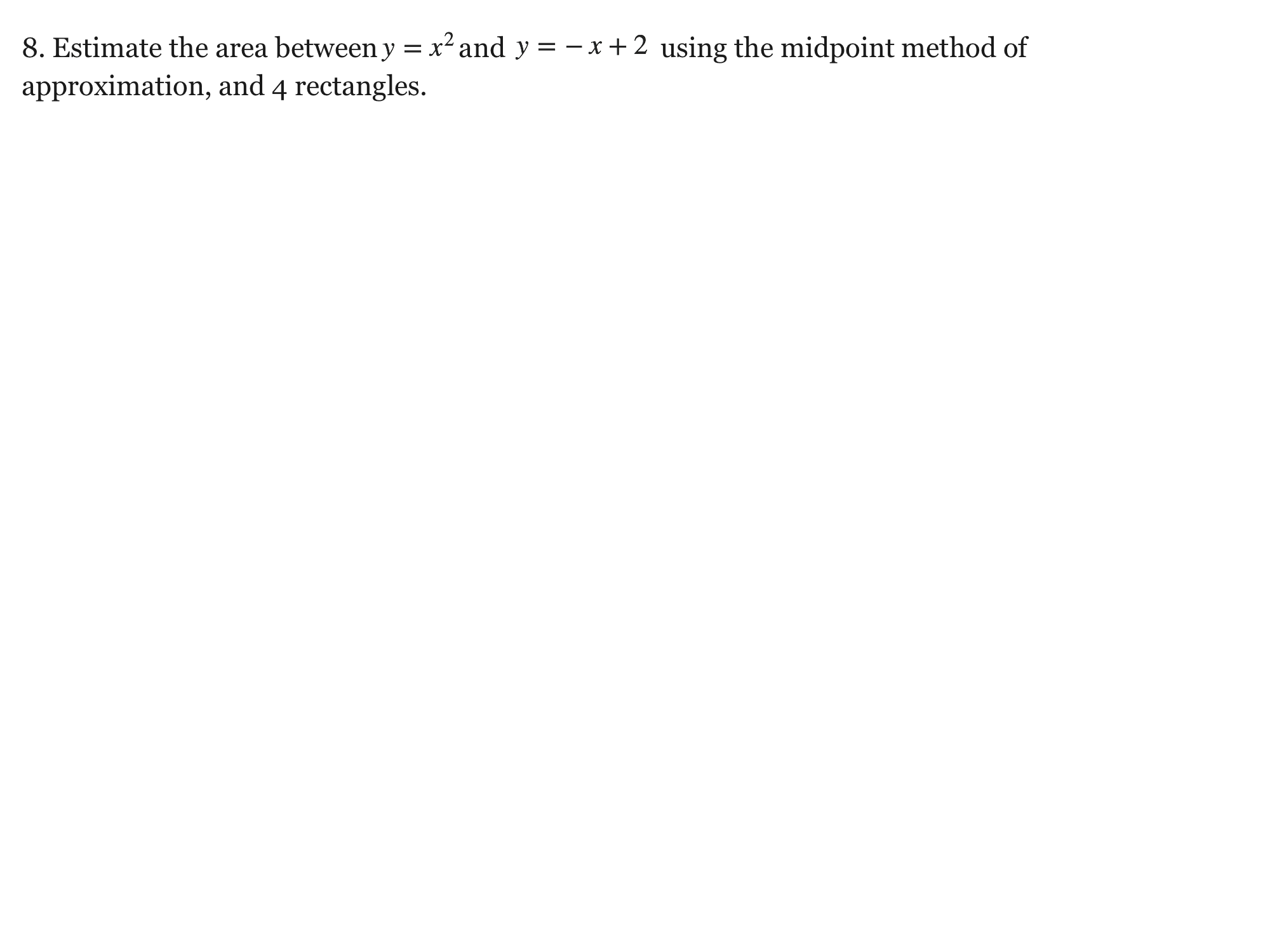
Estimate the area between and from x = 0 to x = 1 using the midpoint method of approximation and 4 rectangles.Show your work for Problem 8
Original source problem image and any figures. Read it together with the accessible problem text and any figure description or source note alongside it. Open the source image at full size. Drawing is temporarily unavailable. Work on paper if needed, then record your reasoning here.
Saving written working requires JavaScript. Keep your work on paper or in your own notes; the source problem above remains available.
-
Original problem
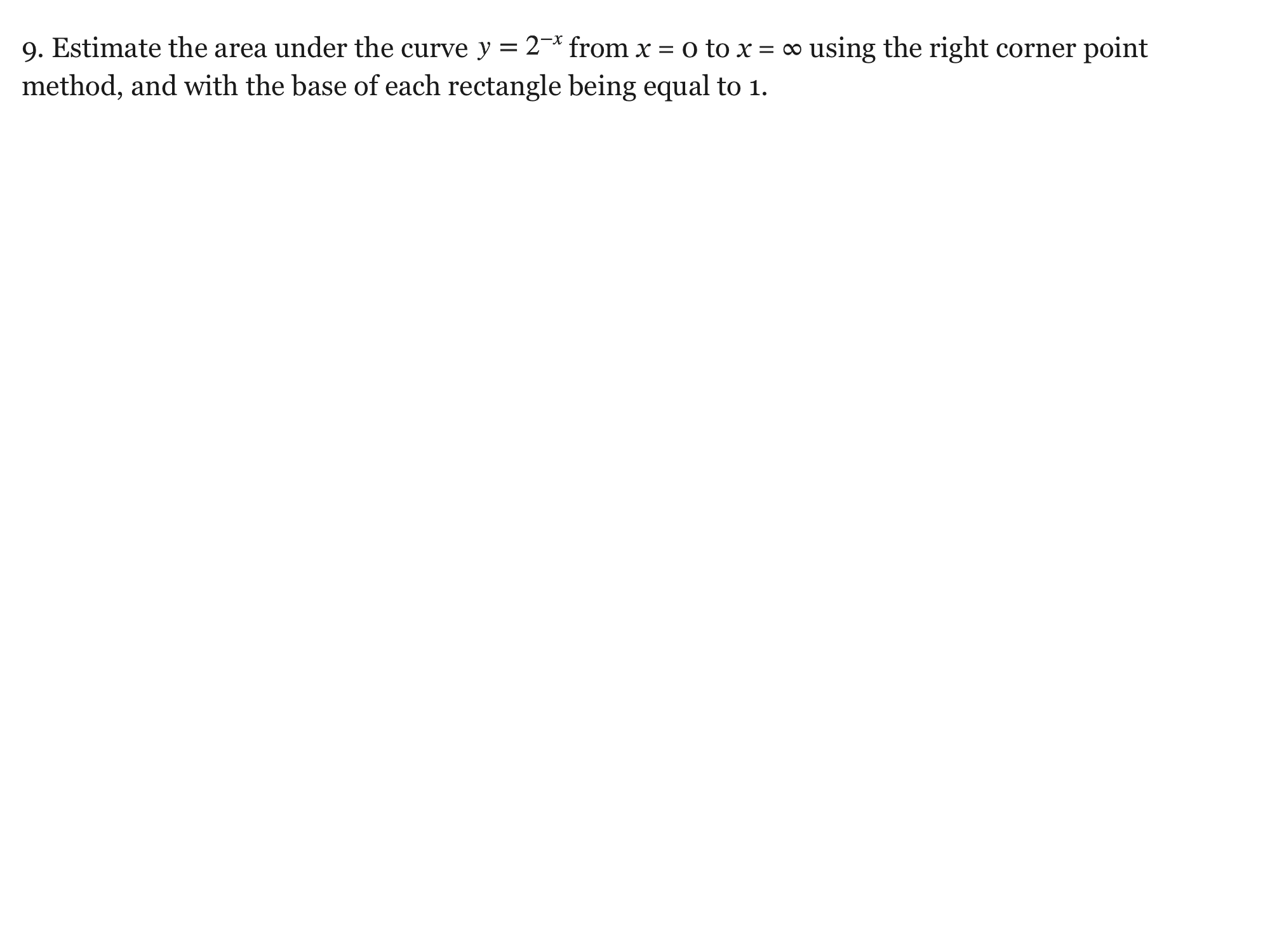
Estimate the area under the curve from x = 0 to x = ∞ using the right corner point method and with the base of each rectangle being equal to 1.Show your work for Problem 9
Original source problem image and any figures. Read it together with the accessible problem text and any figure description or source note alongside it. Open the source image at full size. Drawing is temporarily unavailable. Work on paper if needed, then record your reasoning here.
Saving written working requires JavaScript. Keep your work on paper or in your own notes; the source problem above remains available.
-
Original problem · clarified
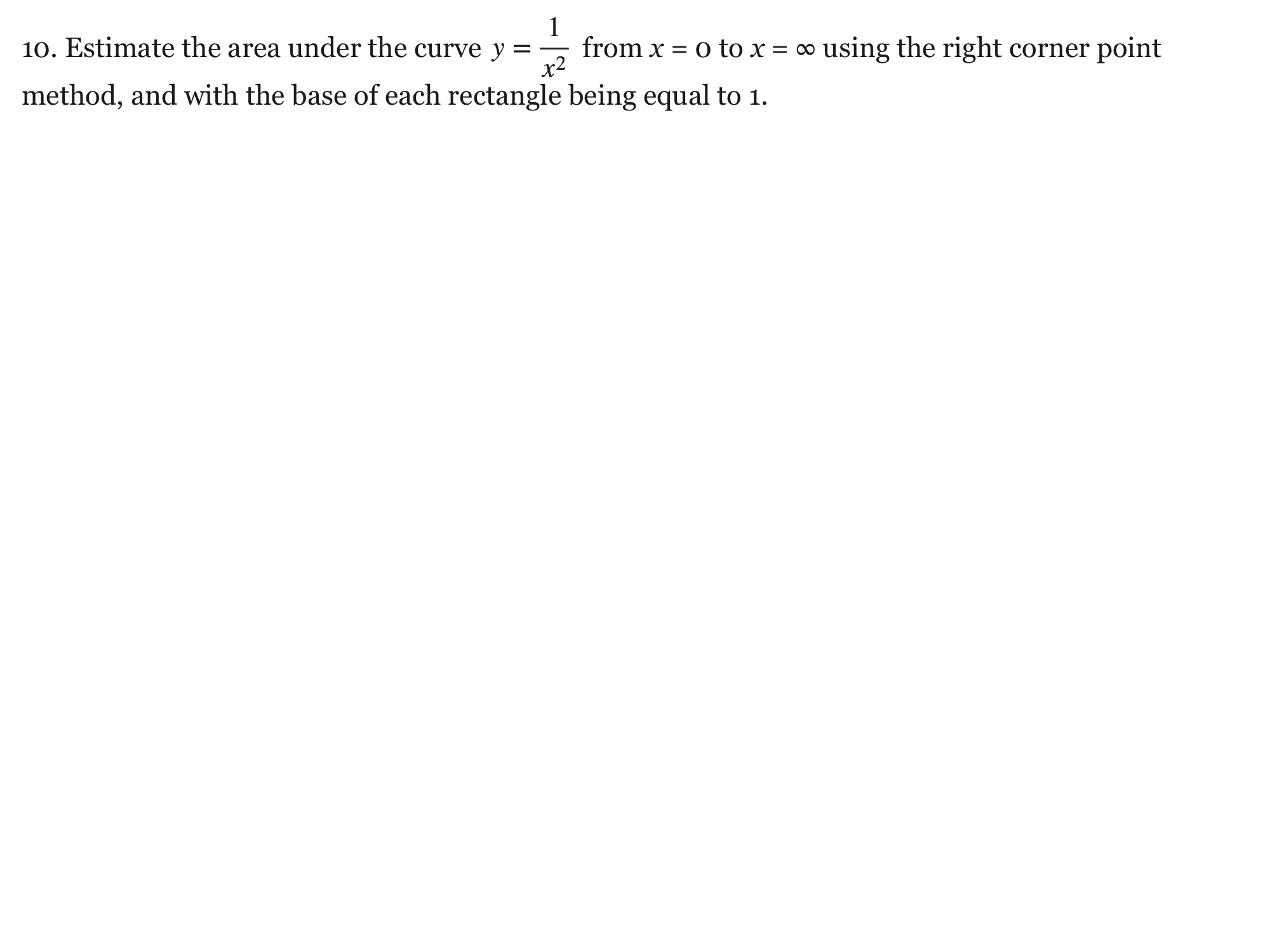
Estimate the area under the curve from x = 0 to x = ∞ using the right corner point method and with the base of each rectangle being equal to 1.Clarification: Estimate the unit-width right-rectangle sum, whose sample points are 1,2,3,… . This is a sampled estimate; the exact improper area starting at x=0 diverges.
Show your work for Problem 10
Original source problem image and any figures. Read it together with the accessible problem text and any figure description or source note alongside it. Open the source image at full size. Drawing is temporarily unavailable. Work on paper if needed, then record your reasoning here.
Saving written working requires JavaScript. Keep your work on paper or in your own notes; the source problem above remains available.
-
Added problem
Estimate the area under on using three left rectangles.
-
Added problem
For on [0,3], use three right rectangles, compute the matching left sum, and give area bounds.
-
Added problem
Use two midpoint rectangles to estimate the area under on [−1,1].
-
Added problem
Use three trapezoids for on [−1,2]. Explain why the result is exact.
-
Added problem
For a decreasing nonnegative function, explain which equal-width rectangle estimate is larger than the true area: left or right?
-
Added problem
At x=0,1,2,3 a table gives f=2,4,8,10. Assume f is nonnegative and increasing. Find left/right sums and area bounds on [0,3].
-
Added problem
A table gives (x,f(x))=(0,2),(1,4),(3,8). Estimate its area with a trapezoid on each interval.
-
Added problem
Use two midpoint rectangles for the area between and on [0,1].
-
Added problem
A function is nonnegative and concave up on an interval. Explain whether its trapezoidal estimate lies above or below the exact area.
-
Added problem
Use two midpoint rectangles for on [0,2]. Explain the error direction using concavity.
-
Added problem
At x=0,1,2,3 a table gives f=0,−2,1,1. On [0,3], find the signed right sum and the right estimate of geometric area.
-
Added problem
Compare left sums with n=2 and n=4 for on [0,2]. Why does the second estimate increase?
-
Added problem
For on [0,1], write Rₙ using and find its limit.
-
Added problem
Compute left, right, midpoint, and trapezoidal estimates with n=2 for on [0,2].
-
Added problem
Find all antiderivatives of .
-
Added problem
Find an antiderivative of and check it.
-
Added problem
Find F if and .
-
Added problem
A student proposes as an antiderivative of . Check and correct it.
-
Added problem
A velocity table gives 2,6,14 m/s at t=0,1,2 s. Use trapezoids to estimate the displacement over the two seconds.
-
Added problem
For the infinite unit-width right rectangle sum of from zero, how many rectangles make its remaining tail less than 0.01?