Corner point approximation
This original textbook reading covers part of the AP topic. Follow the AP course outline for complete topic instruction and practice.
- Corner point approximation
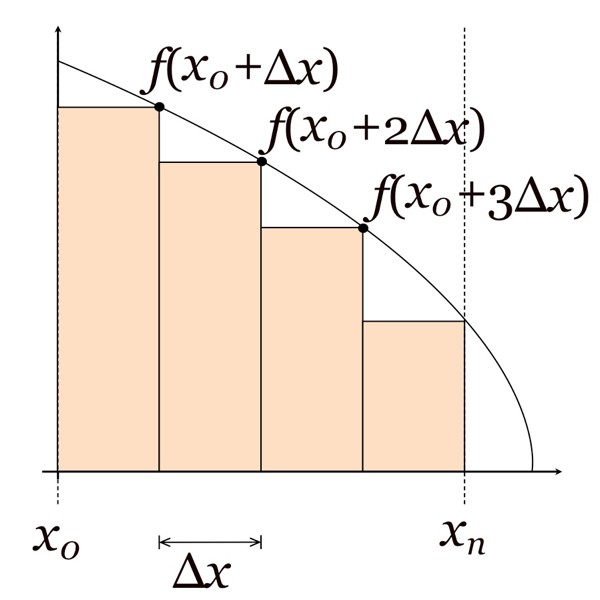
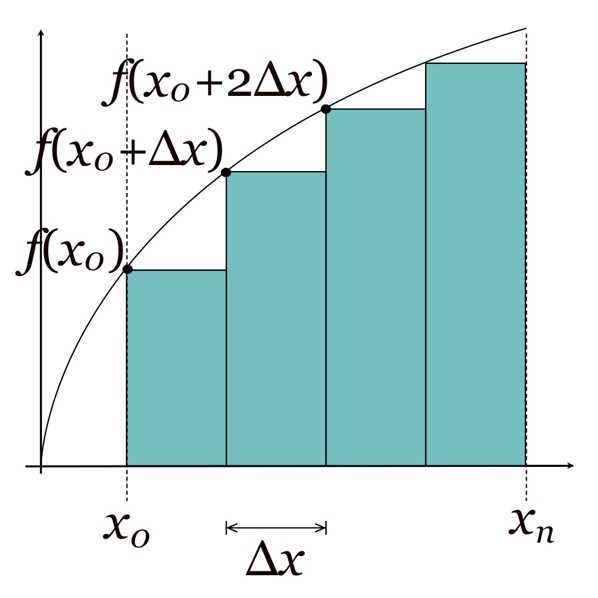
Corner point approximation is the simplest method of approximating the area under a curve. It uses a rectangle, with one of its corner points touching the curve. Using a simple formula of base•height () one can find the area of each rectangle and get a crude approximation.
The right corner point uses a slightly different value of than the left corner point. Each of their examples are shown below. Notice that the base stays constant, whereas the height varies.
- Index
Chapter 7 - FFR - Anti-derivatives
Glossary and deeper reading · 1 refreshers
These editorial refreshers supplement the reading. Definitions and examples are added guidance; original source wording and recorded answers remain in their original context.
-
Riemann sum
A Riemann sum approximates accumulation by adding sample heights times subinterval widths. Left, right, and midpoint sums choose different sample positions in each subinterval. For example, a left sum for x² on [0,2] with two equal widths uses heights 0 and 1, giving 1. A definite integral is the limiting value as the largest subinterval width approaches zero when that limit exists.