Midpoint approximation method
This original textbook reading covers part of the AP topic. Follow the AP course outline for complete topic instruction and practice.
- Midpoint approximation method
A method of estimating areas under curves. It is structured so that the midpoint of the top of each rectangle lies on the curve whose area is being approximated.
Example: Find the area of the curve from the interval 0.5 to 2.5 using the midpoint method, and n = 2 rectangles.
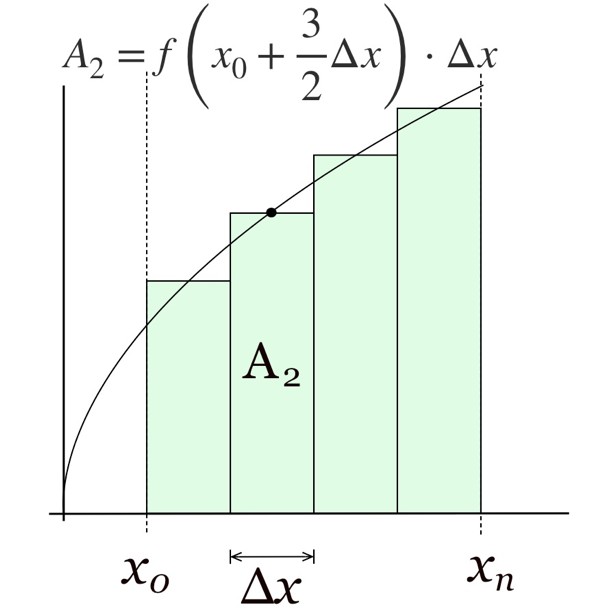
- Index
Chapter 7 - Trapezoidal Method
Glossary and deeper reading · 1 refreshers
These editorial refreshers supplement the reading. Definitions and examples are added guidance; original source wording and recorded answers remain in their original context.
-
Midpoint rule
The midpoint rule approximates a definite integral by sampling at the center of each subinterval. Each sampled height is multiplied by its own subinterval width. For example, one midpoint rectangle for x² on [0,2] has height 1 and width 2, giving 2. For a concave-up function the midpoint sum underestimates the integral, while for a concave-down function it overestimates it.