Washers and Discs
This original textbook reading covers part of the AP topic. Follow the AP course outline for complete topic instruction and practice.
This time, rather than summing up cylindrical shells, we are summing up (integrating) discs, or washers if there is a bound function on the bottom (you can think of washers as really thin donut slices).
Whereas for cylindrical shells we were using the area of the side of a cylinder, now we will be using the area of circles, or more specifically discs.
This method was covered in section 9.3 using a cylinder. For more complex shapes such as cones, the concept stays the same, except the radius of each disc varies with dx or dy.
This time, the direction of integration will be perpendicular to the radius of each disc. Conceptually, whether we choose dy or dx depends on which direction leads us to the next infinitely thin shell or disc or whichever shape we are integrating (yes, it’s possible to integrate using other shapes as well, ex: spherical shells to find the volume of a sphere).
In general disc or washer integration is easier to do in the x-direction, but it is possible to do so in the y-direction as well. We will practice with both methods to increase our proficiency.
Interactive 10.2.1 A familiar shape
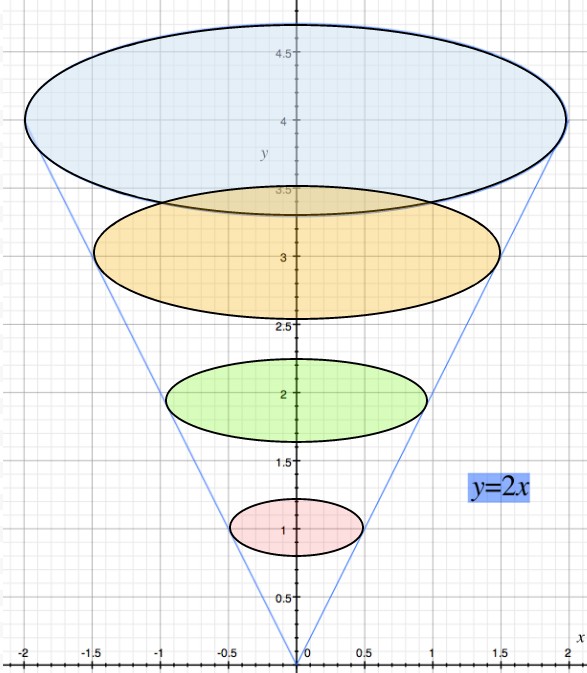
Read all original figure notes
Same curve
Infinitely thin discs
The core concept of summing up an infinite number of very thin shapes stays the same. We are simply changing the shape, and thus the equations we integrate.
Example Problem 10.2.1
On the interval of 0 to 1, the function is bound by on the bottom. The area between them is rotated around the x-axis. Find the volume of the resulting solid using the method of discs (also known as washers).
Interactive 10.2.2 Example 10.2.1
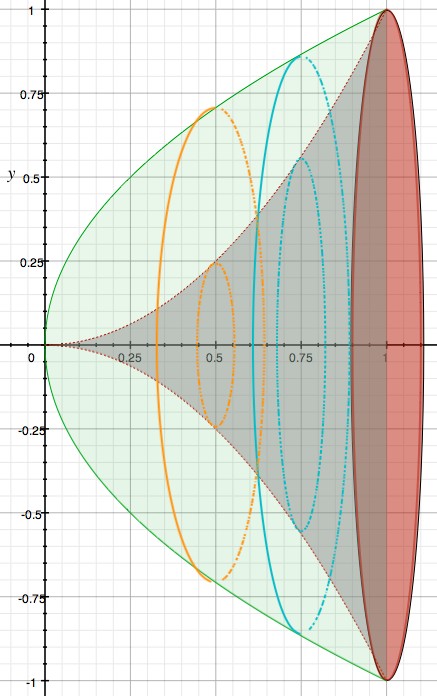
Read all original figure notes
Area of Orange washer/disc
Summation along x-axis
Interactive 10.2.3 A Hint for Example 10.2.2
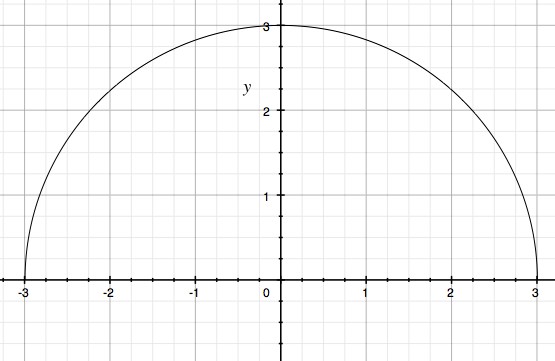
Read all original figure notes
Interval of Integration
Radius of each disc
Equation of a circle
Glossary and deeper reading · 3 refreshers
These editorial refreshers supplement the reading. Definitions and examples are added guidance; original source wording and recorded answers remain in their original context.
-
Cylindrical shell method
The cylindrical shell method computes volume by accumulating thin cylindrical layers parallel to a rotation axis. The volume contribution is circumference times shell height times thickness. For example, rotating a vertical strip at x>0 around the vertical axis gives a contribution 2πx·height·dx. Choose the radius as a distance from the axis and check the shell height against the bounding region.
Read more: Original source · Cylindrical Shells (beyond AB) →
-
Disc method
The disc method finds a solid’s volume using circular slices perpendicular to the rotation axis. A slice with radius R has area πR². For example, rotating the region under y=x on [0,1] around the horizontal axis gives volume equal to the integral of πx². If the region leaves a hole around the axis, a washer rather than a full disc is needed.
-
Washer method
The washer method uses circular slices with a central hole to compute volume. A slice with outer radius R and inner radius r has area π(R²−r²). For example, rotating the region 1≤y≤2 on a horizontal interval around the horizontal axis gives washer area 3π. Both radii are distances from the rotation axis and must be expressed using the same slice variable.