Access this content offline
Omniguides
Skip to the reading

Cylindrical Shells

Beyond this AP Calculus course

This original textbook reading covers part of the AP topic. Follow the AP course outline for complete topic instruction and practice.

The Tortoise Comes Out

In Section 9.3 we discussed how cylindrical shells could be used to derive the volume of a cylinder. Now, we use the same method and apply it to the volume of a cone. This time it will be a little easier because the cone is rotated around the y-axis, which is more convenient for cylindrical shells.

Example Problem 10.1.1

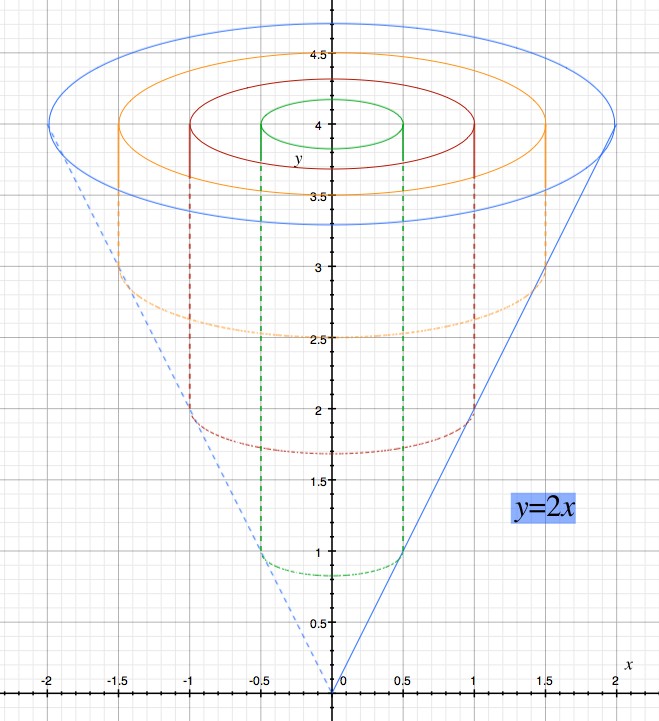
Conic Paper Co. is coming up with a new design for their disposable paper cups. They came up with this design by taking a piece of the cone formed by revolving the equation y = 2x around the y-axis to form a cone. If the cone’s radius is 2 cm, using the cylindrical shells method, calculate the mass of water that this new paper cup can hold, assuming the density of water is 1 gram per cubic centimeter?


Interactive 10.1.1 Example 10.1.1 visualized
Interactive 10.1.1 Example 10.1.1 visualized
Read all original figure notes

Area of each shell

We know the height of each shell is represented by the function y=4-2x, and we know that the radius of each cylindrical shell is represented by x, so the area is represented by the circumference times the height, or A=2πx•(4-2x). Since we want to sum up all of these areas from 0 to 2, the final integral would look like the one shown below.

x ranges from 0 to 2

As we can see x represents the radius, and the radius of the cone, and each cylindrical shell within the cone, is represented by x. However, what is the function that represents the height of the cone, and the height of each cylindrical shell within the cone? Hint: it’s not y=2x

Height of each shell

The trickier part is coming up with a function that will tell us the height of each shell with respect to x. It’s not y=2x, because that gives us the height of the green cylinder equal to 1... what about h=4-2x? That seems to work! This is why it is very important to both draw a picture and imagine the problem visually.

Quite a few things going on here, but it helps to first form a picture of the main ideas first. Here are the key pieces of information the question tells us:

Cylindrical shells

y=2x rotated around y-axis

x ranges from 0 to 2

Final answer’s units are in grams.

V=∫022πx⋅(4-2x)dx=2π∫024x-2x2dx=2π([2x2]02-[2x33]02)=2π((8-0)-(163-0))​
=16π3

Volumes of rotation can be pretty tricky sometimes. If you want to check our answer, we can use the formula of the volume of a cone, V=13πr2h​
and we see that we get the same answer. Let’s try something more difficult.

Example Problem 10.1.2.

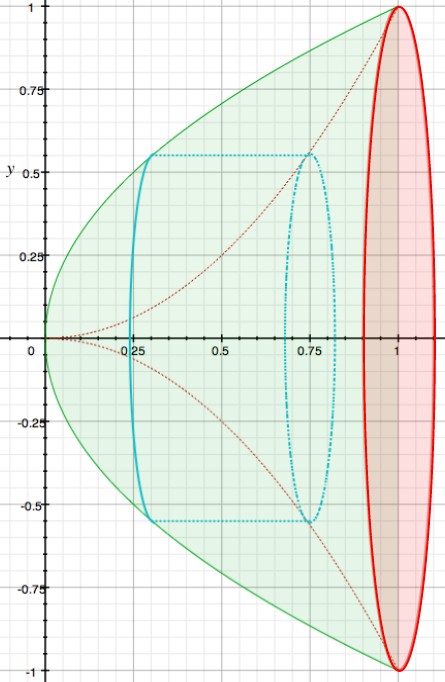
On the interval of 0 to 1, the function y=x is bound by y=x2 on the bottom. The area between them is rotated around the x-axis. Find the volume of the resulting solid using shells.

This is not an easy problem, but it will give us better mastery of the cylindrical shells method of integration. As always, we first try to visualize what the question is asking.​
You probably can’t draw the diagram on the left on your graphing calculator, but you can imagine the area between the two functions looking like a leaf. By rotating this leaf-shaped curve around the
x-axis, we form a bowl. We have to write the integral of these functions with respect to y, giving us:

V=∫012πy⋅(y-y2)dy

This is tricky to visualize because it’s a cylindrical shell turned sideways, where the blue term represents the circumference of the shell, and the green term represents the height of the shell. The dy term tells us to move on to the next infinitely thin shell.​


Interactive 10.1.2 Example 10.1.2

Interactive 10.1.2 Example 10.1.2
Read all original figure notes

Cylindrical Shell

We can see that the radius of this shell is equal to y. Its height is a bit trickier to measure though, because it’s not dependent on x, but on y. The height of this cylindrical shell is equal to x2-√x, or the inside of the bowl (red) minus the outside of the bowl (green). The shells are integrated with respect to y because it represents the radius, so the functions must also be changed so that they have the variable y instead of x.

Lower Bound

The lower bound is shown in red. When these two curves are revolved around the x-axis, they form what looks like a bowl with a cone-shaped inside.

Upper Bound

The upper bound function is y=√x, which is greater than y=x2 on the interval x=0 to x=1. Notice that it acts as a constraint to our cylindrical shell’s height.

If you are having trouble visualizing this, refer to Interactive 10.1.2. Note that for cylindrical shells, whether you use dy or dx depends on which direction the radius of the shell is. ​
Converting the above integral into a more integrable form gives us:

V=2π∫01y32-y3dy=2π([25y52]01-[y44]01)=2π(25-14)​
=3π10 units

Pop Quiz 10.1.1 Volume through cylindrical shells

Question 1 of 5 · 0 correct
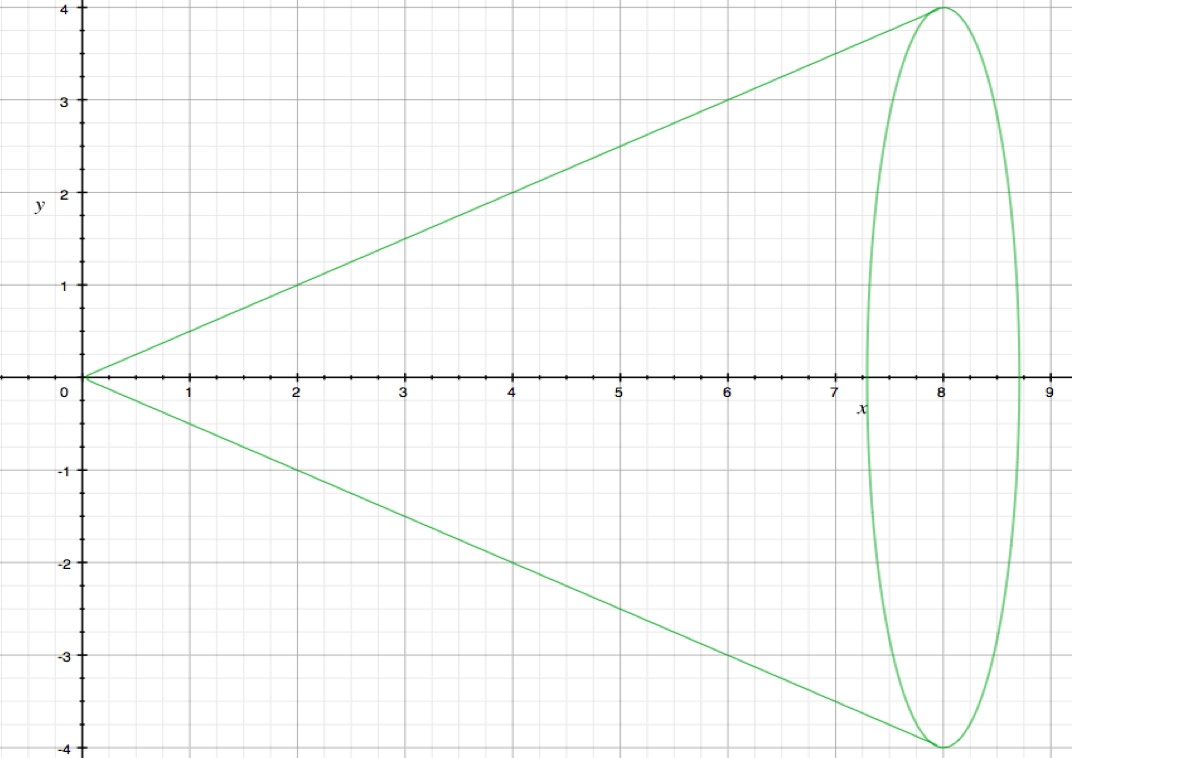
Select the correct integral that represents this shape’s volume using the method of cylinders.

Select one answer.
Search lessons, terms and problems