Chapter 5 Solutions
Worked solutions to all thirty problems, with the reason for each step. These explanations were added for this edition; the chapter answer key and original worked examples follow below.
Chapter problems → · Chapter answer key → · Original worked examples →
Problem 1
Original problem · clarified · added worked solution
Clarification: Assume continuous compounding at an annual rate of 0.10, with t in years since the deposit.
Authored worked explanation for the original source problem.
Source review note: The source answer matches continuous compounding. “Annual rate” alone does not specify continuous versus discrete compounding; this reviewed explanation states the implied convention.
Use the source's continuous model , with t measured from age 20.
Why: The source answer implies this model; annual discrete compounding would be a different model.
At age 60, t=40, and gives .
Why: Differentiate with respect to years; age 65 and the full 45 years are not the requested instant.
Reviewed answer: dollars/year under continuous compounding.
Takeaway: State the growth model and identify elapsed time before differentiating.
Final answer
Problem 2
Original problem · clarified · added worked solution
Clarification: Take the real-domain limit as x approaches 3 from the right.
Authored worked explanation for the original source problem.
Source review note: The source result 0 is consistent for x→3⁺. The printed function has no real left-side domain near 3.
Set h=x−3>0; the expression becomes .
Why: The log and square root require approaching 3 through x>3.
. For the other term, write .
Why: This converts 0·(−∞) into a quotient to which L'Hospital applies.
Its derivative ratio is , so the sum tends to 0.
Why: The numerator and denominator are differentiable for h>0.
Reviewed answer: from the right.
Takeaway: A domain can force a one-sided limit even when the prompt omits the side.
Final answer
Problem 3
Original problem · added worked solution
Authored worked explanation for the original source problem.
For x>1, write .
Why: Taking a logarithm turns a variable power into a product in the exponent.
Both x^x and ln x grow without bound, so the exponent tends to −∞ and the exponential tends to 0.
Why: The factors are positive, so their product cannot cancel.
Reviewed answer:
Takeaway: A negative exponent growing in magnitude forces exponential decay.
Final answer
Problem 4
Original problem · added worked solution
Authored worked explanation for the original source problem.
is ∞/∞ as x→∞, so L'Hospital gives .
Why: The differentiated denominator stays nonzero.
Sine is continuous at 0, so the outside sine tends to sin0=0.
Why: Carry the inner limit through the continuous outer function.
Reviewed answer:
Takeaway: Solve the inner limit before applying the trig function.
Final answer
Problem 5
Original problem · added worked solution
Authored worked explanation for the original source problem.
Source review note: The source uses ln2 as the multiplier for differentiating 3^u; the correct multiplier is ln3.
, and .
Why: Use change of base or the general log derivative, with the original x>0 domain.
For the middle term, let u=x log₂x, so .
Why: The exponent is itself a product.
.
Why: The logarithmic multiplier belongs to the exponential's base 3.
Reviewed answer: , x>0.
Takeaway: Keep the exponential base and the logarithm base separate.
Final answer
Problem 6
Original problem · added worked solution
Authored worked explanation for the original source problem.
The arctangent term gives .
Why: Apply the inverse tangent derivative and the inside logarithm derivative.
The arcsine term gives .
Why: The arccos derivative supplies the negative sign.
Require , so the function domain is [cos1,1]; use the interior for the displayed finite derivative.
Why: A composite inverse trig function needs both inside and outside domain checks.
Reviewed answer: , for cos1<x<1.
Takeaway: The outer inverse trig domain restricts the inner inverse trig output.
Final answer
Problem 7
Original problem · added worked solution
Authored worked explanation for the original source problem.
Take logarithms: .
Why: The base is positive near positive infinity.
The numerator tends to ln4 while the denominator grows without bound, so ln y→0.
Why: This quotient has a finite numerator rather than an indeterminate ∞/∞ form.
Then y→e⁰=1.
Why: Exponentiation is continuous.
Reviewed answer:
Takeaway: A shrinking exponent can send a fixed positive base toward 1.
Final answer
Problem 8
Original problem · added worked solution
Authored worked explanation for the original source problem.
Source review note: The source omits the coefficient 5, uses plus signs in inverse secant/cosecant radicals that require minus signs, and does not correctly differentiate x^(ln x).
For arcsec(4^x), u=4^x>0 and , giving before the factor 5.
Why: Arcsec uses u²−1 and an absolute value, not u²+1.
For arccot(arccsc x), both inside and outside derivatives are negative; on x>1 their product gives before the factor 2.
Why: Use the principal arccot convention with derivative −1/(1+u²).
For v=x^(ln x), , so .
Why: Logarithmic differentiation handles both variable base and exponent.
The last term differentiates to ; the combined function's real interior domain is x>1.
Why: The logarithmic power requires x>0, while arccsc requires |x|≥1.
Reviewed answer: , for x>1.
Takeaway: State inverse-function conventions and check the combined domain.
Final answer
Problem 9
Original problem · added worked solution
Authored worked explanation for the original source problem.
.
Why: The inverse sine and base-3 exponential use different special rules.
At x=0 this is 2+ln3.
Why: Both terms are defined and finite at zero.
Reviewed answer:
Takeaway: Evaluate the complete derivative at the requested point.
Final answer
Problem 10
Original problem · added worked solution
Authored worked explanation for the original source problem.
Source review note: The source gives 4.31, but arcsec(4^(log₂(0.5)))=arcsec(1/4) is not real-defined.
for x>0, so at x=0.5 the arcsec input is 1/4.
Why: Rewrite the exponential using 4=2².
Real arcsec requires its input to have absolute value at least 1.
Why: A real secant value cannot lie strictly between −1 and 1.
The function is therefore not real-defined at the requested input, so it has no real tangent slope there.
Why: Differentiation cannot repair a domain failure.
Reviewed answer: No real tangent slope at x=0.5.
Takeaway: Check a nested inverse trig input before computing its derivative.
Final answer
Problem 11
Added problem and worked solution
Differentiate .
Authored solution to an added practice problem.
The derivative of ln u is u′/u.
Why: The argument x²+1 is positive for all real x.
With u′=2x, the result is 2x/(x²+1).
Why: The chain rule multiplies the outer derivative by the inner derivative.
Reviewed answer:
Takeaway: A log derivative retains its argument in the denominator.
Final answer
Problem 12
Added problem and worked solution
Find the derivative of .
Authored solution to an added practice problem.
The derivative of 5^u is 5^u ln5·u′.
Why: The base determines the logarithmic multiplier.
For u=1−2x, u′=−2.
Why: Include the exponent's slope.
Reviewed answer:
Takeaway: A decreasing exponent gives a negative derivative here.
Final answer
Problem 13
Added problem and worked solution
Find the derivative and domain of .
Authored solution to an added practice problem.
The original logarithm requires x²−4>0.
Why: A real log has a positive argument.
Differentiate by u′/(u ln3) with u=x²−4.
Why: The general log's base 3 contributes ln3 in the denominator.
Reviewed answer: , domain .
Takeaway: Solve the argument inequality before using a log derivative.
Final answer
Problem 14
Added problem and worked solution
Use logarithmic differentiation to differentiate for .
Authored solution to an added practice problem.
Set y=x^x and take logs: .
Why: This removes the variable exponent.
Differentiate to , then multiply by y.
Why: The right side uses the product rule.
Reviewed answer: , x>0.
Takeaway: A variable base and exponent both contribute.
Final answer
Problem 15
Added problem and worked solution
Differentiate .
Authored solution to an added practice problem.
Let y=(x²+1)^x, so .
Why: The base is positive for every real x.
Then , and multiply by y.
Why: Product and chain rules account for the two changing parts.
Reviewed answer:
Takeaway: Logarithms turn a difficult power into a manageable product.
Final answer
Problem 16
Added problem and worked solution
Differentiate and give the finite derivative domain.
Authored solution to an added practice problem.
Use the arcsine derivative 1/√(1−u²).
Why: The finite derivative requires the argument strictly inside [−1,1].
The inside 3x has derivative 3, giving the answer.
Why: The function itself includes endpoints, but its derivative blows up there.
Reviewed answer: , for |x|<1/3.
Takeaway: Differentiate on the interior even when the original function includes endpoints.
Final answer
Problem 17
Added problem and worked solution
Differentiate on its interior domain.
Authored solution to an added practice problem.
Set u=x², whose derivative is 2x.
Why: The outer arccos requires 0≤x²≤1.
The inverse cosine derivative is −u′/√(1−u²), giving the answer.
Why: Keep the outer negative sign and square the complete inner expression.
Reviewed answer: for |x|<1.
Takeaway: A squared input becomes a fourth power in the radical.
Final answer
Problem 18
Added problem and worked solution
Find the derivative of .
Authored solution to an added practice problem.
Use the arctangent derivative u′/(1+u²).
Why: Arctangent accepts every real inner value.
For u=e^x, u′=e^x and u²=e^(2x).
Why: The exponential's square doubles its exponent.
Reviewed answer:
Takeaway: An inverse tangent composition has a plus sign in its denominator.
Final answer
Problem 19
Added problem and worked solution
For the one-to-one function , find without solving for the full inverse.
Authored solution to an added practice problem.
Since f(2)=8+2=10, the inverse sends 10 to 2.
Why: Locate the original input corresponding to the inverse input.
, so the inverse slope is its reciprocal, 1/13.
Why: The inverse derivative rule requires a nonzero original slope.
Reviewed answer: .
Takeaway: Inverse slopes are reciprocal at corresponding points.
Final answer
Problem 20
Added problem and worked solution
A locally invertible function has and . Find the derivative of its inverse at 7.
Authored solution to an added practice problem.
For g=f⁻¹, means g(7)=3.
Why: Match the two functions' corresponding coordinates.
.
Why: The given derivative is nonzero, so the local inverse rule applies.
Reviewed answer: .
Takeaway: A negative inverse slope stays negative.
Final answer
Problem 21
Added problem and worked solution
Use L’Hospital’s rule to evaluate .
Authored solution to an added practice problem.
Both numerator and denominator approach 0.
Why: This is an eligible indeterminate quotient.
Differentiate them separately to get , whose limit is 2.
Why: L'Hospital differentiates the quotient's two parts, not the quotient as a whole.
Reviewed answer:
Takeaway: Check the form before applying the rule.
Final answer
Problem 22
Added problem and worked solution
Evaluate .
Authored solution to an added practice problem.
The first derivative ratio is , still 0/0.
Why: The original numerator and its first derivative both vanish at zero.
Differentiate again to , giving 1/2.
Why: Reapply the rule only after checking the new indeterminate form.
Reviewed answer:
Takeaway: More than one derivative may be needed.
Final answer
Problem 23
Added problem and worked solution
Find .
Authored solution to an added practice problem.
Write for x>0.
Why: A product 0·(−∞) must be converted to an eligible quotient.
The derivative ratio is −x, which tends to 0 as x→0⁺.
Why: Both numerator and denominator are differentiable on the right-hand domain.
Reviewed answer:
Takeaway: Rewrite a product before reaching for L'Hospital.
Final answer
Problem 24
Added problem and worked solution
Evaluate .
Authored solution to an added practice problem.
The quotient x²/e^x is ∞/∞.
Why: Both parts grow without bound.
Apply L'Hospital twice: , then .
Why: Each differentiation lowers the polynomial degree while leaving the exponential.
Reviewed answer:
Takeaway: Exponentials dominate any fixed polynomial power here.
Final answer
Problem 25
Added problem and worked solution
Evaluate .
Authored solution to an added practice problem.
Set y=(1+2x)^(1/x) for x near zero and take .
Why: The positive base permits logarithms on both sides near zero.
L'Hospital gives the logarithmic limit .
Why: The log quotient is 0/0.
Thus y→e².
Why: Exponentiate the logarithmic limit.
Reviewed answer:
Takeaway: Take logs to turn a variable power into a quotient.
Final answer
Problem 26
Added problem and worked solution
A student uses L’Hospital on and gets 1. Diagnose the mistake.
Authored solution to an added practice problem.
At zero, the numerator e^x+1 tends to 2 and denominator x+1 to 1.
Why: The form is 2/1, not 0/0 or ∞/∞.
Direct substitution gives 2; differentiating numerator and denominator would give 1 and an unjustified result.
Why: The rule's hypotheses are essential.
Reviewed answer: The limit is 2 by substitution; L’Hospital cannot be used on the original quotient.
Takeaway: A recognizable quotient is not automatically an indeterminate quotient.
Final answer
Problem 27
Added problem and worked solution
In a fictional savings model, dollars, with t in years. Find the instantaneous growth rate at year 5.
Authored solution to an added practice problem.
Differentiate the stipulated balance to .
Why: The exponent coefficient has units of inverse years.
At t=5 substitute to obtain 80e^0.2.
Why: This is an instantaneous rate, not the amount earned during a whole year.
Reviewed answer: dollars/year.
Takeaway: Units distinguish a balance from its growth rate.
Final answer
Problem 28
Added problem and worked solution
A fictional substance follows grams and halves in 6 hours. Find k and its mass rate at hour 6.
Authored solution to an added practice problem.
The equation gives , so k=ln2/6.
Why: A half-life specifies when the mass is halved.
, so at hour 6, where M=5, the rate is −5k.
Why: The negative sign indicates decreasing mass.
Reviewed answer: h⁻¹; grams/hour.
Takeaway: Use the current mass after finding the rate constant.
Final answer
Problem 29
Added problem and worked solution
State the derivative of for and explain why is needed.
Authored solution to an added practice problem.
From , implicit differentiation gives .
Why: Choose the principal arcsec branch.
The branch sign gives , so solve for y′.
Why: The absolute value makes the correct derivative positive on both allowed intervals.
Reviewed answer: , for |x|>1.
Takeaway: The inverse secant formula needs an absolute value.
Final answer
Problem 30
Added problem and worked solution
Show that the derivative of is on both x>0 and x<0.
Authored solution to an added practice problem.
For x>0, ln|x|=ln x and its derivative is 1/x.
Why: Use the usual log derivative.
For x<0, ln|x|=ln(−x), whose derivative is .
Why: The inside minus sign cancels the denominator's minus sign.
Reviewed answer: , for x≠0.
Takeaway: The absolute-value log extends the primitive to each nonzero sign interval.
Final answer
Chapter answer key and worked steps
Answers and worked steps for the original problems, including verified corrections where needed.
-
Checked answer
dollars/year under continuous compounding.Problem 1 → -
Checked answer
from the right.Problem 2 → -
Original short answer
0Problem 3 → -
Original short answer
0Problem 4 → -
Corrected answer
, x>0.Problem 5 → -
Original short answer
Problem 6 → -
Original short answer
Problem 7 → -
Corrected answer
, for x>1.Problem 8 → -
Original short answer
Problem 9 → -
Corrected answer
No real tangent slope at x=0.5.Problem 10 →
Source worked examples
These are the book’s example problems and worked steps, with the original explanations.
Example Problem 5.1.1
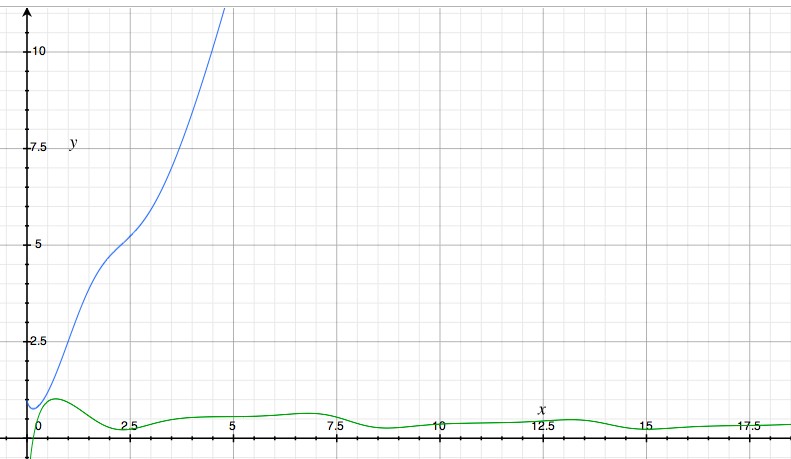
Differentiate and set the derivative as a function of x only.
Gallery 5.1.1 Example Problem 5.1.1
Read all original image captions
Image 1
Image 2
Image 3
Example Problem 5.2.1
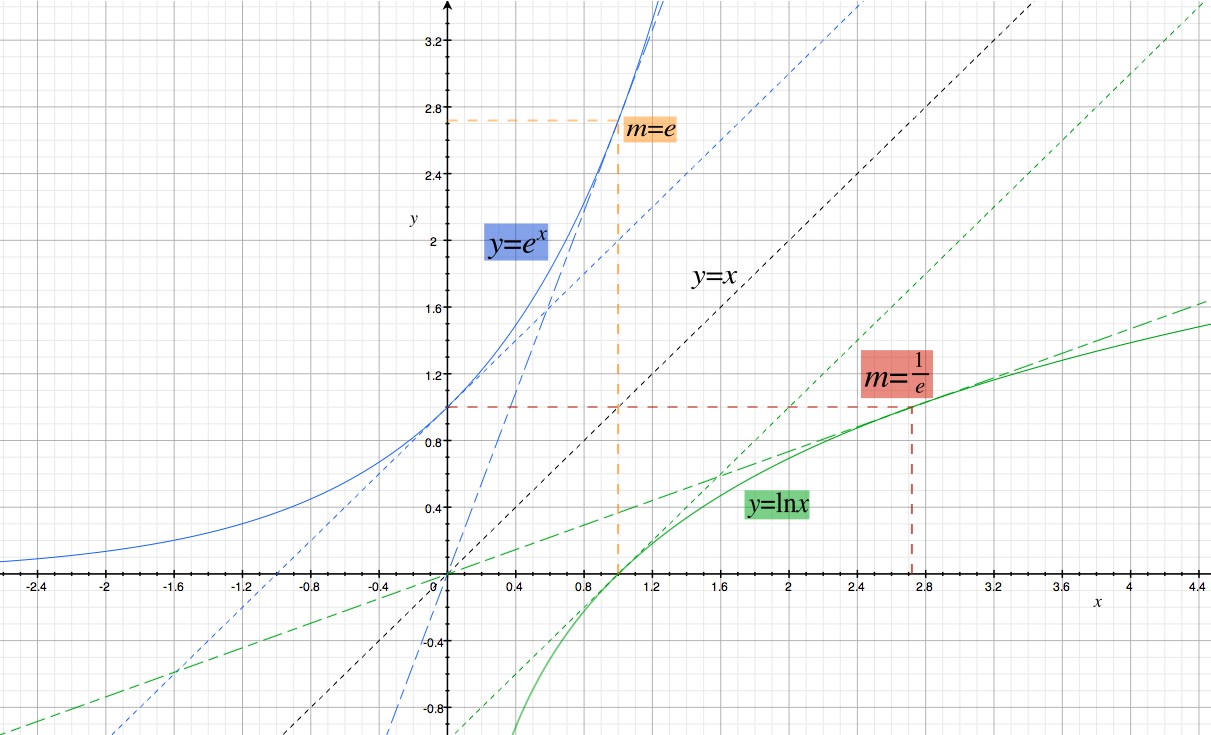
Find the derivative of the inverse of using (a) the formula given above, and (b) by calculating the inverse first, then taking its derivative. Which method is easier?
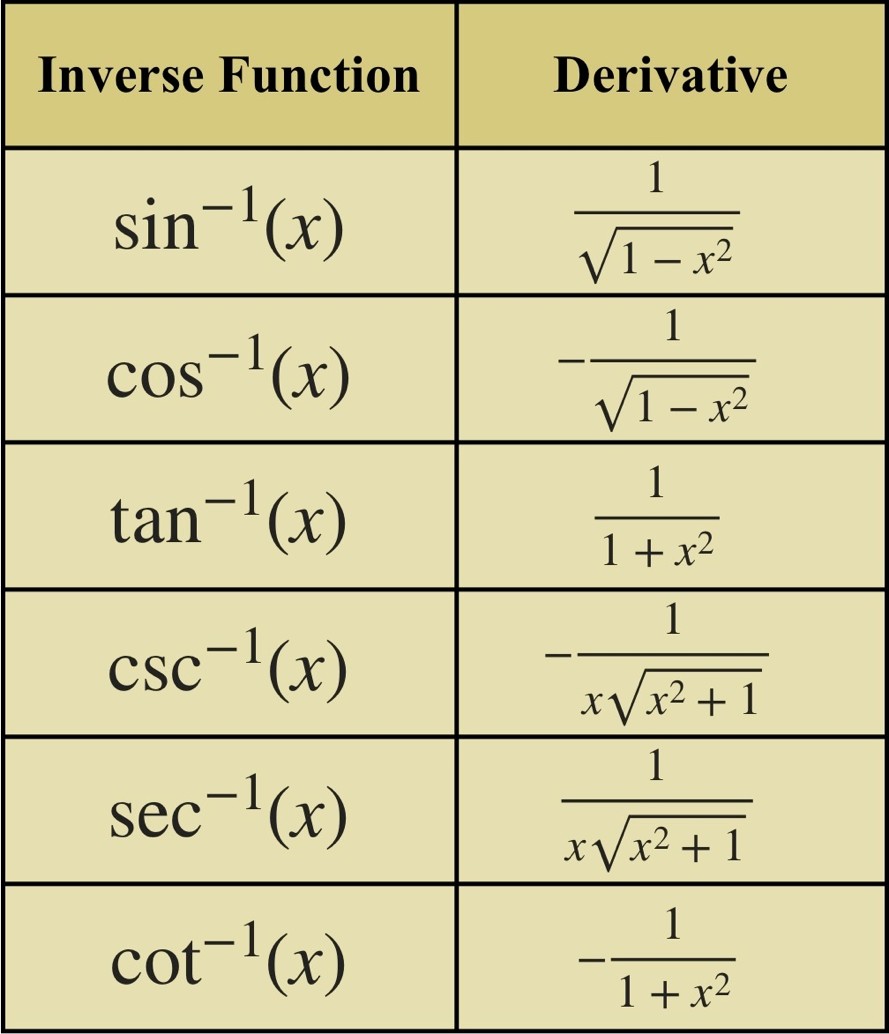
Next is a table summarizing the trigonometric inverse functions and their derivatives.
Interactive 5.2.1 Inverse and normal functions.
Read all original figure notes
Two more points
Second point of interest
First point of interest
Example Problem 5.2.2
Calculate the second derivative of at
Example Problem 5.3.1
Find
Example Problem 5.3.2
Find Use x > 0 for the real logarithmic definition xˣ = ex ln(x).
Example Problem 5.4.1
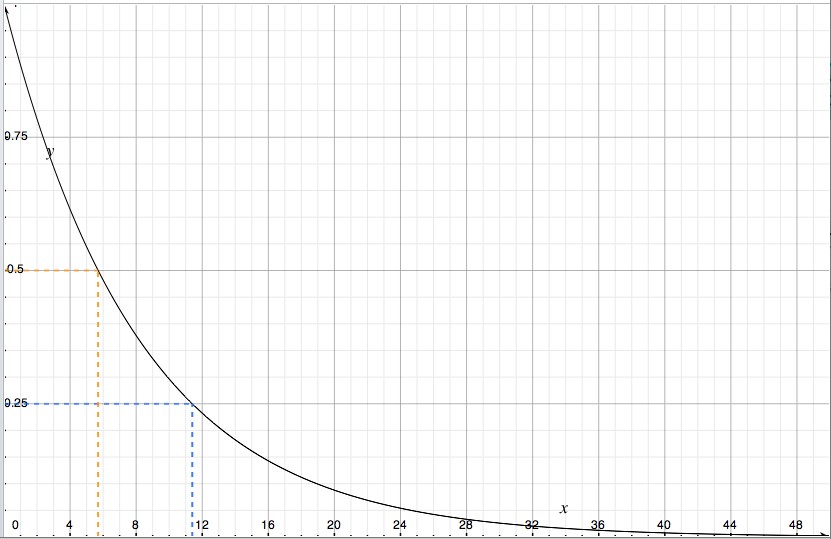
Let’s use an idealized carbon-14 decay model with a half-life of about 5700 years. The independently supplied initial amount is B = 4 g, and the present amount is M = 10 mg = 0.01 g. Assume no isotope enters or leaves the sample after the model begins, apart from radioactive decay. These supplied model amounts replace the earlier unsupported calculation from a mammoth’s total body mass. Real radiocarbon dating uses the remaining isotope ratio in once-living material and calibration; we cannot infer an initial carbon-14 amount from total fossil mass alone.
a) According to this decay model, how much time has elapsed?
b) What is the current rate of change of the tracked carbon-14 mass, in mg per millennium?
Interactive 5.4.1 Sample Problem 5.4.1