Powers and Logarithms
This original textbook reading covers part of the AP topic. Follow the AP course outline for complete topic instruction and practice.
You might have been curious about when this was going to happen, why we waited until finishing implicit differentiation to cover these special derivatives about powers and logs. This is because we are going to use implicit differentiation to prove them!
We proved that the derivative of ex= ex using limits in section 3.2. Now we use implicit differentiation combined with this knowledge to prove three other derivatives. Let’s start by proving this statement:
Now we have proven the derivatives of ex and ln(x). However, we won’t always be dealing with the base e. We need something more general. Let’s try to come up with a formula for the derivative of y= ax.
Now what about a general logarithmic derivative? Thankfully, we can do that too, through implicit differentiation!
We just proved all the logarithmic and exponential derivatives in one swoop thanks to implicit differentiation! Let’s try some practice problems using our new knowledge.
Example Problem 5.1.1
Differentiate and set the derivative as a function of x only.
Gallery 5.1.1 Example Problem 5.1.1
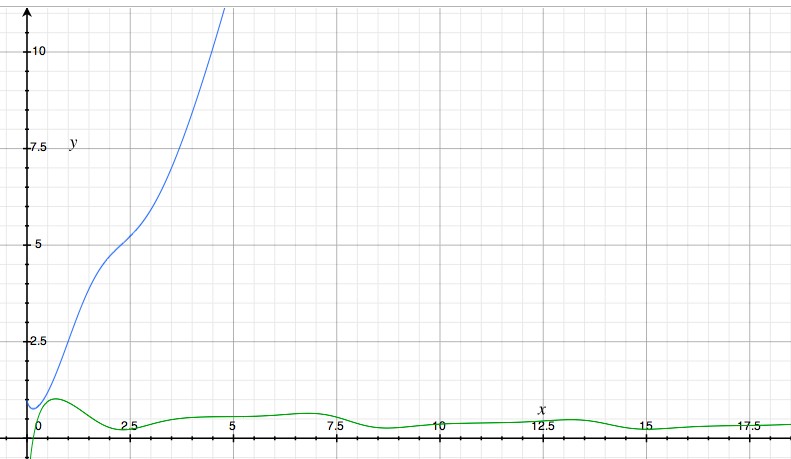
Read all original image captions
Image 1
Image 2
Image 3
Glossary and deeper reading · 3 refreshers
These editorial refreshers supplement the reading. Definitions and examples are added guidance; original source wording and recorded answers remain in their original context.
-
Implicit differentiation
Implicit differentiation finds a derivative from an equation relating variables without first solving explicitly for one variable. When y depends on x, differentiating a term containing y requires the chain rule and a factor of dy/dx. For example, x²+y²=1 gives 2x+2y(dy/dx)=0. Solving that relation for dy/dx gives −x/y only where y≠0 and the relation supports the local function being considered.
-
Derivative
A derivative gives the instantaneous rate of change of a function with respect to its input. At a point, it is the finite limit of the difference quotient when that limit exists. For example, the derivative of x² is 2x, so the tangent slope at x=3 is 6. A derivative function collects those rates across the inputs where the function is differentiable.
-
Limit
A limit describes the value approached by outputs as inputs approach a specified target or grow without bound. For an input approaching a finite target, its value at that exact input does not determine the limit. For example, (x²−1)/(x−1) approaches 2 as x approaches 1 even though the original expression is undefined at 1. A finite two-sided limit requires the left and right approaches to agree.