Inverse Functions
This original textbook reading covers part of the AP topic. Follow the AP course outline for complete topic instruction and practice.
More Special Derivatives!
Just as we saved learning about exponential and logarithmic derivatives until after learning about implicit differentiation, we also saved another set of derivatives, the derivatives of inverse trigonometric functions. After deriving these, we’ll see that finding the derivatives of inverse functions is really methodical. Let’s get started!
Easy right? Hopefully you have been seeing a pattern with the derivatives we have been coming up with. Hopefully in your mind you have been comparing logarithmic derivatives with exponential derivatives, and inverse trigonometric function derivatives with trigonometric derivatives, and have noticed some interesting patterns. At this point we should be able to find the derivative of almost any inverse function.
Additional Exercise: Prove the derivative of csc(x)
Visualization of Inverse Derivatives
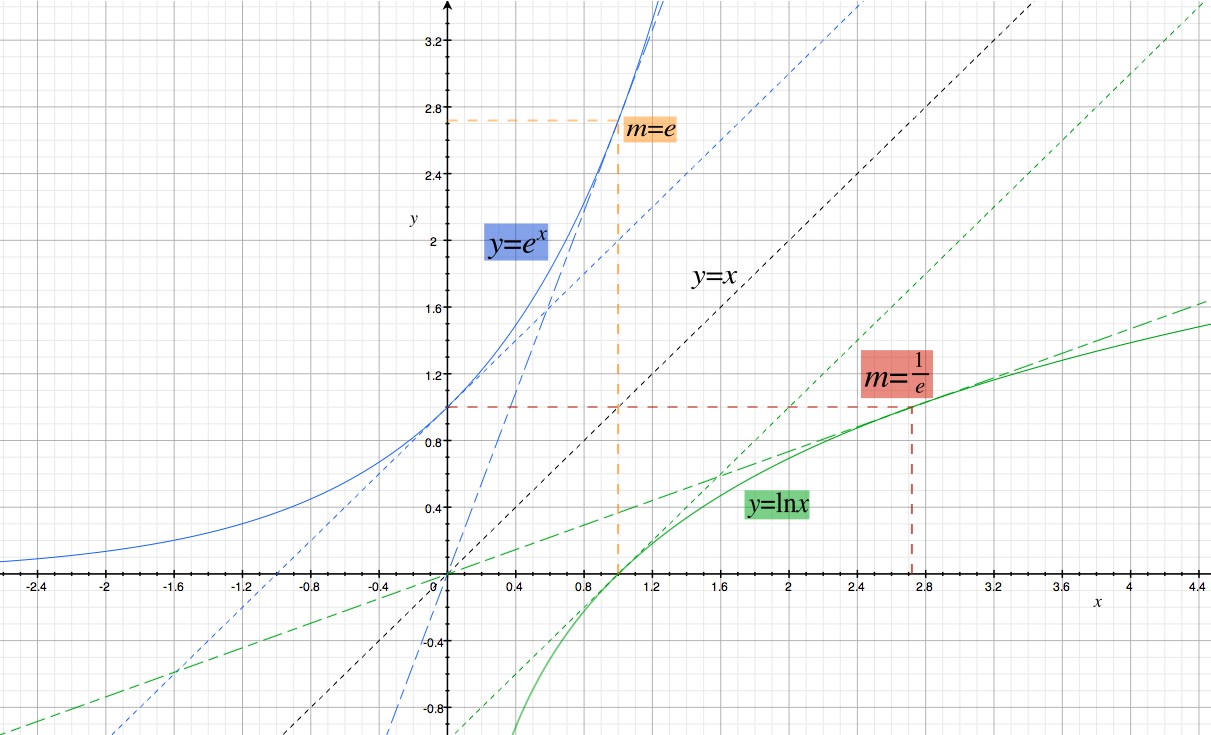
So far, we have been taking the derivatives of inverse functions analytically, but we have not had the chance to see and compare the derivative of an inverse function with the derivative of its parent function. You might imagine that since the inverse function is just the parent function reflected across the line y=x, we might be able to form some sort of logical relationship between their derivatives, and you would be right. Refer to Interactive 5.2.1 for a more in-depth visualization.
Sometimes, given a function, we may want to find the derivative of its inverse. For example, given that , find . Your first instinct may be to switch out x and y, isolate y in terms of x of the inverse function, then take its derivative, but that is an involved process. Instead, there is a neat formula that is helpful, but using it is tricky and requires practice.
The next example will help gain practice with this formula.
Example Problem 5.2.1
Find the derivative of the inverse of using (a) the formula given above, and (b) by calculating the inverse first, then taking its derivative. Which method is easier?
Interactive 5.2.1 Inverse and normal functions.
Read all original figure notes
Two more points
Second point of interest
First point of interest
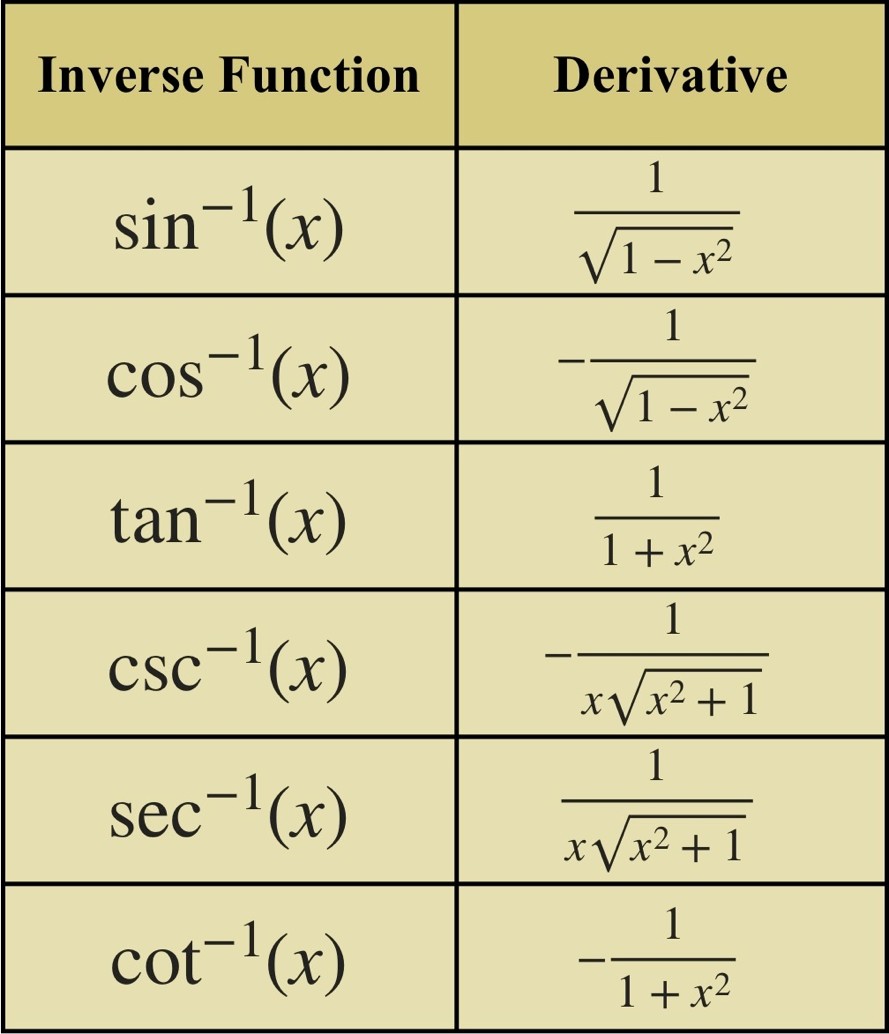
Next is a table summarizing the trigonometric inverse functions and their derivatives.
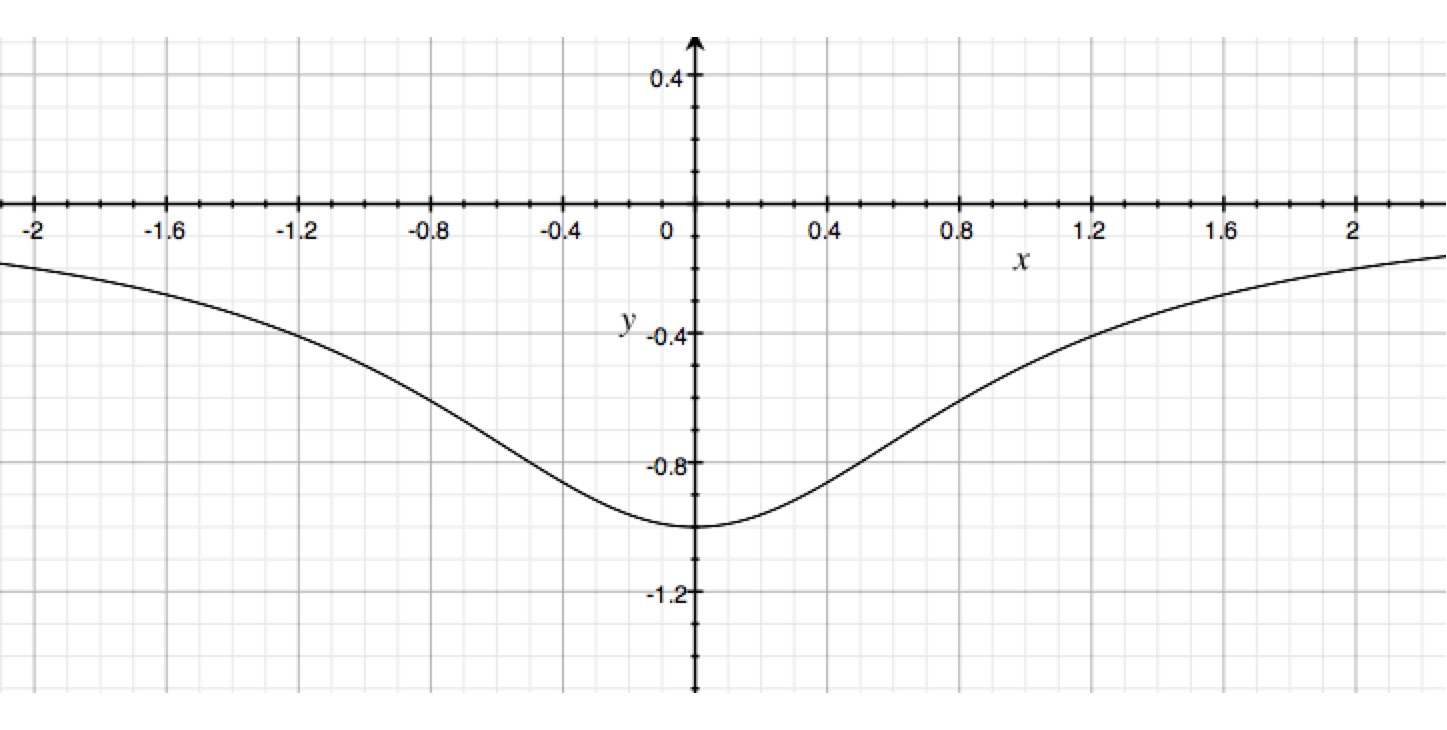
Example Problem 5.2.2
Calculate the second derivative of at
Pop Quiz 5.2.1 Inverse Functions
Question 1 of 5 · 0 correct
Glossary and deeper reading · 5 refreshers
These editorial refreshers supplement the reading. Definitions and examples are added guidance; original source wording and recorded answers remain in their original context.
-
Derivative
A derivative gives the instantaneous rate of change of a function with respect to its input. At a point, it is the finite limit of the difference quotient when that limit exists. For example, the derivative of x² is 2x, so the tangent slope at x=3 is 6. A derivative function collects those rates across the inputs where the function is differentiable.
-
Implicit differentiation
Implicit differentiation finds a derivative from an equation relating variables without first solving explicitly for one variable. When y depends on x, differentiating a term containing y requires the chain rule and a factor of dy/dx. For example, x²+y²=1 gives 2x+2y(dy/dx)=0. Solving that relation for dy/dx gives −x/y only where y≠0 and the relation supports the local function being considered.
-
Inverse trigonometric function
An inverse trigonometric function returns a principal angle from a trigonometric output. The original trigonometric function is restricted to a one-to-one interval to define that inverse. For example, arcsin(1/2)=π/6 under the usual range [−π/2,π/2]. The notation sin⁻¹x means arcsin x, whereas the reciprocal of sine is cosecant.
-
Inverse function
An inverse function reverses another function’s input-output assignment. A function needs to be one-to-one on its chosen domain for an inverse function to exist. For example, x³ has inverse the cube-root function, while x² needs a domain restriction such as x≥0. The notation f⁻¹ denotes an inverse function rather than the reciprocal 1/f.
-
Function
A mathematical function assigns exactly one output to each input in its domain. Inputs can share an output, but one input cannot have two different outputs. For example, f(x)=x² assigns the output 9 to both 3 and −3. Function notation names the rule and its input; f(3) means the output when the input is 3.