AP Unit 10 Problems
Thirty problems for AP Unit 10. Try the problem before opening its separate solution. Write the mathematical setup and the reason your method applies.
Choose your next practice
Find the problems you need.
Mix the choices to focus your practice. Problem numbers and worked-solution links stay the same.
30 of 30 problems shown.
Selection: All topics and practice types.
Printing includes the currently visible selection. Reset filters first to print all 30 problems.
Problem 1
For , derive the nth partial sum and the series sum. Distinguish a term limit from a partial-sum limit.
Written working workspace
Drawing is temporarily unavailable. Work on paper if needed, then record your reasoning here.
Saving written working requires JavaScript. Keep your work on paper or in your own notes; the source problem above remains available.
Problem 2
A series has partial sums for every positive integer n. The graph shows the first six; the formula continues indefinitely. Does the series converge?
Written working workspace
Drawing is temporarily unavailable. Work on paper if needed, then record your reasoning here.
Saving written working requires JavaScript. Keep your work on paper or in your own notes; the source problem above remains available.
Problem 3
Find the sum of and its first four-term partial sum. Justify use of the geometric formula.
Written working workspace
Drawing is temporarily unavailable. Work on paper if needed, then record your reasoning here.
Saving written working requires JavaScript. Keep your work on paper or in your own notes; the source problem above remains available.
Problem 4
A ball is dropped 2 meters. After each impact it rises to 60% of the previous height, then falls the same distance. Under this ideal infinite-bounce model, find the total vertical distance.
Written working workspace
Drawing is temporarily unavailable. Work on paper if needed, then record your reasoning here.
Saving written working requires JavaScript. Keep your work on paper or in your own notes; the source problem above remains available.
Problem 5
Classify using the nth-term test.
Written working workspace
Drawing is temporarily unavailable. Work on paper if needed, then record your reasoning here.
Saving written working requires JavaScript. Keep your work on paper or in your own notes; the source problem above remains available.
Problem 6
A student says: “Because , converges by the nth-term test.” Repair the argument and give a correct classification.
Written working workspace
Drawing is temporarily unavailable. Work on paper if needed, then record your reasoning here.
Saving written working requires JavaScript. Keep your work on paper or in your own notes; the source problem above remains available.
Problem 7
Use the integral test to classify . State its hypotheses and do not identify the integral value with the series sum.
Written working workspace
Drawing is temporarily unavailable. Work on paper if needed, then record your reasoning here.
Saving written working requires JavaScript. Keep your work on paper or in your own notes; the source problem above remains available.
Problem 8
Use the integral test to classify .
Written working workspace
Drawing is temporarily unavailable. Work on paper if needed, then record your reasoning here.
Saving written working requires JavaScript. Keep your work on paper or in your own notes; the source problem above remains available.
Problem 9
Classify each series and state the relevant p: (a) , (b) , (c) . Each starts at n=1.
Written working workspace
Drawing is temporarily unavailable. Work on paper if needed, then record your reasoning here.
Saving written working requires JavaScript. Keep your work on paper or in your own notes; the source problem above remains available.
Problem 10
Does converge? Explain the roles of the starting index and factor 7.
Written working workspace
Drawing is temporarily unavailable. Work on paper if needed, then record your reasoning here.
Saving written working requires JavaScript. Keep your work on paper or in your own notes; the source problem above remains available.
Problem 11
Prove convergence of by direct comparison.
Written working workspace
Drawing is temporarily unavailable. Work on paper if needed, then record your reasoning here.
Saving written working requires JavaScript. Keep your work on paper or in your own notes; the source problem above remains available.
Problem 12
Use limit comparison to classify .
Written working workspace
Drawing is temporarily unavailable. Work on paper if needed, then record your reasoning here.
Saving written working requires JavaScript. Keep your work on paper or in your own notes; the source problem above remains available.
Problem 13
Use the alternating-series test to justify convergence of .
Written working workspace
Drawing is temporarily unavailable. Work on paper if needed, then record your reasoning here.
Saving written working requires JavaScript. Keep your work on paper or in your own notes; the source problem above remains available.
Problem 14
A student applies the alternating-series test to . Show why the test is not applicable, then classify the series by a valid argument.
Written working workspace
Drawing is temporarily unavailable. Work on paper if needed, then record your reasoning here.
Saving written working requires JavaScript. Keep your work on paper or in your own notes; the source problem above remains available.
Problem 15
Use the ratio test on .
Written working workspace
Drawing is temporarily unavailable. Work on paper if needed, then record your reasoning here.
Saving written working requires JavaScript. Keep your work on paper or in your own notes; the source problem above remains available.
Problem 16
Compute ratio-test limits for and , then classify both with a valid test.
Written working workspace
Drawing is temporarily unavailable. Work on paper if needed, then record your reasoning here.
Saving written working requires JavaScript. Keep your work on paper or in your own notes; the source problem above remains available.
Problem 17
Classify as absolute, conditional or divergent. Give both required checks.
Written working workspace
Drawing is temporarily unavailable. Work on paper if needed, then record your reasoning here.
Saving written working requires JavaScript. Keep your work on paper or in your own notes; the source problem above remains available.
Problem 18
Classify . Is its sum preserved if its terms are rearranged into a different order, using every term once?
Written working workspace
Drawing is temporarily unavailable. Work on paper if needed, then record your reasoning here.
Saving written working requires JavaScript. Keep your work on paper or in your own notes; the source problem above remains available.
Problem 19
Approximate the alternating harmonic series with its first four terms. Give an absolute error bound and an interval trapping its sum.
Written working workspace
Drawing is temporarily unavailable. Work on paper if needed, then record your reasoning here.
Saving written working requires JavaScript. Keep your work on paper or in your own notes; the source problem above remains available.
Problem 20
For , what is the smallest number N of retained terms for which the alternating error-bound inequality is strictly less than 0.001?
Written working workspace
Drawing is temporarily unavailable. Work on paper if needed, then record your reasoning here.
Saving written working requires JavaScript. Keep your work on paper or in your own notes; the source problem above remains available.
Problem 21
Use the derivative table to write T₃ about x=2 and approximate f(2.1).
| Value | Number |
|---|---|
| f(2) | 3 |
| f′(2) | −1 |
| f″(2) | 4 |
| f‴(2) | 6 |
Written working workspace
Drawing is temporarily unavailable. Work on paper if needed, then record your reasoning here.
Saving written working requires JavaScript. Keep your work on paper or in your own notes; the source problem above remains available.
Problem 22
Construct the degree-3 Maclaurin polynomial for sin x from derivative values, then approximate sin(0.2). An independent value is sin(0.2)≈0.198669331. Compare the absolute errors of T₁ and T₃ here; does this prove that higher degree is always better?
Written working workspace
Drawing is temporarily unavailable. Work on paper if needed, then record your reasoning here.
Saving written working requires JavaScript. Keep your work on paper or in your own notes; the source problem above remains available.
Problem 23
Approximate using T₂ at 0. Using the valid bound for , give a Lagrange error bound.
Written working workspace
Drawing is temporarily unavailable. Work on paper if needed, then record your reasoning here.
Saving written working requires JavaScript. Keep your work on paper or in your own notes; the source problem above remains available.
Problem 24
Approximate cos(0.3) using . Compare a degree-4 Lagrange bound using M=1 with the alternating-series bound.
Written working workspace
Drawing is temporarily unavailable. Work on paper if needed, then record your reasoning here.
Saving written working requires JavaScript. Keep your work on paper or in your own notes; the source problem above remains available.
Problem 25
Find the radius and interval of convergence of . Show each endpoint test.
Written working workspace
Drawing is temporarily unavailable. Work on paper if needed, then record your reasoning here.
Saving written working requires JavaScript. Keep your work on paper or in your own notes; the source problem above remains available.
Problem 26
Let . Differentiate term by term, identify F′ as a function on its open convergence interval, and determine the new radius and endpoint behavior. Why is F's power series its Taylor series there?
Written working workspace
Drawing is temporarily unavailable. Work on paper if needed, then record your reasoning here.
Saving written working requires JavaScript. Keep your work on paper or in your own notes; the source problem above remains available.
Problem 27
Write the Maclaurin series for cos(2x), the degree-4 Taylor polynomial it supplies, and the interval on which the series represents the function.
Written working workspace
Drawing is temporarily unavailable. Work on paper if needed, then record your reasoning here.
Saving written working requires JavaScript. Keep your work on paper or in your own notes; the source problem above remains available.
Problem 28
Derive a Taylor series for ln x centered at x=1 from the geometric series for 1/(1+u). Give its interval of convergence and justify representation at the included endpoint.
Written working workspace
Drawing is temporarily unavailable. Work on paper if needed, then record your reasoning here.
Saving written working requires JavaScript. Keep your work on paper or in your own notes; the source problem above remains available.
Problem 29
Use the geometric series to represent as a power series centered at zero. Give radius and interval.
Written working workspace
Drawing is temporarily unavailable. Work on paper if needed, then record your reasoning here.
Saving written working requires JavaScript. Keep your work on paper or in your own notes; the source problem above remains available.
Problem 30
Derive a power series for arctan x by integrating a geometric series. At x=0.5, use its first four nonzero terms, give an alternating error bound, and use a calculator's numerical integral to check the approximation. State the full interval of representation.
Written working workspace
Drawing is temporarily unavailable. Work on paper if needed, then record your reasoning here.
Saving written working requires JavaScript. Keep your work on paper or in your own notes; the source problem above remains available.
More chapter problems
Try these problems before opening the solutions. Show your setup, the hypotheses behind your method, and what your answer means.
Regroup and rearrange an absolutely convergent series
Let a_n=(−1)^(n+1)/2^n for n≥1 and S_N=Σ_(n=1)^N a_n. A consecutive grouping uses lengths 1,2,3,… . A different operation rearranges the individual terms into a₂,a₁,a₄,a₃,a₆,a₅,… .
(a) For a_n=(−1)^(n+1)/2^n, establish absolute convergence by evaluating the magnitude series. Then find the original signed sum S.
(b) Regroup a_n=(−1)^(n+1)/2^n into consecutive finite blocks of lengths 1,2,3,…, using every term once in its original order. Compute b₁,b₂,b₃ and their partial sums. Prove that after K blocks the endpoint is m_K=K(K+1)/2 and that the grouped partial sums approach 1/3. Sketch S_N for N=1,…,10, and mark N=1,3,6,10 as the first four grouped endpoints. You may use S_N=(1/3)[1−(−1/2)^N].
(c) For the absolutely convergent series with a_n=(−1)^(n+1)/2^n, decide whether the rearranged order a₂,a₁,a₄,a₃,a₆,a₅,…, using every term exactly once, preserves the original sum 1/3. Justify the conclusion under the absolute-convergence theorem, and verify the limit directly using even and odd rearranged partial sums. Explain how this rearrangement differs from consecutive finite regrouping.
Written working workspace
Drawing is temporarily unavailable. Work on paper if needed, then record your reasoning here.
Saving written working requires JavaScript. Keep your work on paper or in your own notes; the source problem above remains available.
Worked solution and rubric →Revisit the explanation →Revisit the explanation →Read the relevant lesson →
Convergence hypotheses cannot be replaced by a grouped limit
The alternating harmonic series A=Σ_(n=1)^∞ (−1)^(n+1)/n is known to converge to ln 2. The harmonic magnitude series diverges. Compare it with the oscillating series D=1−1+1−1+… . All sums here mean ordinary limits of complete partial-sum sequences.
(a) For the conditionally convergent alternating harmonic series A, form consecutive pairs b_k=1/(2k−1)−1/(2k). Find its first two grouped partial sums and prove the regrouped series still sums to ln 2. State exactly which convergence and grouping hypotheses your proof uses.
(b) For D=1−1+1−1+…, compute S_N for N=1,…,8 and sketch these points on partial-sum axes. Determine the limits of the even and odd subsequences. Evaluate the grouped partial sums for (1−1)+(1−1)+… and for 1+(−1+1)+(−1+1)+… . Does either grouping prove an ordinary sum for D? Explain.
(c) An analyst argues that because the alternating harmonic series converges, both consecutive finite grouping and every rearrangement using each term once must preserve ln 2. Identify the justified portion and the unjustified portion. Then state separately what absolute convergence would guarantee about regrouping and about rearrangement.
Written working workspace
Drawing is temporarily unavailable. Work on paper if needed, then record your reasoning here.
Saving written working requires JavaScript. Keep your work on paper or in your own notes; the source problem above remains available.
Worked solution and rubric →Revisit the explanation →Revisit the explanation →Revisit the explanation →Read the relevant lesson →
Prove increasing-degree convergence on an entire interval
Let f(x)=e^x and T_n be its degree-n Maclaurin polynomial. Work on I=[−1,1]. You may use e<3 and the established remainder estimate |f(x)−T_n(x)|≤M|x|^(n+1)/(n+1)! whenever |f⁽ⁿ⁺¹⁾(t)|≤M for t between 0 and x. For sketching, e^(−1)≈0.367879, e^0=1 and e≈2.718282 are supplied.
(a) For e^x centered at 0, derive the coefficient of x^k from the kth derivative at 0. Write T₁, T₃ and T₅, then evaluate each at x=−1,0,1. Give exact polynomial values.
(b) Using the supplied remainder estimate, prove that T_n approaches e^x for every x in the entire interval [−1,1] as n increases. Establish a bound independent of x, show that it tends to zero, and explain why one sufficiently large degree works for any prescribed positive tolerance at every point in the interval.
(c) Sketch e^x and T₁,T₃,T₅ on the common interval [−1,1], with labeled axes and a legend. Use their three supplied or calculated values at −1,0,1 and the exact formulas to show the curve shapes. Explain what the plot illustrates and why it cannot replace the interval proof in part b.
(d) Find the smallest degree certified by B_n=3/(n+1)! to give absolute error at most 0.001 throughout [−1,1]. Compare the immediately preceding degree, and state whether this certificate proves that the actual error decreases at each degree for each x.
Written working workspace
Drawing is temporarily unavailable. Work on paper if needed, then record your reasoning here.
Saving written working requires JavaScript. Keep your work on paper or in your own notes; the source problem above remains available.
Worked solution and rubric →Revisit the explanation →Revisit the explanation →Revisit the explanation →Read the relevant lesson →
Construct a counterexample to monotone actual errors
Let f(x)=1+x−x², centered at 0, and let T_n be its Maclaurin polynomials. Compare actual errors on I=[−1,1], with a detailed check at x=3/4.
(a) Compute the derivative values at 0 and construct T₀,T₁,T₂. Evaluate f and those polynomials at x=3/4, then compute each actual absolute error. Does increasing degree from 0 to 1 improve the approximation at this point?
(b) For f(x)=1+x−x², determine T_n for every n≥2. Prove increasing-degree convergence to f throughout [−1,1] using an interval-wide remainder bound. Explain why the pointwise error increase in part a does not contradict this conclusion.
(c) Draw the actual absolute error versus degree at x=3/4 for degrees 0,1,2, using a labeled linear vertical scale. Mark what happens for all degrees n≥2. Interpret the graph as evidence against the claim that each larger degree must improve every pointwise approximation.
Written working workspace
Drawing is temporarily unavailable. Work on paper if needed, then record your reasoning here.
Saving written working requires JavaScript. Keep your work on paper or in your own notes; the source problem above remains available.
Worked solution and rubric →Revisit the explanation →Revisit the explanation →Read the relevant lesson →
Define a power series and account for every zero coefficient
Work with expansions about the stated center c=−1. Let P(x)=2−√2(x+1)²+Σ_(k=3)^∞ [((−1)^k)/(k+1)](x+1)^(2k). For classification, consider B(x)=Σ_(n=0)^∞ (x+1)^(n+1/2)/2^n, C(x)=Σ_(n=1)^∞ 3^(−n)(x+1)^(−n), and D(x)=Σ_(n=0)^∞ cos(n)(x+1)^n.
(a) State the general definition of a real-coefficient power series centered at an arbitrary real number c. Specify the allowed index and powers, the nature of the coefficient sequence, and what must remain independent of x. Explain how a series starting at n=1 and a finite polynomial fit the definition.
(b) Rewrite P(x)=2−√2(x+1)²+Σ_(k=3)^∞ [((−1)^k)/(k+1)](x+1)^(2k) as Σ_(n=0)^∞ a_n(x−c)^n. Identify c; list a₀ through a₈, including every zero; and give a rule for all later coefficients. Explain why √2 and the missing powers cause no problem for the definition.
(c) Classify B(x)=Σ_(n=0)^∞ (x+1)^(n+1/2)/2^n, C(x)=Σ_(n=1)^∞ 3^(−n)(x+1)^(−n), and D(x)=Σ_(n=0)^∞ cos(n)(x+1)^n as displayed power-series expansions at center −1, or as expressions that fail this definition. Give the specific reason in each case. Do not infer that a function can never have some different local expansion.
(d) Evaluate P at its center c=−1 by separating its constant term. Explain why the center value is neither zero nor an undefined 0⁰ computation.
Written working workspace
Drawing is temporarily unavailable. Work on paper if needed, then record your reasoning here.
Saving written working requires JavaScript. Keep your work on paper or in your own notes; the source problem above remains available.
Worked solution and rubric →Revisit the explanation →Revisit the explanation →Read the relevant lesson →
Decide center-only convergence and compare complete convergence sets
All three expressions are centered at c=2: F(x)=7+Σ_(n=1)^∞ n!(x−2)^n; G(x)=−3+Σ_(n=1)^∞ ((x−2)/2)^n; H(x)=4−(x−2)². A radius is nonnegative; R=∞ means convergence for every real input.
(a) For F(x)=7+Σ_(n=1)^∞ n!(x−2)^n, first evaluate the series at x=2. Then, for any fixed x≠2, compute the ratio of consecutive tail-term magnitudes and use it to establish divergence. State the radius and complete convergence set, and explain why a ratio calculation dividing by zero must not be used at the center.
(b) For G(x)=−3+Σ_(n=1)^∞ ((x−2)/2)^n, determine the radius and open convergence interval. Test both finite boundary points using the original terms, give the complete interval, and evaluate G at the center.
(c) For the same centered expressions F,G,H, write H as an infinite power series by giving its coefficient sequence. Determine H’s radius and convergence set. Draw three complete convergence number lines for F,G,H on a common scale, labeling center 2, all finite endpoints and their inclusion or exclusion. Use these examples to explain the center-only, finite-interval and all-real-number alternatives.
Written working workspace
Drawing is temporarily unavailable. Work on paper if needed, then record your reasoning here.
Saving written working requires JavaScript. Keep your work on paper or in your own notes; the source problem above remains available.
Worked solution and rubric →Revisit the explanation →Revisit the explanation →Revisit the explanation →Read the relevant lesson →
What does a decreasing bound actually establish?
A proof establishes |e^x−T_n(x)|≤3/(n+1)! for every x in [−1,1]. The bound tends to zero as n increases.
(a) Given the bound |e^x−T_n(x)|≤3/(n+1)! throughout [−1,1], which conclusion necessarily follows as the degree increases?
Worked solution and rubric →Revisit the explanation →Revisit the explanation →Read the relevant lesson →
A radius-zero series still includes its constant term
Consider F(x)=7+Σ_(n=1)^∞ n!(x−2)^n. For each fixed x≠2 its tail-term magnitudes eventually grow.
(a) For F(x)=7+Σ_(n=1)^∞ n!(x−2)^n, which radius, convergence set and center value are correct?
Worked solution and rubric →Revisit the explanation →Revisit the explanation →Read the relevant lesson →
Integration changes endpoints without changing radius
Let F(x)=Σₙ₌₁^∞ (x+1)ⁿ/(n3ⁿ). For −4<x<2 define G(x)=∫₋₁ˣ F(t)dt. Use termwise operations only where the power-series theorem applies; determine endpoint convergence from the actual endpoint series.
(a) Determine the center, radius, and interval of convergence of F. Show the ratio limit and both endpoint tests rather than treating a ratio-test limit of 1 as a decision.
(b) Integrate term by term from −1 to x to construct the complete infinite series for G, including its constant value at the center. Determine its radius and explicitly compare it with F’s radius. Give either a new ratio-limit calculation or the radius-preservation theorem with its interior validity condition.
(c) Test both endpoints of G’s series and give its full interval. On a common number line, draw the complete F and G intervals with labeled center, radius, and open or filled endpoints. Explain why adding x=2 to G’s interval does not give a radius larger than F’s.
(d) Differentiate F term by term to find its derivative series, then test its endpoints. Compare the radii of F, F′, and G, explaining what differentiation and integration preserve and what each operation requires you to retest. Extend your number-line comparison to include F′.
Written working workspace
Drawing is temporarily unavailable. Work on paper if needed, then record your reasoning here.
Saving written working requires JavaScript. Keep your work on paper or in your own notes; the source problem above remains available.
Worked solution and rubric →Revisit the explanation →Revisit the explanation →Read the relevant lesson →
An included endpoint does not enlarge the radius
For |x|<1, the geometric series F(x)=Σₙ₌₀^∞ xⁿ has radius 1. Integrating from 0 to x gives H(x)=Σₙ₌₀^∞ x^(n+1)/(n+1). A student claims that including a new endpoint must enlarge the radius.
(a) Choose the correct radius and endpoint conclusion for H, and explain the relevant endpoint tests.
Worked solution and rubric →Revisit the explanation →Read the relevant lesson →
Write the geometric foundation before substitution
Construct a Maclaurin series for f(x)=1/(3+x²). Use the exact geometric foundation, not an already-substituted series. The rational function itself is defined for all real x.
(a) Write explicitly the Maclaurin identity for 1/(1−u), identify its first term and common ratio, and derive it from the finite sum through uᴺ. State its representation domain and test u=−1 and u=1.
(b) Use that identity to construct the complete infinite series for f, state its radius and interval, and test both endpoints. Evaluate the statement “f(2) exists, so its Maclaurin series must converge at 2.”
(c) At x=1/2, use the first three nonzero terms to approximate f. Give a guaranteed alternating error bound and compare it with the exact error using f(1/2)=4/13. Explain why the finite polynomial is not the infinite series.
Written working workspace
Drawing is temporarily unavailable. Work on paper if needed, then record your reasoning here.
Saving written working requires JavaScript. Keep your work on paper or in your own notes; the source problem above remains available.
Worked solution and rubric →Revisit the explanation →Revisit the explanation →Read the relevant lesson →
Construct a new series from sine
Let S(x)=sin(3x)/x for x≠0 and define S(0)=3. Angles are in radians. Use the sine Maclaurin foundation and ordinary series operations to construct a new infinite series. A supplied independent check is S(1/6)≈2.876553232.
(a) Write the sine foundation explicitly and use it to construct a complete indexed infinite Maclaurin series for S, not merely a finite polynomial. Give its first four nonzero terms, radius, representation interval, and explanation of the value at zero.
(b) Use the first three nonzero terms to estimate S(1/6). Verify the alternating magnitude condition, give a guaranteed error bound, and compare the bound with the observed difference from the supplied check. State whether the partial sum is above or below S(1/6).
(c) Explain why multiplying the original sine-series coefficients by only 3 gives the wrong construction for sin(3x), and why dividing sin(3x) by x does not force a negative-power term here. Use the general term and the zero-value extension in your explanation.
Written working workspace
Drawing is temporarily unavailable. Work on paper if needed, then record your reasoning here.
Saving written working requires JavaScript. Keep your work on paper or in your own notes; the source problem above remains available.
Worked solution and rubric →Revisit the explanation →Revisit the explanation →Read the relevant lesson →
Construct an integral series from the exponential foundation
Let W(x)=∫₀ˣ e^(−2t²)dt. Use the exponential Maclaurin foundation to represent W with a complete infinite series. For a numerical check at x=1/2, a calculator’s integral is approximately 0.427812196. The task does not require an elementary antiderivative.
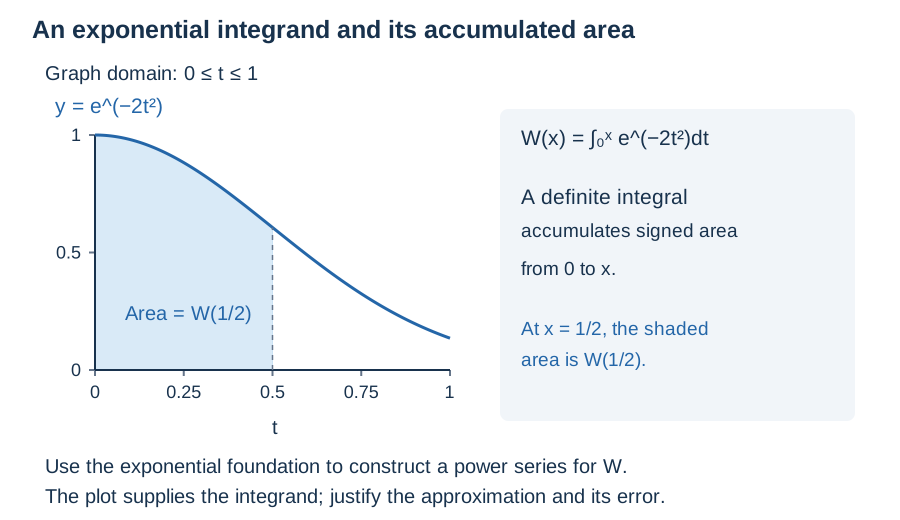
Inspect diagram labels
The diagram keeps its full size here. Focus the view and use the arrow keys, or scroll across it, to inspect every label.
(a) Write the exponential foundation explicitly, substitute −2t², and integrate term by term to construct the complete infinite Maclaurin series for W. Give the first four nonzero terms, fix the constant using W(0), and justify its all-real representation interval.
(b) Estimate W(1/2) using the first three nonzero terms. Justify an alternating error bound, compare it with the supplied independent integral, and state whether the partial sum is an upper or lower estimate.
(c) Differentiate your infinite series to check that it recovers e^(−2x²), and explain why W is increasing and odd. Use the supplied integrand graph to interpret W(1/2) as an area, and distinguish that area from the polynomial approximation in part b.
Written working workspace
Drawing is temporarily unavailable. Work on paper if needed, then record your reasoning here.
Saving written working requires JavaScript. Keep your work on paper or in your own notes; the source problem above remains available.
Worked solution and rubric →Revisit the explanation →Revisit the explanation →Read the relevant lesson →