Radius and Interval of Convergence of Power Series
Determine radius and open convergence interval, then test each endpoint of the original series separately.
College Board Topic 10.13 · CED p. 193 (PDF p. 198) · CED effective Fall 2020; project course outline 2026–27.
A power series is . The coefficients form a number sequence, and a is the center. There is a radius R: the series converges absolutely for |x−a|<R and diverges for |x−a|>R. It may converge only at the center (R=0), or for every real x (R=∞). Finite-radius endpoints need their own tests.
The ratio test often gives an inequality involving x. Solve that inequality to find the open interval, then substitute each endpoint into the original series. Do not include endpoints merely because the ratio equals 1 there; the ratio test is inconclusive at that value. The center itself always gives convergence, with the constant term interpreted normally.
Inside a positive-radius interval, a power series defines a function with derivatives given term by term. Its nth derivative at the center is n!cₙ, so the power series is the Taylor series of its own sum there. This is a statement about the function defined by that convergent power series; it does not say every smooth function equals its Taylor series.
Term-by-term differentiation or integration preserves the radius R. Endpoint convergence can change, so test endpoints again after the operation. For , the radius is 3, the left endpoint is alternating harmonic and the right endpoint is harmonic. Its interval is , meaning left included and right excluded. Its derivative has the same radius but diverges at both endpoints.
Read the retained power-series lesson. Write radius and interval on separate lines: R is a distance from the center, while the interval records endpoint inclusion.
Let's work through it
- For , the ratio limit is . Why: The factor n/(n+1) tends to 1.
- Thus , or , gives absolute convergence and . Why: Solve the ratio-test strict inequality.
- At x=−1 the series is and converges; at x=5 it is harmonic and diverges. Why: Endpoint substitution replaces the inconclusive ratio test with valid series tests.
- The interval is −1≤x<5. Why: Combine the open interval with the separately established endpoint decisions.
The center, real coefficients and allowed powers define the series
A power series centered at a real number c has the form Σ_(n=0)^∞ a_n(x−c)^n, where n is a nonnegative integer and (a_n) is a sequence of real numbers independent of x. The coefficients may be positive, negative, irrational or zero. The center c is fixed; it is not the radius R. A series starting at n=1 fits the same form by taking a₀=0. A polynomial also fits by making all later coefficients zero.
Missing powers have zero coefficients; do not compress the exponent index when terms vanish. For 5−2(x+1)²+Σ_(k=3)^∞ (x+1)^(2k)/3^k, the center is −1. Its coefficients are a₀=5, a₂=−2, a_(2k)=3^(−k) for k≥3, and a_n=0 otherwise. In particular, a₁=a₃=a₄=a₅=0. Even powers alone are still nonnegative integer powers.
At x=c, separate the constant term a₀; every positive-power term is zero. The resulting sum is a₀. This does not require assigning a new value to the indeterminate expression 0⁰: the n=0 term is the constant polynomial a₀ from the start.
When classifying a displayed expression about a stated center, check the coefficients and exponents. A negative power gives a Laurent-type expression, and a fractional power does not fit this power-series definition. This classification concerns the displayed expansion at that center; it is not a claim that the represented function could never have a different local expansion elsewhere.
The center always works, even when no other point does
For real coefficients, the center is always a convergence point because the series there reduces to the finite constant a₀. The convergence set can be only that point (R=0), a positive-length interval around the center, or all real numbers (R=∞). When 0<R<∞, the series converges absolutely for |x−c|<R and diverges for |x−c|>R; each boundary point requires its own test.
Consider F(x)=7+Σ_(n=1)^∞ n!(x−2)^n. At x=2, the tail vanishes, so F(2)=7. At a fixed x≠2, let u_n=n!(x−2)^n. The magnitude ratio |u_(n+1)/u_n|=(n+1)|x−2| tends to infinity. Eventually the magnitudes grow, so the terms fail to approach zero and the series diverges. Thus R=0 and the convergence set is {2}. Do not substitute x=2 into a ratio that was obtained by dividing by a zero term; evaluate the center directly.
By contrast, G(x)=−3+Σ_(n=1)^∞ ((x−2)/2)^n has radius 2. It converges for 0<x<4. At x=0 its terms are (−1)^n, and at x=4 they are 1, so both endpoint series diverge by the nth-term test. The full interval is (0,4), with G(2)=−3. The polynomial H(x)=4−(x−2)² has only finitely many nonzero coefficients, so its radius is infinite and it converges for every real x.
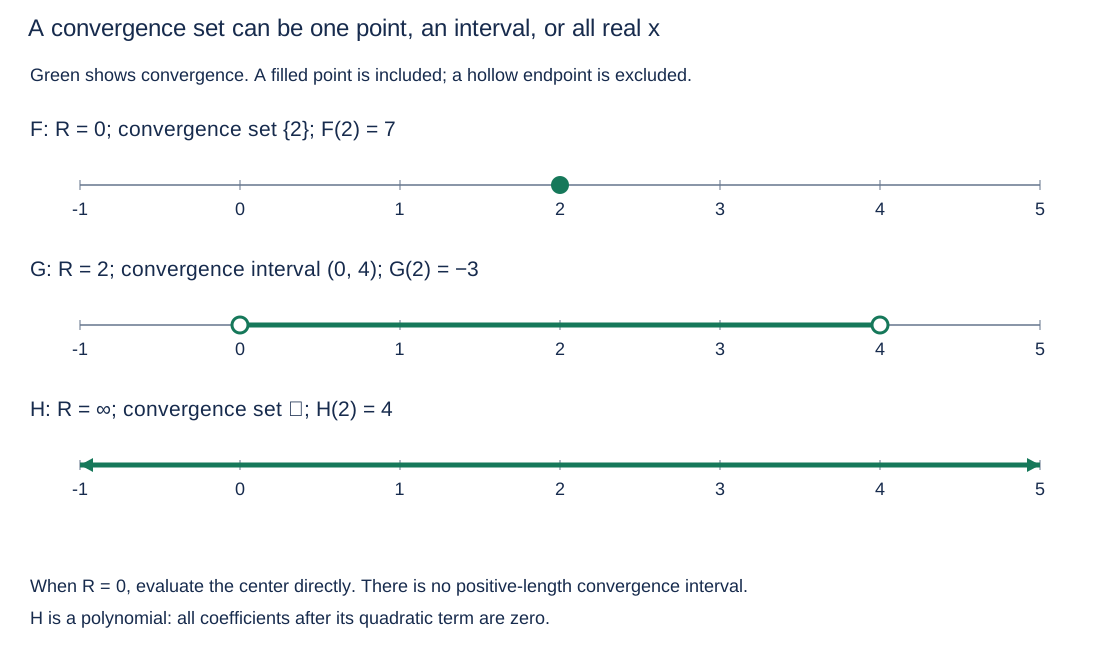
Inspect diagram labels
The diagram keeps its full size here. Focus the view and use the arrow keys, or scroll across it, to inspect every label.
Same radius, newly tested endpoints
A power series can be integrated term by term inside its positive radius of convergence. If F(x)=Σₙ₌₀^∞ aₙ(x−c)ⁿ has radius R, then the series for ∫꜀ˣ F(t)dt is Σₙ₌₀^∞ aₙ(x−c)^(n+1)/(n+1), with the same radius R. A finite integration constant changes only the constant term, not the radius. Dividing a coefficient by n+1 changes a polynomial factor in the index; it does not change the exponential distance scale that determines the radius.
The same radius statement holds for termwise differentiation. It does not say the full intervals are identical. Inside |x−c|<R the operation is justified by the power-series theorem. At x=c−R and x=c+R, substitute into the new series and test each one. Extra denominators introduced by integration can make an endpoint converge even when the original series diverges there. That added point does not increase the radius: values beyond the boundary are still outside the open convergence interval.
For F(x)=Σₙ₌₁^∞ (x−1)ⁿ/(n2ⁿ), the ratio limit is |x−1|/2. Its left endpoint is alternating harmonic and its right endpoint is harmonic, so the interval is [−1,3). Integrating from 1 to x gives G(x)=Σₙ₌₁^∞ (x−1)^(n+1)/(n(n+1)2ⁿ). The new ratio limit is still |x−1|/2. Both endpoint series now converge absolutely because their magnitudes are 2/(n(n+1)). Hence G has interval [−1,3] but still radius 2.
Do not justify an endpoint identity merely by saying “termwise integration works there.” Establish the identity in the open interval first. If an endpoint is included, convergence and a separate argument for equality to the intended function are needed when a function value is claimed. In this example, the right-endpoint integrated series telescopes to 2; the interior antiderivative also has limit 2 as x approaches 3 from below.
![Three aligned number-line intervals share center 1 and radius 2. The original F includes −1 but excludes 3, so its interval is [−1,3). Its derivative excludes both endpoints, giving (−1,3). Its integrated series G includes both endpoints, giving [−1,3]. Filled and open circles show endpoint inclusion; each row labels radius 2.](/calculus/strengthening/bc/u10-b-integration-intervals.svg)
Inspect diagram labels
The diagram keeps its full size here. Focus the view and use the arrow keys, or scroll across it, to inspect every label.
Write every coefficient, including the missing ones
Express 5−2(x+1)²+Σ_(k=3)^∞ (x+1)^(2k)/3^k in the form Σ_(n=0)^∞ a_n(x−c)^n, and evaluate it at its center.
- The common base is x+1=x−(−1), so c=−1. The constant term gives a₀=5, and the quadratic term gives a₂=−2.
- For k≥3, exponent n=2k has coefficient a_(2k)=3^(−k). Thus a₆=1/27, a₈=1/81 and a₁₀=1/243. All odd-index coefficients are zero; a₄ is also zero because the tail begins at k=3.
- The coefficients a₀ through a₈ are 5, 0, −2, 0, 0, 0, 1/27, 0, 1/81. These are fixed real numbers, and every exponent n is a nonnegative integer.
- At x=−1, all positive powers vanish. The sum is a₀=5. A zero coefficient is still part of the coefficient sequence; the polynomial constant is evaluated directly.
Answer and check
c=−1; a₀=5, a₂=−2, a_(2k)=3^(−k) for k≥3, and all other coefficients are zero. The center value is 5.
Compare three radii at the same center
Determine the complete convergence sets for F(x)=7+Σ_(n=1)^∞ n!(x−2)^n, G(x)=−3+Σ_(n=1)^∞ ((x−2)/2)^n, and H(x)=4−(x−2)².
Inspect diagram labels
The diagram keeps its full size here. Focus the view and use the arrow keys, or scroll across it, to inspect every label.
- For F at x=2, every tail term is zero and the sum is 7. For x≠2 the term-magnitude ratio is (n+1)|x−2|→∞, so F diverges there. Its radius is 0 and its convergence set is {2}.
- For G away from the center, the ratio is |x−2|/2. A geometric series converges when this is less than 1, giving 0<x<4 and radius 2. At x=2 the tail is zero and the sum is −3.
- At x=0 the G terms are (−1)^n; at x=4 they are 1. Neither tends to zero. Both endpoints diverge, so the complete interval is (0,4).
- H is a power series with a₀=4, a₂=−1 and all other coefficients zero. It is a finite polynomial at every real input, giving radius ∞ and convergence set ℝ.
- The graphical key uses one included point for F, hollow endpoints for the open G interval, and arrows extending the H line in both directions. These are complete convergence sets, not just radius inequalities.
Answer and check
F: R=0, set {2}, F(2)=7. G: R=2, interval (0,4), G(2)=−3. H: R=∞, set ℝ, H(2)=4.
Integrate a series whose right endpoint diverges
Let F(x)=Σₙ₌₁^∞ (x−1)ⁿ/(n2ⁿ), and for −1<x<3 define G(x)=∫₁ˣ F(t)dt. Compare their radii and full series intervals, and verify the value of the integrated series at x=3.
Inspect diagram labels
The diagram keeps its full size here. Focus the view and use the arrow keys, or scroll across it, to inspect every label.
- For F, the absolute successive-term ratio tends to |x−1|/2, giving center 1, radius 2, and open interval (−1,3). At −1, Σ(−1)ⁿ/n converges conditionally; at 3, Σ1/n diverges.
- Termwise integration gives G(x)=Σₙ₌₁^∞ (x−1)^(n+1)/(n(n+1)2ⁿ). Its ratio is |x−1|n/[2(n+2)], whose limit is again |x−1|/2. Therefore RG=RF=2.
- At x=−1, the new terms are 2(−1)^(n+1)/(n(n+1)); at x=3 they are 2/(n(n+1)). Both endpoint series converge absolutely by comparison with 2/n². G’s series interval is [−1,3].
- At x=3, 2/(n(n+1))=2(1/n−1/(n+1)); the first N terms sum to 2−2/(N+1), which tends to 2.
- Inside (−1,3), integrate the geometric identity 1/(1−u)=Σₙ₌₀^∞ uⁿ from 0 to u=(x−1)/2 to obtain F(x)=−ln((3−x)/2). Integrating F gives G(x)=(3−x)ln((3−x)/2)+(x−1). As x→3⁻, the product (3−x)ln((3−x)/2) tends to zero, so the interior function tends to 2, agreeing with the separately tested endpoint sum.
Answer and check
Both radii are 2. F’s interval is [−1,3); G’s series interval is [−1,3]. The integrated right-endpoint series equals 2, consistent with the continuous limit of the interior antiderivative. This does not require F’s series to converge at 3.
Try it from memory
Pause & retrieve
Try it before you peek.
Write your answer and the reason from memory. Then compare with the worked answer. Your self-assessment is a study decision, not an automatically graded score.
Question 1
See every recall question with its answer
These references preserve each prompt and its answer for direct evidence links. Try the interactive questions above before opening the worked reasoning.
Retrieval 1
Worked answer and reason
Term-by-term differentiation preserves the radius.
Retrieval 2
Worked answer and reason
A new endpoint series may have different convergence and needs a separate test.
Catch the tempting mistake
- The interval of convergence is always the open radius interval.
- Each endpoint can converge or diverge independently. Substitute and test both.
Calculator workspace and limits
For calculus, set the angle selector to Radians. This scientific calculator evaluates arithmetic and functions. It does not graph arbitrary functions, find numerical roots, evaluate numerical derivatives, or compute definite integrals. Those tasks need an approved graphing tool; the May 2027 exam permits approved handheld graphing calculators and Bluebook’s built-in Desmos on calculator-required parts. A graph or decimal estimate helps you check a conclusion; your setup, hypotheses, units and justification still do the explaining.
Scientific calculator
This calculator requires JavaScript. Use the physics formula sheets and show your working manually.
+ − * / ^ ! · pi · e · sqrt · sin, cos, tan · asin, acos, atan · atan2(y,x) · ln, log · abs · exp · hypot(x,y). Use * between factors. Keep units in your written working.
Put it to work
- Unit 10 problem 25 · No calculator · analytic
- Unit 10 problem 26 · No calculator · analytic
- Unit 10 problem 28 · No calculator · analytic
- Unit 10 problem 29 · No calculator · analytic
Explain and apply the mathematics
Try these problems before opening the solutions. Show your setup, the hypotheses behind your method, and what your answer means.
Define a power series and account for every zero coefficient
Work with expansions about the stated center c=−1. Let P(x)=2−√2(x+1)²+Σ_(k=3)^∞ [((−1)^k)/(k+1)](x+1)^(2k). For classification, consider B(x)=Σ_(n=0)^∞ (x+1)^(n+1/2)/2^n, C(x)=Σ_(n=1)^∞ 3^(−n)(x+1)^(−n), and D(x)=Σ_(n=0)^∞ cos(n)(x+1)^n.
(a) State the general definition of a real-coefficient power series centered at an arbitrary real number c. Specify the allowed index and powers, the nature of the coefficient sequence, and what must remain independent of x. Explain how a series starting at n=1 and a finite polynomial fit the definition.
(b) Rewrite P(x)=2−√2(x+1)²+Σ_(k=3)^∞ [((−1)^k)/(k+1)](x+1)^(2k) as Σ_(n=0)^∞ a_n(x−c)^n. Identify c; list a₀ through a₈, including every zero; and give a rule for all later coefficients. Explain why √2 and the missing powers cause no problem for the definition.
(c) Classify B(x)=Σ_(n=0)^∞ (x+1)^(n+1/2)/2^n, C(x)=Σ_(n=1)^∞ 3^(−n)(x+1)^(−n), and D(x)=Σ_(n=0)^∞ cos(n)(x+1)^n as displayed power-series expansions at center −1, or as expressions that fail this definition. Give the specific reason in each case. Do not infer that a function can never have some different local expansion.
(d) Evaluate P at its center c=−1 by separating its constant term. Explain why the center value is neither zero nor an undefined 0⁰ computation.
Written working workspace
Drawing is temporarily unavailable. Work on paper if needed, then record your reasoning here.
Saving written working requires JavaScript. Keep your work on paper or in your own notes; the source problem above remains available.
Worked solution and rubric →Revisit the explanation →Revisit the explanation →
Decide center-only convergence and compare complete convergence sets
All three expressions are centered at c=2: F(x)=7+Σ_(n=1)^∞ n!(x−2)^n; G(x)=−3+Σ_(n=1)^∞ ((x−2)/2)^n; H(x)=4−(x−2)². A radius is nonnegative; R=∞ means convergence for every real input.
(a) For F(x)=7+Σ_(n=1)^∞ n!(x−2)^n, first evaluate the series at x=2. Then, for any fixed x≠2, compute the ratio of consecutive tail-term magnitudes and use it to establish divergence. State the radius and complete convergence set, and explain why a ratio calculation dividing by zero must not be used at the center.
(b) For G(x)=−3+Σ_(n=1)^∞ ((x−2)/2)^n, determine the radius and open convergence interval. Test both finite boundary points using the original terms, give the complete interval, and evaluate G at the center.
(c) For the same centered expressions F,G,H, write H as an infinite power series by giving its coefficient sequence. Determine H’s radius and convergence set. Draw three complete convergence number lines for F,G,H on a common scale, labeling center 2, all finite endpoints and their inclusion or exclusion. Use these examples to explain the center-only, finite-interval and all-real-number alternatives.
Written working workspace
Drawing is temporarily unavailable. Work on paper if needed, then record your reasoning here.
Saving written working requires JavaScript. Keep your work on paper or in your own notes; the source problem above remains available.
Worked solution and rubric →Revisit the explanation →Revisit the explanation →Revisit the explanation →
A radius-zero series still includes its constant term
Consider F(x)=7+Σ_(n=1)^∞ n!(x−2)^n. For each fixed x≠2 its tail-term magnitudes eventually grow.
(a) For F(x)=7+Σ_(n=1)^∞ n!(x−2)^n, which radius, convergence set and center value are correct?
Worked solution and rubric →Revisit the explanation →Revisit the explanation →
Integration changes endpoints without changing radius
Let F(x)=Σₙ₌₁^∞ (x+1)ⁿ/(n3ⁿ). For −4<x<2 define G(x)=∫₋₁ˣ F(t)dt. Use termwise operations only where the power-series theorem applies; determine endpoint convergence from the actual endpoint series.
(a) Determine the center, radius, and interval of convergence of F. Show the ratio limit and both endpoint tests rather than treating a ratio-test limit of 1 as a decision.
(b) Integrate term by term from −1 to x to construct the complete infinite series for G, including its constant value at the center. Determine its radius and explicitly compare it with F’s radius. Give either a new ratio-limit calculation or the radius-preservation theorem with its interior validity condition.
(c) Test both endpoints of G’s series and give its full interval. On a common number line, draw the complete F and G intervals with labeled center, radius, and open or filled endpoints. Explain why adding x=2 to G’s interval does not give a radius larger than F’s.
(d) Differentiate F term by term to find its derivative series, then test its endpoints. Compare the radii of F, F′, and G, explaining what differentiation and integration preserve and what each operation requires you to retest. Extend your number-line comparison to include F′.
Written working workspace
Drawing is temporarily unavailable. Work on paper if needed, then record your reasoning here.
Saving written working requires JavaScript. Keep your work on paper or in your own notes; the source problem above remains available.
Worked solution and rubric →Revisit the explanation →Revisit the explanation →
An included endpoint does not enlarge the radius
For |x|<1, the geometric series F(x)=Σₙ₌₀^∞ xⁿ has radius 1. Integrating from 0 to x gives H(x)=Σₙ₌₀^∞ x^(n+1)/(n+1). A student claims that including a new endpoint must enlarge the radius.
(a) Choose the correct radius and endpoint conclusion for H, and explain the relevant endpoint tests.
For the teacher
- Make learners annotate four objects: center, radius, open interval, endpoints. Include R=0 and R=∞ retrieval so finite-radius reasoning is not treated as universal.
Glossary and deeper reading · 17 refreshers
These editorial refreshers supplement the reading. Definitions and examples are added guidance; original source wording and recorded answers remain in their original context.
-
Sequence
A sequence is an ordered list of terms indexed by integers. A rule can specify each term directly or recursively from earlier terms. For example, aₙ=1/n produces 1, 1/2, 1/3, and so on. An infinite sequence converges when its terms approach a finite limit as the index grows without bound.
-
Infinite series
An infinite series is the sum of the terms of an infinite sequence, defined through its partial sums. The series converges when those partial sums approach a finite value. For example, 1/2+1/4+1/8+⋯ converges to 1. Terms approaching 0 are necessary for convergence, but that condition alone is insufficient.
-
Ratio test
The ratio test examines the limiting absolute ratio of consecutive series terms. A limit below 1 gives absolute convergence, and a limit above 1 or infinite gives divergence. For example, terms 1/n! give ratio 1/(n+1), whose limit is 0, so the series converges absolutely. A limit equal to 1 is inconclusive.
-
Interval
An interval is a set of real numbers containing every number between any two of its members. Parentheses exclude an endpoint, while square brackets include it. For example, (1,4] includes 4 and every number between 1 and 4, but excludes 1. An infinite endpoint always uses a parenthesis because infinity is not a real endpoint.
-
Function
A mathematical function assigns exactly one output to each input in its domain. Inputs can share an output, but one input cannot have two different outputs. For example, f(x)=x² assigns the output 9 to both 3 and −3. Function notation names the rule and its input; f(3) means the output when the input is 3.
-
Derivative
A derivative gives the instantaneous rate of change of a function with respect to its input. At a point, it is the finite limit of the difference quotient when that limit exists. For example, the derivative of x² is 2x, so the tangent slope at x=3 is 6. A derivative function collects those rates across the inputs where the function is differentiable.
-
Polynomial
A polynomial in one variable is a finite sum of constant multiples of nonnegative integer powers of that variable. The degree is the highest exponent with a nonzero coefficient. For example, 2x³−x+5 is a polynomial of degree 3. Expressions containing 1/x or √x are not polynomials in x.
-
Convergence of a series
A series converges when the sequence of its partial sums approaches a finite limit. It diverges when there is no such finite limit. For example, 1/2+1/4+1/8+⋯ converges to 1, while the harmonic series diverges. Convergence of the individual terms to 0 is necessary but does not by itself establish convergence of their sum.
-
Absolute convergence
A series converges absolutely when the series of its absolute term values converges. Absolute convergence also guarantees convergence of the original signed series. For example, an alternating series with magnitudes 1/n² converges absolutely. An absolutely convergent series retains its sum under any rearrangement of its terms.
-
nth-term test for divergence
The nth-term test shows that a series diverges if its terms fail to approach 0. If the term limit is nonzero or does not exist, a finite sum is impossible. For example, the series with terms n/(n+1) diverges because its terms approach 1. When the term limit is 0, the test is inconclusive.
-
Radius of convergence
The radius of convergence R describes how far a power series converges from its center. It converges absolutely for |x−c|<R and diverges for |x−c|>R. For example, the series 1+x+x²+⋯ has center 0 and radius 1. When R is finite and positive, convergence at each endpoint must be checked separately.
-
Constant of integration
A constant of integration represents the arbitrary constant added when finding a family of antiderivatives. It appears because differentiating a constant gives zero. For example, every function x²+C has derivative 2x. An initial condition may determine a particular value of C.
-
Integral
Integration can mean accumulating a function over an interval or finding an antiderivative. A definite integral gives a number, while an indefinite integral represents a family of antiderivatives. For example, integrating 2x indefinitely gives x²+C, and integrating it from 0 to 2 gives 4. The Fundamental Theorem of Calculus connects these two operations under its hypotheses.
-
Antiderivative
An antiderivative of a function is another function whose derivative equals the original function on an interval. Two antiderivatives on the same interval differ by a constant. For example, x² is an antiderivative of 2x, and x²+7 is another. An antiderivative is a function, whereas a definite integral is an accumulated value.
-
Interval of convergence
The interval of convergence is the full set of real inputs where a power series converges. It consists of the interior determined by its radius plus any convergent endpoints. For example, the series x−x²/2+x³/3−⋯ has interval (−1,1]. The radius alone cannot determine whether either endpoint is included.
-
Limit
A limit describes the value approached by outputs as inputs approach a specified target or grow without bound. For an input approaching a finite target, its value at that exact input does not determine the limit. For example, (x²−1)/(x−1) approaches 2 as x approaches 1 even though the original expression is undefined at 1. A finite two-sided limit requires the left and right approaches to agree.
-
Geometric series
A geometric series adds terms that have a fixed common ratio. With first term a and ratio r, it converges to a/(1−r) when |r|<1. For example, 1+1/2+1/4+⋯ sums to 2. For a nonzero first term and |r|≥1, the infinite series diverges.