Determining Absolute or Conditional Convergence
Test both signed and magnitude sums to distinguish absolute, conditional, and divergent behavior.
College Board Topic 10.9 · CED p. 189 (PDF p. 194) · CED effective Fall 2020; project course outline 2026–27.
A series is absolutely convergent if converges. Absolute convergence guarantees the original signed series converges. A series is conditionally convergent if the original series converges but its absolute-value series diverges. A divergent series is neither conditionally nor absolutely convergent.
For , the alternating-series test proves convergence, while the harmonic absolute-value series diverges. It is conditional. For , the absolute-value p-series converges, so the series is absolute without needing a separate alternating-series argument.
Absolutely convergent series keep the same sum under regrouping or rearrangement. Intuitively, the total remaining magnitude can be made small, so shuffling distant terms cannot create a large change. Conditional convergence does not grant that permission: positive and negative contributions can cancel in an order-dependent way. Preserve order unless a valid theorem justifies the operation.
Compare the retained absolute/conditional lesson with the rearrangement discussion. Deep constructions are optional enrichment; the essential distinction here is what absolute convergence allows.
Let's work through it
- For , consider . Why: Absolute convergence tests the magnitudes.
- The magnitude sum converges by p=2>1. Why: Use the p-series benchmark.
- The original series converges absolutely; every rearrangement has the same sum. Why: Absolute convergence implies both convergence and invariance under rearranging or regrouping terms.
Regrouping preserves order; rearrangement changes it
Let S_N = a₁ + ··· + a_N. The series Σ a_n has sum S only when the complete sequence S_N approaches S. To regroup, choose integer endpoints 0 = m₀ < m₁ < m₂ < ··· with m_K → ∞, and set b_k = a_(m_(k−1)+1) + ··· + a_(m_k). Each group is finite and consecutive, every term is used once, and its order is preserved. The grouped partial sum is b₁ + ··· + b_K = S_(m_K). If the original series converges, this subsequence approaches the same S. Consecutive finite regrouping is therefore valid even for a conditionally convergent series.
A rearrangement instead changes the order of the individual terms, using every original term exactly once. Its partial sums are generally not a subsequence of S_N. Absolute convergence supplies a stronger guarantee: if Σ |a_n| converges, every rearrangement and every regrouping into finite blocks has the same sum as the original. If both operations are performed, the sum is still preserved. The reason is that the total magnitude of the omitted tail can be made arbitrarily small; cancellation is no longer needed to control that tail.
Keep the hypotheses visible. Convergence of the original series is required for the subsequence argument. Finite groups may have increasing sizes, but an infinite first group, omitted terms, or repeated terms is not this operation. Conditional convergence permits consecutive finite regrouping; it does not guarantee that arbitrary rearrangements preserve the sum.
Inspect diagram labels
The diagram keeps its full size here. Focus the view and use the arrow keys, or scroll across it, to inspect every label.
A grouped subsequence cannot repair a divergent series
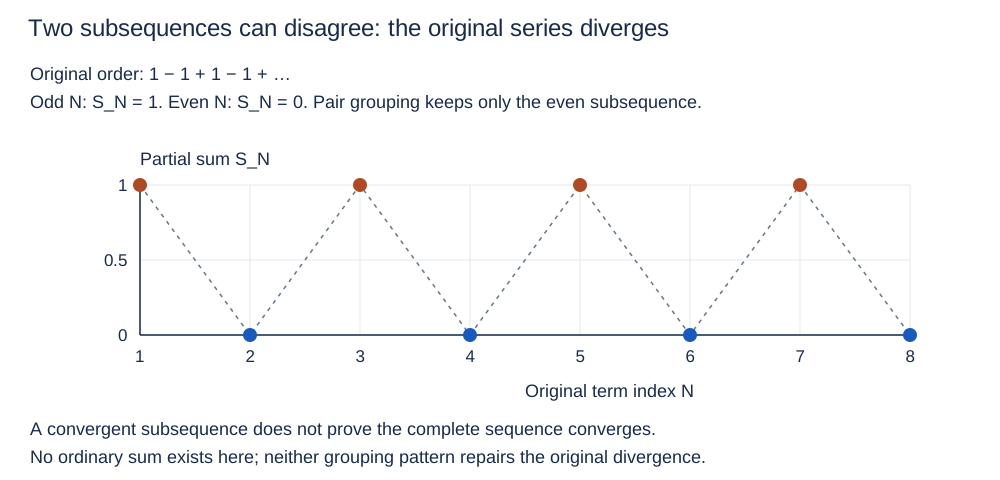
For 1 − 1 + 1 − 1 + ···, the partial sums are 1, 0, 1, 0, ···. The odd subsequence stays at 1 and the even subsequence stays at 0. Since the complete sequence has no single limit, the original series diverges in the ordinary sense.
Writing (1 − 1) + (1 − 1) + ··· gives grouped partial sums 0: it selects the even subsequence. Writing 1 + (−1 + 1) + (−1 + 1) + ··· gives grouped partial sums 1: it selects the odd subsequence. Neither calculation assigns a sum to the original divergent series. The valid theorem starts with an already convergent original series; a convergent subsequence alone cannot establish that hypothesis.
Inspect diagram labels
The diagram keeps its full size here. Focus the view and use the arrow keys, or scroll across it, to inspect every label.
Increasing finite block sizes preserve the sum
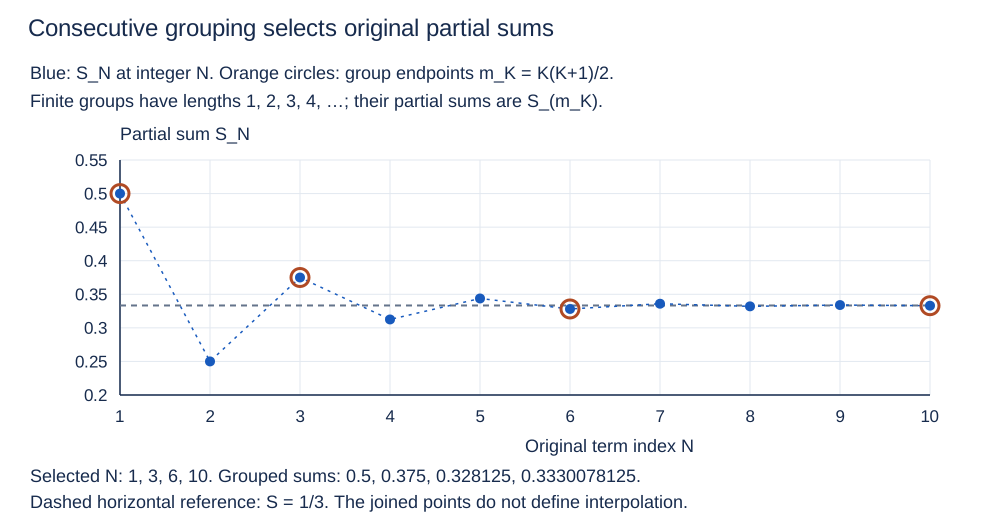
For a_n = (−1)^(n+1)/2^n, n ≥ 1, compare consecutive groups of lengths 1, 2, 3, … with the rearrangement a₂, a₁, a₄, a₃, a₆, a₅, … .
Inspect diagram labels
The diagram keeps its full size here. Focus the view and use the arrow keys, or scroll across it, to inspect every label.
- The absolute-value series Σ 2^(−n) is geometric with first term 1/2 and ratio 1/2, so its sum is 1. The signed geometric series has first term 1/2 and ratio −1/2; its sum is S = (1/2)/(1+1/2) = 1/3.
- The first groups are b₁ = a₁ = 1/2; b₂ = a₂+a₃ = −1/4+1/8 = −1/8; b₃ = a₄+a₅+a₆ = −1/16+1/32−1/64 = −3/64. Their partial sums are 1/2, 3/8 and 21/64.
- After K groups, m_K = 1+2+···+K = K(K+1)/2 original terms have been used. The grouped partial sum is S_(m_K) = (1/3)[1−(−1/2)^(m_K)], which tends to 1/3 because m_K → ∞.
- The pair-swapped order uses each original term once. Absolute convergence guarantees its sum is also 1/3. More concretely, after 2K rearranged terms the sum is S_(2K); the intervening extra term a_(2K+2) tends to zero, so the odd rearranged partial sums have the same limit.
- Consecutive grouping is justified by a subsequence of a convergent sequence. Arbitrary rearrangement is justified here by the stronger absolute-convergence hypothesis.
Answer and check
Both operations preserve the sum 1/3; consecutive group sizes need not be equal or bounded.
Conditional convergence still permits consecutive pairing
It is known that Σ_(n=1)^∞ (−1)^(n+1)/n = ln 2. Compare consecutive pairs with an unrestricted rearrangement and with pairing the divergent series 1−1+1−1+… .
Inspect diagram labels
The diagram keeps its full size here. Focus the view and use the arrow keys, or scroll across it, to inspect every label.
- The harmonic magnitude series Σ 1/n diverges, while the given alternating harmonic series converges. It is conditionally convergent.
- A consecutive pair is b_k = 1/(2k−1)−1/(2k). The sum of the first K pairs is exactly S_(2K), not a new limit calculation with reordered terms.
- Since the complete original partial-sum sequence converges to ln 2, its even subsequence also converges to ln 2. The first two paired partial sums are 1/2 and 7/12.
- No conclusion about all rearrangements follows from conditional convergence. Changing the order removes the direct subsequence identity, and the absolute-value tail is not summable.
- For 1−1+1−1+…, S_(2K)=0 and S_(2K−1)=1. A selected grouped subsequence has a limit, but the original sequence does not. Pairing cannot create an ordinary original sum.
Answer and check
Consecutive pairs of the alternating harmonic series retain ln 2. Arbitrary rearrangements are not guaranteed to retain it; the oscillating divergent series has no ordinary sum.
Try it from memory
Pause & retrieve
Try it before you peek.
Write your answer and the reason from memory. Then compare with the worked answer. Your self-assessment is a study decision, not an automatically graded score.
Question 1
See every recall question with its answer
These references preserve each prompt and its answer for direct evidence links. Try the interactive questions above before opening the worked reasoning.
Retrieval 1
Worked answer and reason
That is the definition of conditional convergence.
Retrieval 2
Worked answer and reason
Conditional convergence does not make rearrangements harmless.
Catch the tempting mistake
- An alternating series is automatically conditionally convergent.
- It can be absolute, conditional or divergent. Test magnitudes and the original series rather than classifying by sign pattern.
Calculator workspace and limits
For calculus, set the angle selector to Radians. This scientific calculator evaluates arithmetic and functions. It does not graph arbitrary functions, find numerical roots, evaluate numerical derivatives, or compute definite integrals. Those tasks need an approved graphing tool; the May 2027 exam permits approved handheld graphing calculators and Bluebook’s built-in Desmos on calculator-required parts. A graph or decimal estimate helps you check a conclusion; your setup, hypotheses, units and justification still do the explaining.
Scientific calculator
This calculator requires JavaScript. Use the physics formula sheets and show your working manually.
+ − * / ^ ! · pi · e · sqrt · sin, cos, tan · asin, acos, atan · atan2(y,x) · ln, log · abs · exp · hypot(x,y). Use * between factors. Keep units in your written working.
Put it to work
- Unit 10 problem 17 · No calculator · analytic
- Unit 10 problem 18 · No calculator · analytic
Explain and apply the mathematics
Try these problems before opening the solutions. Show your setup, the hypotheses behind your method, and what your answer means.
Regroup and rearrange an absolutely convergent series
Let a_n=(−1)^(n+1)/2^n for n≥1 and S_N=Σ_(n=1)^N a_n. A consecutive grouping uses lengths 1,2,3,… . A different operation rearranges the individual terms into a₂,a₁,a₄,a₃,a₆,a₅,… .
(a) For a_n=(−1)^(n+1)/2^n, establish absolute convergence by evaluating the magnitude series. Then find the original signed sum S.
(b) Regroup a_n=(−1)^(n+1)/2^n into consecutive finite blocks of lengths 1,2,3,…, using every term once in its original order. Compute b₁,b₂,b₃ and their partial sums. Prove that after K blocks the endpoint is m_K=K(K+1)/2 and that the grouped partial sums approach 1/3. Sketch S_N for N=1,…,10, and mark N=1,3,6,10 as the first four grouped endpoints. You may use S_N=(1/3)[1−(−1/2)^N].
(c) For the absolutely convergent series with a_n=(−1)^(n+1)/2^n, decide whether the rearranged order a₂,a₁,a₄,a₃,a₆,a₅,…, using every term exactly once, preserves the original sum 1/3. Justify the conclusion under the absolute-convergence theorem, and verify the limit directly using even and odd rearranged partial sums. Explain how this rearrangement differs from consecutive finite regrouping.
Written working workspace
Drawing is temporarily unavailable. Work on paper if needed, then record your reasoning here.
Saving written working requires JavaScript. Keep your work on paper or in your own notes; the source problem above remains available.
Worked solution and rubric →Revisit the explanation →Revisit the explanation →
Convergence hypotheses cannot be replaced by a grouped limit
The alternating harmonic series A=Σ_(n=1)^∞ (−1)^(n+1)/n is known to converge to ln 2. The harmonic magnitude series diverges. Compare it with the oscillating series D=1−1+1−1+… . All sums here mean ordinary limits of complete partial-sum sequences.
(a) For the conditionally convergent alternating harmonic series A, form consecutive pairs b_k=1/(2k−1)−1/(2k). Find its first two grouped partial sums and prove the regrouped series still sums to ln 2. State exactly which convergence and grouping hypotheses your proof uses.
(b) For D=1−1+1−1+…, compute S_N for N=1,…,8 and sketch these points on partial-sum axes. Determine the limits of the even and odd subsequences. Evaluate the grouped partial sums for (1−1)+(1−1)+… and for 1+(−1+1)+(−1+1)+… . Does either grouping prove an ordinary sum for D? Explain.
(c) An analyst argues that because the alternating harmonic series converges, both consecutive finite grouping and every rearrangement using each term once must preserve ln 2. Identify the justified portion and the unjustified portion. Then state separately what absolute convergence would guarantee about regrouping and about rearrangement.
Written working workspace
Drawing is temporarily unavailable. Work on paper if needed, then record your reasoning here.
Saving written working requires JavaScript. Keep your work on paper or in your own notes; the source problem above remains available.
Worked solution and rubric →Revisit the explanation →Revisit the explanation →Revisit the explanation →
For the teacher
- Require two explicit conclusions for a conditional claim: the original converges and the magnitude sum diverges.
Glossary and deeper reading · 9 refreshers
These editorial refreshers supplement the reading. Definitions and examples are added guidance; original source wording and recorded answers remain in their original context.
-
Infinite series
An infinite series is the sum of the terms of an infinite sequence, defined through its partial sums. The series converges when those partial sums approach a finite value. For example, 1/2+1/4+1/8+⋯ converges to 1. Terms approaching 0 are necessary for convergence, but that condition alone is insufficient.
-
Absolute convergence
A series converges absolutely when the series of its absolute term values converges. Absolute convergence also guarantees convergence of the original signed series. For example, an alternating series with magnitudes 1/n² converges absolutely. An absolutely convergent series retains its sum under any rearrangement of its terms.
-
Convergence of a series
A series converges when the sequence of its partial sums approaches a finite limit. It diverges when there is no such finite limit. For example, 1/2+1/4+1/8+⋯ converges to 1, while the harmonic series diverges. Convergence of the individual terms to 0 is necessary but does not by itself establish convergence of their sum.
-
p-series
A p-series has terms 1/nᵖ for positive integers n. It converges exactly when p>1. For example, the p-series with p=2 converges, while p=1 gives the divergent harmonic series. The boundary p=1 belongs to the divergent cases.
-
Conditional convergence
A series converges conditionally when it converges but the series of its absolute term values diverges. Cancellation between positive and negative terms is essential to this convergence. For example, 1−1/2+1/3−1/4+⋯ converges while the harmonic series of its magnitudes diverges. Rearranging a conditionally convergent series can change its sum or destroy convergence.
-
Sequence
A sequence is an ordered list of terms indexed by integers. A rule can specify each term directly or recursively from earlier terms. For example, aₙ=1/n produces 1, 1/2, 1/3, and so on. An infinite sequence converges when its terms approach a finite limit as the index grows without bound.
-
Partial sum
A partial sum adds the first finitely many terms of a series. The nth partial sum is Sₙ=a₁+a₂+⋯+aₙ when indexing begins at 1. For example, the first three terms of 1/2+1/4+1/8+⋯ give partial sum 7/8. Convergence of a series concerns the limit of these sums, not just the limit of the individual terms.
-
Limit
A limit describes the value approached by outputs as inputs approach a specified target or grow without bound. For an input approaching a finite target, its value at that exact input does not determine the limit. For example, (x²−1)/(x−1) approaches 2 as x approaches 1 even though the original expression is undefined at 1. A finite two-sided limit requires the left and right approaches to agree.
-
Harmonic series
The harmonic series is 1+1/2+1/3+1/4+⋯. It diverges even though its individual terms approach 0. For example, grouping terms from 1/2 through 1/3+1/4 and then 1/5+⋯+1/8 shows repeatedly added blocks of at least 1/2. It is a standard comparison that separates a necessary term condition from actual convergence.