AP Unit 10 Solutions
Worked solutions to all thirty Unit 10 problems. Each solution gives the mathematical steps and the reason for using them. Compare your setup and justification as well as the final answer.
Problem 1
For , derive the nth partial sum and the series sum. Distinguish a term limit from a partial-sum limit.
- . Why: A common denominator verifies this finite algebraic identity.
- . Why: All interior reciprocals cancel in the finite N-term sum.
- , so the series sum is 1. The term limit is 0, a different limit. Why: The infinite series is defined by a finite limit of its partial sums.
Final answer
Review the teaching: Topic 10.1
Problem 2
A series has partial sums for every positive integer n. The graph shows the first six; the formula continues indefinitely. Does the series converge?
- Odd-indexed partial sums equal 1; even-indexed partial sums equal 3. Why: Evaluate (−1)ⁿ separately for odd and even n.
- The two subsequences have different limits. Why: The exact formula establishes the behavior beyond the plotted samples.
- The series diverges. Why: Its partial sums cannot approach one finite value when two subsequences approach different values.
Final answer
Review the teaching: Topic 10.1
Problem 3
Find the sum of and its first four-term partial sum. Justify use of the geometric formula.
- First term and ratio , with . Why: Identify the ratio and check the convergence hypothesis.
- Infinite sum . Why: The geometric partial-sum limit exists under that hypothesis.
- . Why: Four terms starting at n=0 end at n=3.
Final answer
Review the teaching: Topic 10.2
Problem 4
A ball is dropped 2 meters. After each impact it rises to 60% of the previous height, then falls the same distance. Under this ideal infinite-bounce model, find the total vertical distance.
- The initial drop contributes 2 meters. Later bounce heights are for n≥1. Why: The first rebound is 1.2 meters, not the original drop height.
- Each rebound height is traveled once up and once down, so . Why: The factor 2 for round trips multiplies each height 2(0.6)ⁿ.
- meters. Why: The geometric ratio has magnitude less than 1; use the first included power.
Final answer
Review the teaching: Topic 10.2
Problem 5
Classify using the nth-term test.
- The summand is . Why: The test begins with a term limit.
- . Why: Divide numerator and denominator by n.
- The series diverges. Why: A convergent series must have term limit zero; here it is 1.
Final answer
Review the teaching: Topic 10.3
Problem 6
A student says: “Because , converges by the nth-term test.” Repair the argument and give a correct classification.
- The zero term limit does not establish convergence. Why: The nth-term condition is necessary, with no valid converse.
- is the harmonic p-series with p=1. Why: Identify a test that actually decides convergence.
- It diverges, despite its terms tending to zero. Why: The p-series criterion requires p>1 for convergence.
Final answer
Review the teaching: Topic 10.3 Topic 10.5
Problem 7
Use the integral test to classify . State its hypotheses and do not identify the integral value with the series sum.
- For x≥2, is positive and continuous, and . Why: These are the required positive continuous decreasing-tail hypotheses.
- . Why: Use u=ln x and evaluate ∫u⁻²du at infinity.
- The series converges. Its sum is not asserted to equal 1/ln2. Why: The integral test transfers convergence behavior, not exact value.
Final answer
Review the teaching: Topic 10.4
Problem 8
Use the integral test to classify .
- is positive and continuous for x≥2; . Why: The test applies on this tail.
- . Why: Substitute u=ln x to integrate 1/u.
- This grows without bound as b→∞, so the series diverges. Why: Under the verified hypotheses, the improper integral and series share divergence.
Final answer
Review the teaching: Topic 10.4
Problem 9
Classify each series and state the relevant p: (a) , (b) , (c) . Each starts at n=1.
- (a) has p=3/2 and converges. Why: p is greater than 1.
- (b) has p=1 and diverges. Why: The harmonic series is the threshold case.
- (c) has p=0.9 and diverges. Why: A positive exponent below 1 does not meet the convergence criterion.
Final answer
Review the teaching: Topic 10.5
Problem 10
Does converge? Explain the roles of the starting index and factor 7.
- Rewrite the term as . Why: A power of a product splits into a fixed scalar and a p-series term.
- The p-value is 1.1>1. Why: The benchmark sum converges by the p-series criterion.
- The given tail converges. Why: A fixed nonzero factor and deletion of finitely many initial terms do not change convergence.
Final answer
Review the teaching: Topic 10.5
Problem 11
Prove convergence of by direct comparison.
- for n≥1. Why: The larger positive denominator gives the smaller reciprocal.
- converges. Why: It is a p-series with p=2.
- The given series converges by comparison. Why: A nonnegative sum bounded termwise above by a convergent sum converges.
Final answer
Review the teaching: Topic 10.6
Problem 12
Use limit comparison to classify .
- Choose positive benchmark . Why: The dominant-power ratio suggests harmonic scale.
- . Why: Divide numerator and denominator by n²; the limit is finite and positive.
- The series diverges. Why: The harmonic benchmark diverges, and standard limit comparison gives the same behavior.
Final answer
Review the teaching: Topic 10.6
Problem 13
Use the alternating-series test to justify convergence of .
- Set . Why: Separate the alternating sign from its magnitude.
- and . Why: The denominator increases without bound.
- The signed series converges. Why: Positive decreasing magnitudes tending to zero meet the alternating-series hypotheses.
Final answer
Review the teaching: Topic 10.7
Problem 14
A student applies the alternating-series test to . Show why the test is not applicable, then classify the series by a valid argument.
- Magnitudes are 1/n for odd n and 3/n for even n. Each even magnitude exceeds the previous odd magnitude. Why: 3/(2k)>1/(2k−1) for every k≥1; the magnitudes are not eventually decreasing.
- At the partial-sum level, . Why: Expand the numerator without rearranging any infinite sum.
- The first partial-sum sequence has a finite limit; the second grows without bound. Hence the given series diverges to positive infinity. Why: The ordinary alternating harmonic series converges, while the harmonic series diverges.
Final answer
Review the teaching: Topic 10.7 Topic 10.5
Problem 15
Use the ratio test on .
- . Why: Cancel powers and use (n+1)!=(n+1)n!.
- The limit is . Why: The denominator tends to infinity.
- The series converges absolutely. Why: This is the ratio-test convergence case.
Final answer
Review the teaching: Topic 10.8
Problem 16
Compute ratio-test limits for and , then classify both with a valid test.
- The respective ratios are and , both tending to 1. Why: Form aₙ₊₁/aₙ and take the limit.
- The ratio test is inconclusive for both. Why: Its limit-1 case gives no convergence decision.
- The harmonic series diverges; the p=2 series converges. Why: The p-series criterion supplies the decision the ratio test could not.
Final answer
Review the teaching: Topic 10.8 Topic 10.5
Problem 17
Classify as absolute, conditional or divergent. Give both required checks.
- The signed series converges. Why: Its magnitudes 1/n decrease to zero, so the alternating-series test applies.
- The absolute-value series diverges. Why: It is harmonic, p=1.
- Convergence is conditional. Why: The original converges while its magnitude sum does not.
Final answer
Review the teaching: Topic 10.9
Problem 18
Classify . Is its sum preserved if its terms are rearranged into a different order, using every term once?
- The magnitude sum is , which converges. Why: It is a p-series with p=2.
- The original series is absolutely convergent and therefore convergent. Why: Absolute convergence implies convergence of the signed series.
- Every such rearrangement has the same sum. Why: Absolute convergence guarantees invariance under rearrangement and regrouping.
Final answer
Review the teaching: Topic 10.9
Problem 19
Approximate the alternating harmonic series with its first four terms. Give an absolute error bound and an interval trapping its sum.
- . Why: Add the specified four terms in order.
- The magnitudes decrease to zero, and the next magnitude is . Why: Verify the alternating-bound hypotheses and identify the first omitted term.
- , and . Why: The true sum lies between S₄ and S₅=S₄+1/5.
Final answer
Review the teaching: Topic 10.10
Problem 20
For , what is the smallest number N of retained terms for which the alternating error-bound inequality is strictly less than 0.001?
- The alternating bound is . Why: Magnitudes n⁻³ decrease to zero; the next term is indexed N+1.
- Require , so . Why: The requested bound is strict, not merely at most 0.001.
- The smallest integer is . Why: N=9 gives equality in the bound; N=10 gives 1/1331<0.001.
Final answer
Review the teaching: Topic 10.10
Problem 21
Use the derivative table to write T₃ about x=2 and approximate f(2.1).
| Value | Number |
|---|---|
| f(2) | 3 |
| f′(2) | −1 |
| f″(2) | 4 |
| f‴(2) | 6 |
- Coefficients are , or . Why: Divide each kth derivative by k!.
- . Why: Every power uses the given center 2.
- . Why: Substitute x−2=0.1; the table alone does not prove this is the exact function value.
Final answer
Review the teaching: Topic 10.11
Problem 22
Construct the degree-3 Maclaurin polynomial for sin x from derivative values, then approximate sin(0.2). An independent value is sin(0.2)≈0.198669331. Compare the absolute errors of T₁ and T₃ here; does this prove that higher degree is always better?
- At 0 the derivative values through order 3 are . Why: The derivative cycle is sin, cos, −sin, −cos.
- . Why: Use f⁽ᵏ⁾(0)/k! as each coefficient.
- . Why: Evaluate the polynomial near its center; use approximation notation.
- T₁(0.2)=0.2 has error about 0.001330669; T₃ has error about 0.000002664. T₃ is better at this point. Why: Compare each value to the supplied independent value.
- This one comparison does not prove higher degree is always better everywhere. Why: Taylor accuracy is local and a general claim needs appropriate remainder control.
Final answer
Review the teaching: Topic 10.11
Problem 23
Approximate using T₂ at 0. Using the valid bound for , give a Lagrange error bound.
- . Why: The degree-2 exponential Maclaurin polynomial has coefficients 1/k!.
- The third derivative is eᵗ, bounded by the given throughout the relevant interval. Why: A degree-2 Lagrange bound requires order 3 over the whole interval.
- . Why: Apply M|x−a|³/3! with center a=0.
Final answer
Review the teaching: Topic 10.12 Topic 10.11
Problem 24
Approximate cos(0.3) using . Compare a degree-4 Lagrange bound using M=1 with the alternating-series bound.
- . Why: Substitute into the given degree-4 polynomial.
- A Lagrange bound is . Why: The fifth derivative is −sin t, whose magnitude is at most 1.
- The alternating bound is , which is sharper. Why: At x=0.3 the cosine terms decrease to zero; the next nonzero term is degree 6, not degree 5.
Final answer
Review the teaching: Topic 10.12
Problem 25
Find the radius and interval of convergence of . Show each endpoint test.
- For x≠2 the ratio limit is ; at x=2 all terms vanish. Why: Cancel powers and use n/(n+1)→1; the center is treated directly.
- gives and open interval . Why: Apply the strict ratio-test convergence condition.
- At x=−1 the series is alternating harmonic and converges; at x=5 it is harmonic and diverges. Why: The endpoint ratio limit 1 is inconclusive, so substitute into the original series.
- The full interval is . Why: Include only the endpoint whose series converges.
Final answer
Review the teaching: Topic 10.13
Problem 26
Let . Differentiate term by term, identify F′ as a function on its open convergence interval, and determine the new radius and endpoint behavior. Why is F's power series its Taylor series there?
- . Why: Termwise differentiation is valid inside F’s positive radius.
- Reindex as . Why: Use the geometric identity for |x−2|<3.
- The radius stays 3; at x=−1 and x=5 the derivative terms have magnitude 1/3 and do not tend to zero, so its interval is . Why: Differentiation preserves radius but requires new endpoint tests.
- At center 2, the nth derivative of the sum equals n! times its nth power-series coefficient. Why: Inside a positive radius, termwise derivatives recover the Taylor coefficients of the represented function.
Final answer
Review the teaching: Topic 10.13 Topic 10.15
Problem 27
Write the Maclaurin series for cos(2x), the degree-4 Taylor polynomial it supplies, and the interval on which the series represents the function.
- Start with . Why: This is the cosine foundation series.
- Substitute u=2x: . Why: Substitute into every power and retain its factorial.
- The degree-4 polynomial is , and the representation holds for all real x. Why: It is the corresponding partial sum; the cosine remainder tends to zero for every fixed x.
Final answer
Review the teaching: Topic 10.14
Problem 28
Derive a Taylor series for ln x centered at x=1 from the geometric series for 1/(1+u). Give its interval of convergence and justify representation at the included endpoint.
- For |u|<1, . Why: Substitute −u into the geometric foundation.
- Integrate from 0 to x−1: . Why: The integral is ln(1+u), and the constant is fixed by ln1=0.
- At x=0 the series is and diverges; at x=2 it is alternating harmonic and converges. Why: The radius is 1; each endpoint needs its own test.
- The interval is , and at x=2 the integrated geometric remainder has magnitude at most 1/(N+1), tending to zero. Why: This verifies equality to ln2 at the convergent endpoint rather than relying on convergence alone.
Final answer
Review the teaching: Topic 10.14 Topic 10.15 Topic 10.13
Problem 29
Use the geometric series to represent as a power series centered at zero. Give radius and interval.
- For |x|<1, . Why: The geometric identity holds on its open radius-1 interval.
- Differentiate: . Why: Termwise differentiation is valid inside the radius; reindex k=n−1.
- Radius remains 1, and both endpoints diverge because term magnitudes k+1 do not tend to zero. Why: Differentiation preserves radius, but endpoint decisions use the new terms.
Final answer
Review the teaching: Topic 10.15 Topic 10.13
Problem 30
Derive a power series for arctan x by integrating a geometric series. At x=0.5, use its first four nonzero terms, give an alternating error bound, and use a calculator's numerical integral to check the approximation. State the full interval of representation.
- for |t|<1. Integrating from 0 to x gives . Why: Substitute −t² into the geometric series and integrate term by term, fixing the constant at x=0.
- At x=±1 the signed odd-reciprocal sums converge; the integrated finite-geometric remainder tends to zero. Thus the representation holds on . Why: Both endpoint convergence and vanishing remainder support the closed interval.
- At 0.5 the four-term approximation is . Why: The first four indices are 0,1,2,3.
- The error is at most . Numerical integration gives about , within that bound. Why: The alternating magnitudes decrease to zero; the first omitted term bounds the unseen tail, and the integral independently checks the decimal.
Final answer
Review the teaching: Topic 10.15 Topic 10.10
Explain and apply: worked solutions
Compare the setup and the reasoning, as well as the final answer. Use the rubric to find your next step; equivalent correct reasoning earns the same credit.
Regroup and rearrange an absolutely convergent series
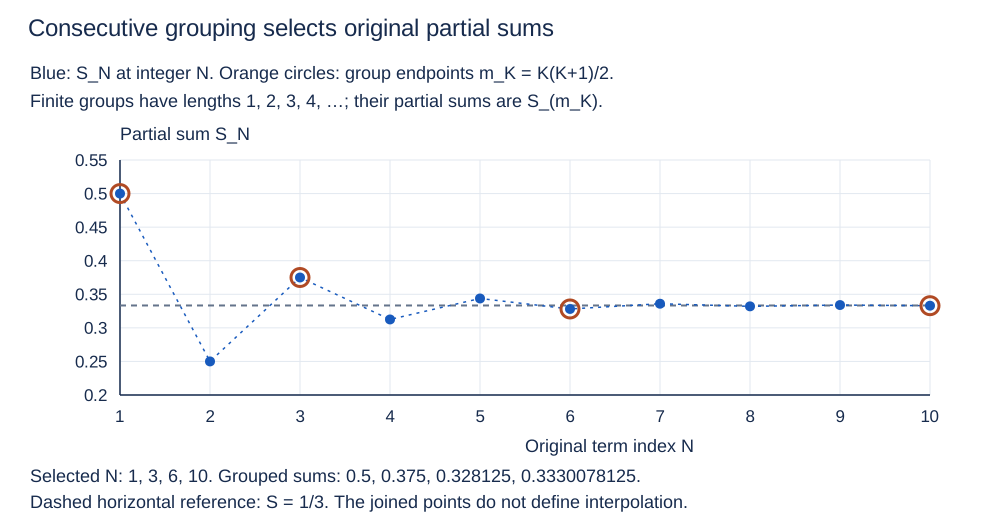
Let a_n=(−1)^(n+1)/2^n for n≥1 and S_N=Σ_(n=1)^N a_n. A consecutive grouping uses lengths 1,2,3,… . A different operation rearranges the individual terms into a₂,a₁,a₄,a₃,a₆,a₅,… .
Part a
For a_n=(−1)^(n+1)/2^n, establish absolute convergence by evaluating the magnitude series. Then find the original signed sum S.
Σ |a_n|=1, so the original is absolutely convergent; S=1/3.
- The magnitude series has first term 1/2 and common ratio 1/2. Its sum is (1/2)/(1−1/2)=1.
- The signed series has first term 1/2 and common ratio −1/2. Its sum is (1/2)/(1+1/2)=1/3.
Scoring criteria
- Evaluates the magnitude geometric series and explicitly establishes absolute convergence.
- Uses the signed ratio −1/2 to obtain S=1/3.
Part b
Regroup a_n=(−1)^(n+1)/2^n into consecutive finite blocks of lengths 1,2,3,…, using every term once in its original order. Compute b₁,b₂,b₃ and their partial sums. Prove that after K blocks the endpoint is m_K=K(K+1)/2 and that the grouped partial sums approach 1/3. Sketch S_N for N=1,…,10, and mark N=1,3,6,10 as the first four grouped endpoints. You may use S_N=(1/3)[1−(−1/2)^N].
b₁=1/2, b₂=−1/8, b₃=−3/64. Grouped partial sums are 1/2,3/8,21/64; after K blocks they are S_(m_K)→1/3. The completed graph marks N=1,3,6,10.
- The first blocks contain respectively a₁; a₂,a₃; and a₄,a₅,a₆. Their sums are 1/2, −1/4+1/8=−1/8, and −1/16+1/32−1/64=−3/64.
- Add the block values: 1/2, 1/2−1/8=3/8, and 3/8−3/64=21/64. In general the first K block lengths total 1+2+···+K=K(K+1)/2.
- The grouped sum is exactly S_(m_K). Since m_K→∞, (−1/2)^(m_K)→0; hence S_(m_K)→1/3. Every block is finite and consecutive, so the convergence-subsequence argument applies.
- The original S_N values for N=1,…,10 are 1/2,1/4,3/8,5/16,11/32,21/64,43/128,85/256,171/512,341/1024. Plot these discrete points and the horizontal limit 1/3.
- The completed key highlights N=1,3,6,10. The fourth selected value is 341/1024=0.3330078125. Marking these points displays the grouped subsequence without changing term order.
Scoring criteria
- Computes the three blocks and their three partial sums correctly.
- Derives m_K and the identity between grouped sums and original endpoint sums.
- Uses convergence with finite consecutive blocks to prove the common sum.
- Draws all ten discrete points and clearly identifies the four selected endpoints and limit.
Part c
For the absolutely convergent series with a_n=(−1)^(n+1)/2^n, decide whether the rearranged order a₂,a₁,a₄,a₃,a₆,a₅,…, using every term exactly once, preserves the original sum 1/3. Justify the conclusion under the absolute-convergence theorem, and verify the limit directly using even and odd rearranged partial sums. Explain how this rearrangement differs from consecutive finite regrouping.
The rearrangement retains sum 1/3. Its even partial sums equal S_(2K), and its odd partial sums equal S_(2K)+a_(2K+2); both approach 1/3. It changes individual term order.
- Absolute convergence guarantees that every rearrangement using all terms once preserves the original sum. This pair-swapped sequence uses precisely those terms with no omissions or repetitions.
- After 2K rearranged terms, all original terms through 2K have appeared, so the sum is S_(2K)→1/3.
- After 2K+1 rearranged terms, the next selected term is a_(2K+2)=−2^(−2K−2). The sum is S_(2K)+a_(2K+2)→1/3 because this added term tends to zero.
- The two parity subsequences exhaust the rearranged partial sums and have the same limit. Unlike consecutive regrouping, this operation swaps individual terms; its odd partial sums are not original consecutive endpoint sums.
Scoring criteria
- Identifies use of every term once and invokes absolute convergence for rearrangement.
- Verifies both even and odd partial-sum limits with correct indices.
- Explicitly distinguishes reordered individual terms from consecutive finite grouping.
Inspect diagram labels
The diagram keeps its full size here. Focus the view and use the arrow keys, or scroll across it, to inspect every label.
Return to the unit problem →Try this problem in its lesson →
Convergence hypotheses cannot be replaced by a grouped limit
The alternating harmonic series A=Σ_(n=1)^∞ (−1)^(n+1)/n is known to converge to ln 2. The harmonic magnitude series diverges. Compare it with the oscillating series D=1−1+1−1+… . All sums here mean ordinary limits of complete partial-sum sequences.
Part a
For the conditionally convergent alternating harmonic series A, form consecutive pairs b_k=1/(2k−1)−1/(2k). Find its first two grouped partial sums and prove the regrouped series still sums to ln 2. State exactly which convergence and grouping hypotheses your proof uses.
The first paired partial sums are 1/2 and 7/12. After K pairs the sum is S_(2K)→ln 2 because the original series converges and all groups are finite and consecutive.
- b₁=1−1/2=1/2; b₂=1/3−1/4=1/12. The first two grouped partial sums are 1/2 and 1/2+1/12=7/12.
- The first K pairs use exactly the first 2K original terms in the original order, so their sum is S_(2K).
- The complete S_N sequence is given to converge to ln 2. Therefore its even subsequence converges to ln 2. This proof uses original convergence, finite consecutive groups and no omitted or repeated terms; it does not require absolute convergence.
Scoring criteria
- Calculates block values and distinguishes them from grouped partial sums.
- Gives the exact S_(2K) identity and its limit.
- States the original convergence and finite consecutive-group hypotheses without demanding absolute convergence.
Part b
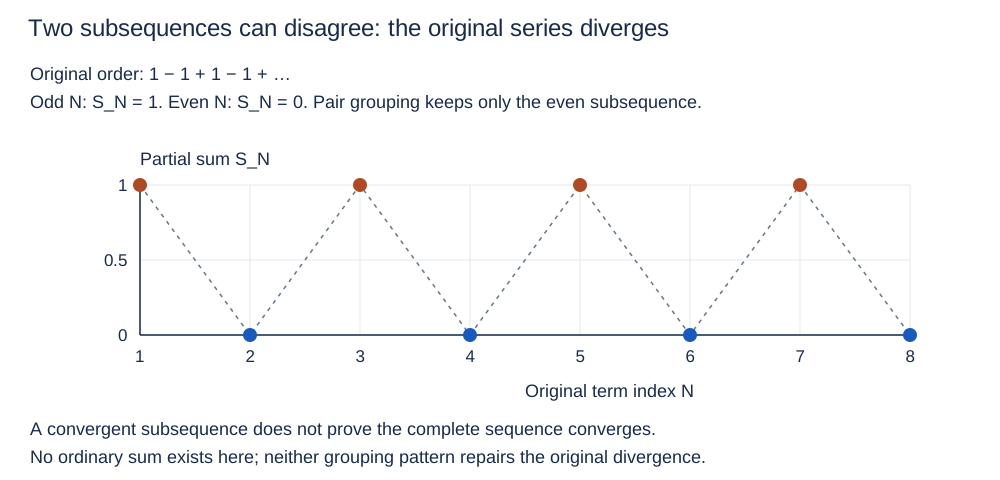
For D=1−1+1−1+…, compute S_N for N=1,…,8 and sketch these points on partial-sum axes. Determine the limits of the even and odd subsequences. Evaluate the grouped partial sums for (1−1)+(1−1)+… and for 1+(−1+1)+(−1+1)+… . Does either grouping prove an ordinary sum for D? Explain.
The complete sequence alternates 1,0,1,0,1,0,1,0 and diverges. Even sums approach 0, odd sums approach 1. The two grouped sequences are respectively always 0 and always 1; neither gives the original series an ordinary sum.
- For even N=2K there are K positive and K negative unit terms, so S_(2K)=0. For odd N=2K−1 there is one extra positive term, so S_(2K−1)=1.
- Plot the eight points shown in the separate completed key. Label both axes and the levels 0 and 1; do not smooth away the alternating values.
- The first grouping selects S_(2K)=0. In the second grouping, a singleton first group contributes 1 and every later pair contributes 0, selecting S_(2K−1)=1.
- The two subsequences have distinct limits, so the complete original sequence has no limit. The original convergence hypothesis fails; grouped subsequences cannot repair that failure.
Scoring criteria
- Produces all eight points and correctly labeled levels/axes.
- Computes both original subsequence limits and both grouped sequences.
- Concludes original divergence from different limits and explains the failed theorem hypothesis.
Part c
An analyst argues that because the alternating harmonic series converges, both consecutive finite grouping and every rearrangement using each term once must preserve ln 2. Identify the justified portion and the unjustified portion. Then state separately what absolute convergence would guarantee about regrouping and about rearrangement.
Consecutive finite regrouping is justified by original convergence; unrestricted rearrangement is not guaranteed for the conditional series. Under absolute convergence, both finite regrouping and rearrangement using every term once preserve the original sum.
- The consecutive grouped partial sums are a subsequence of the known convergent S_N, so they retain ln 2.
- A rearrangement changes individual term order. Its partial sums need not be a subsequence of S_N, and the magnitude series is divergent. Convergence alone does not give arbitrary rearrangement invariance.
- If Σ |a_n| converges, finite regroupings have the same value and every rearrangement using all terms exactly once has the same value. This stronger hypothesis controls the total magnitude of any remaining tail.
Scoring criteria
- Separates the valid consecutive-group claim from the unsupported rearrangement guarantee.
- States both absolute-convergence guarantees explicitly.
- Connects the distinction to subsequence identity or summable magnitude tails.
Inspect diagram labels
The diagram keeps its full size here. Focus the view and use the arrow keys, or scroll across it, to inspect every label.
Return to the unit problem →Try this problem in its lesson →
Prove increasing-degree convergence on an entire interval
Let f(x)=e^x and T_n be its degree-n Maclaurin polynomial. Work on I=[−1,1]. You may use e<3 and the established remainder estimate |f(x)−T_n(x)|≤M|x|^(n+1)/(n+1)! whenever |f⁽ⁿ⁺¹⁾(t)|≤M for t between 0 and x. For sketching, e^(−1)≈0.367879, e^0=1 and e≈2.718282 are supplied.
Part a
For e^x centered at 0, derive the coefficient of x^k from the kth derivative at 0. Write T₁, T₃ and T₅, then evaluate each at x=−1,0,1. Give exact polynomial values.
The coefficient is 1/k!. T₁=1+x; T₃=1+x+x²/2+x³/6; T₅=T₃+x⁴/24+x⁵/120. At −1 the values are 0,1/3,11/30; at 0 all are 1; at 1 they are 2,8/3,163/60.
- Every derivative of e^x is e^x, so f⁽ᵏ⁾(0)=1. Dividing by k! gives coefficient 1/k!.
- Sum the coefficients through degrees 1,3 and 5 to obtain the three displayed polynomials.
- At −1, alternating substitutions give 0; 1−1+1/2−1/6=1/3; and 1/3+1/24−1/120=11/30.
- At 0 only the constant term remains. At 1, positive substitutions give 2, 8/3 and 163/60.
Scoring criteria
- Derives coefficients from derivative values and factorials.
- Writes all three complete polynomials.
- Evaluates the nine requested entries exactly, preserving the correct signs.
Part b
Using the supplied remainder estimate, prove that T_n approaches e^x for every x in the entire interval [−1,1] as n increases. Establish a bound independent of x, show that it tends to zero, and explain why one sufficiently large degree works for any prescribed positive tolerance at every point in the interval.
|e^x−T_n(x)|≤B_n=3/(n+1)! for every x∈[−1,1]. Since B_(n+1)/B_n=1/(n+2)≤1/2, B_n→0; a single sufficiently large degree therefore makes the error smaller than any given tolerance throughout the interval.
- For any x in [−1,1], every t between 0 and x lies in [−1,1]. The derivative magnitude e^t is at most e<3, and |x|≤1.
- The supplied estimate gives |e^x−T_n(x)|≤3|x|^(n+1)/(n+1)!≤3/(n+1)!. This bound is independent of the chosen x.
- Successive bounds have ratio 1/(n+2)≤1/2. Thus 0≤B_n≤3·2^(−n), which tends to zero.
- For any ε>0 choose N with 3·2^(−N)<ε. Then for every n≥N and every x∈[−1,1], |e^x−T_n(x)|<ε. This proves increasing-degree convergence over the complete stated interval.
Scoring criteria
- Uses a derivative bound valid for every point between the center and each x in the interval.
- Obtains the uniform factorial error bound.
- Proves that bound tends to zero using a valid limit argument.
- Explains the single-degree, all-points tolerance conclusion rather than checking only samples.
Part c
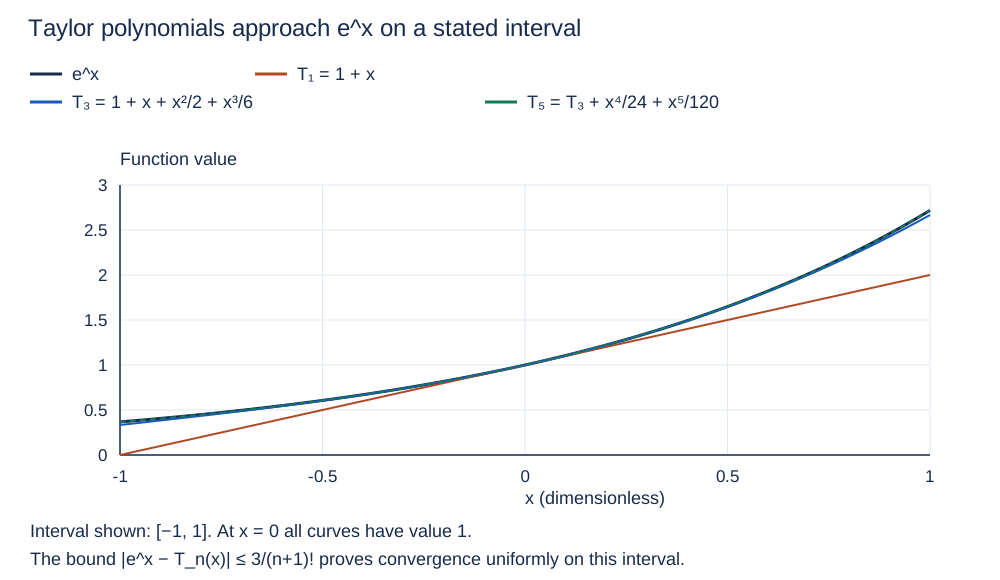
Sketch e^x and T₁,T₃,T₅ on the common interval [−1,1], with labeled axes and a legend. Use their three supplied or calculated values at −1,0,1 and the exact formulas to show the curve shapes. Explain what the plot illustrates and why it cannot replace the interval proof in part b.
The separate completed graph shows the four curves on [−1,1], all meeting at (0,1). It illustrates approximation but cannot prove an infinite-degree limit; the remainder argument does that.
- Plot e^x as increasing and convex through the supplied points; plot T₁ as the line through (−1,0),(0,1),(1,2).
- Plot T₃ through values 1/3,1,8/3 and T₅ through 11/30,1,163/60. Their exact derivatives are positive on [−1,1], giving increasing shapes consistent with the formulas.
- The complete graphical key uses one common horizontal and vertical scale and names each curve in the legend. The higher-degree curves lie visually closer to e^x at the sample endpoints.
- Only finitely many curves and points are pictured. The uniform vanishing bound is needed to infer the limiting behavior for all degrees and every point.
Scoring criteria
- Draws all four labeled curves on the stated common domain, including the correct center and endpoint values.
- Preserves correct axis scales and identifies the curve formulas.
- Distinguishes graphical illustration from proof of infinite-degree convergence.
Part d
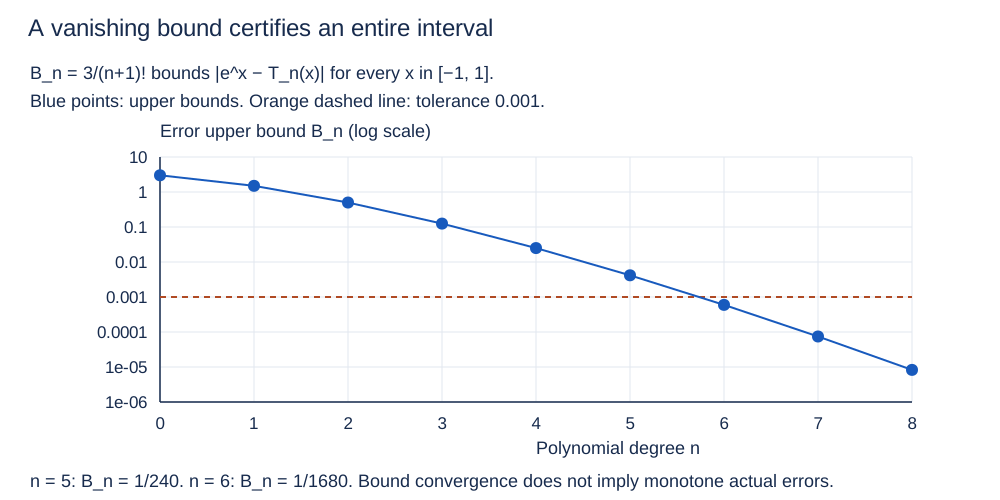
Find the smallest degree certified by B_n=3/(n+1)! to give absolute error at most 0.001 throughout [−1,1]. Compare the immediately preceding degree, and state whether this certificate proves that the actual error decreases at each degree for each x.
Degree 6 is the first certified degree: B₅=1/240>0.001 and B₆=1/1680<0.001. This certificate does not prove monotone actual-error reduction.
- The bounds decrease with n because their successive ratio is 1/(n+2)<1.
- At n=5, B₅=3/720=1/240; since 240<1000, this is greater than 1/1000. At n=6, B₆=3/5040=1/1680<1/1000.
- Degree 6 is therefore the least degree certified by this bound. A smaller degree might have actual error below the tolerance, but that is not established by this certificate.
- A bound approaching zero proves convergence. It is a ceiling on actual errors, not their exact values, so decreasing bounds alone do not prove step-by-step actual-error decrease.
Scoring criteria
- Checks consecutive degrees 5 and 6 and justifies minimality for this bound.
- States that the certificate applies throughout [−1,1].
- Separates certified bounds from actual errors and rejects the stronger monotonicity inference.
Inspect diagram labels
The diagram keeps its full size here. Focus the view and use the arrow keys, or scroll across it, to inspect every label.
Inspect diagram labels
The diagram keeps its full size here. Focus the view and use the arrow keys, or scroll across it, to inspect every label.
Return to the unit problem →Try this problem in its lesson →
Construct a counterexample to monotone actual errors
Let f(x)=1+x−x², centered at 0, and let T_n be its Maclaurin polynomials. Compare actual errors on I=[−1,1], with a detailed check at x=3/4.
Part a
Compute the derivative values at 0 and construct T₀,T₁,T₂. Evaluate f and those polynomials at x=3/4, then compute each actual absolute error. Does increasing degree from 0 to 1 improve the approximation at this point?
T₀=1, T₁=1+x, T₂=f. At 3/4, f=19/16 and the polynomial values are 16/16,28/16,19/16. The errors are 3/16,9/16,0; degree 1 is less accurate than degree 0 here.
- At 0, f=1, f′=1 and f″=−2. Coefficients are 1,1,−2/2!=−1; higher derivatives are zero.
- At x=3/4, f=1+3/4−9/16=19/16. T₀=1=16/16, T₁=7/4=28/16, and T₂=19/16.
- Take absolute differences from 19/16: 3/16,9/16 and 0. The error increases by a factor of three from degree 0 to 1.
Scoring criteria
- Constructs coefficients from derivative values with the factorial.
- Computes the exact function and polynomial values at the specified point.
- Uses actual absolute errors to identify a genuine error increase.
Part b
For f(x)=1+x−x², determine T_n for every n≥2. Prove increasing-degree convergence to f throughout [−1,1] using an interval-wide remainder bound. Explain why the pointwise error increase in part a does not contradict this conclusion.
T_n=f for every n≥2, so |f(x)−T_n(x)|=0 throughout [−1,1] for all such n. The sequence converges there despite the earlier error increase.
- All derivatives above order 2 are identically zero, so additional Taylor coefficients vanish and T_n=1+x−x² for n≥2.
- For every x∈[−1,1], the remainder is exactly zero for n≥2. The interval-wide bound B_n=0 from degree 2 onward tends to zero.
- Any positive tolerance is met by every degree at least 2 at every point in the interval. Convergence constrains the eventual limit, not the sign of each earlier change in actual error.
Scoring criteria
- Identifies all later zero coefficients and exact equality from degree 2 onward.
- Uses a bound valid throughout the stated interval to establish convergence.
- Explains why a temporary actual-error increase is compatible with convergence.
Part c
Draw the actual absolute error versus degree at x=3/4 for degrees 0,1,2, using a labeled linear vertical scale. Mark what happens for all degrees n≥2. Interpret the graph as evidence against the claim that each larger degree must improve every pointwise approximation.
The completed key has heights 3/16,9/16 and 0 at degrees 0,1 and 2; all later errors remain 0. The initial rise disproves the universal monotone-error claim.
- Place degrees 0,1,2 on the horizontal axis and actual absolute error on the vertical axis. Use values 0.1875,0.5625 and 0 on a common linear scale.
- The separate graphical key gives the complete bars and zero marker, with exact fractions labeled. Its vertical axis is actual error, not an upper bound.
- From n=2 onward the curve of discrete errors stays at zero. The increase between n=0 and n=1 provides a counterexample even though the sequence converges.
Scoring criteria
- Draws and labels the three exact error heights on a linear scale.
- Identifies zero error for every later degree.
- Interprets the increase without incorrectly concluding that the Taylor sequence fails to converge.
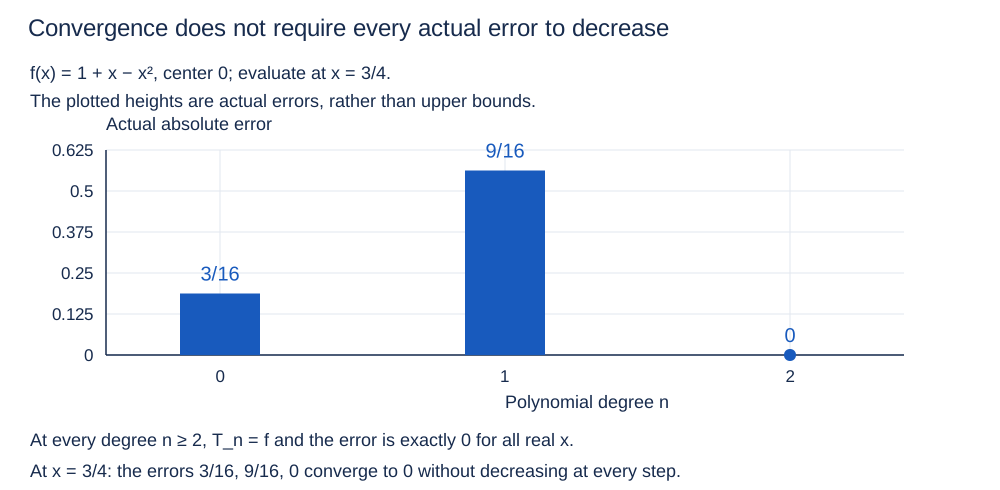
Inspect diagram labels
The diagram keeps its full size here. Focus the view and use the arrow keys, or scroll across it, to inspect every label.
Return to the unit problem →Try this problem in its lesson →
Define a power series and account for every zero coefficient
Work with expansions about the stated center c=−1. Let P(x)=2−√2(x+1)²+Σ_(k=3)^∞ [((−1)^k)/(k+1)](x+1)^(2k). For classification, consider B(x)=Σ_(n=0)^∞ (x+1)^(n+1/2)/2^n, C(x)=Σ_(n=1)^∞ 3^(−n)(x+1)^(−n), and D(x)=Σ_(n=0)^∞ cos(n)(x+1)^n.
Part a
State the general definition of a real-coefficient power series centered at an arbitrary real number c. Specify the allowed index and powers, the nature of the coefficient sequence, and what must remain independent of x. Explain how a series starting at n=1 and a finite polynomial fit the definition.
The form is Σ_(n=0)^∞ a_n(x−c)^n, with c real, n a nonnegative integer, and fixed real coefficients a_n independent of x. A missing constant means a₀=0; a polynomial has all sufficiently high coefficients zero.
- Choose a fixed real center c and a real coefficient sequence (a_n). Each term is a_n times the nonnegative integer power (x−c)^n.
- The coefficients may be negative, irrational or zero, but cannot vary with x in this defining form. The index starts at 0 and includes the constant a₀.
- A display starting at n=1 has the same form by setting a₀=0. A polynomial is included by setting every coefficient above its degree to zero.
Scoring criteria
- Writes the complete summation form and specifies a real fixed center.
- States nonnegative integer powers and fixed real coefficients independent of x.
- Explains the missing constant and finite-polynomial cases using zero coefficients.
Part b
Rewrite P(x)=2−√2(x+1)²+Σ_(k=3)^∞ [((−1)^k)/(k+1)](x+1)^(2k) as Σ_(n=0)^∞ a_n(x−c)^n. Identify c; list a₀ through a₈, including every zero; and give a rule for all later coefficients. Explain why √2 and the missing powers cause no problem for the definition.
c=−1. The coefficients a₀,…,a₈ are 2,0,−√2,0,0,0,−1/4,0,1/5. In general a_(2k)=(−1)^k/(k+1) for k≥3, with a₀=2,a₂=−√2 and all other coefficients zero.
- Use x+1=x−(−1), so c=−1. The separate constant and quadratic terms give a₀=2 and a₂=−√2.
- The first tail exponent is 2·3=6 with coefficient (−1)³/4=−1/4; exponent 8 has coefficient (−1)⁴/5=1/5. Exponent 4 is absent because the tail starts at k=3.
- All odd exponents are absent, so their coefficients are zero. List every position from 0 to 8: 2,0,−√2,0,0,0,−1/4,0,1/5.
- For each integer k≥3, set a_(2k)=(−1)^k/(k+1). Set all indices not covered by that rule or the two separate terms to zero. Irrational coefficients such as −√2 are real and allowed.
Scoring criteria
- Identifies the shifted center and constant/quadratic coefficients.
- Lists all nine coefficients in exponent-index order without compressing missing powers.
- Gives the complete even-tail rule and zeros elsewhere.
- Explains that fixed irrational real coefficients and zero coefficients satisfy the definition.
Part c
Classify B(x)=Σ_(n=0)^∞ (x+1)^(n+1/2)/2^n, C(x)=Σ_(n=1)^∞ 3^(−n)(x+1)^(−n), and D(x)=Σ_(n=0)^∞ cos(n)(x+1)^n as displayed power-series expansions at center −1, or as expressions that fail this definition. Give the specific reason in each case. Do not infer that a function can never have some different local expansion.
B fails because its exponents are half-integers. C fails because its exponents are negative. D is a power series at −1: cos(n) is a fixed real coefficient and n is a nonnegative integer.
- For B the exponents n+1/2 are not integers, even though its coefficients 2^(−n) are real. It is not the stated power-series form about −1.
- For C the exponents −n are negative for every n≥1. Its display is Laurent-type rather than a series of nonnegative powers at −1.
- For D, the coefficient at index n is the real number cos(n), independent of x. The exponent is n≥0 and the base is x+1, so it satisfies the power-series definition.
- The conclusions classify these displayed expansions at the specified center. They do not rule out some other valid expansion about a different center.
Scoring criteria
- Rejects B for fractional exponents and C for negative exponents.
- Accepts D with correct center and fixed real coefficient reasoning.
- Keeps the conclusion scoped to the displayed expansions.
Part d
Evaluate P at its center c=−1 by separating its constant term. Explain why the center value is neither zero nor an undefined 0⁰ computation.
P(−1)=2. The n=0 term is the constant 2; every positive-power term vanishes.
- At x=−1, the base x+1 is zero, so the quadratic and every tail term vanish.
- The n=0 term was the constant a₀=2 before substitution. It is evaluated as a constant polynomial, not by introducing an indeterminate 0⁰ expression.
- The partial sums at the center are all 2, so the series converges there to 2.
Scoring criteria
- Retains a₀=2 and removes only positive-power terms.
- Explains the constant-polynomial interpretation and center convergence.
Return to the unit problem →Try this problem in its lesson →
Decide center-only convergence and compare complete convergence sets
All three expressions are centered at c=2: F(x)=7+Σ_(n=1)^∞ n!(x−2)^n; G(x)=−3+Σ_(n=1)^∞ ((x−2)/2)^n; H(x)=4−(x−2)². A radius is nonnegative; R=∞ means convergence for every real input.
Part a
For F(x)=7+Σ_(n=1)^∞ n!(x−2)^n, first evaluate the series at x=2. Then, for any fixed x≠2, compute the ratio of consecutive tail-term magnitudes and use it to establish divergence. State the radius and complete convergence set, and explain why a ratio calculation dividing by zero must not be used at the center.
F(2)=7. For x≠2, |u_(n+1)/u_n|=(n+1)|x−2|→∞, so the tail terms fail to approach zero. Thus R=0 and the convergence set is {2}. The center must be evaluated directly.
- At x=2, every positive-power term is zero and the separate constant 7 remains. Every partial sum equals 7.
- For fixed x≠2, u_n=n!(x−2)^n is nonzero and |u_(n+1)/u_n|=((n+1)!/n!)|x−2|=(n+1)|x−2|.
- This ratio eventually exceeds 2, so the nonzero term magnitudes eventually grow at least geometrically and cannot tend to zero. The series diverges by the necessary term condition (or the ratio test).
- Only x=2 converges, giving radius 0 and set {2}. At the center, the ratio of zero tail terms is undefined; the direct constant-term evaluation supplies the valid conclusion.
Scoring criteria
- Evaluates the center as 7 with the constant retained.
- Calculates the ratio for fixed noncenter x and connects its growth to nonzero-term divergence.
- States R=0 and precisely the set {2}.
- Treats the center separately rather than applying an undefined 0/0 ratio.
Part b
For G(x)=−3+Σ_(n=1)^∞ ((x−2)/2)^n, determine the radius and open convergence interval. Test both finite boundary points using the original terms, give the complete interval, and evaluate G at the center.
R=2, open and complete interval (0,4). At x=0 and x=4 the terms do not approach zero, so neither endpoint is included. G(2)=−3.
- The tail is geometric with ratio q=(x−2)/2. It converges for |q|<1, equivalent to |x−2|<2 or 0<x<4. Thus R=2.
- At x=0, q=−1 and the tail terms are (−1)^n. At x=4, q=1 and the terms are 1. Neither sequence tends to zero, so both endpoint series diverge.
- Adding the constant −3 does not change convergence of a tail. The complete interval is (0,4). At x=2 the tail is zero, so the center sum is −3.
Scoring criteria
- Derives the radius and open interval from the geometric ratio.
- Substitutes and validly tests each endpoint; does not include them from an inconclusive equality.
- States the complete interval and the correct nonzero constant at the center.
Part c
For the same centered expressions F,G,H, write H as an infinite power series by giving its coefficient sequence. Determine H’s radius and convergence set. Draw three complete convergence number lines for F,G,H on a common scale, labeling center 2, all finite endpoints and their inclusion or exclusion. Use these examples to explain the center-only, finite-interval and all-real-number alternatives.
H has a₀=4,a₂=−1 and all other coefficients zero; R=∞ and set ℝ. F has only the included point 2. G has hollow endpoints 0 and 4 with the interval between them included. H includes all real x, shown with arrows in both directions.
- The finite polynomial H has coefficients 4,0,−1,0,0,… in powers of x−2. Every input gives a finite value, so the radius is infinite.
- For F, draw a single filled point at 2 and no positive-length included interval. For G, draw the included segment between 0 and 4 with hollow endpoint circles. For H, show all x values included with a line extending by arrows in both directions.
- The separate completed diagram uses a common labeled real-number scale and states each radius and center value. It distinguishes the radius distance from the convergence set.
- A power series always converges at its center to the constant coefficient. It can have only that point, a positive interval around the center (with boundary decisions), or the entire real line. These three actual series exemplify those cases.
Scoring criteria
- Gives H’s full coefficient rule and radius ∞.
- Draws the single included center for F, the fully specified open interval for G, and all-real convergence for H.
- Labels a common scale, center and finite endpoints, with unambiguous endpoint conventions.
- Explains all three alternatives while retaining center convergence.
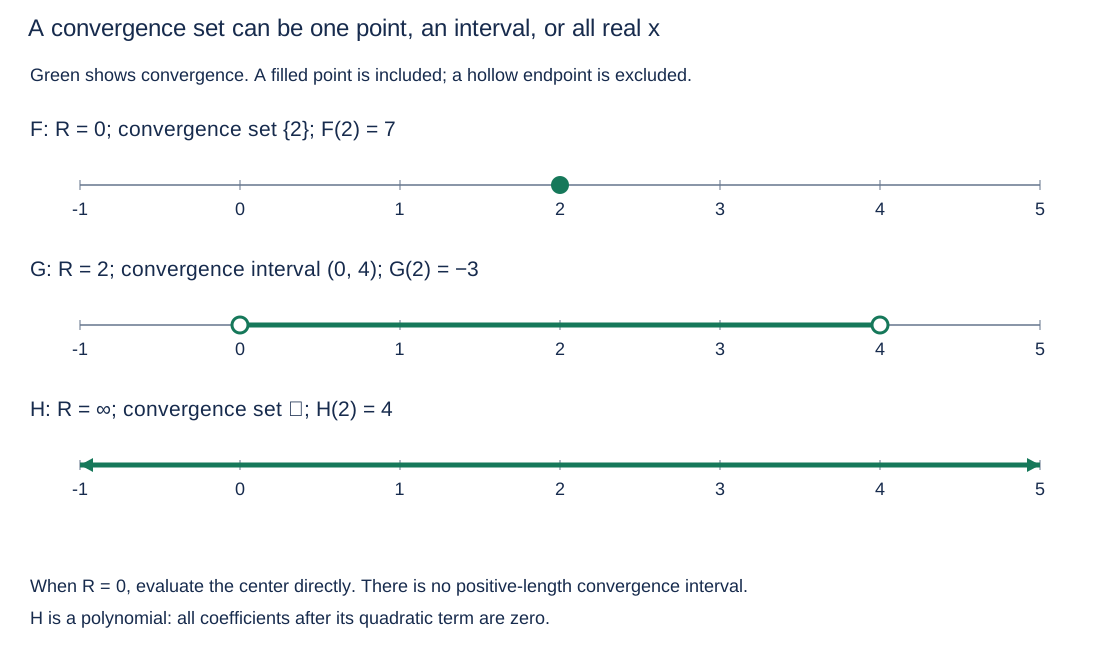
Inspect diagram labels
The diagram keeps its full size here. Focus the view and use the arrow keys, or scroll across it, to inspect every label.
Return to the unit problem →Try this problem in its lesson →
What does a decreasing bound actually establish?
A proof establishes |e^x−T_n(x)|≤3/(n+1)! for every x in [−1,1]. The bound tends to zero as n increases.
Part a
Given the bound |e^x−T_n(x)|≤3/(n+1)! throughout [−1,1], which conclusion necessarily follows as the degree increases?
T_n approaches e^x throughout [−1,1]; this bound alone does not establish monotone actual errors or convergence outside that interval.
- For any positive tolerance, the factorial bound eventually falls below it for every x in [−1,1] at once. This proves interval-wide convergence, while a bound does not compare successive actual errors and has only the stated domain.
Scoring criteria
- Selects interval-wide convergence on [−1,1] from the common vanishing factorial bound.
- Rejects both strict monotone actual-error inference and extension of this numerical bound outside the stated interval.
Return to the unit problem →Try this problem in its lesson →
A radius-zero series still includes its constant term
Consider F(x)=7+Σ_(n=1)^∞ n!(x−2)^n. For each fixed x≠2 its tail-term magnitudes eventually grow.
Part a
For F(x)=7+Σ_(n=1)^∞ n!(x−2)^n, which radius, convergence set and center value are correct?
R=0, the convergence set is {2}, and F(2)=7 because the constant survives.
- At the center, F(2)=7 directly. Away from the center, the magnitude ratio (n+1)|x−2| tends to infinity and the terms fail to approach zero. Therefore the radius is 0 and the only convergence point is 2.
Scoring criteria
- Selects R=0 with precisely the included center {2}.
- Retains the center constant 7 and evaluates the center directly instead of using the undefined tail ratio.
Return to the unit problem →Try this problem in its lesson →
Integration changes endpoints without changing radius
Let F(x)=Σₙ₌₁^∞ (x+1)ⁿ/(n3ⁿ). For −4<x<2 define G(x)=∫₋₁ˣ F(t)dt. Use termwise operations only where the power-series theorem applies; determine endpoint convergence from the actual endpoint series.
Part a
Determine the center, radius, and interval of convergence of F. Show the ratio limit and both endpoint tests rather than treating a ratio-test limit of 1 as a decision.
Center −1, radius 3, interval [−4,2). The ratio limit is |x+1|/3. At −4 the alternating harmonic series converges conditionally; at 2 the harmonic series diverges.
- For x≠−1, the absolute term ratio is |x+1|n/[3(n+1)], tending to |x+1|/3; the center converges directly.
- Solve |x+1|<3 and substitute x=−4 and x=2 separately.
- Use decreasing 1/n→0 for the alternating left endpoint and harmonic divergence for the right.
Scoring criteria
- Correct center −1, radius 3, and strict open interval.
- Both actual endpoint series and valid convergence/divergence tests.
- Full interval [−4,2), with the left conditional distinction.
Part b
Integrate term by term from −1 to x to construct the complete infinite series for G, including its constant value at the center. Determine its radius and explicitly compare it with F’s radius. Give either a new ratio-limit calculation or the radius-preservation theorem with its interior validity condition.
G(x)=Σₙ₌₁^∞ (x+1)^(n+1)/(n(n+1)3ⁿ), with G(−1)=0. Its radius is 3, exactly equal to F’s. The integrated ratio tends to |x+1|/3; termwise integration is justified inside |x+1|<3.
- Integrate each power with respect to t, divide by n+1, and evaluate the lower endpoint t=−1.
- The integrated successive-term ratio is |x+1|n/[3(n+2)], with unchanged limit |x+1|/3.
- State RG=RF=3 and distinguish an interior operation from endpoint tests.
Scoring criteria
- Complete infinite integrated series with the n(n+1) denominator and center value zero.
- Explicit equality of original and integrated radii, both 3.
- Correct theorem hypothesis or integrated ratio calculation; no endpoint assumption from termwise integration.
Part c
Test both endpoints of G’s series and give its full interval. On a common number line, draw the complete F and G intervals with labeled center, radius, and open or filled endpoints. Explain why adding x=2 to G’s interval does not give a radius larger than F’s.
At −4, G’s terms are 3(−1)^(n+1)/(n(n+1)); at 2, they are 3/(n(n+1)). Both converge absolutely, so G’s interval is [−4,2]. Draw F with filled −4/open 2, and G with both filled; mark center −1 and radius 3 in both. Adding a boundary point changes endpoint inclusion, not the distance from center to the convergence boundary.
- Substitute each endpoint into the integrated terms, retaining the extra factor 3 and the n(n+1) denominator.
- Compare absolute magnitudes with 3/n² to establish both endpoint decisions.
- Use the shared center and unchanged strict inequality |x+1|<3 to label radius 3; use separate circles for inclusion.
Scoring criteria
- Both correct endpoint series and absolute convergence justification.
- Correct full G interval and completed F/G number-line representation.
- Explicitly distinguishes endpoint inclusion from radius.
Part d
Differentiate F term by term to find its derivative series, then test its endpoints. Compare the radii of F, F′, and G, explaining what differentiation and integration preserve and what each operation requires you to retest. Extend your number-line comparison to include F′.
F′(x)=Σₙ₌₁^∞ (x+1)^(n−1)/3ⁿ, with radius 3 and interval (−4,2). At either endpoint the derivative term magnitude is 1/3, so neither converges. F, F′, and G all have radius 3. Differentiation and integration preserve radius but not endpoint inclusion; each new endpoint series must be tested. Draw F′ with both endpoints open on the same scale.
- Differentiate the power; the numerator’s factor n cancels the original 1/n.
- At x=−4 and x=2, every derivative term has magnitude 1/3 and therefore fails the necessary zero-term condition.
- Compare all three radii explicitly and use the actual endpoint outcomes to explain the distinction.
Scoring criteria
- Correct derivative series and endpoint divergence from nonzero term magnitude.
- Explicit equality RF=RF′=RG=3 for both operations.
- Complete three-row comparison and correct explanation of radius versus separately tested endpoints.
![Three aligned solution intervals share center −1 and radius 3. F includes −4 but excludes 2, with interval [−4,2). F′ excludes both endpoints, giving (−4,2). G includes both endpoints, giving [−4,2]. Filled and open circles show endpoint convergence; each row labels radius 3.](/calculus/strengthening/bc/u10-b-integration-solution.svg)
Inspect diagram labels
The diagram keeps its full size here. Focus the view and use the arrow keys, or scroll across it, to inspect every label.
Return to the unit problem →Try this problem in its lesson →
An included endpoint does not enlarge the radius
For |x|<1, the geometric series F(x)=Σₙ₌₀^∞ xⁿ has radius 1. Integrating from 0 to x gives H(x)=Σₙ₌₀^∞ x^(n+1)/(n+1). A student claims that including a new endpoint must enlarge the radius.
Part a
Choose the correct radius and endpoint conclusion for H, and explain the relevant endpoint tests.
H still has radius 1, converges at −1, and diverges at 1; its interval is [−1,1). Integration preserves radius. At −1 the series is alternating harmonic; at 1 it is harmonic.
- Apply integration’s radius-preservation rule to keep R=1.
- Substitute −1 and +1 into the new series; use alternating convergence and harmonic divergence.
- A closed circle at one boundary changes inclusion, not the radius.
Scoring criteria
- Selects unchanged radius 1 and interval [−1,1).
- Explains both endpoint outcomes using the new terms.
Return to the unit problem →Try this problem in its lesson →
Write the geometric foundation before substitution
Construct a Maclaurin series for f(x)=1/(3+x²). Use the exact geometric foundation, not an already-substituted series. The rational function itself is defined for all real x.
Part a
Write explicitly the Maclaurin identity for 1/(1−u), identify its first term and common ratio, and derive it from the finite sum through uᴺ. State its representation domain and test u=−1 and u=1.
1/(1−u)=Σₙ₌₀^∞ uⁿ=1+u+u²+⋯ for |u|<1, with first term 1 and common ratio u. The finite sum is (1−u^(N+1))/(1−u); its remainder u^(N+1)/(1−u) tends to zero for |u|<1. At u=±1, the terms do not tend to zero, so both endpoints are excluded.
- Multiply the finite sum by 1−u to cancel consecutive powers.
- Solve for the finite sum and take N→∞ under |u|<1.
- At each endpoint apply the necessary zero-term condition rather than interpreting a finite rational value as convergence.
Scoring criteria
- Exact foundation identity including Σ index from 0 and powers uⁿ.
- Correct first term, ratio, finite-sum derivation, and limiting remainder condition.
- Domain |u|<1 with both endpoint exclusions justified.
Part b
Use that identity to construct the complete infinite series for f, state its radius and interval, and test both endpoints. Evaluate the statement “f(2) exists, so its Maclaurin series must converge at 2.”
Substitute u=−x²/3 and multiply by 1/3 to obtain f(x)=Σₙ₌₀^∞ (−1)ⁿx^(2n)/3^(n+1). The radius is √3 and interval (−√3,√3). At either endpoint the terms (−1)ⁿ/3 do not tend to zero. At x=2 the ratio is −4/3, so the series diverges despite f(2)=1/7.
- Rewrite f(x) as (1/3)/(1−(−x²/3)); substitute into every power.
- Solve |−x²/3|<1 and test the two boundary values.
- Compare the function’s domain with this particular series’s convergence interval using x=2.
Scoring criteria
- Complete infinite series with correct powers, signs, coefficient factor, and index.
- Radius √3 and both endpoint exclusions from actual terms.
- Rejects the domain-implies-series claim using the x=2 term or ratio behavior.
Part c
At x=1/2, use the first three nonzero terms to approximate f. Give a guaranteed alternating error bound and compare it with the exact error using f(1/2)=4/13. Explain why the finite polynomial is not the infinite series.
P₄=1/3−x²/9+x⁴/27 gives P₄(1/2)=133/432≈0.307870370. The next magnitude is 1/5184, so the error is at most 1/5184. The exact error is 1/5616, smaller than that bound. P₄ is a three-term partial sum; omitted nonzero terms remain, so it is an approximation to f here.
- At x=1/2 the successive magnitude ratio is 1/12, validating decrease to zero.
- Compute the three-term value and next omitted x⁶/81 magnitude.
- Subtract 4/13 to check the actual error; distinguish a guaranteed tail bound from an observed difference.
Scoring criteria
- Correct 133/432 approximation and first-omitted-term bound 1/5184.
- Valid alternating hypotheses and exact error 1/5616.
- Explicit polynomial/partial-sum distinction and approximation interpretation.
Return to the unit problem →Try this problem in its lesson →
Construct a new series from sine
Let S(x)=sin(3x)/x for x≠0 and define S(0)=3. Angles are in radians. Use the sine Maclaurin foundation and ordinary series operations to construct a new infinite series. A supplied independent check is S(1/6)≈2.876553232.
Part a
Write the sine foundation explicitly and use it to construct a complete indexed infinite Maclaurin series for S, not merely a finite polynomial. Give its first four nonzero terms, radius, representation interval, and explanation of the value at zero.
sin u=Σₙ₌₀^∞ (−1)ⁿu^(2n+1)/(2n+1)! for all real u. Therefore S(x)=Σₙ₌₀^∞ (−1)ⁿ3^(2n+1)x^(2n)/(2n+1)!=3−(9/2)x²+(81/40)x⁴−(243/560)x⁶+⋯. Its radius is infinite and it represents the extended S for all real x. At zero its constant term is 3, agreeing with the quotient’s limit and the supplied extension.
- Substitute u=3x into the entire indexed power, then divide by x for x≠0.
- Compute terms n=0,1,2,3 and note that division leaves nonnegative even powers.
- At x=0 only the constant term remains. Equality elsewhere follows from the sine foundation, and the extension makes the identity valid at zero.
Scoring criteria
- Explicit sine foundation and complete infinite general term with correct powers, scaling, sign, and factorial.
- Four correct nonzero terms.
- Infinite radius/all-real representation, with the removable-point explanation.
Part b
Use the first three nonzero terms to estimate S(1/6). Verify the alternating magnitude condition, give a guaranteed error bound, and compare the bound with the observed difference from the supplied check. State whether the partial sum is above or below S(1/6).
P₄(1/6)=1841/640=2.8765625, with error at most 1/107520≈0.0000093006. The observed difference is about 0.0000092680, below the bound. Successive magnitudes have ratio 9x²/((2n+2)(2n+3)), at most 1/24 at x=1/6, so they decrease to zero. The next signed term is negative, so P₄ is an upper estimate.
- Evaluate 3−(9/2)x²+(81/40)x⁴ at x=1/6.
- Use the first omitted nonzero term 243x⁶/560, with a justified alternating tail.
- Compare the supplied numerical check with the theorem’s guarantee and use the sign of the next term.
Scoring criteria
- Correct 1841/640 estimate and 1/107520 bound.
- Valid decreasing-to-zero argument and observed-error comparison.
- Correct upper-estimate conclusion and finite/infinite distinction.
Part c
Explain why multiplying the original sine-series coefficients by only 3 gives the wrong construction for sin(3x), and why dividing sin(3x) by x does not force a negative-power term here. Use the general term and the zero-value extension in your explanation.
The substitution produces (3x)^(2n+1)=3^(2n+1)x^(2n+1), so the scale depends on n; it is not simply 3 in every coefficient. Sine has no constant term and its lowest power is x, so division by x leaves x^(2n), starting at x⁰. The resulting constant 3 equals the continuous extension at zero; no negative power is needed.
- Track the substituted variable inside each indexed power.
- Identify the smallest original power before dividing.
- Connect the remaining n=0 term with the function’s defined center value.
Scoring criteria
- Explains the indexed power of 3 rather than a uniform scaling mistake.
- Uses the sine series’s missing constant to justify nonnegative powers after division.
- Connects the constructed constant term to S(0)=3.
Return to the unit problem →Try this problem in its lesson →
Construct an integral series from the exponential foundation
Let W(x)=∫₀ˣ e^(−2t²)dt. Use the exponential Maclaurin foundation to represent W with a complete infinite series. For a numerical check at x=1/2, a calculator’s integral is approximately 0.427812196. The task does not require an elementary antiderivative.
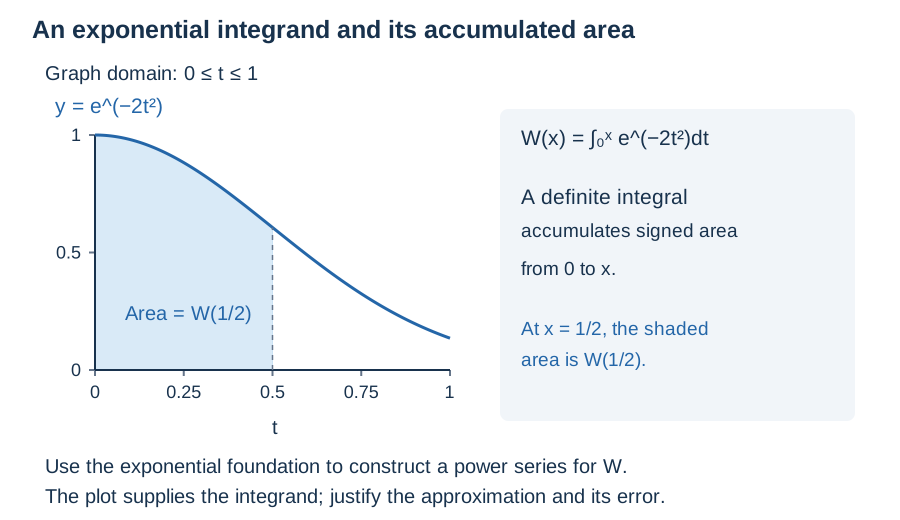
Inspect diagram labels
The diagram keeps its full size here. Focus the view and use the arrow keys, or scroll across it, to inspect every label.
Part a
Write the exponential foundation explicitly, substitute −2t², and integrate term by term to construct the complete infinite Maclaurin series for W. Give the first four nonzero terms, fix the constant using W(0), and justify its all-real representation interval.
eᵘ=Σₙ₌₀^∞ uⁿ/n! for every real u. Substitute −2t² and integrate to get W(x)=Σₙ₌₀^∞ (−1)ⁿ2ⁿx^(2n+1)/(n!(2n+1))=x−(2/3)x³+(2/5)x⁵−(4/21)x⁷+⋯. W(0)=0 fixes the constant. The substituted exponential series has infinite radius, and termwise integration is valid on every finite interval from 0 to x, so the series represents W for all real x.
- Apply −2t² to every exponential indexed power while retaining n!, including its factor 2ⁿ.
- Integrate each term from 0 to x, introducing the factor 2n+1 in the denominator.
- Use the definite lower endpoint and the infinite-radius theorem to justify the constant and representation, not just formal coefficient matching.
Scoring criteria
- Explicit exponential foundation and correct full infinite general term.
- Four correct nonzero terms and W(0)=0.
- Justified all-real interval from the foundation and termwise integration on every finite interval.
Part b
Estimate W(1/2) using the first three nonzero terms. Justify an alternating error bound, compare it with the supplied independent integral, and state whether the partial sum is an upper or lower estimate.
P₅(1/2)=103/240≈0.429166667. The next omitted magnitude is 1/672≈0.001488095. At x=1/2 the successive magnitude ratio is 2x²(2n+1)/((n+1)(2n+3))<1 and tends to zero, so the terms decrease to zero and the alternating bound applies. The observed difference is about 0.001354471, inside the bound. The next signed term is negative, so P₅ is an upper estimate.
- Evaluate x−(2/3)x³+(2/5)x⁵ at 1/2.
- Use (4/21)|x|⁷ as the first omitted nonzero magnitude and verify decrease to zero.
- Compare actual numerical difference with the guarantee; identify the next term’s sign.
Scoring criteria
- Correct 103/240 approximation and 1/672 bound.
- Valid alternating magnitude argument.
- Observed-error comparison and correct upper-estimate conclusion.
Part c
Differentiate your infinite series to check that it recovers e^(−2x²), and explain why W is increasing and odd. Use the supplied integrand graph to interpret W(1/2) as an area, and distinguish that area from the polynomial approximation in part b.
Termwise differentiation cancels each 2n+1 factor, giving Σₙ₌₀^∞ (−1)ⁿ2ⁿx^(2n)/n!=e^(−2x²). The derivative is positive, so W is increasing. The integrand is even and the lower endpoint is 0, so W(−x)=−W(x); this agrees with the constructed odd powers. W(1/2) is the exact area under e^(−2t²) from 0 to 1/2, while 103/240 approximates that area with a bounded unseen series tail.
- Differentiate each general term and recover the substituted exponential identity.
- Use positivity of the derivative and symmetry of the definite integral or odd series powers.
- Read the shaded integrand region as the represented integral, keeping approximate equality for the truncated polynomial.
Scoring criteria
- Correct derivative check and equality to the exponential integrand.
- Correct increasing/odd reasoning tied to the construction.
- Correct exact-area versus approximate-polynomial interpretation.
Return to the unit problem →Try this problem in its lesson →