Chemical Equations
Supporting original reading. Follow the AP topic pathway for reviewed scope, worked reasoning and targeted practice.
Chemistry I · original Chapter 2 · combined Chapter 2
Section 2
Chemical Equations
Everything around us involves chemical reactions, and a chemical equation is a way of writing what exactly is taking place. This process can go from a very simple equation to very long and complex equations involving more complicated compounds like those found in biological processes.
Very similar to a mathematical equation, a chemical equation takes the form of x + y → xy. The species to the left of the arrow are called the reactants and result in the product(s) to the right of the equal sign. In the above example we have a combination reaction, where reacting x with y yields an “xy” compound, the product.
Now let us take this and apply it to the real world, the formation of water. We already know the chemical formula for a water molecule is H2O. How would this be achieved through a reaction?
H + O → H2O
This seems to make sense at first, but there are two problems.
- The water molecule is made of 2 hydrogen atoms. Yet on the
reactant side, there is only 1 hydrogen atom. - Both hydrogen and oxygen are diatomic (Chapter 1). They do not exist in nature as a single atom.
To fix both these problems, we will make a balanced equation. 1) consists of adding coefficients in front of both reactants and/or products as necessary to make both sides equal, so we will first address 2) as we know we have to make both reactants diatomic:
H2 + O2 → H2O
Now all reactants and products are written as they would exist in nature, but numerically, problem 1 still exists. There are now 2 oxygen atoms on the reactant side where only 1 exists on the product side (water molecule). We can quickly solve this by adding
coefficients:
H2 + O2 → 2H2O
2H2 + O2 → 2H2O
Notice we took two steps here:
- We multiplied the water molecule by a coefficient of 2 so we would have equal number of oxygen atoms on both sides. But this resulted in an imbalance of hydrogen atoms.
- A coefficient of 2 was added to the hydrogen on the reactant side to solve the imbalance from the last step.
The result is a perfectly balanced equation. All atoms are written as they would exist in nature and there are equal number of each atom on both sides (4 hydrogens + 2 oxygens = 4 hydrogens + 2 oxygens).
This is done to obey the Law of Conversation of Mass - mass cannot be created or destroyed.
We will later on cover the different types of reactions that can be encountered, but a very common type is called a double replacement reaction. In this reaction, two compounds exchange their cations (positively charged ion; by convention, usually the first species written in a compound). They essentially trade elements, which is why it is called a double replacement.
AB + CD → AD + CB
A and C are the cations, B and D are the anions
In strong-acid/strong-base neutralization, hydronium and hydroxide react to form water. The spectator ions remain in solution, and the resulting dissolved salt can be a strong electrolyte. Neutralization involving a weak acid or base requires the corresponding reaction and equilibrium model; it does not mean every product is a weak electrolyte.
H2SO4(aq) + Ba(OH)2(s) → BaSO4(s) + HOH(l)
The equation might look difficult at first, but we only have to split it into parts and investigate what is happening:
H2SO4(aq) + Ba(OH)2(s) → BaSO4(s) + HOH(l)
Before balancing and taking into account coefficients and subscripts, you will see the cations, hydrogen (H) and barium (Ba) switched their corresponding anions, sulfate (SO4) and hydroxide (OH). Therefore, we confirm it is a double replacement.
If we now take inventory, we will see that both the Ba and SO4 are equal on both sides, but the H and OH are not. This is easily corrected by adding a coefficient in front of HOH:
H2SO4(aq) + Ba(OH)2(s) → BaSO4(s) + 2HOH(l)
HOH simplifies reactions involving acids and bases, but is just
another way of writing water (H2O).
Perhaps what happens in the above example is a bit difficult to visualize, so here is an image that represents the reaction going to products.
Example Problem 2.2.1
Balance the equation: C2H4 + O2 → CO2 + H2O
This is the combustion (reaction of a hydrocarbon with oxygen) of ethylene. To balance the equation, we have to have equal numbers of C, H, and O on both sides. The best way to decide which element to start balancing first is to look at what is present only once on both sides. In this case, it’s either carbon or Hydrogen (Oxygen is present in both CO2 and H2O). Let’s choose Carbon first.
C2H4 + O2 → 2CO2 + H2O
Balance the Carbon (C) by multiplying Carbon Dioxide (CO2) by a coefficient of 2. When balancing reactions, it is generally a good idea to balance elements that only appear once on each side, in this case Carbon
C2H4 + 3O2 → 2CO2 + 2H2O
Balance the Oxygen (O) by analyzing the product side. Since we have 5 oxygen atoms (an odd number), we will add a coefficient of 2 to Water (H2O) to achieve an even number of 6 Oxygen atoms on the product side. We can now easily balance the reactant Oxygen by multiplying by a coefficient of 3 to achieve the same 6 atoms. This step also ended up balancing the Hydrogen (H) so our balanced equation is:
C2H4 + 3O2 → 2CO2 + 2H2O
Interactive 2.2.1 Double replacement reaction
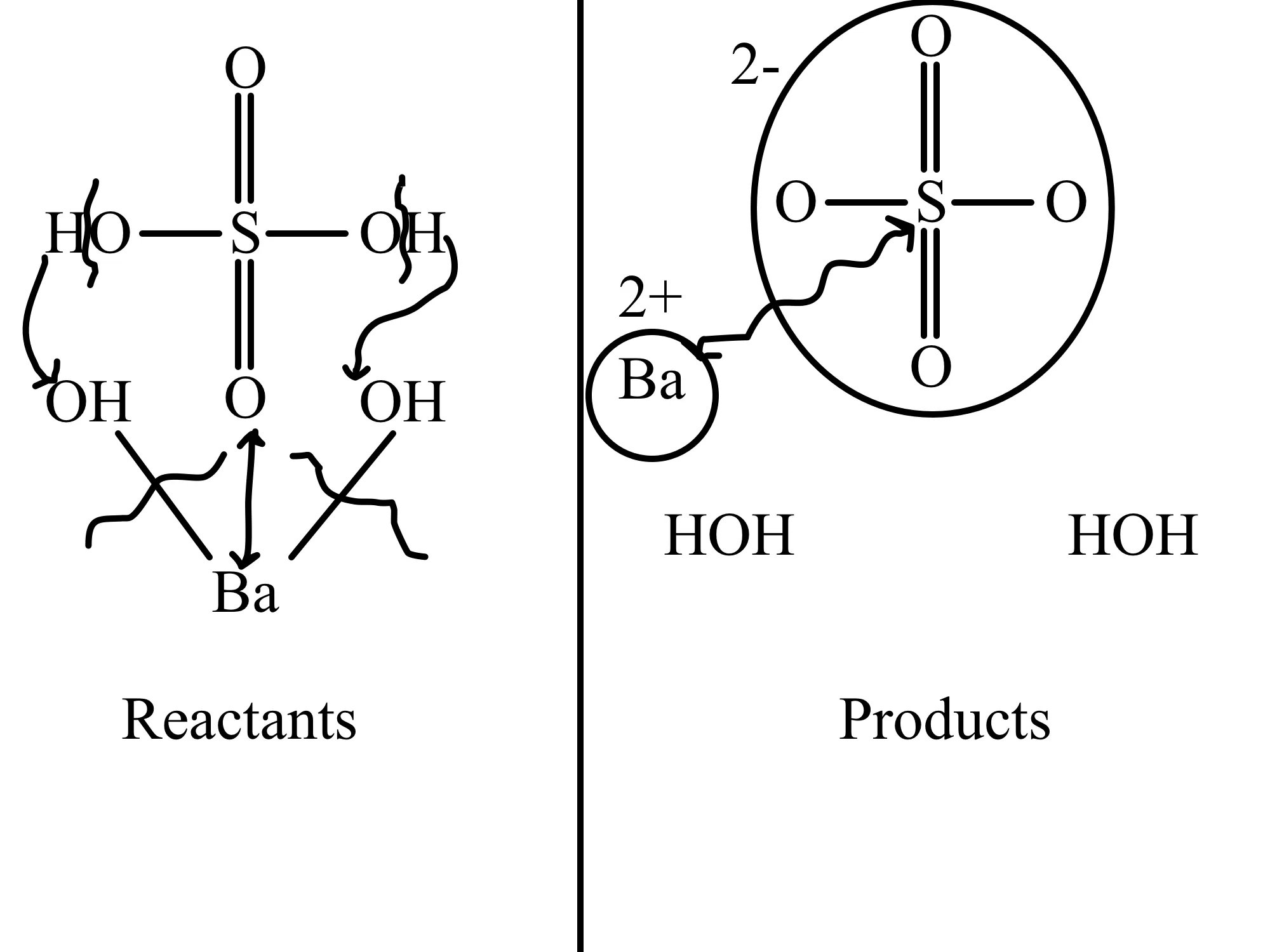
Read all reviewed figure notes
Bonds Break
The squiggly lines show which bonds break. The straight lines show which bonds exist between the compounds. Ba(OH)2 has two hydroxide ions bonded to the Barium, and H2SO4 has two hydrogen ions bonded to the Sulfate (which is a polyatomic ion)
New bonds form
In this reaction, H⁺ and OH⁻ form water, while Ba²⁺ and SO₄²⁻ form the sparingly soluble solid BaSO₄. The barium and sulfate ions are not too large to attract one another, and they are not merely spectators. Precipitation creates an ionic solid. In a net ionic description, write Ba²⁺(aq) + SO₄²⁻(aq) → BaSO₄(s), together with the neutralization step appropriate to the stated acid and base.
Glossary and deeper reading · 5 refreshers
These editorial refreshers supplement the reading. Definitions and examples are added guidance; original source wording and recorded answers remain in their original context.
-
Cation
A cation is a positively charged ion. Its total positive nuclear charge exceeds its total electron charge. For example, calcium commonly forms a cation with charge +2 by losing two electrons.
-
Ion
An ion is an atom or group of atoms with a net electric charge. Ordinary ion formation changes electron count without changing the element's proton count. For example, a sodium atom losing one electron becomes a sodium ion with charge +1.
-
Anion
An anion is a negatively charged ion. It has more electrons than needed to balance its positive nuclear charge. For example, a chlorine atom gaining one electron forms a chloride anion.
-
Hydronium
Hydronium is the H₃O⁺ ion used in the introductory model of proton behavior in water. Aqueous H⁺ notation is shorthand for a solvated proton rather than a bare proton moving independently in the liquid. For example, a Brønsted acid can transfer a proton to water and form hydronium.
-
Spectator ion
A spectator ion appears unchanged on both sides of the complete ionic equation. It is omitted from the net ionic equation because it does not undergo the represented reaction. For example, sodium ions can be spectators when two other dissolved ions form a precipitate.