The Mole
Supporting original reading. Follow the AP topic pathway for reviewed scope, worked reasoning and targeted practice.
Chemistry I · original Chapter 2 · combined Chapter 2
Section 1
The Mole
The mole is a unit of measurement used in both chemistry and physics. It represents a numerical quantity and is based on Avogadro’s Number, named after Amedeo Avogadro. It is a constant 6.02 x 10²³. The following relationship will better clarify what it means:
1 dozen = 12, 1 mole = 6.02 x 10²³
The idea behind these two terms is basically the same. You could say you have one dozen eggs, meaning you have 12 eggs, and the same way you could say that you have one mole of eggs meaning you have 6.02 x 10²³ eggs.
x 10 n notation is referred to as scientific notation. It is used to compactly write very large numbers. Avogadro’s Number is actually 602 followed by 21 zeros - a very large number.
The atomic mass listed for carbon, about 12.01 u, is an abundance-weighted average over naturally occurring isotopes. It is not the exact mass of every individual carbon atom. A carbon-12 atom has mass 12 u by definition. For an ordinary sample of carbon with the tabulated isotopic composition, we can use a molar mass of about 12.01 g mol⁻¹ in our sample calculations.
Using the mole offers a very useful relationship that will help us to better understand weights and amounts of elements and compounds:
1 mol C = 6.02 x 10²³ C atoms = 12.01 g
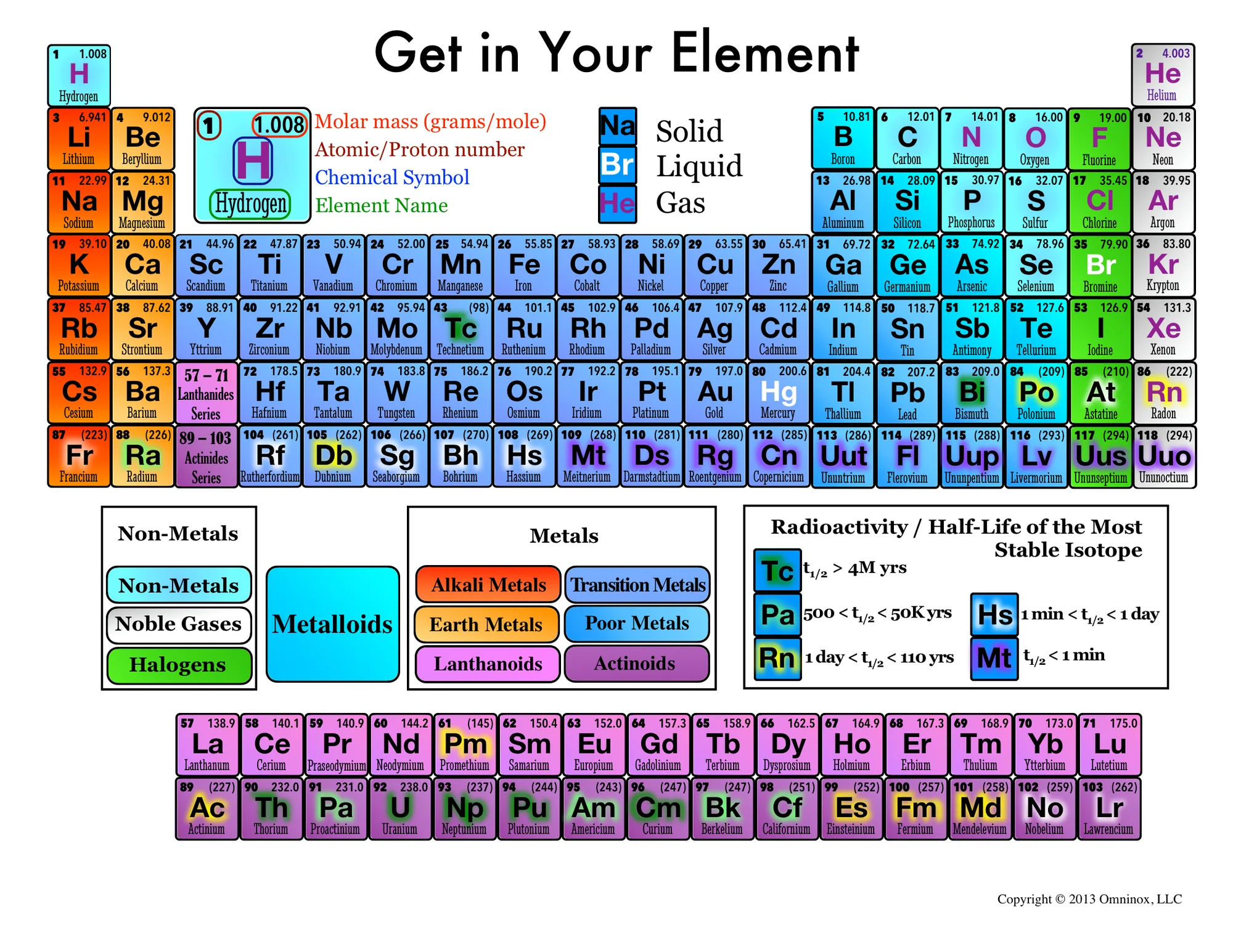
 Look at the image on the left carefully - the number on the top right demonstrates the relative weight of the element, but can carry two different units: amus (atomic mass units) or atomic weight (grams per mole). Meaning, one mole of carbon (6.02 x 10²³ atoms) weighs 12.01 grams. How much do you think one mole of Carbon Dioxide (CO2) weighs?
This relationship applies to all elements in the periodic table, because it provides easier measurement.
Similarly, molarity (M) is a measure of how many moles (mol) of solute are dissolved in a liter (L) of solution.
Recall the difference between, solute, solvent, and solution from Chapter 1
Therefore, if we are told we have a solution with 0.50 M NaCl, that simply means there are 0.50 moles of NaCl for every 1 liter of solution.
To facilitate conversion between moles, grams, and liters, we will use a process called dimensional analysis.
Example Problem 2.1.1
Gallery 2.1.1 Dimensional Analysis
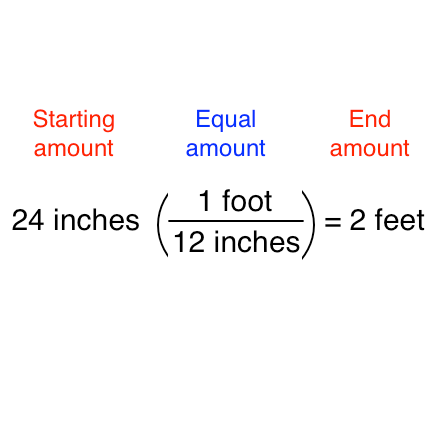
This is a simple example of how to correctly setup a dimensional analysis problem.
Read all original image captions
Image 1
This is a simple example of how to correctly setup a dimensional analysis problem.
Image 2
The blue lines show how we go from unit to unit, and the red lines show the units that end up cancelled.
a) The problem asks for weight in grams instead of amu, so we will need: the atomic weight (AW) of Lithium, and Avogadro’s Number (to calculate the relationship between atom and weight).

This would read as: how many grams of Li are there? = 1 Li atom is related to 6.94 grams of Li per 1 mol of Li (6.02 x 10²³ Li atoms).
b) The process of calculating molarity is very similar. We know molarity = moles of solute / liters of solution. Since we already calculated the amount of Li in grams, we will convert that into moles, and then use the amount of liters of solution (given in the question) to calculate M, molarity.

Clearly, this number is very small, but that is because we are calculating the molarity for a single atom of Lithium in a lot of solution relative to its size. Normal calculations for molarity usually result in much more approachable numbers.
This process of dimensional analysis depends on making ratios (as fractions) to cancel out certain units and end up with the correct unit and numerical quantity at the end of the calculation.
One mole counts the same number of specified entities for any substance: exactly 6.02214076 × 10²³. State what you are counting. For water, the entities can be H₂O molecules; for sodium chloride solid, formula units; for dissolved sodium chloride under a complete-dissociation model, Na⁺ and Cl⁻ ions. The compound formula tells us the corresponding number of each kind of atom or ion.
Example Problem 2.1.2
How much does one molecule of water weigh?
A molecule of water is made of 2 hydrogen and 1 oxygen atoms (H2O):
2 H atoms = 2 x 1.01 amu = 2.02 amu
1 O atom = 1 x 16.00 amu = 16.00 amu
1 H2O molecule = 18.02 amu
So the molecular weight of one H2O molecule is 18.02 amu. If we had 1 mol of H2O, that would weigh 18.02 grams.
Knowing how to find atomic weights on the periodic table, how to correctly set-up and calculate in dimensional analysis, and how to take “inventory” for compounds will help you answer almost any question dealing with moles or weights. Let’s try something even more difficult
Example Problem 2.1.3
Reviewed numeric example: a60.0mL final NaCl solution has analytical concentration0.200M. UsingM(NaCl)=58.44g mol⁻¹, find its dissolved salt mass and the number of formula units represented. n=0.0120mol, mass=0.701g, and formula units=7.23×10²¹. Under complete dissociation there are that manyNa⁺ions and that manyCl⁻ions. When converting NaCl to a particle count, use formula units, not NaCl molecules. One mole of solid NaCl represents one mole of Na⁺ ions and one mole of Cl⁻ ions in the lattice. If that amount dissolves completely in water, the same ion amounts are dispersed through the solution; dissolution does not change the sodium-to-chloride ratio.
With any dimensional analysis problem, there are a few rules of thumb to keep in mind that will help make the process easier.
Rule of thumbs:
- First convert to moles
- Make the first unit one that is not a fraction (ex: volume, area, length, mass)
- Keep the end goal in mind when converting.
Let’s start by incorporating the first and second rules of thumb. Starting with volume, we have:

After carrying out the operations (60)•(0.2)/1000, we find that there are 0.012 moles of NaCl in the solution. Now it’s time for rule number 3. The end goal is grams, so once we multiply the moles by the molecular weight of NaCl, we can find the grams of NaCl that are present in the solution. Using the periodic table at the end of this section, we see that the atomic weight of Na is approximately 23 g/mol and the atomic weight of Cl is 35.45 g/mol. Now we can calculate how many grams.

Glossary and deeper reading · 7 refreshers
These editorial refreshers supplement the reading. Definitions and examples are added guidance; original source wording and recorded answers remain in their original context.
-
Mole
A mole is an amount of substance containing exactly 6.02214076 × 10²³ specified entities. The entities can be atoms, molecules, ions, or formula units, so the counted entity must be named. For example, one mole of oxygen molecules contains two moles of oxygen atoms.
-
Avogadro’s constant
Avogadro’s constant connects a number of specified entities to an amount in moles. Its exact value is 6.02214076 × 10²³ per mole. For example, multiplying two moles of helium atoms by this constant gives their number of atoms.
-
Isotope
Isotopes are atoms of the same element with different numbers of neutrons. They have the same proton number but different masses. For example, carbon-12 and carbon-13 each have six protons but have six and seven neutrons, respectively.
-
Molar mass
Molar mass is the mass of one mole of a specified substance. It is commonly expressed in grams per mole and connects a sample's mass to its amount of substance. For example, water has a molar mass of approximately 18.02 grams per mole.
-
Molarity
Molarity is the amount of a solute in moles divided by the final solution volume in liters. It describes concentration rather than the total amount of solute. For example, 0.10 mole dissolved to make 0.50 liter of solution gives a molarity of 0.20 mole per liter.
-
Solute
A solute is a component dispersed in a solvent to form a solution. It need not be a solid, and a solution need not be liquid. For example, carbon dioxide is a gaseous solute in carbonated water.
-
Solvent
A solvent is the component used as the dissolving medium in a solution. It is often present in the greater amount, though the designation also depends on the mixture's context. For example, water is the solvent in a dilute aqueous sugar solution.