Pendulums
Original textbook reading.
The small-angle simple pendulum and energy reasoning fit AP. Physical-pendulum geometry and compound inertia calculations go beyond the required simple-pendulum period treatment.
A pendulum has periodic motion in the ideal conservative model. For small angular amplitudes, its restoring torque is approximately proportional to angle, so the motion is approximately simple harmonic.
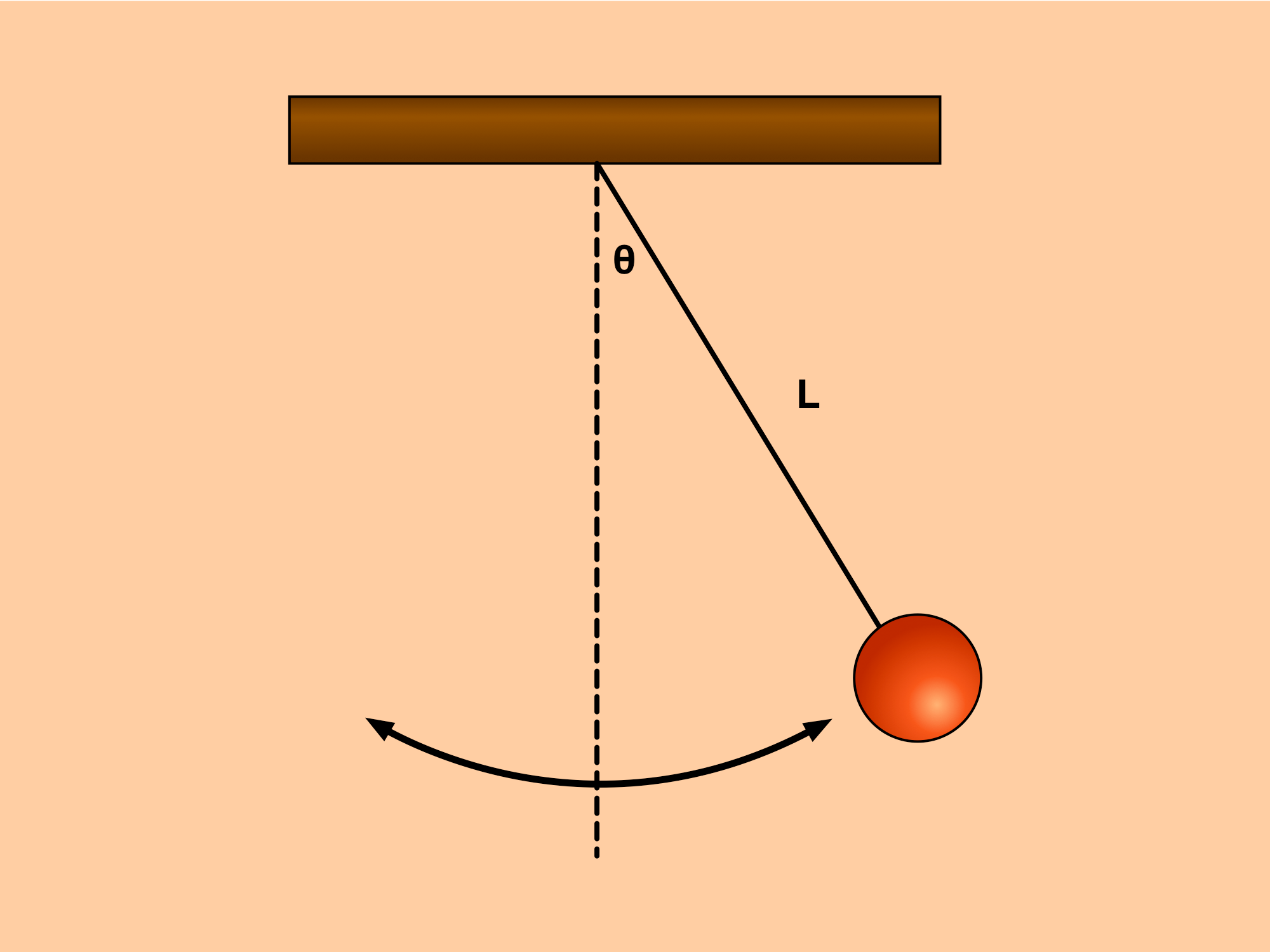
A ball swings periodically under gravity and string tension. With negligible dissipation, its amplitude stays constant; at small angles the motion is approximately SHM.
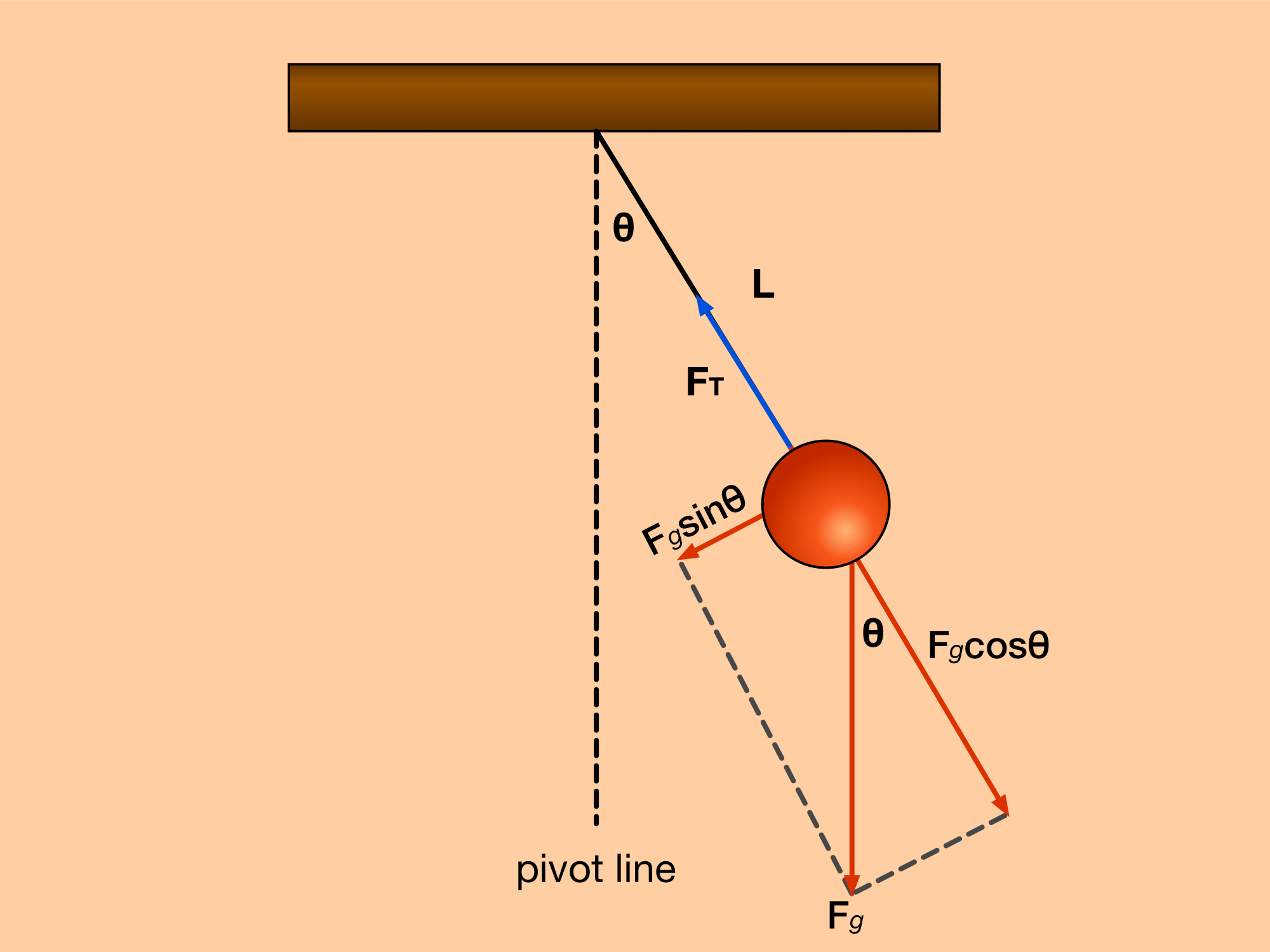
Now let’s consider a ball (assuming it is a point mass) hanging at the end of a string that is attached to a ceiling and pivots back and forth along a pivot line as shown. The two forces acting on the ball are the tension force within the string and the gravitational force acting on the ball.
Resolve the bob’s weight into a tangential component −mg sinθ, directed toward the lowest position, and a radial component mg cosθ. String tension need not equal mg cosθ during motion: their radial difference supplies the centripetal acceleration.
The tangential gravitational force acts toward the equilibrium line, opposing angular displacement rather than velocity. It slows the bob while it moves away from equilibrium and speeds it up while it returns.
For a point bob on a light inextensible string, θ̈=−(g/L)sinθ. Neglecting dissipative forces gives periodic motion. Only the small-angle approximation sinθ≈θ turns that equation into SHM. Gravity and string tension remain present.
Figure 10.2.1 Oddly Shaped Mass for a Pendulum
The small-angle pendulum has the following approximate period:
This is the main equation for a period for pendulums that you will probably encounter in your class:
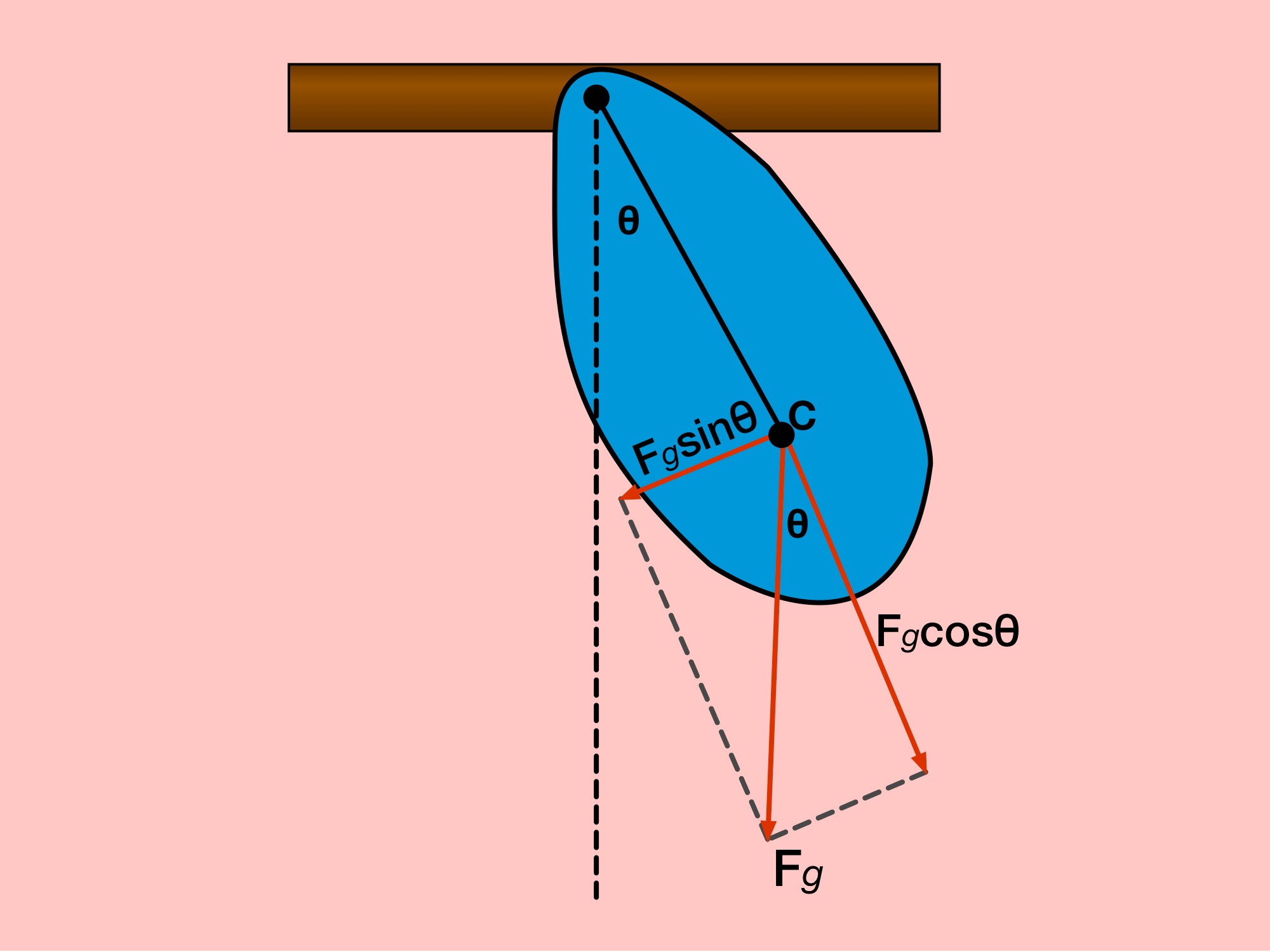
There is also another type of pendulum that we have to consider. We just dealt with a point mass, the ball. But what if the mass didn’t have a shape like that? What if it was irregularly shaped?
Oddly Shaped Masses
As shown in the figure, the mass can look as something as strange as that. Does this mass follow a SHM? Does it have a period?
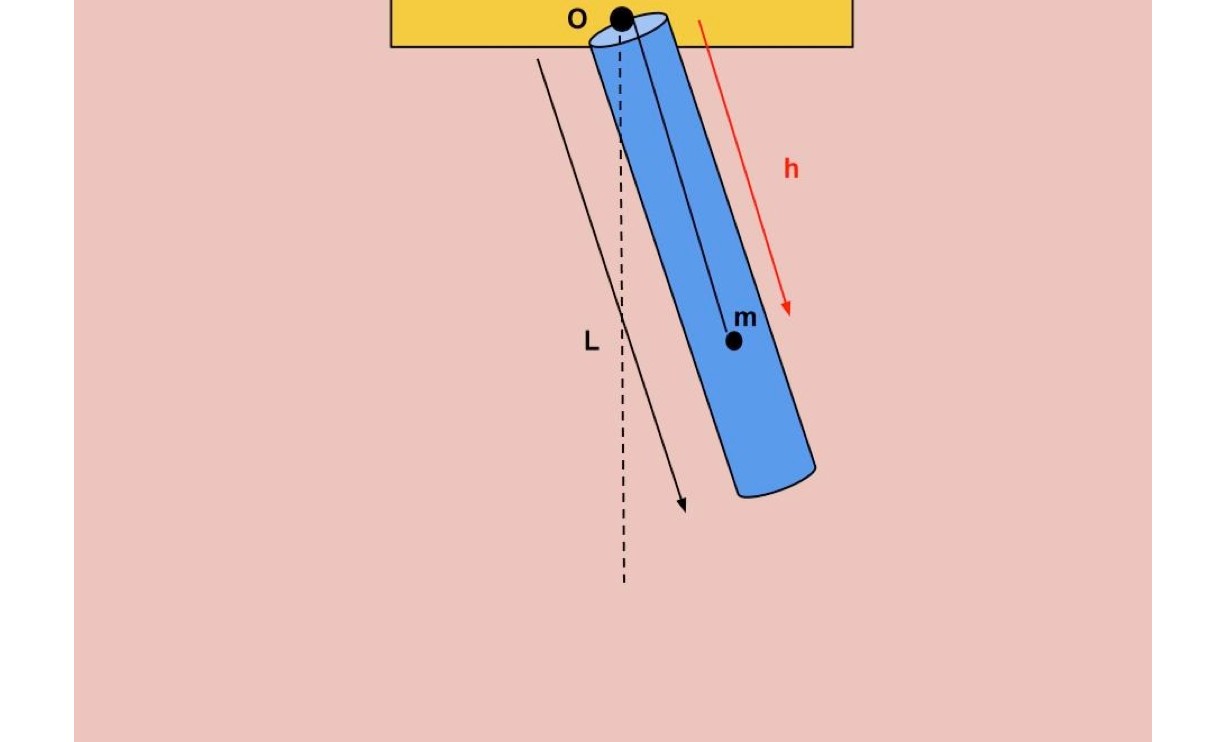
A rigid body suspended from a fixed pivot is a physical pendulum. If its centre of mass lies a distance h below the pivot, its torque is −mgh sinθ. For small angular oscillations, the period depends on h and the moment of inertia about the pivot:
T=2π√[I/(mgh)] (Equation 10.2.2), for small angles; g is the positive magnitude of gravitational acceleration.
Here I is the moment of inertia about the pivot axis and h is the pivot-to-centre-of-mass distance. The equivalent simple-pendulum length is L_eq=I/(mh), which generally differs from h.
Figure 10.2.2 Spring Harmonics
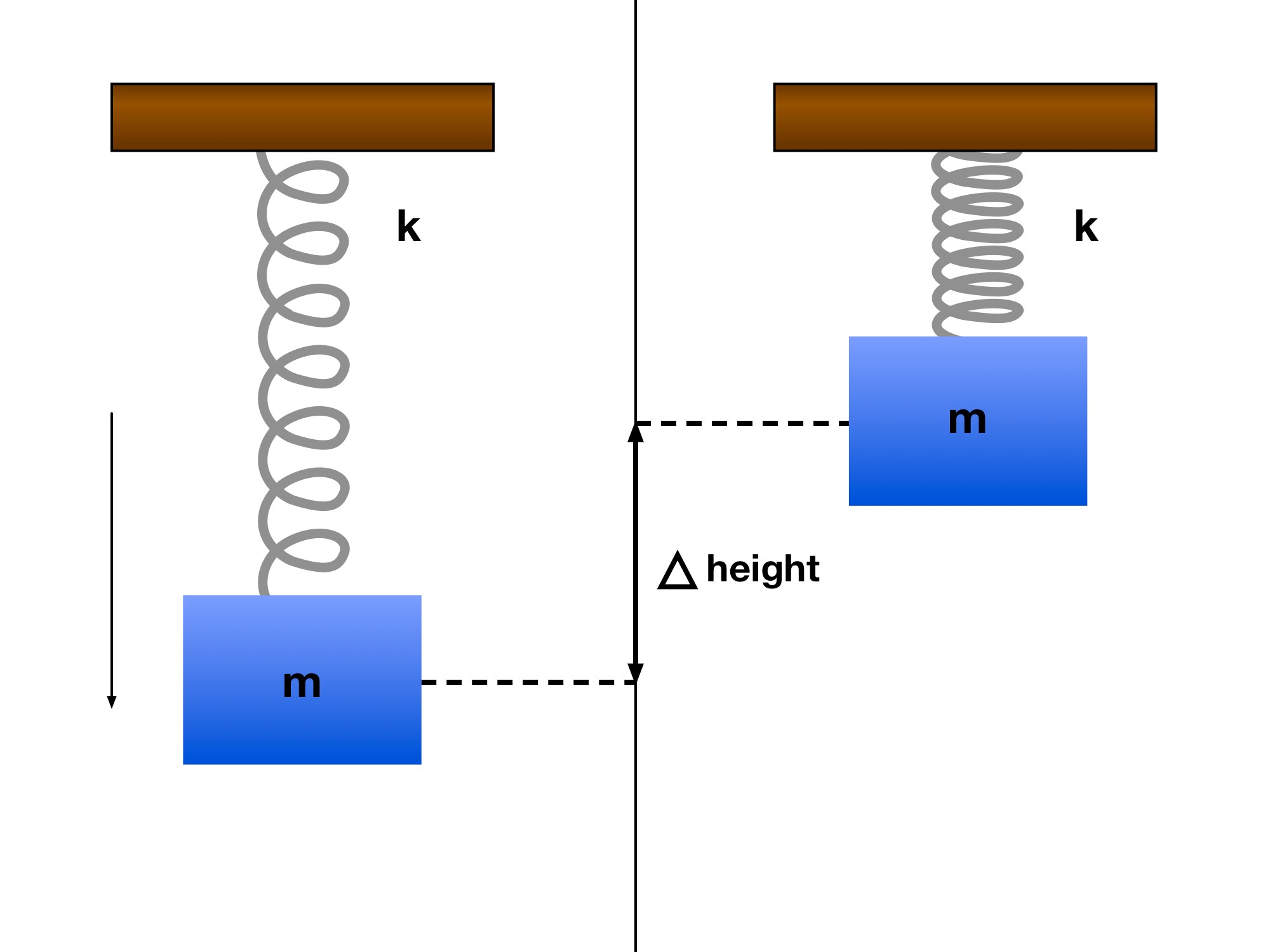
Springs act like harmonics too, therefore it has a period:
(Equation 10.2.3) Where is the mass attached to the spring and is the spring constant.
An ideal linear spring with no dissipation oscillates at constant amplitude about its equilibrium. A vertical spring also experiences gravity, which shifts that equilibrium. Removing damping is the relevant condition; the restoring spring force must remain.
Example Problem 10.2.1
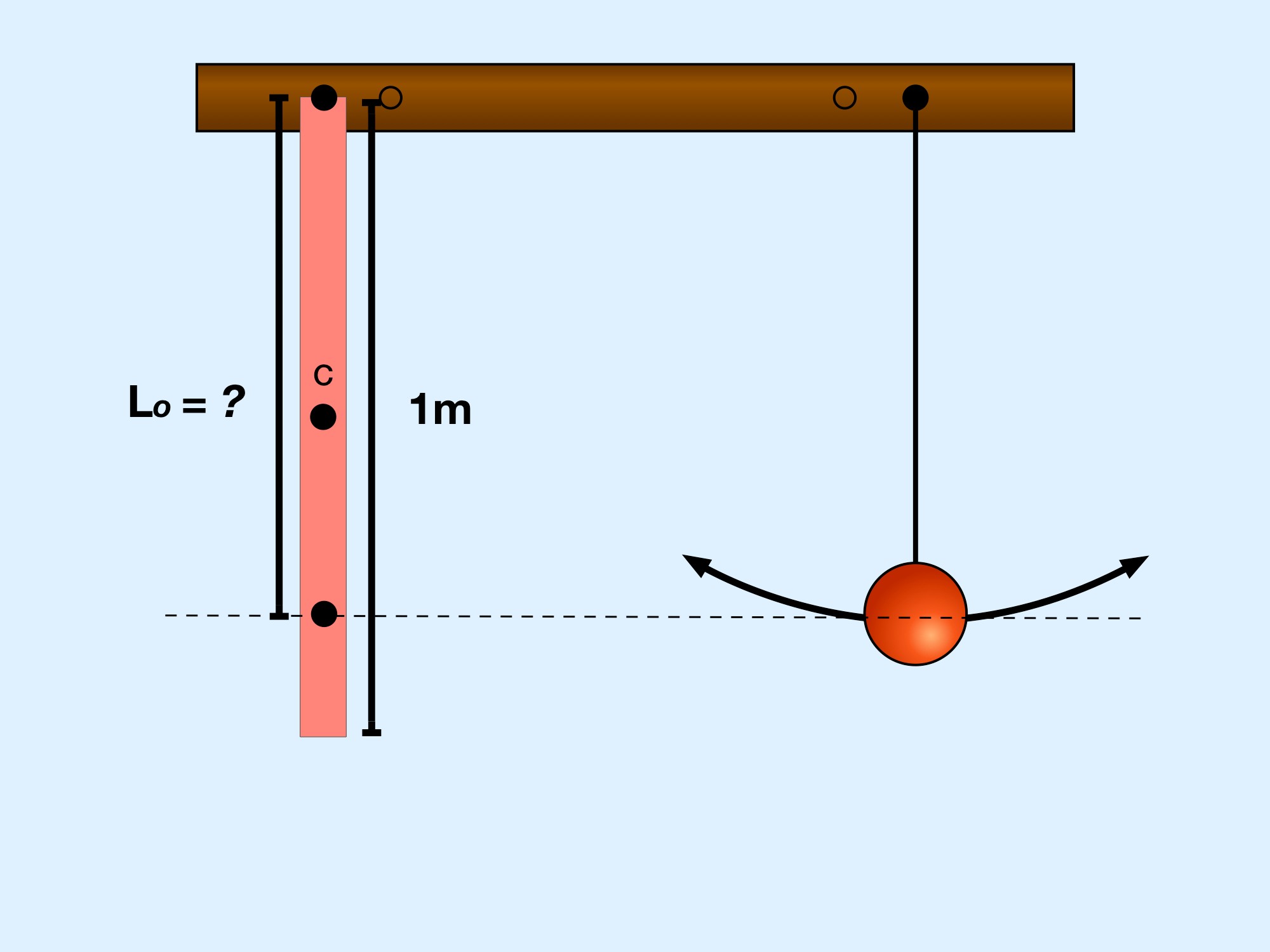
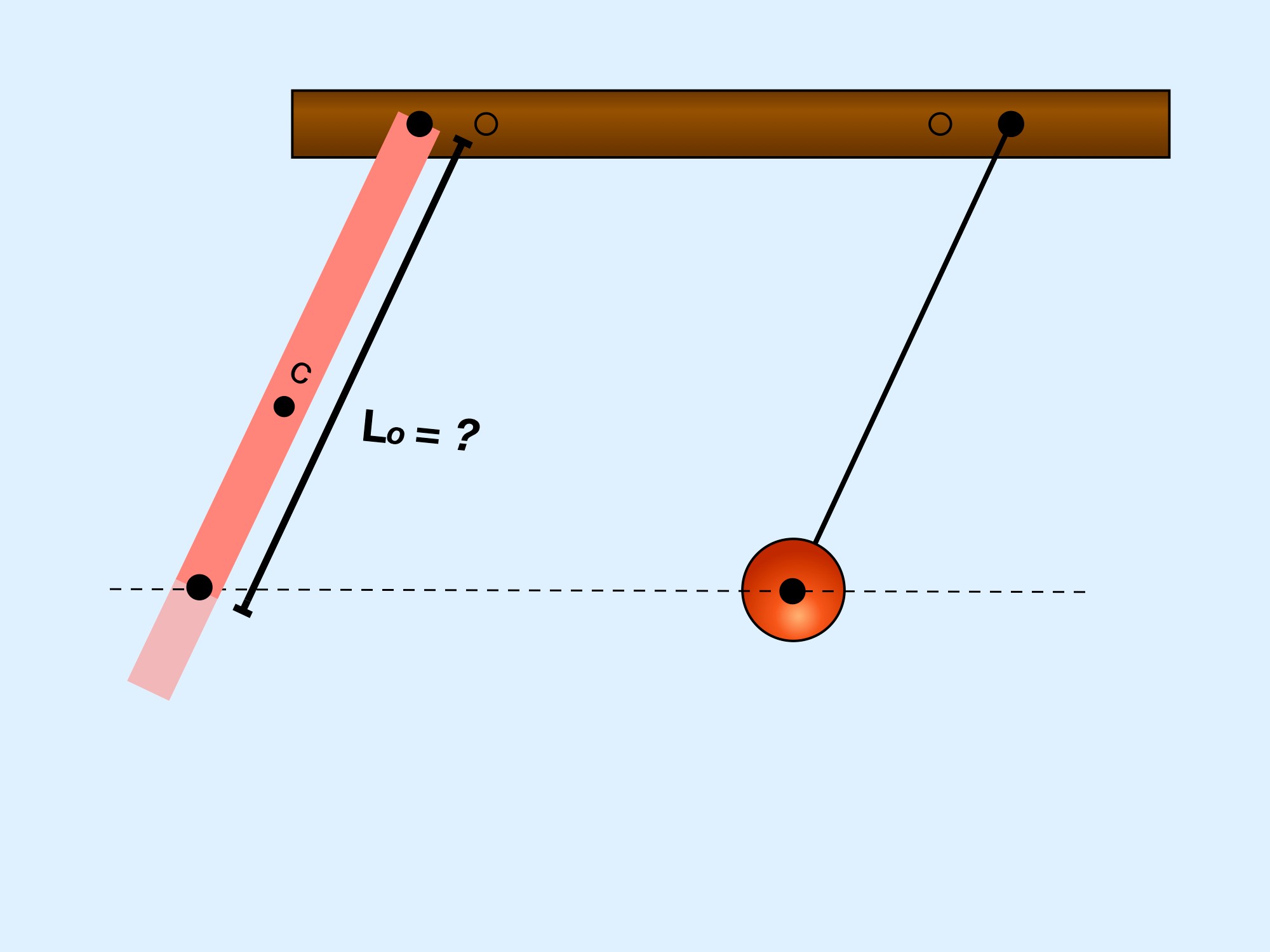
Notice how there are two pendulum systems occurring here. We have the point mass-string pendulum and the rod pendulum. Given that the center of mass of the rod is in the middle of the rod, from the pivot point , and the total distance of the rod is , find the period of the pendulum system and the distance on the rod where the periods of the ball and the rod systems will be the same.
Example Problem 10.2.1
Step 1: Find the period of the rod
Well since the rod has a total length of , we can then say that the center of mass of the rod is located at a distance of . With that in mind, let’s find the period using our Pendulum equation. We are using that equation since the mass of the pendulum is not a simple ball string one.
T=2π√[I/(mgh)], with I measured about the pivot.
In this case, the rotational inertia of a rod is:
Plugging this in to the period equation, we get:
Step 3: Set the periods of the two systems equal to each other
Since we know that the systems are going to have the same periods, let’s just set the period of the simple ball system equal to the period of the rod system:
T_simple=2π√(L₀/g)=T_rod=2π√[2L/(3g)].
In this case, the is supposed to represent the distance where the rod has the same period as the ball. Since the two equations are essentially the same, we can rewrite the top equation as simply:
Example 10.2.1 How are the Periods the Same?
Pop Quiz 10.2.1 PENDULUMS, PENDULUMS, PENDULUMS, PENDULUMS
Question 1 of 5 · 0 correct
AP Topic 7.2 · Read the worked solution
For an ideal small-angle simple pendulum with fixed length, what happens to its period if the point-bob mass doubles and all other factors stay the same?
Read every full question without answers
Question 1
For an ideal small-angle simple pendulum with fixed length, what happens to its period if the point-bob mass doubles and all other factors stay the same?
Question 2
The pictured pendulums have the same radius, but their axial lengths, mass distributions and pivot-axis inertias are not all specified. Which conclusion about their small-angle periods is justified from that information?
- The disk must have the longest period.
- The cone must have the longest period.
- The longest period cannot be determined from radius alone; compare I/(mh) using the full geometry.
- The sphere must have the longest period.
Question 3
Question 4
A point bob on a light inextensible string of length L is released from rest at angular displacement θ from the downward vertical. Assume the string remains taut throughout the swing (for example, a release no more than 90° from the downward vertical). With no dissipation and gravitational magnitude g, what is its maximum speed?
Question 5
A uniform solid cylinder has length L=1.00 m, diameter 0.500 cm and mass 0.500 g. It is pivoted at the centre of one end about an axis perpendicular to the cylinder’s length, as a physical pendulum. Thus h=L/2. Find the inertia about that pivot in kg·m² and the small-angle period in seconds, using g=9.8 m/s². For this axis, I=mL²/3+mR²/4.


Reviewed physics notes (25)
These corrections keep the original lesson’s purpose while fixing errors in the source edition.
- Correct the unrestricted SHM claim. — Reference 1
- Radial force balance must include the acceleration. — Reference 1
- A restoring force opposes displacement, not invariably the direction of motion. — Reference 1
- Repetition and absence of external forces do not define SHM. — Reference 1
- Qualify the formula. — Reference 1
- Physical pendulums also need a small-angle approximation and pivot-axis inertia. — Reference 1
- A vector cannot appear as the scalar square-root denominator. — Reference 1
- Clarify the pivot axis and distinguish centre-of-mass distance from equivalent length. — Reference 1, Reference 2
- External force absence would eliminate a spring’s restoring force; state the intended no-dissipation condition. — Reference 1
- Gravity and tension are external forces on the bob. — Reference 1
- Back-and-forth motion is not sufficient for exact SHM. — Reference 1
- An unspecified height is not the correct equilibrium description. — Reference 1
- Correct the no-external-force claim. — Reference 1
- No segment can be discarded from the real rod’s inertia merely because it is drawn transparent. — Reference 1, Reference 2
- The period equality concerns the full rod’s inertia, not just the rod up to the marked point. — Reference 1
- Use scalar gravitational magnitude and explicitly show the dimensionally correct square-root relation. — Reference 1
- Specify the model in which the existing mass-independent key is correct. — Reference 1
- Radius alone cannot rank disk, cone, cylinder and sphere periods. — Reference 1, Reference 2
- Replace the underdetermined image-only ranking choices with explicit conclusions while preserving each choice ID. — Reference 1, Reference 2
- Specify the approximation under which the existing 2T key is correct. — Reference 1
- State the conservative release conditions required by the energy formula. — Reference 1
- Use scalar gravitational magnitude under the speed square root. — Reference 1
- A uniform cylinder does not have h=L/3, and a pendulum needs the transverse pivot inertia rather than the tiny axial spin inertia. — Reference 1, Reference 2
- Replace source choices that used the wrong inertia axis or inconsistent period. The existing third-choice key is retained. — Reference 1, Reference 2
- State the small-angle domain directly beside the formula. — Reference 1
Glossary and deeper reading · 15 refreshers
These editorial refreshers supplement the reading. Definitions and examples are added guidance; original source wording and recorded answers remain in their original context.
-
Amplitude
Amplitude is the maximum magnitude of a repeating disturbance measured from its equilibrium value. It describes the size of the oscillation rather than its frequency or propagation speed. For example, pulling a spring-mounted mass farther from equilibrium increases its oscillation amplitude when it is released from rest.
-
Torque
Torque describes a force’s turning effect about a chosen axis or point. Its magnitude is force times the perpendicular lever arm, and its direction or sign describes the rotation tendency. For example, pushing near the handle of a door produces more torque than the same perpendicular push near the hinge.
-
Force
A force describes an interaction that can change an object’s momentum. It is a vector measured in newtons, so both size and direction matter when forces are added. For example, a rope can pull a cart while the floor exerts friction in another direction.
-
Tension
Tension is a pulling force transmitted through a stretched rope, string, or similar connector. It acts along the connector away from the object it pulls, and an ideal massless rope has the same tension throughout an uninterrupted segment. For example, a rope supporting an accelerating load can have a tension different from the load’s weight.
-
Centripetal acceleration
Centripetal acceleration is the inward acceleration component that changes the direction of motion along a curved path. For circular motion its magnitude is speed squared divided by the circle’s radius. For example, a car moving at constant speed around a bend still has centripetal acceleration.
-
Gravity
Gravity is the attractive interaction between masses in the Newtonian model. For spherical bodies or point-mass approximations, its strength decreases with the square of the separation between their centers. For example, Earth’s gravity provides the inward force that keeps a satellite in orbit.
-
Mechanical equilibrium
Mechanical equilibrium means there is no translational or angular acceleration for the system being considered. For a rigid body, both the net external force and the net external torque must vanish. For example, a stationary ladder supported against a wall requires both force balance and torque balance.
-
Simple harmonic motion
Simple harmonic motion occurs when the net restoring force is proportional to displacement from equilibrium and points in the opposite direction. The resulting position varies sinusoidally with time in the ideal model. For example, a mass attached to an ideal spring can execute simple harmonic motion when damping is negligible.
-
Oscillation period
An oscillation period is the time required for one complete repeating cycle. It is the reciprocal of frequency and is measured in seconds. For example, measuring the time for several pendulum swings and dividing by the number of cycles estimates the period.
-
Center of mass
The center of mass is the position obtained by weighting each part’s position by its mass. Its motion represents the translational motion of the whole system under the net external force. For example, adding a heavy object to one end of a light bar shifts the center of mass toward that end.
-
Rotational inertia
Rotational inertia measures how strongly a mass distribution resists a change in angular velocity about a specified axis. Mass farther from that axis contributes more strongly because each contribution depends on squared distance. For example, moving small masses outward along a rotating rod increases its rotational inertia without changing its total mass.
-
Magnitude
Magnitude is the nonnegative size of a vector quantity. It does not specify direction, and it differs from a signed component. For example, a westward velocity can have a negative x component while its speed, the velocity magnitude, stays positive.
-
Acceleration
Acceleration is the vector rate of change of velocity with time. It can change an object’s speed, direction, or both, and it is measured in meters per second squared. For example, a satellite moving at constant speed in a circular orbit accelerates toward the center.
-
Spring constant
A spring constant measures the stiffness of a spring within its approximately linear range. Its units are newtons per meter, and a larger value means more force is needed for the same deformation. For example, two springs stretched by the same distance exert different forces if one is stiffer.
-
Damping
Damping is a process that transfers energy out of an oscillation and reduces its amplitude over time. The motion can remain oscillatory or approach equilibrium without oscillating, depending on the damping strength. For example, an oscillator moving through a viscous liquid loses mechanical energy to the liquid.