Chapter 2 Solutions
Worked solutions to all thirty problems, with the reason for each step. These explanations were added for this edition; the chapter answer key and original worked examples follow below.
Chapter problems → · Chapter answer key → · Original worked examples →
Problem 1
Original problem · added worked solution
Authored worked explanation for the original source problem.
At a general point a, .
Why: The constant 1 cancels in the change of output.
Thus when .
Why: Multiplication by 4 scales every input error by 4.
Reviewed answer: ; to guarantee a prescribed ε use .
Takeaway: For a linear function, error scales by the absolute slope.
Final answer
Problem 2
Original problem · added worked solution
Authored worked explanation for the original source problem.
Rewrite the expression as .
Why: Divide each polynomial by its highest power before taking the outer quotient.
The reciprocal powers tend to 0, leaving 4/5.
Why: The limiting denominator is 5, so the quotient limit rule is valid.
Reviewed answer:
Takeaway: Leading coefficients determine this rational limit.
Final answer
Problem 3
Original problem · added worked solution
Authored worked explanation for the original source problem.
For nearby inputs other than 4, the function is .
Why: A limit ignores an isolated value at the target input.
So , even though .
Why: The nearby branch is continuous but the assigned point creates a discontinuity.
Reviewed answer:
Takeaway: The value at one point and the limit there can disagree.
Final answer
Problem 4
Original problem · added worked solution
Authored worked explanation for the original source problem.
Rationalize with : near zero.
Why: Use cos²−1=−sin² and cancel only where sine is nonzero.
The numerator tends to 0 and denominator to 2, giving 0.
Why: The rewritten denominator is nonzero at the limit point.
Reviewed answer:
Takeaway: Trig identities can remove an apparent 0/0 without derivatives.
Final answer
Problem 5
Original problem · added worked solution
Authored worked explanation for the original source problem.
Use and .
Why: These identities factor the numerator and denominator.
The quotient becomes near zero, which tends to 0/2=0.
Why: Cancelling the common sine factor is valid in the punctured neighborhood.
Reviewed answer:
Takeaway: Factor first; evaluate the equivalent nearby expression second.
Final answer
Problem 6
Original problem · added worked solution
Authored worked explanation for the original source problem.
Source review note: The source gives 1/2. The printed numerator contains +sin x, so it leaves a 1/x divergence and has no two-sided limit.
Split the quotient into .
Why: The two terms have different sizes near zero.
The first term tends to −1/2 because and .
Why: This uses special trig limits already introduced in this chapter.
The second term is , which behaves like 1/x.
Why: Its sign changes across zero and its magnitude grows without bound.
A bounded first term cannot cancel that divergence; the one-sided limits are opposite infinities.
Why: A finite two-sided limit requires agreement from both sides.
Reviewed answer: No two-sided limit; right limit , left limit .
Takeaway: Check the lowest-order behavior of every numerator term.
Final answer
Problem 7
Original problem · added worked solution
Authored worked explanation for the original source problem.
Source review note: The source gives +1/2; rationalization of the printed 4−x radicand yields −1/2.
and .
Why: Multiply each difference by its conjugate.
Cancel x for x≠0 to get .
Why: The negative sign from the first radicand remains.
At zero this tends to −2/4=−1/2.
Why: The rewritten denominator does not vanish.
Reviewed answer:
Takeaway: A conjugate can expose a sign as well as a common factor.
Final answer
Problem 8
Original problem · added worked solution
Authored worked explanation for the original source problem.
Rationalize both differences: the numerator is and denominator is .
Why: Both have the same vanishing polynomial factor.
Cancel it near x=1 to obtain .
Why: A punctured neighborhood excludes x=1 but allows evaluating the equivalent expression's limit.
Substitute 1: 6/4=3/2.
Why: The new denominator stays positive.
Reviewed answer:
Takeaway: Rationalizing both numerator and denominator can reveal the same factor.
Final answer
Problem 9
Original problem · added worked solution
Authored worked explanation for the original source problem.
Source review note: The source gives 4/3, but its printed denominator has x²+14, which does not vanish at x=2. The reviewed limit is 0.
At x=2 the numerator is , but the denominator is .
Why: Check the expression as printed before assuming it is 0/0.
Continuity of the radicals and nonzero denominator give the limit 0.
Why: The quotient rule for limits applies directly.
Reviewed answer:
Takeaway: Not every radical difference needs rationalization.
Final answer
Problem 10
Original problem · added worked solution
Authored worked explanation for the original source problem.
For , for every h≠0.
Why: The derivative uses a difference quotient before taking the limit.
Its limit as h approaches zero is 0.
Why: We never divide by h=0; the nearby values are already identically zero.
Reviewed answer:
Takeaway: A derivative is a limit of quotients, not a quotient evaluated at zero.
Final answer
Problem 11
Added problem and worked solution
Find .
Authored solution to an added practice problem.
A polynomial is continuous at 2, so substitute directly.
Why: No denominator or domain obstruction occurs.
.
Why: Evaluate after confirming continuity.
Reviewed answer:
Takeaway: Direct substitution is the first tool to try.
Final answer
Problem 12
Added problem and worked solution
Find and explain why the quotient can be undefined at 3.
Authored solution to an added practice problem.
Factor .
Why: The numerator and denominator share a vanishing factor.
For x≠3, the quotient is x+3, so its limit is 6.
Why: Cancelling changes the point value but preserves nearby values.
Reviewed answer:
Takeaway: A hole need not prevent a limit.
Final answer
Problem 13
Added problem and worked solution
Evaluate .
Authored solution to an added practice problem.
Multiply by to get for x≠0.
Why: The conjugate changes the numerator into x.
The rewritten expression tends to 1/6.
Why: Its denominator is continuous and nonzero at zero.
Reviewed answer:
Takeaway: Conjugates turn a radical difference into a cancelable factor.
Final answer
Problem 14
Added problem and worked solution
Near 1, for and for . Find both one-sided limits and the two-sided limit.
Authored solution to an added practice problem.
For x<1, the branch is x+2, giving a left limit of 3.
Why: Use the formula valid on that side.
For x>1, the branch is 2x+3, giving a right limit of 5.
Why: A separate branch controls the other side.
Since 3≠5, no two-sided limit exists, whatever value is assigned at x=1.
Why: Changing one point cannot join two different nearby heights.
Reviewed answer: Left limit 3; right limit 5; two-sided limit does not exist.
Takeaway: Compare sides before claiming a two-sided limit.
Final answer
Problem 15
Added problem and worked solution
Define for and . Choose k to make f continuous at 2.
Authored solution to an added practice problem.
For x≠2, .
Why: Factor and cancel away from the missing point.
Its limit at 2 is 4, so define f(2)=4.
Why: Continuity requires the point value to equal the existing limit.
Reviewed answer: .
Takeaway: Filling a removable hole uses the limit value.
Final answer
Problem 16
Added problem and worked solution
For , give a δ in terms of a prescribed that proves the limit at any real a.
Authored solution to an added practice problem.
.
Why: The vertical translation cancels.
If , then the output error is less than ε.
Why: The strict input inequality gives the strict output inequality.
Reviewed answer: works.
Takeaway: The input tolerance is the output tolerance divided by the absolute slope.
Final answer
Problem 17
Added problem and worked solution
Prove with an explicit epsilon–delta choice.
Authored solution to an added practice problem.
.
Why: Factor the output error.
Impose , so and .
Why: A local bound turns the second factor into a fixed constant.
Also impose to get .
Why: The minimum enforces both requirements at once.
Reviewed answer: works.
Takeaway: For nonlinear errors, first bound the extra factor in a small neighborhood.
Final answer
Problem 18
Added problem and worked solution
Evaluate , with angles in radians.
Authored solution to an added practice problem.
Rewrite .
Why: Match the angle and denominator in the known sine limit.
As x→0, 5x→0 and the last ratio tends to 1.
Why: The special limit uses radians.
Reviewed answer:
Takeaway: Make the denominator match the sine's angle.
Final answer
Problem 19
Added problem and worked solution
Use identities rather than derivatives to evaluate .
Authored solution to an added practice problem.
.
Why: The half-angle identity exposes a square.
Divide by x² to get , which tends to 9/2.
Why: Both sine ratios tend to 1.
Reviewed answer:
Takeaway: A squared sine limit handles a cosine difference.
Final answer
Problem 20
Added problem and worked solution
Find and justify it without graphing.
Authored solution to an added practice problem.
Since , multiplying by x² gives .
Why: x² is nonnegative on both sides of zero.
Both bounds tend to 0, so the middle expression does too.
Why: The squeeze theorem does not require the oscillating factor itself to have a limit.
Reviewed answer:
Takeaway: A shrinking multiplier can control an oscillation.
Final answer
Problem 21
Added problem and worked solution
Evaluate .
Authored solution to an added practice problem.
Divide numerator and denominator by x² to obtain .
Why: The highest power removes the large common scale.
The reciprocal terms tend to 0, leaving 6/(−4)=−3/2.
Why: The limiting denominator is nonzero.
Reviewed answer:
Takeaway: Keep the leading coefficient's sign.
Final answer
Problem 22
Added problem and worked solution
Find .
Authored solution to an added practice problem.
Divide by x³: .
Why: Use the denominator's larger degree.
The numerator tends to 0 and denominator to 1.
Why: The denominator grows two powers faster than the leading numerator term.
Reviewed answer:
Takeaway: A lower-degree numerator is overwhelmed at infinity.
Final answer
Problem 23
Added problem and worked solution
Find and .
Authored solution to an added practice problem.
For x<2, x−2 is negative and tends to 0, so its reciprocal tends to −∞.
Why: The denominator's sign controls the quotient.
For x>2, the reciprocal tends to +∞.
Why: The opposite denominator sign gives the opposite one-sided behavior.
Reviewed answer: Left limit ; right limit .
Takeaway: An infinite two-sided limit needs matching signs.
Final answer
Problem 24
Added problem and worked solution
Does exist? Show the two sides.
Authored solution to an added practice problem.
For x<0, , so .
Why: The absolute-value formula depends on the side of zero.
For x>0, , so the quotient is 1.
Why: The values stay different however close x gets to zero.
Reviewed answer: Left limit −1; right limit 1; no two-sided limit.
Takeaway: A constant value on each side can still produce a jump.
Final answer
Problem 25
Added problem and worked solution
A table near gives , , , and . What limit is suggested, and can the table prove it?
Authored solution to an added practice problem.
The left entries 2.9 and 2.99 move toward 3; the right entries 3.01 and 3.1 are also compatible with approaching 3.
Why: Use values nearest the target from both directions.
The table leaves all other nearby inputs unknown, so state a conjecture rather than a proof.
Why: A limit describes every sufficiently close input, not just sampled ones.
Reviewed answer: The entries suggest a limit of 3; a finite table alone cannot prove it.
Takeaway: Tables give evidence for a limit, while a formula or bound can establish it.
Final answer
Problem 26
Added problem and worked solution
Evaluate and explain the composition step.
Authored solution to an added practice problem.
The inner polynomial x²+1 tends to 5 as x→2.
Why: Polynomials are continuous.
The positive square root is continuous at the positive input 5, so the composite tends to √5.
Why: A continuous outer function carries the inner limit through the composition.
Reviewed answer:
Takeaway: Check that the outer function is continuous at the inner limit.
Final answer
Problem 27
Added problem and worked solution
Evaluate .
Authored solution to an added practice problem.
Expand .
Why: The difference quotient compares nearby squared values.
For h≠0 divide by h to get , whose limit is 6.
Why: The derivative comes from a limit after cancellation.
Reviewed answer:
Takeaway: An algebraic expansion can make a derivative limit straightforward.
Final answer
Problem 28
Added problem and worked solution
Evaluate .
Authored solution to an added practice problem.
Factor and .
Why: Both polynomials vanish at x=1.
The quotient is for x≠1, so the limit is 2/3.
Why: Cancel only the common factor, leaving the distinct remaining factors.
Reviewed answer:
Takeaway: Keep track of which factor remains above and below.
Final answer
Problem 29
Added problem and worked solution
Use limits to explain why is continuous at zero but has no derivative there.
Authored solution to an added practice problem.
Both one-sided function limits of at zero are 0, equal to f(0).
Why: That establishes continuity.
The quotient is −1 for negative h and 1 for positive h.
Why: The derivative tests slopes, not just heights.
The slopes disagree, so the graph has a corner at zero.
Why: Continuity alone does not guarantee a derivative.
Reviewed answer: Continuous at zero, but left slope −1 and right slope 1.
Takeaway: Meeting heights do not necessarily mean meeting slopes.
Final answer
Problem 30
Added problem and worked solution
Evaluate using the exponential special limit.
Authored solution to an added practice problem.
Match with k=3.
Why: This is the defining exponential limit from the source's special limits.
The limiting value is .
Why: The increment's coefficient becomes the exponential's exponent.
Reviewed answer:
Takeaway: Identify the increment and the growing exponent together.
Final answer
Chapter answer key and worked steps
Answers and worked steps for the original problems, including verified corrections where needed.
-
Original short answer
Problem 1 → -
Original short answer
Problem 2 → -
Original short answer
Problem 3 → -
Original short answer
Problem 4 → -
Original short answer
Problem 5 → -
Corrected answer
No two-sided limit; right limit , left limit .Problem 6 → -
Corrected answer
Problem 7 → -
Original short answer
Problem 8 → -
Corrected answer
Problem 9 → -
Original short answer
Prove itProblem 10 →
Source worked examples
These are the book’s example problems and worked steps, with the original explanations.
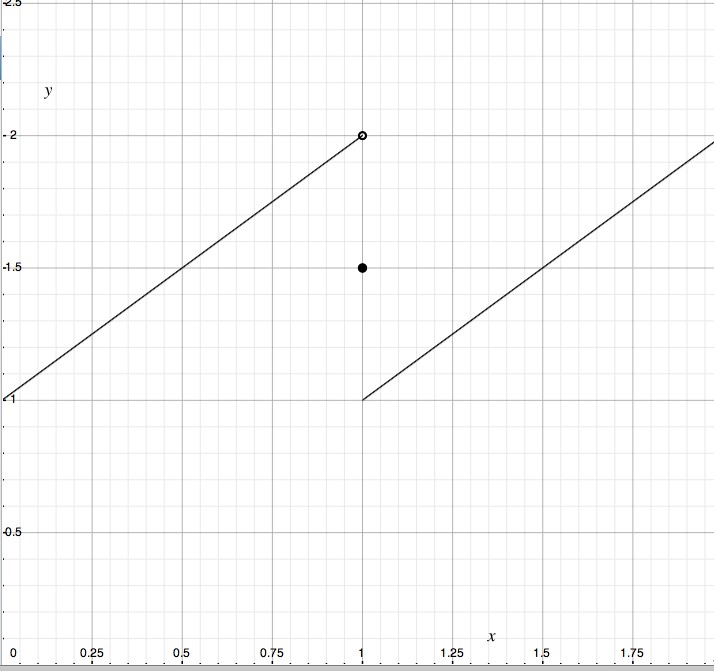
Example Problem 2.1.1.
In the graph of the function below, find:
Example Problem 2.2.1.
Formal Definition and Solving Limits →
Find ε as a function of δ for .
Example Problem 2.2.2.
Formal Definition and Solving Limits →
Solve
Example Problem 2.2.3.
Formal Definition and Solving Limits →
Solve
Example Problem 2.3.1.
Find the limit:
Example Problem 2.3.2.
Find the limit:
Example Problem 2.3.3.
Solve the limit:
Example Problem 2.4.1.
Find the derivative function of using limits.