Formal Definition and Solving Limits
This original textbook reading covers part of the AP topic. Follow the AP course outline for complete topic instruction and practice.
This reading includes verified answer corrections and explicitly stated clarifications.
The Epsilon Delta Definition of a limit formalizes the concept of what a limit is. It is a formal definition, and is thus used more widely in proofs. Try your best to understand this section, as it is a little difficult, conceptually and quantitatively.
The formal definition of a limit
We have mentioned before that the limit is a value that a function approaches, when x approaches an arbitrary constant c. This definition leaves a lot of open questions for mathematicians: How close does x have to approach to give a reasonable estimate of the limit? How can we define how close x is to c and how close the limit of the function is to f(x), given x? In order to answer these questions, the formal definition of the limit states that:
Assume c is an accumulation point of the function’s domain: domain inputs other than c occur arbitrarily close to c. The statement limx→c f(x) = L means: for every ε > 0, there is a δ > 0 such that, for every x in the function’s domain, 0 < |x − c| < δ implies |f(x) − L| < ε. The input is close to c but not equal to c, and the output is close to L. We do not assume f is continuous near c; a limit can exist even when f is not defined at c.
Gallery 2.2.1 Epsilon Delta Limits
Read all original image captions
Image 1
Image 2
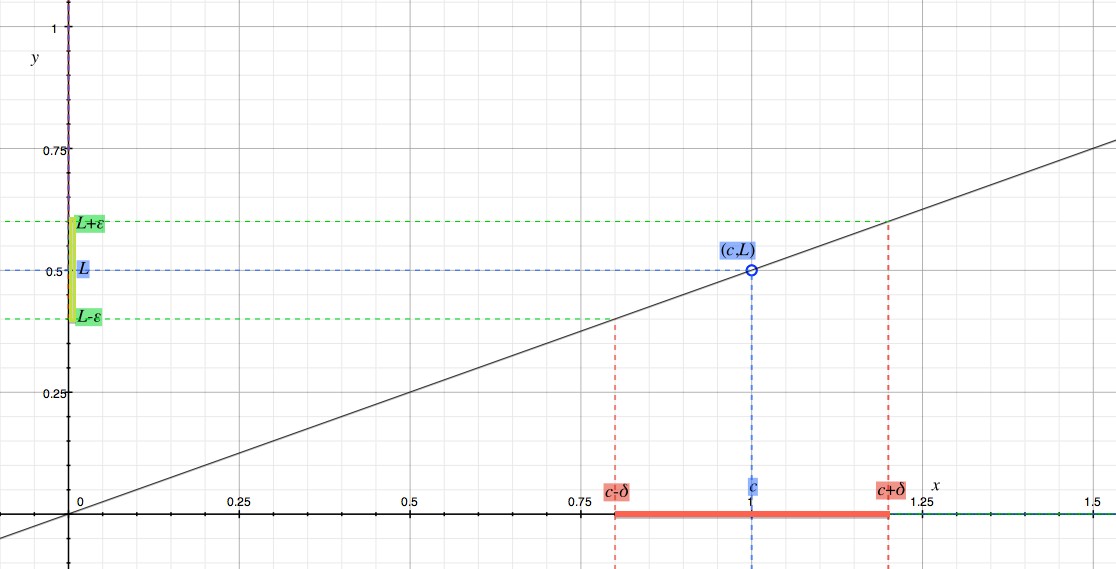
Choose the output tolerance ε first, then choose δ small enough that every domain input with 0 < |x − c| < δ satisfies |f(x) − L| < ε. Continuity does not let us choose δ arbitrarily large for a fixed ε. In this picture, c = 1, L = 0.5, ε = 0.25 and δ = 0.5: the drawn straight-line behavior has slope 1/2, so |f(x) − L| = |x − c|/2. For a separate example, f(x) = 2x − 2 has |f(x) − f(c)| = 2|x − c|, so any positive δ ≤ ε/2 works.
Image 3
Discontinuities can make choosing intervals a bit tricky, so generally it is a better idea to pick smaller intervals to make sure we have a better approximation of the limit. Can you write ε as a function of δ for the graphs covered in this gallery? What is the correlation to the graph of the function?
The output interval is (L − ε, L + ε), and the input interval is (c − δ, c + δ), with c itself excluded from the limit test. You can think of ε as the allowed output error and δ as the input distance that guarantees it. Smaller output errors may require smaller input distances.
Errors are important in many science and engineering applications. Knowing how much your final error will increase for each change in measurement is crucial in determining the significance of your final results. Even computers, when adding really small numbers, have errors associated with them that might not work for very small calculations such as finding the concentration of a chemical in parts per billion. Limits combined with other properties in Calculus are used to determine measurement errors.
Example Problem 2.2.1.
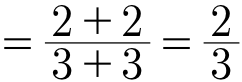
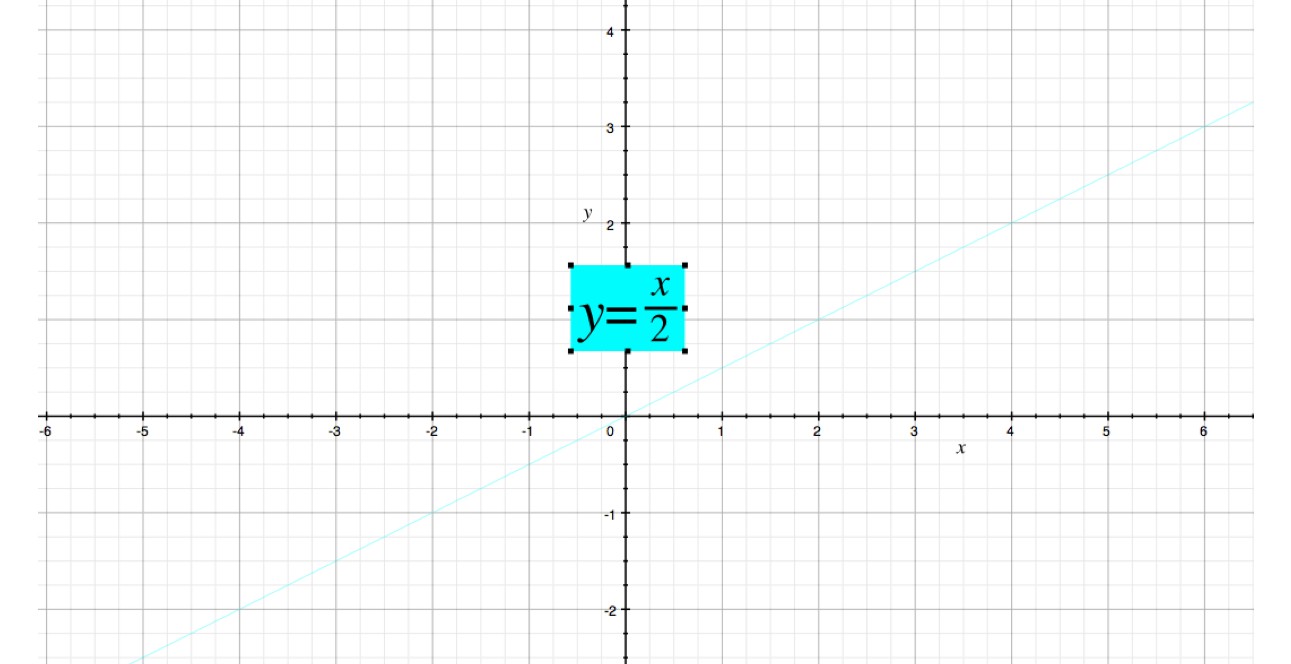
Find ε as a function of δ for .
Pop Quiz 2.2.1 Calculating limits
Question 1 of 7 · 0 correct
Glossary and deeper reading · 4 refreshers
These editorial refreshers supplement the reading. Definitions and examples are added guidance; original source wording and recorded answers remain in their original context.
-
Limit
A limit describes the value approached by outputs as inputs approach a specified target or grow without bound. For an input approaching a finite target, its value at that exact input does not determine the limit. For example, (x²−1)/(x−1) approaches 2 as x approaches 1 even though the original expression is undefined at 1. A finite two-sided limit requires the left and right approaches to agree.
-
Function
A mathematical function assigns exactly one output to each input in its domain. Inputs can share an output, but one input cannot have two different outputs. For example, f(x)=x² assigns the output 9 to both 3 and −3. Function notation names the rule and its input; f(3) means the output when the input is 3.
-
Domain
The domain of a function is the set of inputs for which the function is defined. An expression and its context can both restrict the allowed inputs. For example, the real function f(x)=1/(x−2) has domain all real numbers except 2. For a model of elapsed time, a sensible domain may also require t≥0.
-
Interval
An interval is a set of real numbers containing every number between any two of its members. Parentheses exclude an endpoint, while square brackets include it. For example, (1,4] includes 4 and every number between 1 and 4, but excludes 1. An infinite endpoint always uses a parenthesis because infinity is not a real endpoint.