Continuity and Limits
This original textbook reading covers part of the AP topic. Follow the AP course outline for complete topic instruction and practice.
This reading includes verified answer corrections and explicitly stated clarifications.
What is a limit?
A limit is the value a function approaches as its input approaches a given point. The function need not reach that value or even be defined at the point. If the function is continuous there, its limit equals its value. Let’s see why this distinction matters.
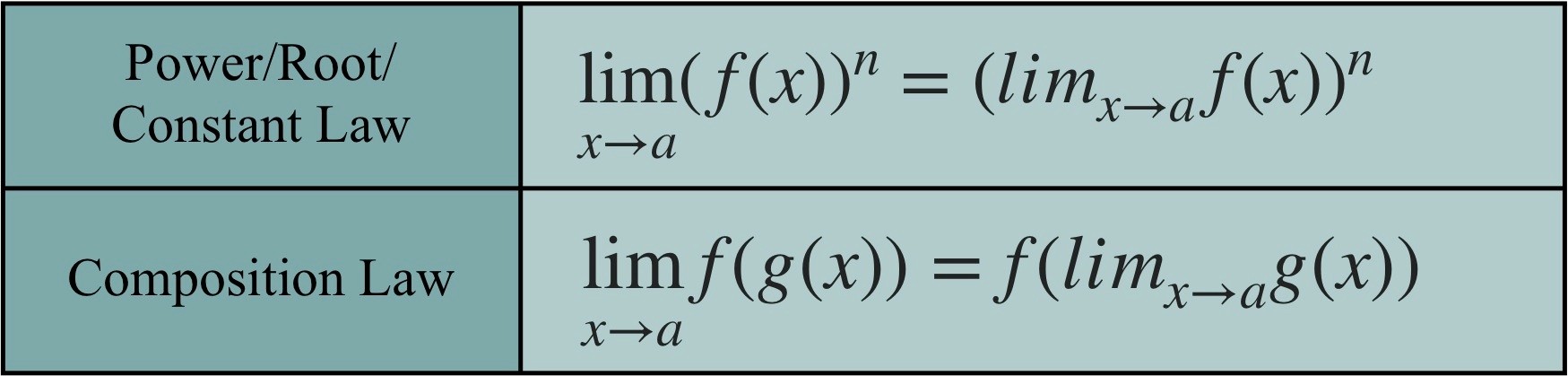
If the function is continuous:
That is basically the fancy mathematical way of saying “the limit of a given function f(x) as x approaches a (an arbitrary constant value) is equal to the value of the function at point a. However, this is only true if the function is continuous at a! Before we discuss when it is true for discontinuous functions, let’s define continuity.
What is a Continuous Function?
The simplest way to answer this question is this: if you can trace the curve of the function without picking up your pencil or pen, you are dealing with a continuous function. Almost every function you have dealt with so far in studying mathematics starting way back in Algebra 2 has probably been a continuous function.
Gallery 2.1.1 Discontinuities
Read all original image captions
Image 1
Image 2
Image 3
Image 4
Image 5
Image 6
Examples of continuous functions:
- Exponential functions
- Logarithmic functions
- Linear and polynomial functions
- Sinusoidal functions
Examples of discontinuous functions:
- Rational functions at excluded denominator zeros
- Some trigonometric functions (tangent, cotangent, secant, cosecant)
- Some piecewise functions
- Fractional functions that could have a zero in the denominator
What makes a function discontinuous?
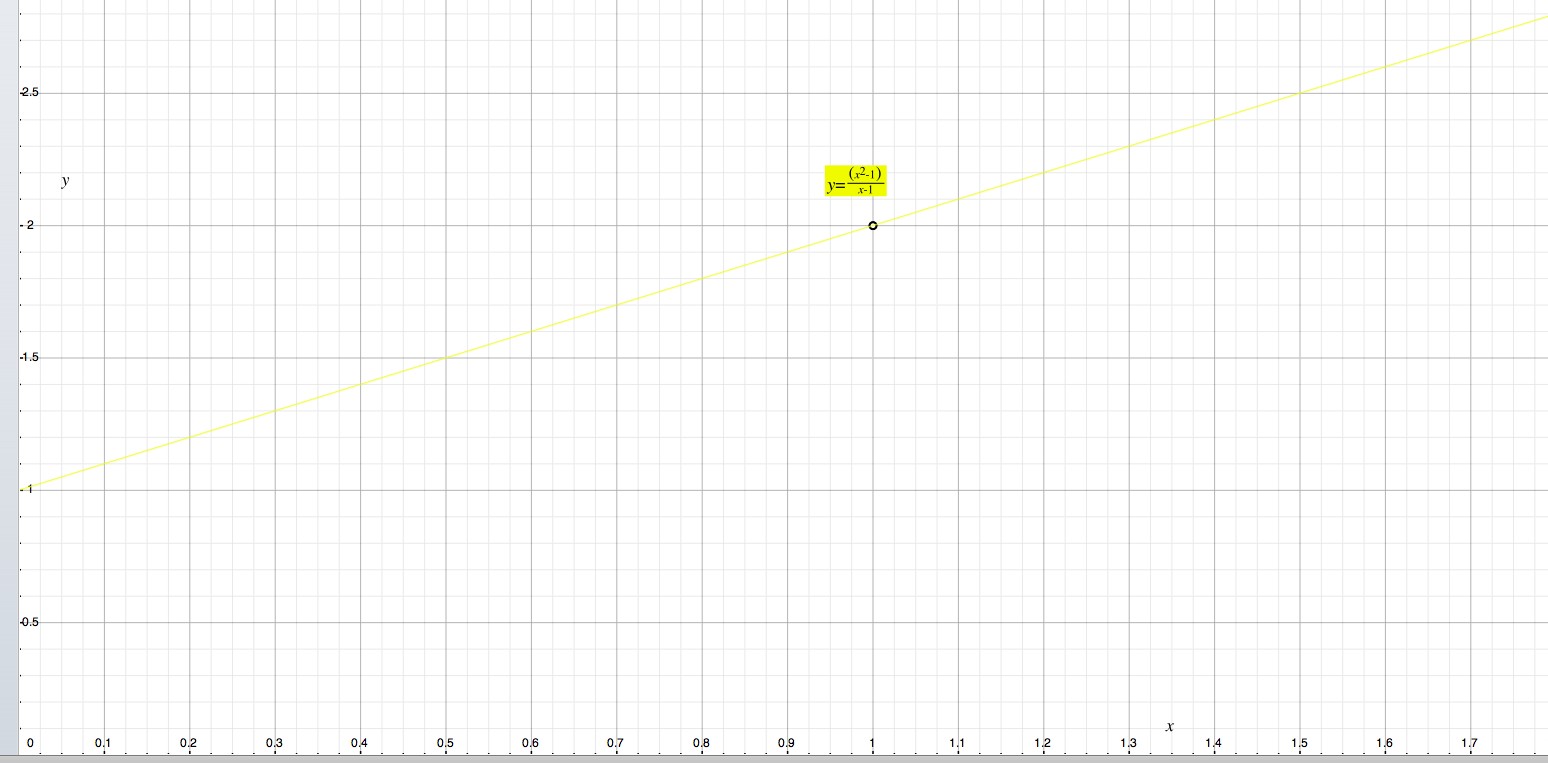
If a function is discontinuous, it is because it contains one or more discontinuities, which can usually be spotted by either observing the graph of the function or its equation. Gallery 2.1.1 shows a few different types of removable and essential (also known as non-removable) discontinuities:
Example Problem 2.1.1.
In the graph of the function below, find:
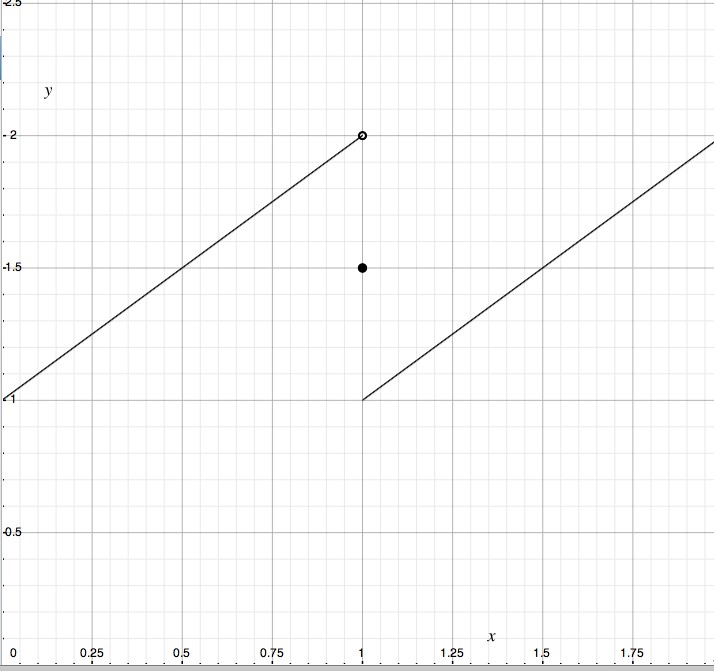
So far we have looked at how to solve limits visually. However, it is also possible to solve them analytically through equations. Just as there are laws in arithmetic and algebra, there are also laws that determine what we can do with limits. Although these laws are very useful, keep in mind that they assume that all limits listed in these laws exist.
Table 2.1 - Limit Laws
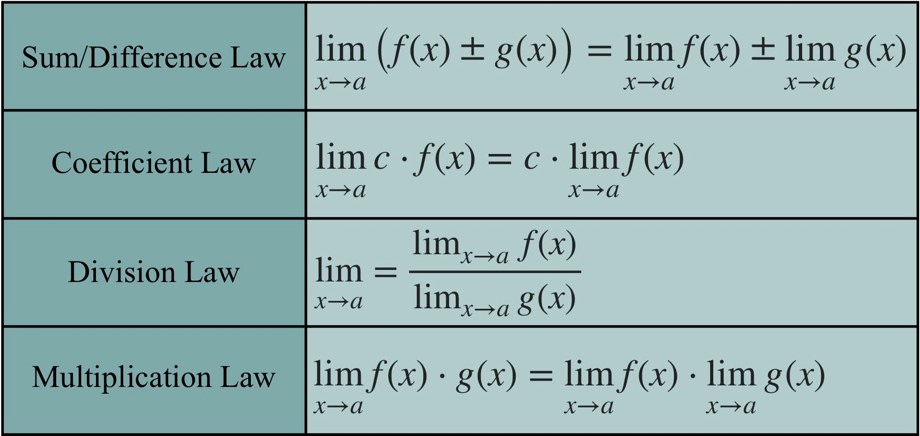
Table 2.2 - Advanced Limit laws
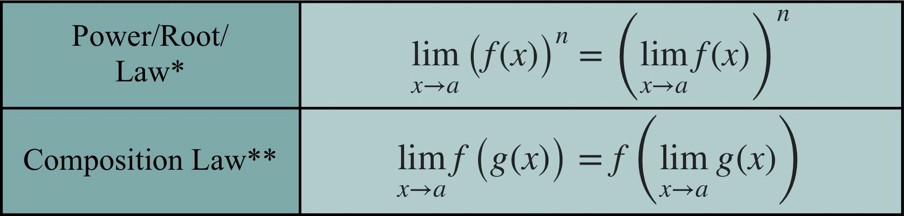 *Although written as the Power Law, it also applies as the Root Law by simply making n a fractional number. It even applies for n = 0, which would give 1 as solution to the limit, because anything raised to the 0 power is 1, and the limit as x approaches any value of a constant function is that constant, in this case 1.
**The Composition Law has an additional assumption that f(x) is continuous on the limit of g(x) as x approaches a.
Key point: The interesting thing about limits is that since they only approach a value, we can use them to estimate behaviors of functions that we would not be able to do otherwise. For example, limits allow us to calculate the behavior of a function at infinity and negative infinity, even though all functions are undefined at infinity. How is this possible? It is because limits only approach infinity. They do not ever equal infinity. Practically, this is the same as plugging in a very high or low value for x, such as ±100,000,000, rather than ±infinity.
Interactive 2.1.1 Visualizing the Squeeze Theorem
Read all original figure notes
Lower Bound
Limit
Upper Bound
Squeeze Theorem
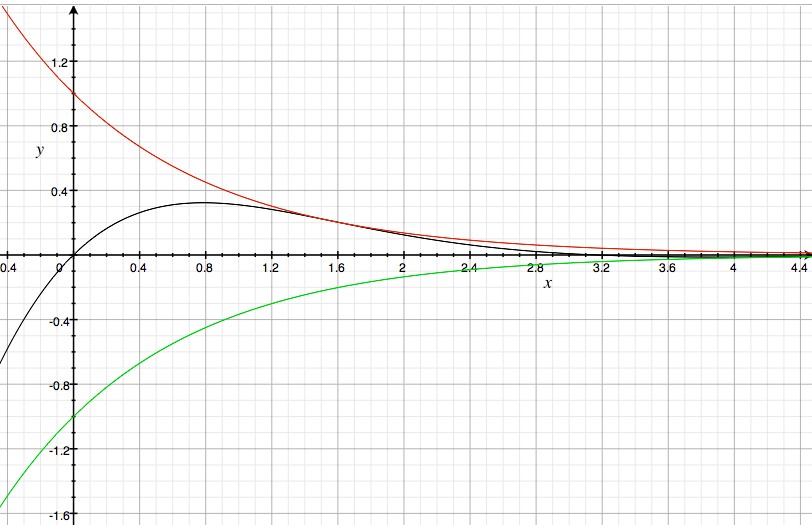
The Squeeze Theorem says that if a function can be bounded by an upper bound function and a lower bound function, and the limits of each of those function is known and converges to the same value, then the limit of the bound function also converges to that value. Mathematically: If is unknown, but there exist functions, g(x) and h(x) such that , and = , then . In case that was just mumbo jumbo to you, here is a visual explanation.
The 6 types of discontinuities
•Hole discontinuity - Occurs when a function is undefined at a single point.
•Skip discontinuity - Occurs when a continuous function has at least one value that pops out, resulting in an isolated point.
•Jump discontinuity - Occurs when a piece of the function breaks off to create a separate function.
•Hopscotch discontinuity - Occurs when two different piecewise functions have a point that is not common in either of their equation.
•Infinite discontinuity - Occurs for a given x-value when one side of the function approaches +∞ and another side of the function approaches -∞.
•Compression discontinuity - Occurs when a function infinitely oscillates back and forth as it approaches a specific value.
Glossary and deeper reading · 7 refreshers
These editorial refreshers supplement the reading. Definitions and examples are added guidance; original source wording and recorded answers remain in their original context.
-
Limit
A limit describes the value approached by outputs as inputs approach a specified target or grow without bound. For an input approaching a finite target, its value at that exact input does not determine the limit. For example, (x²−1)/(x−1) approaches 2 as x approaches 1 even though the original expression is undefined at 1. A finite two-sided limit requires the left and right approaches to agree.
-
Function
A mathematical function assigns exactly one output to each input in its domain. Inputs can share an output, but one input cannot have two different outputs. For example, f(x)=x² assigns the output 9 to both 3 and −3. Function notation names the rule and its input; f(3) means the output when the input is 3.
-
Continuity
A function is continuous at an input when its value exists, its finite limit exists, and those two values agree. At a domain endpoint, continuity uses the relevant one-sided approach. For example, x² is continuous at 3 because both its value and its nearby limit are 9. Continuity on an interval requires the appropriate condition at every input in that interval.
-
Polynomial
A polynomial in one variable is a finite sum of constant multiples of nonnegative integer powers of that variable. The degree is the highest exponent with a nonzero coefficient. For example, 2x³−x+5 is a polynomial of degree 3. Expressions containing 1/x or √x are not polynomials in x.
-
Sinusoidal function
A sinusoidal function has the shape of a sine or cosine graph after shifts, scaling, and possible reflection. A common form is A sin(B(x−h))+D with nonzero A and B. For example, 2 sin(3x)+1 has amplitude 2, midline 1, and period 2π/3. The parameters control vertical variation, repetition, and position of the wave.
-
Rational function
A rational function is a quotient of two polynomials. Its domain excludes inputs that make the original denominator zero. For example, (x²−1)/(x−1) agrees with x+1 away from x=1, but remains undefined there. Canceling a common factor does not automatically restore an excluded input.
-
Discontinuity
A discontinuity is a failure of continuity at an input being considered. The obstruction can be a missing or mismatched value, unequal one-sided limits, oscillation, or unbounded behavior. For example, assigning f(0)=5 while f(x)=x elsewhere creates a discontinuity at 0. Identifying the obstruction determines whether changing one value can repair it.