Special Limits
This original textbook reading covers part of the AP topic. Follow the AP course outline for complete topic instruction and practice.
This book is light on proofs and heavy on visuals. If you would like a formal proof of the following limits, there are many resources available that would help you. They involve using techniques like polynomial expansion and Riemann sums that are helpful if you plan to pursue formal mathematics, or if you are asked to prove them on an exam. However, most people do not fit those criteria. Most people are visual learners and this learning material in your hands is made to be very visual.
So on the next page you will not find long, boring proofs, but a colorful slideshow gallery, probably one of the most important galleries in your life so far. It will give you a preview to your third and final technique in solving complex limits. You should spend at least two minutes per picture on the slideshow to truly understand the images and graphs, and notice important trends that will help you remember the pictures and their corresponding functions.
Gallery 2.3.1 Special Limits
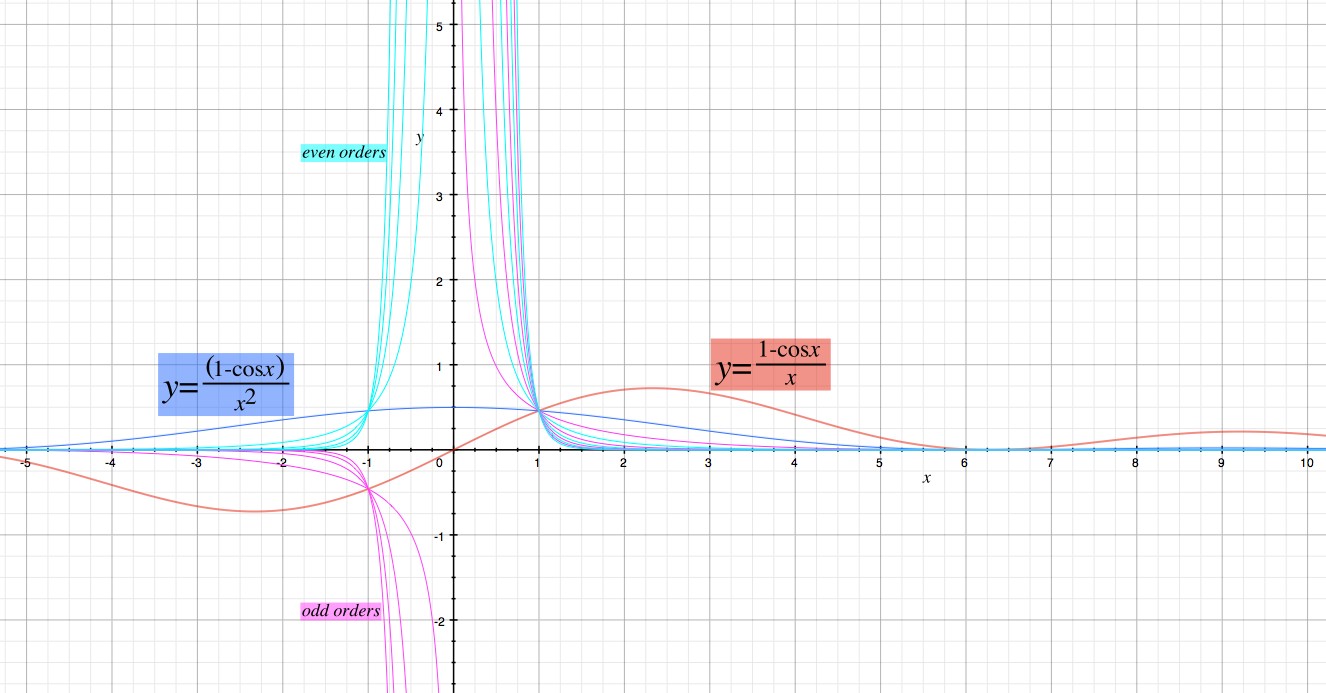
Notice the limits of each function as it approaches 0. The limit of the red function is 0. This is one of the most common limits to be proven in Calculus at the college level. As you increase the order of the x in the denominator to 2, the limit becomes 0.5. As you increase the order further, the limits oscillate between “limit DNE” for odd orders and “limit approaches +∞” for even orders.
Read all original image captions
Image 1
Notice the limits of each function as it approaches 0. The limit of the red function is 0. This is one of the most common limits to be proven in Calculus at the college level. As you increase the order of the x in the denominator to 2, the limit becomes 0.5. As you increase the order further, the limits oscillate between “limit DNE” for odd orders and “limit approaches +∞” for even orders.
Image 2
Image 3
Image 4
This is a great example of what we can accomplish using limits. It is possible to define a whole function through a set of function’s limits at infinity. Notice how an increasing exponent on e corresponds to the same coefficient to the 1/x term inside the parentheses. Also notice that the scale on this graph is logarithmic on the y-axis. This means that every notch increases by a factor of 10. You might want to familiarize yourself with reading these graphs, especially if you plan to go into a science or engineering field.
Limits of polynomial fractions approaching Infinity
If I were to ask you to solve , you would probably think that the limit is 0 because the denominator approaches ∞ much faster than the numerator, and you would be right. Similarly, if I were to ask you to solve , you would realize that the limit approaches -∞ because the numerator approaches -∞ much faster than the denominator. However, how can we solve ? Both the numerator and the denominator have the same highest degree exponent in this case. The shortcut for evaluating this limit is to take the coefficient of the highest degree in the numerator and divide it by the coefficient of the highest degree in the denominator.
A Review of Special Limits
Some of the more important special limits discussed in Gallery 2.3.1 are discussed in the glossary definition for special limits, and also listed below:
Glossary and deeper reading · 3 refreshers
These editorial refreshers supplement the reading. Definitions and examples are added guidance; original source wording and recorded answers remain in their original context.
-
Polynomial
A polynomial in one variable is a finite sum of constant multiples of nonnegative integer powers of that variable. The degree is the highest exponent with a nonzero coefficient. For example, 2x³−x+5 is a polynomial of degree 3. Expressions containing 1/x or √x are not polynomials in x.
-
Riemann sum
A Riemann sum approximates accumulation by adding sample heights times subinterval widths. Left, right, and midpoint sums choose different sample positions in each subinterval. For example, a left sum for x² on [0,2] with two equal widths uses heights 0 and 1, giving 1. A definite integral is the limiting value as the largest subinterval width approaches zero when that limit exists.
-
Limit
A limit describes the value approached by outputs as inputs approach a specified target or grow without bound. For an input approaching a finite target, its value at that exact input does not determine the limit. For example, (x²−1)/(x−1) approaches 2 as x approaches 1 even though the original expression is undefined at 1. A finite two-sided limit requires the left and right approaches to agree.