Riemann Rearrangement Theorem
Beyond this AP Calculus course
This original textbook reading covers part of the AP topic. Follow the AP course outline for complete topic instruction and practice.
Section Overview
Section 3
Riemann Rearrangement Theorem
The Riemann Rearrangement Theorem relies on something which you may have not dealt with yet, rearrangement of a series. The idea is fairly simple but as we will find out later in this section with the introduction of the Riemann Rearrangement series rearrangement can under certain circumstances bring about unintended consequences.
To get you ready for the Riemann Rearrangement Theorem we will do an examples with some simple rearrangement so that we are used to the idea.
Example 5.3.1
Rearrange the following series into three separate orders.

Let’s start with an obvious rearrangement. Will switch the first number with another. Let’s use two. The rearrangement is then

Now let’s do something a little more interesting. We’ll flip everything around! This rearrangement is as follows.

Finally for the third rearrangement we can mix everything up. Here it is.

We will be doing this with infinite series. The principle is the same exactly the same.
The Riemann Rearrangement Theorem is a very odd thing and will most likely seem at least a little paradoxical. The proof of the theorem will not be presented but if you are interested it is easily available through other outlets such as the internet.
The Riemann Rearrangement Theorem follows:
For any conditionally convergent series it is possible to rearrange the series so that it either approaches some arbitrary value or diverges.
What this theorem then allows us to do is take any conditionally convergent series and by rearranging its terms have it either converge to some value or even make it diverge. It is important to realize that this value it converges to can be anything.
Example 5.3.2
Show that the alternating and one half of the alternating series are rearrangements of one another.
To solve this problem we need to recall a few things.In particular we need the definition of the alternating harmonic series and what it normally converges to. From a previous chapter we have that
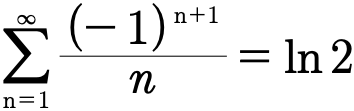
Now that we have the alternating harmonic series and it’s value we need to assure ourselves of one more thing. Since in order for the Riemann Series Theorem to work it is necessary for the series in question to be conditionally convergent we must show (or know) that it is. The alternating series test proves that this is the case (it is discussed later in this book).
Now that we have all our information we are ready to apply the theorem. Since we are trying the halve what the alternating harmonic series normally converges to what we eventually want is to get something in the form of
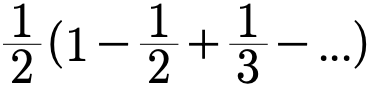
or by multiplying through
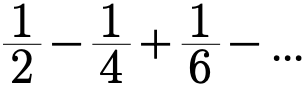
which then may be written as
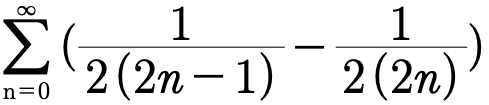
If we now decompose the first term in the summand we can get that

Putting this into our sum gives us

Expanding the sum out would be a problem with its current definition so in order to work we need to change our limits. Instead of starting at zero we can try starting at one. This gives us

Expanded out then we get

which if reordered is nothing more than the alternating harmonic series
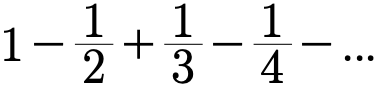
Supplementary Image for Example 5.3.2
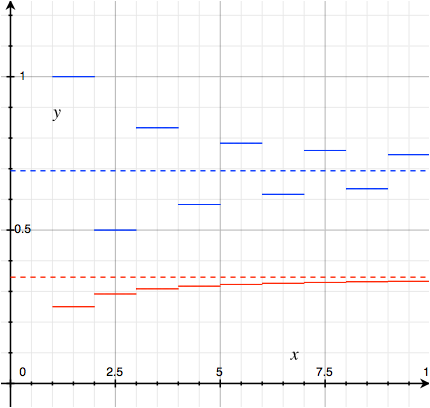
Read all original figure notes
The Red Series
The series plotted in red is the rearranged alternating series. It approaches one-half the normal value of the alternating series which is denoted by the dotted red line.
The Blue Series
The series plotted in blue is the familiar alternating harmonic series in its normal form. It approaches its normal value denoted by the dotted blue line.
Chapter 5 Problems
- What is required for a series to pass the alternating series test?
- What is required for a series to pass the test for absolute convergence?
- Do the following sums define alternating series?
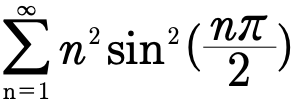
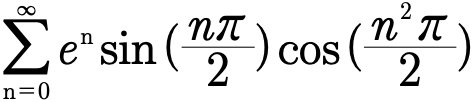
- Determine if the following sums converge.
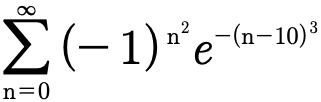
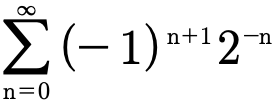
- Determine whether the following series are absolutely convergent, conditionally convergent, or neither.
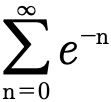
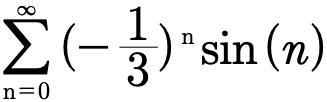
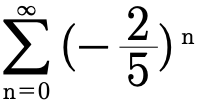
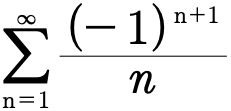
4. Show that the alternating series may be arranged so that it may converge to a value other than the value of example 5.3.2