Absolute and Conditional Convergence
This original textbook reading covers part of the AP topic. Follow the AP course outline for complete topic instruction and practice.
Section Overview
Absolute and Conditional Convergence
When looking at infinite series it is sometimes possible to classify them into different domains in terms of their convergence. One of the ways you may do this is by looking for something called absolute convergence.
To be absolutely convergent a series must past a simple test, the sum of the absolute value of the summand (the inside part of the sum) must itself converge. Using mathematical notation we can restate the definition in a slightly more rigorous way.
For some series defined by
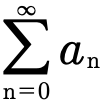
if
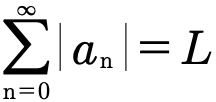
where  is a constant then the series defined by
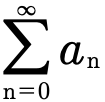
converges.
Absolute Convergence and Example 5.2.1
Read all original figure notes
Graph of Partial Sums
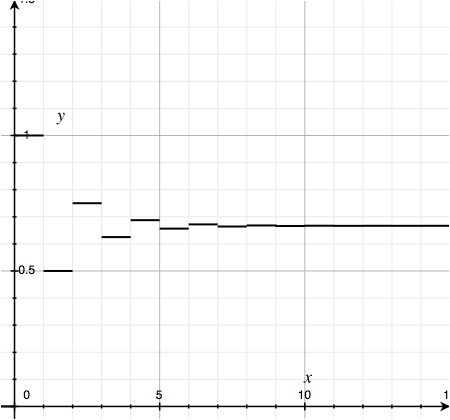
This is a graph of the subsequent partial sums of series for example 5.2.1.
Alternating Behavior
If the series under study is an alternating series you will often see this behavior early on. If the series is absolutely converging this behavior will stop and the series will converge to a single value.
Convergence
At large values an absolutely convergent series will converge. This is true whether or not the series in question is alternating or not.
Determine whether the following sum defines an absolutely convergent series.
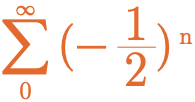
The goal in this problem is to determine whether the sum converges absolutely and to do that we must determine if the sum of the absolute value of the given sums summand converges. That is we must show that
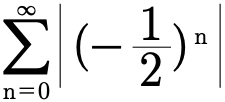
converges.
The first thing we should then do is look at our summand
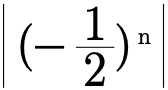
If we transform all the negative terms to positive using the absolute value then all we will be left with is

This we can then put back into our sum and notice that we have something very familiar
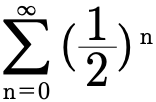
a geometric series.
Since
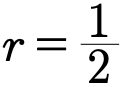
for this geometric series it converges and since this series converges we can conclude that the original series given
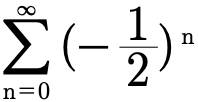
converges as well.
Conditional Convergence and Example 5.2.2
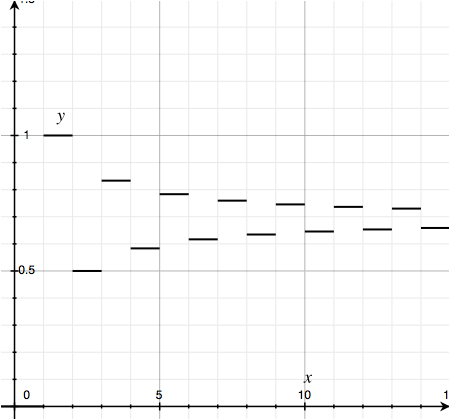
Read all original figure notes
Graph of Partial Sums
This is a graph of the partial sums for the alternating harmonic series in example 5.2.2.
Oscillations
As you can see in a conditionally convergent series you may get oscillations between higher and lower values. Eventually these oscillations peter out so that the series converges to a single value but the oscillations will be prominent throughout.
Example 5.2.2
Determine whether the following sum defines a conditionally convergent series.
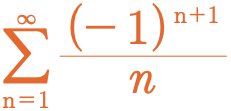
You may recognize the given series as the alternating harmonic series given earlier in the book. This series we already know is convergent. To determine if this series is conditionally convergent we must test for absolute convergence.
The first step then it to look at the absolute value of the summand.
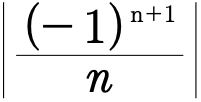
If we remove all the negatives by taking the absolute value we’re left with

which when summed gives us the harmonic series.
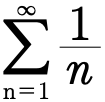
Since the absolute value of the alternating harmonic series is the harmonic series and the harmonic series is divergent we can conclude that the alternating harmonic series is conditionally convergent.
Glossary and deeper reading · 4 refreshers
These editorial refreshers supplement the reading. Definitions and examples are added guidance; original source wording and recorded answers remain in their original context.
-
Conditional convergence
A series converges conditionally when it converges but the series of its absolute term values diverges. Cancellation between positive and negative terms is essential to this convergence. For example, 1−1/2+1/3−1/4+⋯ converges while the harmonic series of its magnitudes diverges. Rearranging a conditionally convergent series can change its sum or destroy convergence.
-
Infinite series
An infinite series is the sum of the terms of an infinite sequence, defined through its partial sums. The series converges when those partial sums approach a finite value. For example, 1/2+1/4+1/8+⋯ converges to 1. Terms approaching 0 are necessary for convergence, but that condition alone is insufficient.
-
Convergence of a series
A series converges when the sequence of its partial sums approaches a finite limit. It diverges when there is no such finite limit. For example, 1/2+1/4+1/8+⋯ converges to 1, while the harmonic series diverges. Convergence of the individual terms to 0 is necessary but does not by itself establish convergence of their sum.
-
Absolute convergence
A series converges absolutely when the series of its absolute term values converges. Absolute convergence also guarantees convergence of the original signed series. For example, an alternating series with magnitudes 1/n² converges absolutely. An absolutely convergent series retains its sum under any rearrangement of its terms.