Sequences
This original textbook reading covers part of the AP topic. Follow the AP course outline for complete topic instruction and practice.
Section 1
Sequences
Sequence an = 2n-1
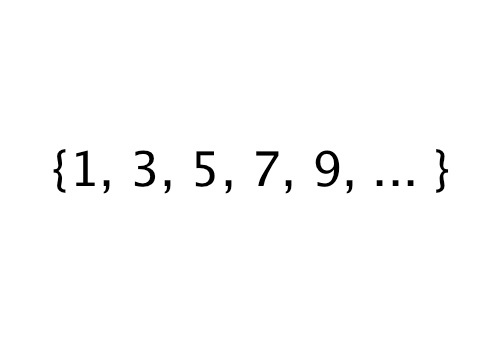
Read all original figure notes
Initial term
The difference between a sequence and a function is that a sequence starts at an initial value.
To infinity
A sequence carries on until infinity, similar to a continuous function.
Chapter 2 - Sequences and Series
Basic Definition
A sequence is an infinite list of numbers in a particular order.
A specific number in a sequence is called a term.
Terms are named in chronological order. (ex: first term, second term, third term, etc.)
Terms are expressed in the following notation:
a1 = first term
a2 = second term
a3 = third term
an = nth term
Sequences may be expressed in two ways.
1. {an}n=k, where k is the starting index
2. an = f(n)
Some sequences can be thought of as the output of functions, where you only plug in whole numbers, or integers. These are known as explicit sequences. Explicit sequences usually give you a formula, designated as an = f(n).
Example Problem 2.1.1
Write out the first four terms of the sequence, given
an = 2n+1, with the starting index n=1
To write the sequence, we need to know its terms. Let’s start with the first term. To find a1, plug the starting index n=1 into an
a1 = 2(1)+1 = 2+1 = 3
Use the same method to find a2, a3, a4, and so on
a2 = 2(2)+1 = 4+1 = 5
a3 = 2(3)+1 = 6+1 = 7
a4 = 2(4) + 1 = 8+1 = 9
Now that we know the values for a1, a2, a3, and a4, we can write them into the sequence
{3, 5, 7, 9, ... }
Two basic types of sequences are Arithmetic Sequences and Geometric Sequences.
An arithmetic sequence is one where the consecutive terms have a common difference.
A geometric sequence is one where the consecutive terms have a common ratio.
Formulas for Arithmetic and Geometric Sequences
Arithmetic Sequence
an = dn + c, where d is the common difference and c is the constant.
d = an - an-1
Sequence diverges towards ±∞.
Geometric Sequence
an = a1rn-1, where r is the common ratio.
r = an / an-1
Sequence converges to 0 only when -1<r<1
Sequence diverges when |r|>1
When r=1,  (1)n = 1.
Example Problem 2.1.2
Find a formula for the arithmetic sequence
{3, 10, 17, 24, ... }
Example Problem 2.1.2 Answer
The first step is to find the common difference.
d = an - an-1
d = a2 - a2-1 = a2 - a1
d = 10 - 3
d = 7
Next, plug d into the arithmetic sequence formula
an = dn + c
an = 7n + c
To find the value of the constant, choose a term to plug into the formula. In this example the first term will be used; however, any term may be used.
a1 = 7(1) + c
3 = 7 + c
c = -4
Now knowing the values of d and c, plug them back into the arithmetic sequence formula, to find that
an = 7n - 4
Example Problem 2.1.3
Find a formula for the the geometric sequence
{2, 6, 18, 54, ... }
First, find the common ratio.
r = an / an-1
r = a2 / a2-1 = a2 / a1
r = 6 / 2
r = 3
Next, plug r and a1 into the Geometric Sequence formula,
an = a1rn-1
To find that
an = 2(3)n-1
In the previous two examples, the common difference and the common ratio were found using the first two terms. Note that you may use any two, consecutive terms to find the common difference or ratio, as long as it is the same for every pair of consecutive terms in the sequence.
Not all sequences are explicit; they may not give you a specific formula to find the nth term.
To understand this further, let’s look at this next sequence.
Example Problem 2.1.4
Find a7 and a8 of the sequence
{0, 1, 1, 2, 3, 5, ... }
The pattern for this sequence is that the next term is the sum of the two receding terms (the third term is the sum of the first and second, or a3 = a1 + a2 . The fourth term is the sum of the second and third, or a4 = a2 + a3), being that a1 = 0 and a2 = 1.
To find a7, add together a5 and a6.
a7 = a5 + a6
a7 = 3 + 5
a7 = 8
Repeat the process to find a8.
a8 = a6 + a7
a8 = 5 + 8
a8 = 13
This kind of sequence, where the next term is found by applying a recurring pattern, is called a recursive sequence, and in the case of example 2.1.4, this recursive sequence is known as the Fibonacci Sequence, where an = an-2 + an-1 .
While this may look like an explicit formula, you cannot find any nth term without first knowing the two receding terms.
As a sequence is an infinite list, there is no final term. With that said, there exists a hundredth term, thousandth term, and even a millionth term.
In Calculus, the behavior of a sequence is analyzed to see what the value of the term an is as n gets larger and larger, approaching infinity.
To understand this concept, let’s look at the graph of a sequence in this next example problem.
Example 2.1.5
Graph the first 100 terms of an = 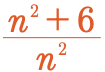 starting with n=1
To graph the terms of a sequence, plug the values into the coordinates
(n, an)
Looking at the first ten, the terms appear to be decreasing, at first dramatically and then leveling off.
Looking at the first fifty and hundred, the graph appears to have leveled off at y = 1. As n gets larger and larger, the terms seem to get closer to 1.
The value 1 is known as the limit of the sequence as n approaches infinity. You may also hear that the sequence is bounded to 1, or that 1 is the lower bound.
If there exists a limit for a sequence, it is written as
lim an = L
n->∞
And in the case of example 2.1.5, the limit is written as
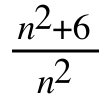 = 1
Graph 2.1.5
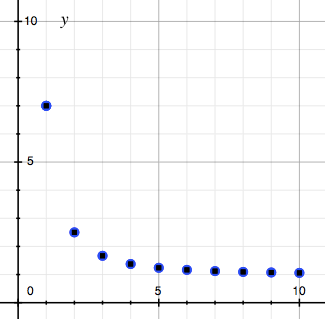
The first ten terms.
Read all original image captions
Image 1
The first ten terms.
Image 2
The first fifty terms.
Image 3
The first 100 terms. As you can probably notice, if we were to zoom out really far, the sequence would start to look like a function.
Tip: You can plug the formula for an into one of the Y equations, substituting n for x, on your graphing calculator. Going to the Table screen, you can find any nth term by plugging in ‘x=n’. The corresponding term an will be in the Y column. The Table screen is a great way to see the hundredth, thousandth, or any larger term.
Now that the value of an as n approaches infinity can be seen as a limit, there are several properties that you must know.
Sequence Properties
- If the next term of a sequence is either always greater than or always less than the previous term, then the sequence is known as monotonic.
- If the next term of a sequence is always greater than the previous term, or if an > an-1, then the sequence is known as monotonically increasing.
- If the next term of a sequence is always less than the previous term, or if an < an-1, then the sequence is known as monotonically decreasing.
- If the term an gets closer to a value L as n approaches infinity, then lim an = L.
- If a sequence increases without bound, then the lim an = ∞.
- If a sequence decreases without bound, then the lim an = -∞.
- If an = f(n) and there exists a function f(x) such that f(n)=f(x), and the lim f(x) = L, then the lim an = L.
- Given an ≤ bn ≤ cn, and lim an = L = lim cn, then lim bn = L also.
The fourth property states that there may be a value to which the sequence gets closer to as you reach the infinite term.
The fifth and sixth property state that a sequence may head towards positive or negative infinity.
The seventh property states that if there’s a function that corresponds to the terms of a sequence, and there is a limit for the function, the the sequence heads toward that limit also.
The eighth property is known as the Squeeze Theorem. The Squeeze Theorem states that if a function (or sequence) lies between two known functions (or sequences), and if those two functions (or sequences) head toward the same limit, then the middle function (or sequence) heads toward that limit also.
If there is a limit for a sequence, then it is known as a converging sequence, where it converges to that limit.
If there is no limit, then it is a diverging sequence.
Properties of Limits



Example 2.1.6
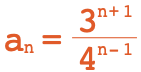 , with the starting index n=1 converges or diverges. If it converges, find its limit.
We want to see if 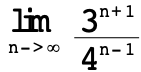 exists.
With sequences, more than likely you will have to change the formula in order to check if it converges or not, and this one is no exception.
Using the property of combining exponents with the same base,
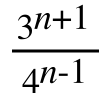 =
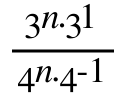
Since the exponent on the second 4 is negative, you can bring it up to get

Following
 ,

And since  <1,
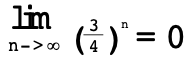
And so

Therefore, the sequence converges to 0.
Example 2.1.7
Find out if the sequence an =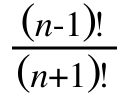 , with the starting index n=1, converges or diverges. If it converges, find its limit.
Let’s start with finding the first four terms.
a1 = 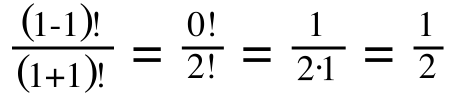
a2 = 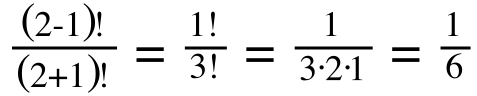
a3 = 
a4 = 
Looking at the first four terms, the terms are decreasing as n becomes larger. Also, you can see that the numbers in the numerator are always canceled out by numbers in the denominator, leaving the product of two numbers in the denominator. With algebraic manipulation, you can see that the term
an = 
With the new format of an, you can find the limit of 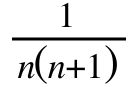 to see
= 0.
Therefore, the sequence converges to 0.
Example 2.1.8
See if the sequence an = 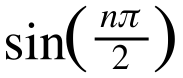 , with starting index n=1, converges or diverges. If it converges, find its limit.
Let’s find the first five terms.
a1 = 
a2 = 
a3 = 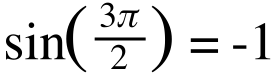
a4 = 
a5 = 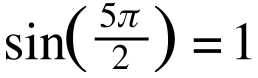
Looking at the first five terms, you can see that the first term is equal to the fifth term. Because of the behavior of the sine function, the sequence will forever cycle through the values {1, 0, -1, 0, 1, 0, ...}. Since there is no value to which the sequence heads to as n approaches infinity,
= DNE
And since the limit does not exist, the sequence diverges.
Example 2.1.9
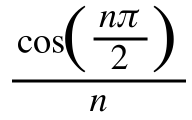 , with starting index n=1, converges or diverges. If it converges, find its limit.
This example will be approached by first looking at the numerator of the term.
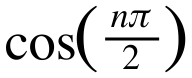
Since this is a cosine function, you know the value will never be less than -1 or be greater than 1. As such,
-1 ≤ ≤ 1
Now since is being divided by n in the sequence, the next step will be to divide by n across the inequality.
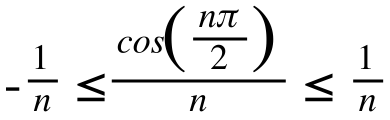
The next step is to take the limit as n approaches infinity of the left and right sides.
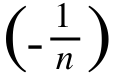 = 0 =

Since they both head toward the same limit, this means that, according to the Squeeze Theorem,
Graph 2.1.8
Read all original image captions
Image 1
= 0
Therefore, the sequence converges to 0.
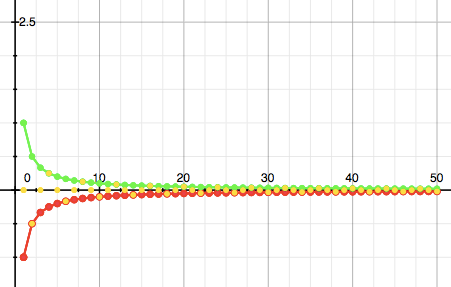
Here is the graph of example 2.1.8. The sequence 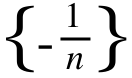 is in red, the sequence
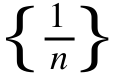 is in green, and the sequence is in yellow. Notice how the sequence is bounded between the other two sequences.
Note: While the graph of a sequence plots only the points, the upper and lower sequence show lines to emphasize that the middle sequence is bounded between the other two.
Finally, here is one last tip for determining the convergence of a sequence.
L'Hôpital’s Rule
If 
 =
 or
 ,
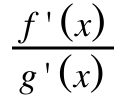
Then
= 
You may remember L'Hôpital’s Rule from Calculus I. While the rule is for functions, it works for sequences also.
As long as the limit meets either one of the two conditions ( or ), you can take the derivative of the numerator and the denominator and find the limit of the new expression to obtain the original limit.
Example 2.1.10
Determine the convergence of the sequence 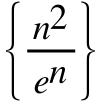 n=1.
We are looking to see if 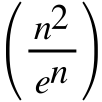 exists.
When n approaches infinity, the value of the sequence yields
 .
Since it meets one of the conditions for L'Hôpital’s Rule, we can take the derivative of the top and the bottom and check the limit of that.
Taking the derivative, we are now looking to see if 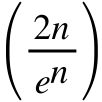 exists.
Again, as n approaches infinity, the value of the limit is
.
So we do L'Hôpital’s Rule again.
Now we are looking to see if 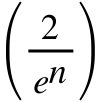 exists, and it does.
= 0.
This tells us that the sequence n=1 converges to 0.
Review 2.1
Question 1 of 6 · 0 correct
Find 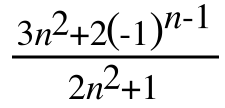
Glossary and deeper reading · 3 refreshers
These editorial refreshers supplement the reading. Definitions and examples are added guidance; original source wording and recorded answers remain in their original context.
-
Infinite series
An infinite series is the sum of the terms of an infinite sequence, defined through its partial sums. The series converges when those partial sums approach a finite value. For example, 1/2+1/4+1/8+⋯ converges to 1. Terms approaching 0 are necessary for convergence, but that condition alone is insufficient.
-
Index of a sequence or sum
An index identifies the position of a term in a sequence or finite or infinite sum. The starting index determines which term is included first. For example, a sum indexed by n=0 starts with the term obtained by substituting 0 into its term formula. Reindexing is valid only when the formula and bounds change together so that the same terms are retained.
-
Function
A mathematical function assigns exactly one output to each input in its domain. Inputs can share an output, but one input cannot have two different outputs. For example, f(x)=x² assigns the output 9 to both 3 and −3. Function notation names the rule and its input; f(3) means the output when the input is 3.