Power Series
This original textbook reading covers part of the AP topic. Follow the AP course outline for complete topic instruction and practice.
Section Overview
Section 1
Power series are series in the form of

where  are the coefficients for each term and
 is some constant which the series is centered around. Power series occur in many places in mathematics and are occasionally find use in the physical sciences. Having knowledge about power series will help in understanding Taylor Series in the following section since Taylor Series are a form of power series.
The operations on power series can be easily determined by recalling the properties of algebra you are familiar with. To add or subtract two power series together you would only need to add or subtract coefficients of corresponding exponents. Subtraction in a power series may then be defined as

where both f(x) and g(x) denote power series centered around the same number.
Multiplication of two power series can be a little more hairy to think about but as with addition and subtraction it follows from familiar algebraic rules. Like when multiplying polynomials together each term in one polynomial must be multiplied to every term in the other polynomial. Symbolically this may be written as

and further generalized to be

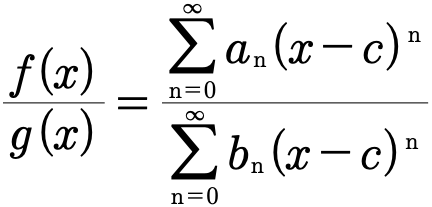
Division for power series is defined as
Example 6.2.1
Let

Compute
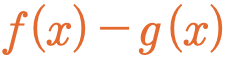
Using the rules for the addition and subtraction of power series this should be pretty straight forward. All we have to do is combine the coefficients using the appropriate sign.


Power series may alongside the usual operations be integrated and differentiated. In both cases this is done term by term using the rules for differentiation and integration for powers. As with the other operations on power series a symbolic definition may be created.

Notice the shift in indices in the sums. The reason for the 1 in the middle sum is due to the fact that in the power series there is a single term which is a constant value. Taking the derivative of a constant yields zero so it is thrown away. To start at zero again n then needs to be shifted by one.
Integration has a similar definition.

The constant k here is the sum of all integration constants which results from integrating each term separately. A similar index shift occurs here as with the derivative.
Example 6.1.2
Integrate and take the derivative of the following power series. Simplify if possible.
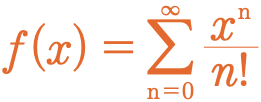
To start off this problem let’s first use our definition to take the derivative of this power series.

This equation can then be simplified since

Making the appropriate substitutions then gives us
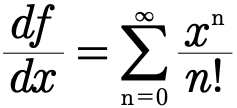
The integral of this power series proceeds in the same manner. First use the definition to get the integral.

Here the extra term in the denominator can be combined into the factorial to give.
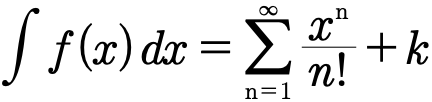
You may have noticed something odd about the derivative and integral in the previous example. If k were 1 both the derivative and the integral would be the same as the initial power series. This is no coincidence. The power series in the example is actually the exponential function and using methods discussed later in the chapter this power series can easily be derived.
Convergence in power series depends upon x’s value and the nature of the power series coefficients. In general there are two different scenarios which describe a power series convergence.
1. If x=c a power series will converge.
2. For some power series there is a number r named the radius of convergence for which if |x-c|< r the power series will converge and for which if |x-c|> r the power series will diverge.
The geometric series (which is itself a power series) exhibits this behaviour. It has a radius of convergence of 1 since in order for a geometric series to converge |r|<1 and for the geometric series to diverge |r|>1.
Determining when a power series will converge is possible and is easily done using the ratio test
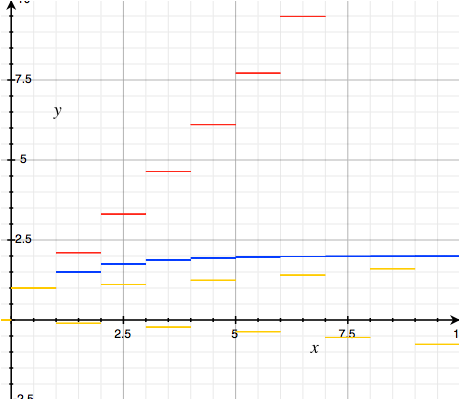
A Power Series in Disguise
Read all original figure notes
|r|<1
The blue line is inside the radius of convergence. As a result the blue line converges.
|r|>1
The yellow and red lines are both outside the radius of convergence and as a result they both diverge.
Review 1.1 Power Series
Question 1 of 5 · 0 correct
Is the following series a power series?

Glossary and deeper reading · 4 refreshers
These editorial refreshers supplement the reading. Definitions and examples are added guidance; original source wording and recorded answers remain in their original context.
-
Power series
A power series is an infinite series of constant multiples of powers of x−c about a center c. It can converge for some inputs and diverge for others. For example, 1+x+x²+⋯ represents 1/(1−x) when |x|<1. Determining the radius and checking the endpoints establishes its interval of convergence.
-
Infinite series
An infinite series is the sum of the terms of an infinite sequence, defined through its partial sums. The series converges when those partial sums approach a finite value. For example, 1/2+1/4+1/8+⋯ converges to 1. Terms approaching 0 are necessary for convergence, but that condition alone is insufficient.
-
Taylor series
A Taylor series is the infinite power series built from a function’s derivatives at a chosen center. Its coefficients are the derivatives at the center divided by the corresponding factorials. For example, eˣ has Taylor series 1+x+x²/2!+x³/3!+⋯ centered at 0. A Taylor series represents the function only where convergence and the vanishing remainder justify that equality.
-
Polynomial
A polynomial in one variable is a finite sum of constant multiples of nonnegative integer powers of that variable. The degree is the highest exponent with a nonzero coefficient. For example, 2x³−x+5 is a polynomial of degree 3. Expressions containing 1/x or √x are not polynomials in x.