Chapter 4 Source Answers and Examples
Chapter problems → · Original reading →
This chapter has no answer key. Its worked examples follow.
Worked examples and reviewed revisions
Example Problem 4.2.1
Original example and steps
Example Problem 4.2.1
Draw the Lewis Structure for Carbon Tetrachloride (CCl4)
Because this compound involves only two types of atoms, we will start by drawing the Lewis Structures for each one.
Carbon: <Image 1>
Chlorine: <Image 2>
Now we start by finding the total number of valence electrons: 4 + (4)*7 = 32. This will be the only electrons we can work with.
Now, we draw up the molecules all bonded together. Since Carbon can form 4 bonds, we will use that as the center and have all the chlorines bonded to it:
<Image 3>
Now we have created 4 bonds using 2 electrons each. This leaves us with 32 - 4*2 = 24 electrons to divvy up. Since the Carbon atom is full (8 electrons) we have to split these electrons between each Chlorine. Remember to distribute them evenly, as they’re all the same atom. This gives us 6 electrons on each chlorine, for a final structure that looks like:
<Image 4>
Example Problem 4.2.2
Original example and steps
Example Problem 4.2.2
Draw the Lewis Structure for the Carbon Monoxide (CO) molecule.
Carbon monoxide is just two atoms, so we start with their individual lewis structures:
Carbon: <Image 1>
Oxygen: <Image 2>
First things first, we figure out how many electrons we are working with. The 4 from Carbon and the 6 from Oxygen give us 10 to work with.
Example Problem 4.2.3
Original example and steps
Example Problem 4.2.3
Draw the Lewis Structure for the Ammonium (NH4+) ion.
We start with the involved atoms:
Nitrogen: <Image 1>
Hydrogen: <Image 2>
Next, we count our valence electrons: 5 + 4*1 = 9. But wait! We have an ion, so we have to subtract one, giving us 8.
Next, we draw the single bonds between the atoms:
<Image 3>
That used 4 bonds, using up all our electrons. Now we need to show the total charge and the formal charge, which exists on the N atom:
<Image 4>
As there is no way to remove all the formal charges, we are done.
Example Problem 4.2.4
Original example and steps
Example Problem 4.2.4
Draw the Lewis Structure for the Acetate (CH3COO-) ion.
If we start with the involved atoms, we have:
Carbon: <Image 1>
Hydrogen: <Image 2>
Oxygen: <Image 3>
Next we count up our electrons: 4*2+1*3+6*2+1 = 24.
Now we draw the initial single bonds. This one is quite a bit trickier than before. In this compound, we still have carbon acting as the central atom, but instead of one carbon, we have two that are bonded to one another. This looks like:
<Image 4>
We see that we have 6 bonds involved here. This means that we have 12 left over electrons to spend. To figure out what to do with these, we look at the octets involved.
The first carbon atom, along with its hydrogens, are set. The second carbon atom, and each oxygen atom are a bit lacking. Because the carbon currently has only 3 bonds, let’s add another between it and one of the oxygen atoms. Because there are so many bonds, we will switch to a line-bond notation, where the two electrons in a bond are replaced by one line:
<Image 5>
Now we have satisfied the octet of the carbon, we have one oxygen needing 4 electrons and another needing 6. This works out perfectly, as we have 10 leftover electrons. This gives us our final Lewis Structure of:
<Image 6>
That’s not all, though! You may be wondering how we chose the top oxygen to receive the double bond. In fact, that was a completely arbitrary choice. Either oxygen could receive the second bond, and if we just take the electrons and append them accordingly, we would have two equally valid structures. This means the two are in resonance and we need to show them as such:
<Image 7>
Gallery 4.2.2 Drawing the Lewis Structure for H2O
Original example and steps
Gallery 4.2.2 Drawing the Lewis Structure for H2O
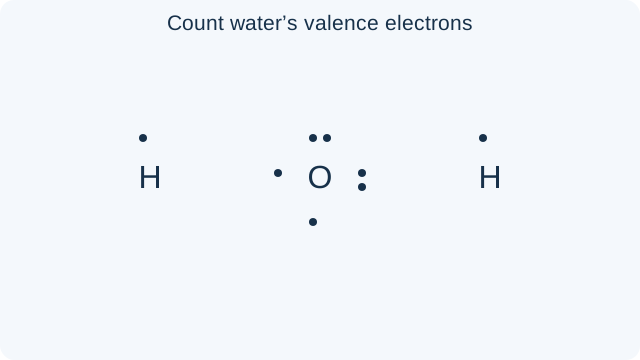
New reviewed diagram replaces the source numeral placeholder.
Two H atoms supply two electrons and O supplies six, for eight total valence electrons.
Read all reviewed image captions
Image 1
New reviewed diagram replaces the source numeral placeholder.
Two H atoms supply two electrons and O supplies six, for eight total valence electrons.
Image 2
New reviewed diagram replaces the source numeral placeholder.
The two orange highlighted pairs between H and O are bonding pairs: one electron from each H is paired with one of oxygen’s electrons. The four blue electrons remain on oxygen as two lone pairs. All eight valence electrons are counted. This straight Lewis counting layout does not depict water’s molecular geometry.
Image 3
New reviewed diagram replaces the source numeral placeholder.
The finished structure has two bonding pairs and two lone pairs on oxygen. Each hydrogen has a duet and oxygen has an octet.
Example Problem 4.3.1
Worked example
AP edition reviewed replacement.
Estimate ΔH forCH₄(g)+2O₂(g)→CO₂(g)+2H₂O(g), using supplied mean bond energiesC–H413,O=O498,C=O799,O–H463kJmol⁻¹.
New independently computed worked answer.
Breaking reactant bonds requires4(413)+2(498)=2648kJ. Forming product bonds releases2(799)+4(463)=3450kJ. ΔH≈2648−3450=−802kJ per written reaction, or per mole of methane reacted. The original2638sum and positive812result are superseded. These are mean gas-phase bond estimates; liquid water requires phase-change thermochemistry.
Gallery 4.3.2 Born-Haber Cycle
Original example and steps
Gallery 4.3.2 Born-Haber Cycle
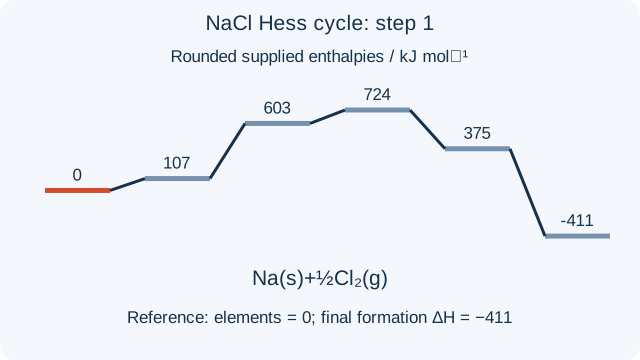
New reviewed diagram replaces the source numeral placeholder.
Choose the standard elements as zero:Na(s)+½Cl₂(g). The formation enthalpy ofNaCl(s) is−411kJmol⁻¹ relative to that reference. This is a reviewed Hess-law enrichment diagram with rounded supplied values.
Read all reviewed image captions
Image 1
New reviewed diagram replaces the source numeral placeholder.
Choose the standard elements as zero:Na(s)+½Cl₂(g). The formation enthalpy ofNaCl(s) is−411kJmol⁻¹ relative to that reference. This is a reviewed Hess-law enrichment diagram with rounded supplied values.
Image 2
New reviewed diagram replaces the source numeral placeholder.
SublimingNa adds107kJmol⁻¹, reaching relative enthalpy+107. This is a reviewed Hess-law enrichment diagram with rounded supplied values.
Image 3
New reviewed diagram replaces the source numeral placeholder.
IonizingNa adds496kJmol⁻¹, reaching107+496=603. This is a reviewed Hess-law enrichment diagram with rounded supplied values.
Image 4
New reviewed diagram replaces the source numeral placeholder.
Dissociating½Cl₂ adds121kJmol⁻¹, reaching724. This is a reviewed Hess-law enrichment diagram with rounded supplied values.
Image 5
New reviewed diagram replaces the source numeral placeholder.
Adding an electron toCl releases349kJmol⁻¹, reaching375. This is a reviewed Hess-law enrichment diagram with rounded supplied values.
Image 6
New reviewed diagram replaces the source numeral placeholder.
FormingNaCl(s) from gaseousNa⁺andCl⁻ releases786kJmol⁻¹:375−786=−411. Lattice formation is−786; lattice dissociation is+786. This is a reviewed Hess-law enrichment diagram with rounded supplied values.
Gallery 4.4.1 VSEPR Model
Original example and steps
Gallery 4.4.1 VSEPR Model
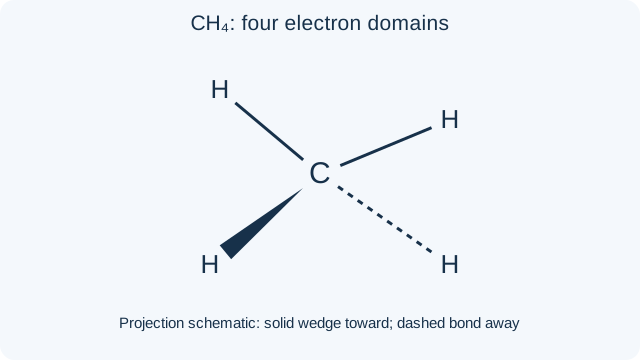
New reviewed diagram replaces the source numeral placeholder.
Reviewed replacement species:CH₄ has four C–H bonding domains and no lone pairs on its central carbon. An isolatedNe atom is not aNe molecule with a VSEPR central atom.
Read all reviewed image captions
Image 1
New reviewed diagram replaces the source numeral placeholder.
Reviewed replacement species:CH₄ has four C–H bonding domains and no lone pairs on its central carbon. An isolatedNe atom is not aNe molecule with a VSEPR central atom.
Image 2
New reviewed diagram replaces the source numeral placeholder.
Four electron domains give tetrahedral electron-domain geometry in this model. A domain describes a region of electron density, not a little electron parked at a vertex.
Image 3
New reviewed diagram replaces the source numeral placeholder.
VSEPR models the domain arrangement that reduces repulsions. It predicts molecular geometry; it does not draw atomic electron trajectories.
Image 4
New reviewed diagram replaces the source numeral placeholder.
Methane’s electron-domain and molecular geometries are tetrahedral, with ideal bond angles about109.5°. The drawing is a projection, not a flat square molecule.
Gallery 4.4.2 Drawing 3-D structures
Original example and steps
Gallery 4.4.2 Drawing 3-D structures
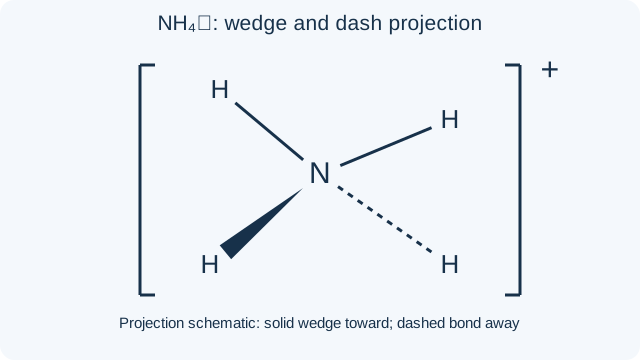
New reviewed diagram replaces the source numeral placeholder.
The chosen species is ammonium,NH₄⁺, with four N–H bonds and no nitrogen lone pair. The positive charge is required; it is not neutralNH₄.
Read all reviewed image captions
Image 1
New reviewed diagram replaces the source numeral placeholder.
The chosen species is ammonium,NH₄⁺, with four N–H bonds and no nitrogen lone pair. The positive charge is required; it is not neutralNH₄.
Image 2
New reviewed diagram replaces the source numeral placeholder.
Ordinary lines represent bonds in the drawing plane. We choose that plane to communicate a three-dimensional tetrahedral arrangement.
Image 3
New reviewed diagram replaces the source numeral placeholder.
A solid wedge points toward the viewer; a dashed wedge or hashed bond points away. The source caption reversed those meanings. Ordinary lines remain in the plane.