Atomic Bond Energies
Supporting original reading. Follow the AP topic pathway for reviewed scope, worked reasoning and targeted practice.
Chemistry I · original Chapter 4 · combined Chapter 4
Section Breakdown
Section 3
Atomic Bond Energies
Once a covalent bond forms, separating the atoms takes energy. The bond dissociation enthalpy, D, is the positive enthalpy change for breaking one mole of specified bonds in gaseous species. It measures the cost of breaking the bond, rather than energy that is released by breaking it.
| Bond | Enthalpy (kJ/mol) |
|---|---|
| H-H | 436 |
| H-C | 413 |
| H-O | 463 |
| H-N | 391 |
| O-O | 146 |
| C-C | 348 |
| C-O | 351 |
| Cl-Cl | 243 |
| O=O | 498 |
| C=C | 614 |
| C=O | 799 |
C≡C | 1072 |
C≡N | 890 |
The unit kJ mol⁻¹ refers to a mole of bonds broken. For example, breaking one mole of H–H bonds in H₂(g) requires about 436 kJ. Reversing that process, forming the same bonds from gaseous H atoms, releases about 436 kJ.
Gallery 4.3.1 Covalent Bonding
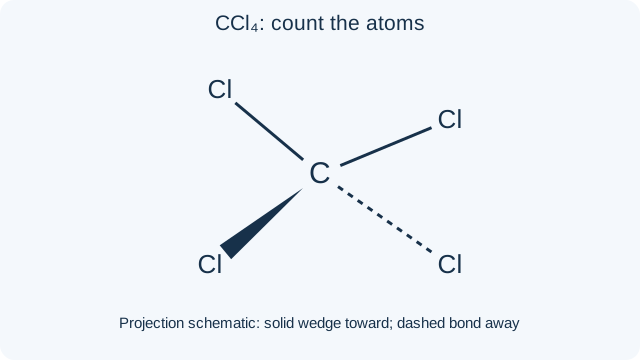
New reviewed diagram replaces the source numeral placeholder.
One C atom and four Cl atoms contribute4+4(7)=32valence electrons. The shown geometry is a schematic of the final molecule, not a claim that free atoms already form that arrangement.
Read all reviewed image captions
Image 1
New reviewed diagram replaces the source numeral placeholder.
One C atom and four Cl atoms contribute4+4(7)=32valence electrons. The shown geometry is a schematic of the final molecule, not a claim that free atoms already form that arrangement.
Image 2
New reviewed diagram replaces the source numeral placeholder.
In the Lewis structure, four C–Cl bonds use eight electrons and the twelve chlorine lone pairs use the remaining24. Electrons are described quantum mechanically; they are not ushered along classical paths.
Image 3
New reviewed diagram replaces the source numeral placeholder.
Forming bonds from separated gas-phase atoms lowers energy under the stated bonding model. The final CCl₄ arrangement is tetrahedral; its four polar C–Cl bond dipoles cancel by symmetry.
Bond strength depends on the bonded atoms, bond order and electronic structure. For the same pair of atoms, higher bond order generally gives a shorter, stronger bond. Atomic size and proton count alone do not determine D; nuclei repel, while attractions involving electrons help hold the atoms together.
This gallery illustrates what is involved in creating a covalent bond:
The bond energy is also known as the bond dissociation energy, D.
Knowing what the bond dissociation energies allows us to predict the total energy involved in a reaction. There can be two situations in a chemical reaction.
An exothermic reaction releases more energy as product bonds form than it requires to break reactant bonds. The net enthalpy change is negative. Count all the bonds and include the coefficients in the balanced equation.
An endothermic reaction requires more energy to break reactant bonds than product-bond formation releases. The net enthalpy change is positive. Average bond enthalpies provide an approximate gas-phase calculation.
When a reaction has a net release of energy, it is known as exothermic. When the reaction requires more energy, it is known as endothermic. These terms determine whether a reaction will heat up a beaker or cool it off.
The amount of energy released or needed is referred to as the enthalpy of reaction, which is found by taking the difference between the total bond enthalpies of the reactants and the products, like so:
ΔH ≈ ΣD(bonds broken) − ΣD(bonds formed). The D values themselves are positive bond-breaking enthalpies.
Multiply each D by the moles of that bond involved in the balanced reaction. A negative result is exothermic; a positive result is endothermic. Report the reaction basis, since doubling the equation doubles its enthalpy change.
Example Problem 4.3.1
What is the enthalpy of reaction for the combustion of Methane (CH4)?
Okay, first thing we need to do here is balance our reaction. Doing so gives us:
Now that we have our equation, we need to know the involved bonds. To do this, we need the Lewis Structures of all involved molecules:
CH4:<Image 1>
O2:<Image 2>
CO2:<Image 3>
H2O:<Image 4>
Okay, with these Lewis Structures we can determine the number of bonds involved.
You may realize that all these bonds we’ve dealt with have been covalent bonds. If you were to try and to the same for ionic bonds, you wouldn’t be able to, as the bond dissociation energy we have dealt with refers to the sharing of electrons, and is inherently covalent. To deal with ionic bonds, we turn to a term called Lattice Energy.
An ionic lattice forms from gaseous ions, not neutral gaseous atoms. State the energy convention before using a lattice value. Lattice dissociation enthalpy is positive for separating one mole of solid into gaseous ions; lattice formation enthalpy is negative for the reverse process. Their magnitudes are equal for exactly reversed steps. Stronger charge attraction and shorter ion separation generally increase that magnitude.
To determine the lattice energy of an ionic compound, we use the Born-Haber Cycle, which is a 5-step process:
- Start with the standard forms of each component (as we haven’t covered those yet, you will be given them). Convert the cation into the involved number of gaseous atoms (1 for NaCl, 2 for Al2Cl3, etc.) This is called atomization.
- Remove an electron from each atom of the cation. This is ionization.
- Perform the atomization of the anion.
- Perform the ionization of the anion.
- Combine the gaseous ions into the ionic solid.
The energy involved in the last step is the Lattice Energy of the compound.
You won’t be able to find the lattice energy simply by going through that process, unless you know what the total energy difference between the standard states and the final molecule is.
Gallery 4.3.2 Born-Haber Cycle
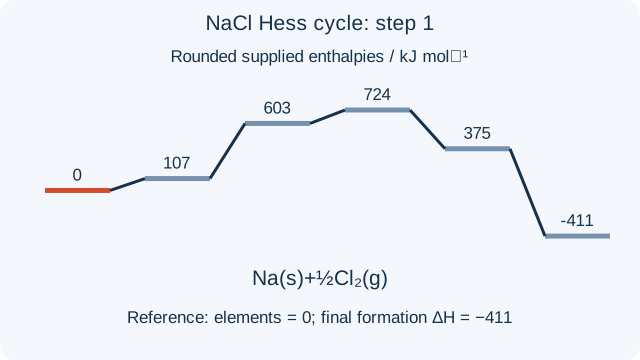
New reviewed diagram replaces the source numeral placeholder.
Choose the standard elements as zero:Na(s)+½Cl₂(g). The formation enthalpy ofNaCl(s) is−411kJmol⁻¹ relative to that reference. This is a reviewed Hess-law enrichment diagram with rounded supplied values.
Read all reviewed image captions
Image 1
New reviewed diagram replaces the source numeral placeholder.
Choose the standard elements as zero:Na(s)+½Cl₂(g). The formation enthalpy ofNaCl(s) is−411kJmol⁻¹ relative to that reference. This is a reviewed Hess-law enrichment diagram with rounded supplied values.
Image 2
New reviewed diagram replaces the source numeral placeholder.
SublimingNa adds107kJmol⁻¹, reaching relative enthalpy+107. This is a reviewed Hess-law enrichment diagram with rounded supplied values.
Image 3
New reviewed diagram replaces the source numeral placeholder.
IonizingNa adds496kJmol⁻¹, reaching107+496=603. This is a reviewed Hess-law enrichment diagram with rounded supplied values.
Image 4
New reviewed diagram replaces the source numeral placeholder.
Dissociating½Cl₂ adds121kJmol⁻¹, reaching724. This is a reviewed Hess-law enrichment diagram with rounded supplied values.
Image 5
New reviewed diagram replaces the source numeral placeholder.
Adding an electron toCl releases349kJmol⁻¹, reaching375. This is a reviewed Hess-law enrichment diagram with rounded supplied values.
Image 6
New reviewed diagram replaces the source numeral placeholder.
FormingNaCl(s) from gaseousNa⁺andCl⁻ releases786kJmol⁻¹:375−786=−411. Lattice formation is−786; lattice dissociation is+786. This is a reviewed Hess-law enrichment diagram with rounded supplied values.
The following gallery illustrates what the 5-step process entails, using the example of NaCl.
Glossary and deeper reading · 7 refreshers
These editorial refreshers supplement the reading. Definitions and examples are added guidance; original source wording and recorded answers remain in their original context.
-
Bond enthalpy
A bond enthalpy is the enthalpy required to break a specified bond in the gas phase. Tables often give average values, so estimates for complex reactions are approximate. For example, a reaction estimate adds the costs of bonds broken and subtracts the energy released by bonds formed.
-
Covalent bond
A covalent bond involves shared electron density between atoms. The sharing can be approximately equal or unequal depending on the atoms and their environment. For example, the bond in a hydrogen molecule shares electrons between two identical atoms.
-
Enthalpy
Enthalpy is a state function defined from internal energy, pressure, and volume. At constant pressure with only pressure–volume work, an enthalpy change equals the heat transferred to the system. For example, a negative reaction enthalpy indicates heat release for the written reaction under those conditions.
-
Mole
A mole is an amount of substance containing exactly 6.02214076 × 10²³ specified entities. The entities can be atoms, molecules, ions, or formula units, so the counted entity must be named. For example, one mole of oxygen molecules contains two moles of oxygen atoms.
-
Endothermic process
An endothermic process absorbs heat into the chosen system. Under constant-pressure conditions with only pressure–volume work, its enthalpy change is positive. For example, melting ice absorbs heat while the phase change occurs.
-
Exothermic process
An exothermic process transfers heat from the chosen system to its surroundings. Under constant-pressure conditions with only pressure–volume work, its enthalpy change is negative. For example, freezing water releases heat to the surroundings.
-
Bond order
Bond order describes the degree of bonding between two atoms in a specified bonding model. Localized single, double, and triple bonds have orders one, two, and three, while delocalized models can give fractional values. For example, equivalent bonds in a resonance description can have bonding intermediate between a single and double bond.