Lewis Structures
Supporting original reading. Follow the AP topic pathway for reviewed scope, worked reasoning and targeted practice.
Chemistry I · original Chapter 4 · combined Chapter 4
Section Breakdown
- Atomic Lewis Structures
- Forming covalent bonds
- Formal Charges
- Ions
- Ionic bonds
Section 2
Lewis Structures
Now that we know a bit about how electrons are used in bonds, we will begin to draw up lewis structures, which are a way of illustrating the bonds between atoms in a molecule by drawing every valence electron.
Here is an example of a lewis structure of water:
H:O:H
Here, oxygen has six valence electrons. In water, two participate in two O–H bonding pairs, each with an electron from a hydrogen atom. The other four oxygen valence electrons remain as two lone pairs. Count all eight valence electrons in the H₂O molecule: six from O and one from each H. A line-bond shorthand may omit dots, but it does not make the lone pairs disappear.
If we look at the periodic table, we can know how many valence electrons very easily for non-metals, alkali metals, and alkali earth metals by looking at the column it is in. The first column (the alkali metals) each have one valence electron. The second (alkali earth metals) have two. From there we skip the central section of the periodic table and jump to column 13, which starts with Boron. That column has 3 valence electrons, and then from there on, the number of valence electrons simply increases by one. Finally, the noble gases have 8 valence electrons.
Even though noble gases have 8 electrons, they typically don’t form compounds very easily. This is due to something called the octet rule, which says that atoms tend to form bonds in order to attain 8 valence electrons. This can be seen on the oxygen molecule in the H2O example. The oxygen molecule has 8 electrons in its perimeter.
Gallery 4.2.2 Drawing the Lewis Structure for H2O
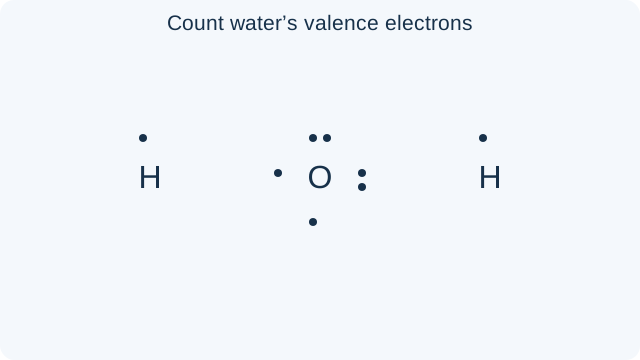
New reviewed diagram replaces the source numeral placeholder.
Two H atoms supply two electrons and O supplies six, for eight total valence electrons.
Read all reviewed image captions
Image 1
New reviewed diagram replaces the source numeral placeholder.
Two H atoms supply two electrons and O supplies six, for eight total valence electrons.
Image 2
New reviewed diagram replaces the source numeral placeholder.
The two orange highlighted pairs between H and O are bonding pairs: one electron from each H is paired with one of oxygen’s electrons. The four blue electrons remain on oxygen as two lone pairs. All eight valence electrons are counted. This straight Lewis counting layout does not depict water’s molecular geometry.
Image 3
New reviewed diagram replaces the source numeral placeholder.
The finished structure has two bonding pairs and two lone pairs on oxygen. Each hydrogen has a duet and oxygen has an octet.
Gallery 4.2.1 Lewis Structures
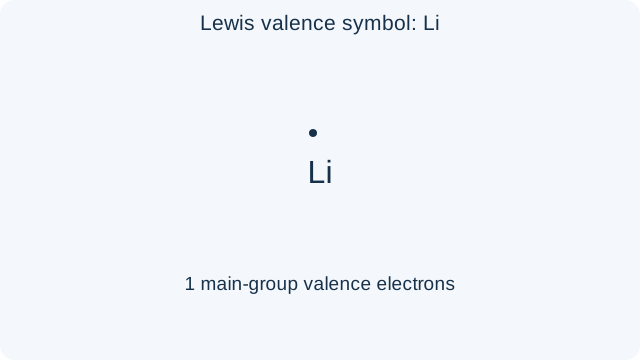
New reviewed diagram replaces the source numeral placeholder.
Li has 1 valence electrons in this neutral main-group atom. Place one dot on each side before pairing. Dot position is a bookkeeping convention, not a physical orbital map.
Read all reviewed image captions
Image 1
New reviewed diagram replaces the source numeral placeholder.
Li has 1 valence electrons in this neutral main-group atom. Place one dot on each side before pairing. Dot position is a bookkeeping convention, not a physical orbital map.
Image 2
New reviewed diagram replaces the source numeral placeholder.
Be has 2 valence electrons in this neutral main-group atom. Place one dot on each side before pairing. Dot position is a bookkeeping convention, not a physical orbital map.
Image 3
New reviewed diagram replaces the source numeral placeholder.
B has 3 valence electrons in this neutral main-group atom. Place one dot on each side before pairing. Dot position is a bookkeeping convention, not a physical orbital map.
Image 4
New reviewed diagram replaces the source numeral placeholder.
C has 4 valence electrons in this neutral main-group atom. Place one dot on each side before pairing. Dot position is a bookkeeping convention, not a physical orbital map.
Image 5
New reviewed diagram replaces the source numeral placeholder.
N has 5 valence electrons in this neutral main-group atom. Place one dot on each side before pairing. Dot position is a bookkeeping convention, not a physical orbital map.
Image 6
New reviewed diagram replaces the source numeral placeholder.
O has 6 valence electrons in this neutral main-group atom. Place one dot on each side before pairing. Dot position is a bookkeeping convention, not a physical orbital map.
Image 7
New reviewed diagram replaces the source numeral placeholder.
F has 7 valence electrons in this neutral main-group atom. Place one dot on each side before pairing. Dot position is a bookkeeping convention, not a physical orbital map.
Image 8
New reviewed diagram replaces the source numeral placeholder.
Ne has 8 valence electrons in this neutral main-group atom. Place one dot on each side before pairing. Dot position is a bookkeeping convention, not a physical orbital map.
Well, once you have the valence electron number, you begin to add dots around the atom’s label, on each side of the atomic label (i.e. top, bottom, left, right). You only put one on each side until you run out of electrons, and if you have more, then you can begin pairing them. We will go ahead now and show you a gallery of all the lewis structures for the elements Li through Neon, to show you what we mean:
Once you have the structures drawn, it is time to begin bonding atoms. Note that you sometimes have a side with only one electron and other times you have sides with two electrons. These represent electron pairs. For example, Oxygen has two electron pairs and two unpaired electrons. Typically, the only bond-forming electrons are the unpaired electrons. Therefore, Oxygen can form 2 bonds.
Unpaired electrons can bond with unpaired electrons from other atoms. The following gallery will guide you through drawing the lewis structure of water (H2O).
One technique for drawing Lewis Structures that is very useful for the upcoming special circumstances is outlined in the following example problem. It entails finding the total number of valence electrons, then making the initial sets of bonds, and finally adding any leftover electrons.
The other major aspect of putting together Lewis Structures is the octet rule. This applies to most of the atoms in the first couple rows of the periodic table, with some exceptions (H, S, P for example). The rule states that an atom will bond such that it forms a structure that provides it with 8 electrons. These include both electrons involved in a bond, at least in the case of covalent bonds (which the bulk of this section deals with).
Formal charge is bookkeeping, not a direct measurement of an atom’s physical charge. Assign each atom all of its lone-pair electrons and half the electrons in each bond; compare that assigned count with the neutral atom’s valence-electron count. Formal charge helps us compare possible Lewis structures, while bond polarity concerns unequal electron density and oxidation state uses a different assignment convention.
Example Problem 4.2.1
Draw the Lewis Structure for Carbon Tetrachloride (CCl4)
Because this compound involves only two types of atoms, we will start by drawing the Lewis Structures for each one.
Carbon: <Image 1>
Chlorine: <Image 2>
Now we start by finding the total number of valence electrons: 4 + (4)*7 = 32. This will be the only electrons we can work with.
Now, we draw up the molecules all bonded together. Since Carbon can form 4 bonds, we will use that as the center and have all the chlorines bonded to it:
<Image 3>
Now we have created 4 bonds using 2 electrons each. This leaves us with 32 - 4*2 = 24 electrons to divvy up. Since the Carbon atom is full (8 electrons) we have to split these electrons between each Chlorine. Remember to distribute them evenly, as they’re all the same atom. This gives us 6 electrons on each chlorine, for a final structure that looks like:
<Image 4>
You should now be a whiz at putting together basic Lewis Structures.
A few more rules now, and then you’ll be ready to draw any compound’s structure.
If the initial single-bond skeleton leaves a central atom short of an octet, consider converting a neighboring lone pair into an additional shared electron pair. That creates a double or triple bond without adding atoms or electrons. Recount electrons and formal charges after the change, and use the specified charge and known octet exceptions to assess the structure.
Example Problem 4.2.2
Draw the Lewis Structure for the Carbon Monoxide (CO) molecule.
Carbon monoxide is just two atoms, so we start with their individual lewis structures:
Carbon: <Image 1>
Oxygen: <Image 2>
First things first, we figure out how many electrons we are working with. The 4 from Carbon and the 6 from Oxygen give us 10 to work with.
Starting off with the single bond:
<Image 3>
We have 8 electrons left to spend. You might notice a problem though. Each atom needs 6 more electrons to make its octet. So now we’ll add another bond.
<Image 4>
This leaves us with 6 electrons. However, each atom is still 4 electrons short. If we add yet another bond:
<Image 5>
We finally have 4 electrons left, with each atom needing 2 electrons. Giving those electrons out, we have the final structure, which satisfies the octet rule:
<Image 6>
An ion will be similar to any other compound, except that it will have extra electrons (if it is negative) or less electrons (if it is positive).
Note that a positively charge ion is called a cation and a negatively charged ion is an anion.
Example Problem 4.2.3
Draw the Lewis Structure for the Ammonium (NH4+) ion.
We start with the involved atoms:
Nitrogen: <Image 1>
Hydrogen: <Image 2>
Next, we count our valence electrons: 5 + 4*1 = 9. But wait! We have an ion, so we have to subtract one, giving us 8.
Next, we draw the single bonds between the atoms:
<Image 3>
That used 4 bonds, using up all our electrons. Now we need to show the total charge and the formal charge, which exists on the N atom:
<Image 4>
As there is no way to remove all the formal charges, we are done.
We are nearly done talking about the Lewis Structures of covalent bonded molecules. One last topic we have to cover is resonance.
Sometimes, we have multiple options that satisfy all the rules we have previously described. In that case, each possible structure is correct. This is called resonance. The compound will have a few different representations, and you have to illustrate them all if you want to fully represent the structure of the molecule.
Resonance contributors are alternative Lewis drawings for the same arrangement of nuclei. The actual species is a delocalized hybrid, not a molecule switching rapidly between the drawings. Equivalent contributors can contribute equally; non-equivalent contributors do not necessarily have equal weights. Use measured bond lengths and a consistent electron count to explain why a single localized drawing is incomplete.
An example of resonance is the SO2 molecule, whose Lewis Structure(s) looks like this:
<Image 1>
Notice that the structures are each bracketed and linked by the double-headed arrow. This is what resonance entails. The arrow represents that the true form exists somewhere in between those given forms.
On the next page, we will go through an example of how to find the resonance structure of a complex ion: the acetate ion (CH3COO-).
Example Problem 4.2.4
Draw the Lewis Structure for the Acetate (CH3COO-) ion.
If we start with the involved atoms, we have:
Carbon: <Image 1>
Hydrogen: <Image 2>
Oxygen: <Image 3>
Next we count up our electrons: 4*2+1*3+6*2+1 = 24.
Now we draw the initial single bonds. This one is quite a bit trickier than before. In this compound, we still have carbon acting as the central atom, but instead of one carbon, we have two that are bonded to one another. This looks like:
<Image 4>
We see that we have 6 bonds involved here. This means that we have 12 left over electrons to spend. To figure out what to do with these, we look at the octets involved.
The first carbon atom, along with its hydrogens, are set. The second carbon atom, and each oxygen atom are a bit lacking. Because the carbon currently has only 3 bonds, let’s add another between it and one of the oxygen atoms. Because there are so many bonds, we will switch to a line-bond notation, where the two electrons in a bond are replaced by one line:
<Image 5>
Now we have satisfied the octet of the carbon, we have one oxygen needing 4 electrons and another needing 6. This works out perfectly, as we have 10 leftover electrons. This gives us our final Lewis Structure of:
<Image 6>
That’s not all, though! You may be wondering how we chose the top oxygen to receive the double bond. In fact, that was a completely arbitrary choice. Either oxygen could receive the second bond, and if we just take the electrons and append them accordingly, we would have two equally valid structures. This means the two are in resonance and we need to show them as such:
<Image 7>
That just about does it for Lewis Structures, but you might also need to draw Lewis Structures for ionic bonds. We don’t need an example problem for this, so instead you’ll just get the quick version. As there is no sharing of electrons in an ionic bond, the Lewis Structure of ions involved in an ionic bond must show the distinction.
Review 4.2.1 Lewis Structures
Question 1 of 5 · 0 correct
What do you expect the overall charge to be for this molecule?

Also, when drawing the Lewis Structure, remember to include the formal charges of the involved ions.
A couple example structures are:
MgO: <Image 1>
CaCl2: <Image 2>
BaBr2: <Image 3>
Al2O3: <Image 4>
Glossary and deeper reading · 9 refreshers
These editorial refreshers supplement the reading. Definitions and examples are added guidance; original source wording and recorded answers remain in their original context.
-
Lewis structure
A Lewis structure represents valence electrons using bonds and lone pairs. Its construction requires an electron count, an atom arrangement, and a final check against the total available electrons and charge. For example, water's Lewis structure has two O–H bonds and two lone pairs on oxygen.
-
Covalent bond
A covalent bond involves shared electron density between atoms. The sharing can be approximately equal or unequal depending on the atoms and their environment. For example, the bond in a hydrogen molecule shares electrons between two identical atoms.
-
Formal charge
Formal charge is electron bookkeeping that assigns half of each bonding pair to each bonded atom. It compares that assigned electron count with the neutral atom's valence-electron count and is not a direct measurement of actual charge distribution. For example, all formal charges in an ion's Lewis structure must sum to the ion's total charge.
-
Ion
An ion is an atom or group of atoms with a net electric charge. Ordinary ion formation changes electron count without changing the element's proton count. For example, a sodium atom losing one electron becomes a sodium ion with charge +1.
-
Ionic bonding
Ionic bonding is electrostatic attraction among oppositely charged ions. An ionic solid normally forms an extended lattice rather than separate ion-pair molecules. For example, sodium chloride consists of a repeating array of sodium and chloride ions.
-
Valence electron
Valence electrons are the electrons most directly involved in an atom's bonding and chemical behavior. For main-group atoms, they occupy the highest occupied principal shell. For example, neutral chlorine has seven valence electrons, helping explain its tendency to form a chloride ion.
-
Lone pair
A lone pair is a pair of valence electrons assigned to one atom rather than to a bond in a Lewis model. Lone pairs influence geometry and can participate in interactions or new bonds. For example, oxygen's two lone pairs help explain water's bent molecular shape.
-
Octet rule
The octet rule is a useful model in which many main-group atoms form arrangements with eight valence-shell electrons. It has important exceptions, including hydrogen's duet and electron-deficient or odd-electron species. For example, methane's Lewis structure gives carbon an octet through four bonds.
-
Oxidation number
An oxidation number is a formal electron-accounting value assigned using specified rules. Changes in oxidation number help identify oxidation and reduction but are not always actual atomic charges. For example, oxygen usually has oxidation number −2 in water while hydrogen has +1.