AP Unit 10 Solutions
Compare your physical setup and reasoning with these worked solutions. A numerical answer is one check; the assumptions, signs, units and representations explain what it means.
Problem 1
Two small beads A and B are 0.20 m apart. A has lost 2.0 × 10¹² electrons and B has gained 1.0 × 10¹² electrons. Each bead’s diameter is 1 mm. Treat them in air as point charges.
Part a
Find the charges on A and B, explain the sign of each, and justify the point-charge approximation. Include the charge of a neutron and why the charges are quantized.
A has an electron deficit, so qA = +(2.0 × 10¹²)(1.60 × 10⁻¹⁹) = +3.2 × 10⁻⁷ C. B has an excess, so qB = −1.6 × 10⁻⁷ C.
Why this step? Electrons carry −e; removing them increases net charge.
A neutron carries zero charge. Net ordinary-object charge changes by integer multiples of e. The 0.001 m diameter is 1/200 of the separation, so treating each bead as a point is reasonable here.
Why this step? Particle charges and the geometry establish the microscopic and point-charge models.
Answer and check
qA = +0.32 μC, qB = −0.16 μC; the size is negligible relative to separation.
Part b
Find the magnitude and direction of each mutual force. Then predict the force factor if both charge magnitudes double and the separation triples. Also explain what changes if only B’s charge sign reverses.
FE = (8.99 × 10⁹)(3.2 × 10⁻⁷)(1.6 × 10⁻⁷)/(0.20)² = 0.0115 N.
Why this step? Coulomb’s law gives magnitude using absolute charge product.
The opposite signs attract, so A is pulled toward B and B toward A with equal 0.0115 N forces. The combined change gives factor (2 × 2)/3² = 4/9.
Why this step? Force directions lie on the connecting line and both forces form an equal-and-opposite interaction pair.
Reversing only B makes both charges positive; the forces become repulsive with the same magnitude, still along their connecting line.
Why this step? Changing one sign changes attraction into repulsion without changing the absolute charge product.
Answer and check
Each force is 0.0115 N toward the other bead; the new magnitude is 4/9 of the old value.
Scoring and feedback
- Credit signed charge reasoning, a size/separation comparison, line-of-separation directions, and the factor 4/9. A negative force magnitude is not a direction explanation.
- a (4 points): one each for signed bead charges, particle-charge/quantization explanation, numeric electron charge multiplication, and size/separation point-model check.
- b (4 points): one each for Coulomb magnitude, equal-and-opposite attractive directions, factor 4/9, and the sign-reversal repulsion comparison.
Problem 2
A student claims that electricity must control planetary orbits because it is much stronger than gravity between two protons. Use mp = 1.67 × 10⁻²⁷ kg and the constants in the teacher guide.
Part a
Derive FE/Fg for a proton pair, calculate it, and explain why the planetary claim does not follow. Explain how electric interactions also relate to the normal force of a table.
. The common r² cancels.
Why this step? Both pair-force models have inverse-square distance dependence.
Proton electric forces repel while their gravitational forces attract. Nearly neutral planets have cancellations of positive and negative contributions; gravitational mass contributions add. A table’s normal force is an effective contact-force description of many microscopic electromagnetic interactions.
Why this step? Microscopic strength alone does not determine the net large-scale interaction.
Answer and check
The ratio is about 1.24 × 10³⁶, independent of proton separation in these models. Large-scale neutrality and many-particle cancellation make the student’s inference invalid.
Part b
For fixed free charges in an ideal uniform linear dielectric with κ = 5, predict the electric-force factor relative to vacuum. Explain what permittivity measures, polarization, the role of composition, and why an insulator can respond without conducting across the sample.
ε = 5ε₀, so FE,medium = FE,vacuum/5.
Why this step? The specified uniform dielectric response replaces free-space permittivity in this simple model.
Permittivity characterizes a medium’s polarization response to an electric field. Bound electron distributions shift or dipoles partly align, giving charge separation and an opposing response without changing the sample’s net charge. Composition and molecular arrangement set how easily these configurations respond. In an insulator charge cannot move freely through the whole sample; a conductor has mobile carriers.
Why this step? Local polarization and conduction over macroscopic distances are distinct mechanisms.
Answer and check
The force factor is 1/5 under the stated uniform-medium assumption; polarization does not imply conduction or net charging.
Scoring and feedback
- Do not require a memorized force ratio. Credit the derived ratio and cancellation argument. The dielectric factor is valid only for the stipulated simple medium.
- a (4 points): one each for symbolic force ratio, numerical ratio, neutrality/gravity scale argument, and microscopic contact-force interpretation.
- b (3 points): one each for dielectric factor, permittivity/polarization mechanism, and composition plus conduction distinction.
Problem 3
In an isolated apparatus, an initially neutral plastic rod is rubbed with an initially neutral cloth. The rod then has −12 nC. It is brought near an initially neutral insulated metal can without touching.
Part a
Find the cloth charge and the number of electrons transferred during rubbing. Explain why rubbing changes net charge but bringing the rod nearby alone does not change the can’s net charge.
Total rod-plus-cloth charge remains zero, so Qcloth = +12 nC. N = 12 × 10⁻⁹/(1.60 × 10⁻¹⁹) = 7.5 × 10¹⁰ electrons move to the rod.
Why this step? Net charge changes arise from transfer, not creation.
The rod’s field redistributes the can’s electrons, but no charge crosses the insulated can boundary, so its net charge stays zero.
Why this step? A distribution change can occur in a neutral system without a net-charge change.
Answer and check
Cloth: +12 nC; 7.5 × 10¹⁰ electrons transfer to the rod; the ungrounded can remains net neutral.
Part b
Draw and describe the signs on the can’s near and far regions, then predict how a neutral insulating strip could also be attracted.
The negative rod repels can electrons away, leaving the near region relatively positive and the far region relatively negative.
Why this step? Mobile charges redistribute under the external electrostatic force.
Bound electrons in the insulator shift slightly away from the rod. The nearer positive part is attracted more strongly than the farther negative part is repelled in the nonuniform field.
Why this step? Polarization and unequal distances permit attraction of a net-neutral system.
Answer and check
The can’s near side is positive and far side negative; the strip can polarize and be attracted while remaining neutral.
Scoring and feedback
- Require a signed transfer statement and an explicit system boundary. Induced regions do not constitute new net charge.
- a (3 points): one each for cloth charge, electron count, and isolated-can conservation.
- b (2 points): one for near/far distribution sketch and one for polarized-insulator attraction reasoning.
Problem 4
A neutral conducting sphere is insulated from Earth. A positive rod is held near it. A switch can briefly connect the sphere to Earth.
Part a
Design a sequence that leaves the sphere with negative net charge without touching the rod to it. Illustrate the charge distributions and identify electron-transfer direction and the step at which net charge changes.
Hold the rod nearby, close the grounding switch, then open the switch while keeping the rod in place. Finally remove the rod.
Why this step? Disconnecting ground traps the transferred charge before removing the inducing field.
Electrons enter from Earth while grounded because of attraction toward the rod. Net sphere charge changes during the Earth connection, then remains fixed after isolation.
Why this step? Ground is a large, approximately neutral charge reservoir; the conservation boundary now permits transfer.
Answer and check
Ground with the positive rod present, disconnect ground, then remove the rod; excess electrons leave the sphere negative.
Part b
In a separate contact experiment, remove the rod and all other asymmetric external fields. Two identical metal spheres, initially −4 nC and +10 nC, touch in a symmetric environment while isolated from Earth, then separate. Find their final charges and each signed charge change.
The isolated two-sphere system has +6 nC total charge. The rod has been removed and the identical spheres share a symmetric environment. Their common equilibrium potential therefore corresponds to equal charges, giving +3 nC each.
Why this step? Conservation sets the sum; symmetry sets equal sharing.
The formerly −4 nC sphere changes by +7 nC and the formerly +10 nC sphere by −7 nC. Electrons move from the former to the latter.
Why this step? Signed changes must cancel across the combined system.
Answer and check
Each sphere finishes at +3 nC; their changes are +7 nC and −7 nC respectively.
Scoring and feedback
- The grounding order and transfer explanation are essential. Equal sharing requires identical geometry and a symmetric environment.
- a (3 points): one each for grounding order, incoming electrons, and system-boundary/distribution illustration.
- b (3 points): one each for total charge, symmetric equal sharing, and signed changes/electron direction.
Problem 5
Sources +2.0 nC at (−0.10 m, 0) and +2.0 nC at (+0.10 m, 0) surround point P = (0, 0.10 m).
Part a
Draw the separate source-field arrows at P and calculate the net field. Explain what arrow length represents in a vector map and what field-line density would imply. Then reverse only the right-hand source to −2.0 nC: draw its new source-field arrow and calculate the new net field at P.
Each source is 0.141 m from P, so each field magnitude is (8.99 × 10⁹)(2.0 × 10⁻⁹)/0.020 = 899 N/C. Both arrows point away from the respective positive source at 45° above horizontal.
Why this step? Field direction is based on a positive test charge, and source distance is the diagonal.
Horizontal components cancel; vertical components add: E = 2(899)sin45° = 1.27 × 10³ N/C upward. Scaled arrow lengths encode magnitude; closer field lines indicate larger magnitude under a consistent drawing convention.
Why this step? Vector superposition uses components; map conventions give a graphical magnitude representation.
With only the right source negative, its 899 N/C contribution points from P down and right toward that source. The left positive source still gives an up-and-right arrow. Vertical components cancel; horizontal components add, producing 1.27 × 10³ N/C right.
Why this step? Negative-source field points toward its source; changing source polarity is distinct from changing the test charge.
Answer and check
E⃗net = 1.27 × 10³ N/C upward. Draw two equal diagonal source arrows and a vertical resultant. After reversing only the right-hand source, the net field is instead 1.27 × 10³ N/C right, with opposing vertical source components.
Part b
Find the force on a small −3.0 nC test charge at P and compare it with the force on +3.0 nC at the same point in the original two-positive-source configuration. Explain why making either test charge nonperturbing matters.
F⃗ = qE⃗ gives magnitude (3.0 × 10⁻⁹)(1.27 × 10³) = 3.81 × 10⁻⁶ N downward.
Why this step? Negative charge reverses force direction relative to the field.
The test charge must not appreciably rearrange the sources or their charge distribution; otherwise it changes the field being measured.
Why this step? The field definition assumes a negligibly perturbing test charge.
The +3.0 nC test charge has the same 3.81 μN force magnitude upward, in the same direction as the original upward field.
Why this step? Positive test charge has force parallel to the source field; it does not reverse or change the field.
Answer and check
3.81 μN downward, while the source field remains upward. The +3.0 nC charge instead feels 3.81 μN upward, along the same original source field.
Scoring and feedback
- Credit vector sketches and horizontal cancellation. A correct magnitude with a force-direction error does not show correct field reasoning.
- a (5 points): one each for source distances/magnitudes, original equal diagonal arrows, original net-field addition, map/line-density interpretation, and the negative-source reversal arrows with the rightward net field.
- b (3 points): one for negative-charge force, one for positive-test same-direction force, and one for the nonperturbing-test condition.
Problem 6
An isolated solid conducting sphere has radius R = 0.050 m and net charge +5.0 nC. It is in electrostatic equilibrium.
Part a
Calculate the field at r = 0.030 m and r = 0.10 m from its center. Sketch E magnitude against r and state the direction at its surface. State where the sphere’s excess charge resides at equilibrium.
At 0.030 m the observation point is in the conducting material, so E = 0. At 0.10 m it is outside the spherically symmetric source, so E = kQ/r² = 4.50 × 10³ N/C.
Why this step? Use equilibrium inside, the equivalent point-charge model outside.
The graph is zero for r < R, jumps to the outside-surface value kQ/R² = 1.80 × 10⁴ N/C, then falls as 1/r². Surface field is radial outward and perpendicular to the surface.
Why this step? The ideal charged surface permits a discontinuity between inside and outside fields.
The conductor’s excess +5.0 nC charge resides on its surface; freely mobile charge has redistributed until the internal field vanishes.
Why this step? The surface-charge location and zero internal field are complementary equilibrium properties.
Answer and check
0 N/C inside and 4.50 × 10³ N/C outward at 0.10 m; the outside curve decays as r⁻².
Part b
Explain why an internal field would contradict equilibrium in the metal. Replace the sphere with an insulating sphere carrying excess charge through its volume: can you conclude its internal field is zero?
A nonzero field in the metal would exert force on mobile carriers, which would redistribute instead of remaining in electrostatic equilibrium.
Why this step? The conductor result follows from carrier mobility.
No. Excess insulating charge can remain in the interior and on the surface; the internal field may be nonzero. This is a qualitative statement, not a request to calculate its general internal field.
Why this step? Insulating carriers cannot rearrange freely throughout the volume.
Answer and check
Metal equilibrium requires E = 0 in its material; an insulator can maintain interior charge and nonzero interior field.
Scoring and feedback
- Accept an idealized radial discontinuity with clear inside/outside labels. Do not require an insulator-field integral.
- a (5 points): one each for zero interior field, equivalent-center exterior value, radial graph with surface discontinuity, perpendicular outward surface field, and excess charge on the surface.
- b (2 points): one for conductor-equilibrium mobility reasoning and one for qualitative interior-insulator distinction.
Problem 7
A +3.0 nC charge and a −2.0 nC charge are slowly separated from 0.10 m to 0.25 m. Choose U = 0 at infinite separation.
Part a
Find Ui, Uf, and ΔU. State the external work and electric-force work if the speeds stay negligibly small.
Ui = kq₁q₂/0.10 = −5.39 × 10⁻⁷ J; Uf = kq₁q₂/0.25 = −2.16 × 10⁻⁷ J.
Why this step? The charge product is negative because the charges attract.
ΔU = +3.24 × 10⁻⁷ J. Wext = +3.24 × 10⁻⁷ J and WE = −3.24 × 10⁻⁷ J.
Why this step? Negligible ΔK makes external work equal to ΔU; conservative electric work has the opposite sign.
Answer and check
Ui = −0.539 μJ, Uf = −0.216 μJ; ΔU = Wext = +0.324 μJ and WE = −0.324 μJ.
Part b
Sketch the U versus r curve for this pair, label zero at infinity, and compare the energy change if both separations were doubled.
The curve is negative, rises toward zero as r grows, and has inverse-distance magnitude.
Why this step? U = kq₁q₂/r sets both sign and shape.
Doubling both distances halves Ui and Uf, so ΔU also halves to +1.62 × 10⁻⁷ J.
Why this step? The 1/r scaling differs from the force’s 1/r² dependence.
Answer and check
An inverse-distance curve below zero; the scaled separation change requires half as much slow external work.
Scoring and feedback
- Score sign, energy reference, and the condition that external work equals ΔU.
- a (4 points): one each for signed Ui/Uf, positive ΔU, external-work condition, and electric-work sign.
- b (2 points): one for inverse-distance graph below zero and one for half-scaled energy change.
Problem 8
Three point charges +q, +q, and −q occupy an equilateral triangle of side a.
Part a
Derive the total assembly energy by listing the pairs. For q = 4.0 nC and a = 0.20 m, calculate it.
The positive-positive pair contributes +kq²/a; each positive-negative pair contributes −kq²/a. Thus U = −kq²/a.
Why this step? There are three unique interactions, each counted once.
U = −(8.99 × 10⁹)(4.0 × 10⁻⁹)²/0.20 = −7.19 × 10⁻⁷ J.
Why this step? Substitute into the signed scalar sum.
Answer and check
U = −kq²/a = −0.719 μJ.
Part b
The negative charge is moved infinitely far away while the two positive charges stay fixed. Find ΔU and the slow external work symbolically and numerically.
The remaining positive-positive pair still has +kq²/a. The two pairs involving the removed charge tend to zero, so Uf = +kq²/a.
Why this step? Only distances in pairs involving the moving charge change.
ΔU = Uf − Ui = 2kq²/a = +1.44 × 10⁻⁶ J. For a slow move Wext = ΔU.
Why this step? The negative charge must be pulled away from both attracting partners.
Answer and check
ΔU = Wext = +2kq²/a = +1.44 μJ.
Scoring and feedback
- Credit the unchanged pair explanation; counting every ordered pair doubles the answer incorrectly.
- a (3 points): one each for three unique pair terms, symbolic signed sum, and numerical energy.
- b (3 points): one each for unchanged source pair, two removed pair terms, and positive external-work result.
Problem 9
Two fixed sources +6.0 nC and −2.0 nC are each 0.20 m from an observation point P. Use zero potential at infinity.
Part a
Find V(P), then the interaction energy of a +3.0 nC test charge at P. Explain why source-field arrows alone cannot be added as potential arrows.
V = k(6.0 − 2.0) × 10⁻⁹/0.20 = 179.8 V.
Why this step? Add signed scalar contributions; equal distances let them combine directly.
U = qtestV = (3.0 × 10⁻⁹)(179.8) = 5.39 × 10⁻⁷ J. Potential has no direction and no vector components.
Why this step? Potential is energy per unit test charge, while electric field is a vector.
Answer and check
V = +180 V and U = +0.539 μJ.
Part b
A 9 V battery moves 2.0 mC of positive charge internally from its low-potential terminal to its high-potential terminal. Find the energy increase and name its source. Separately, two unequal isolated metal spheres touch: what equality must hold after redistribution?
ΔU = qΔV = (2.0 × 10⁻³)(9) = +0.018 J. Chemical energy supplies this internal charge-separation energy.
Why this step? Potential difference is energy change per charge; battery chemistry maintains it.
After the spheres touch and reach equilibrium, their potentials are equal. Their charges need not be equal because geometry affects the charge–potential relation.
Why this step? Conductors exchange mobile electrons until the driving potential difference vanishes.
Answer and check
The energy increase is 18 mJ from battery chemistry; touching spheres reach equal potential.
Scoring and feedback
- Potential addition is scalar. Require the chemical source and equal-potential condition rather than equal-charge assertion.
- a (3 points): one each for signed scalar superposition, test-charge interaction energy, and scalar/vector distinction.
- b (3 points): one each for battery energy per charge, chemical source, and equal-potential contact condition.
Problem 10
A map shows vertical equipotentials 24 V at x = 0 cm, 18 V at x = 1 cm, and 12 V at x = 2 cm. Farther right, 6 V and 0 V contours are 2 cm apart. The lines are smooth and locally parallel.
Part a
Draw local field arrows in both regions with relative magnitudes. Explain their orientation, direction, and whether a field component lies along a contour.
The arrows are horizontal toward increasing x, perpendicular to the contours, because V decreases rightward.
Why this step? Equipotentials have no potential change along their length and hence no tangential field component.
In the first region E ≈ 6 V/0.010 m = 600 N/C. In the farther region E ≈ 6 V/0.020 m = 300 N/C. Draw the first arrows twice as long on a common scale.
Why this step? Normal spacing for the same potential step estimates field magnitude.
Answer and check
Rightward, normal arrows: about 600 N/C and 300 N/C respectively; zero tangential component.
Part b
A −2.0 μC charge moves from the 24 V line to the 12 V line. Find ΔU and describe its initial electric-force direction. What is the work if it instead moves between two points on the 18 V line?
ΔU = qΔV = (−2.0 × 10⁻⁶)(12 − 24) = +24 × 10⁻⁶ J.
Why this step? Both charge and final-minus-initial voltage carry signs.
The electric force points left, opposite the rightward field. Along 18 V, ΔV = 0, so electric work is zero.
Why this step? The force depends on charge sign, while equal-potential motion has no electric-energy change.
Answer and check
ΔU = +24 μJ; initial force left; equipotential-path electric work 0 J.
Scoring and feedback
- Field arrows are determined from the source map, then force uses charge sign. Accept average-field estimates for the stated local contour regions.
- a (4 points): one each for normal/rightward arrows, two field estimates, common-scale arrow comparison, and zero tangential component.
- b (3 points): one each for signed ΔU, negative-charge force direction, and equipotential zero work.
Problem 11
A parallel-plate capacitor has plate overlap area 0.030 m², a uniform dielectric κ = 2.0, and plate separation 1.5 mm. It is connected to an ideal 10 V battery. Neglect edges.
Part a
Find C, each plate’s charge, central field magnitude and direction, and stored energy. Explain why Q is not the capacitor’s net charge.
C = κε₀A/d = 3.54 × 10⁻¹⁰ F. Q = CΔV = 3.54 × 10⁻⁹ C; the plates carry +Q and −Q.
Why this step? Physical geometry determines capacitance; separated opposite charges set voltage.
E = ΔV/d = 6.67 × 10³ N/C from positive plate to negative plate. U = ½CΔV² = 1.77 × 10⁻⁸ J.
Why this step? The central field is uniform; the energy expression gives stored field energy, not all work supplied by the fixed-voltage battery.
Answer and check
C = 354 pF; plates ±3.54 nC; E = 6.67 × 10³ N/C; U = 17.7 nJ; ideal net capacitor charge is zero.
Part b
Construct a quantitative graph of capacitor ΔV (V) against Q (nC), using numerical scales and plotting (0, 0), (1.77 nC, 5 V), and (3.54 nC, 10 V) as it charges from zero. Explain why its area is the stored energy ½QΔV and distinguish that from the work supplied by the constant 10 V battery. Then predict C and U if overlap area doubles with the battery still connected.
The capacitor-voltage graph is a straight line through the origin with slope 1/C; its triangular area is ½QfinalΔVfinal = 17.7 nJ. This is stored field energy and minimum quasistatic assembly work. The fixed-voltage battery graph is horizontal at 10 V; delivering final Q = 3.54 nC supplies QΔV = 35.4 nJ.
Why this step? The capacitor voltage changes as charge separates, but a constant-voltage battery supplies energy at its fixed voltage; the two areas describe different systems.
Doubling A doubles C; fixed battery ΔV then doubles Q and U. C′ = 708 pF and U′ = 35.4 nJ.
Why this step? Capacitance depends on geometry and energy at fixed voltage is proportional to C.
Answer and check
Capacitor graph area = stored energy ½QΔV = 17.7 nJ. Fixed-voltage battery work = QΔV = 35.4 nJ during charging from empty; the remaining 17.7 nJ goes to other energy channels, normally resistor heating. Doubling overlap area gives twice the capacitance and stored energy at fixed 10 V.
Scoring and feedback
- Require overlap area of one plate, not both. Score graph axes and the physical area interpretation.
- a (4 points): one each for geometry-based C, opposite plate charges, field magnitude/direction, and stored energy/net-charge distinction.
- b (5 points): one each for quantitative axes/scales and plotted V–Q points, triangular stored-energy area, distinct battery rectangle/work, energy-channel explanation, and fixed-voltage doubled-area result.
Problem 12
An initially air-gap capacitor has C₀ = 200 pF and is charged to 20 V. A κ = 4 dielectric can fully fill the gap without changing geometry. A separate particle experiment uses a uniform 500 N/C vertical field.
Part a
Compare final charge, voltage, field factor, and stored energy for dielectric insertion with the battery disconnected and with it connected. Explain the induced field direction.
Initially Q₀ = C₀V₀ = 4.0 nC and U₀ = ½C₀V₀² = 40 nJ. Both cases give C′ = 800 pF.
Why this step? The dielectric changes the same physical capacitance in both cases.
Isolated: Q′ = 4.0 nC, V′ = 5 V, E′/E₀ = 1/4, U′ = 10 nJ. Connected: V′ = 20 V, Q′ = 16 nC, E′/E₀ = 1, U′ = 160 nJ.
Why this step? Charge stays fixed only when isolated; voltage stays fixed only with the ideal battery.
The dielectric polarizes and its induced field opposes the field from the free plate charges. In the connected case extra free charge compensates, maintaining the net field V/d.
Why this step? Polarization changes internal contributions even when the net field remains unchanged.
Answer and check
Isolated: 4 nC, 5 V, E₀/4, 10 nJ. Connected: 16 nC, 20 V, E₀, 160 nJ.
Part b
A particle with q = −1.0 μC and m = 2.0 × 10⁻⁴ kg enters horizontally at 4.0 m/s into the downward 500 N/C field over horizontal length 0.20 m. Create a qualitative y-versus-x graph of the path with labeled axes (x rightward, y upward) and indicate its horizontal initial tangent. Then find the electric acceleration, transit time, and deflection. Neglect gravity and edge fields, and assume no plate collision.
The force is upward: |a| = |q|E/m = 2.5 m/s². Horizontal velocity stays constant.
Why this step? Negative charge accelerates opposite the uniform field.
t = 0.20/4.0 = 0.050 s. Upward deflection y = ½(2.5)(0.050)² = 0.00313 m.
Why this step? Use independent perpendicular constant-velocity and parallel constant-acceleration motions.
Answer and check
Electric acceleration 2.5 m/s² upward; transit time 0.050 s; upward deflection 3.13 mm under the stipulated negligible-gravity model.
Scoring and feedback
- Different capacitor constraints must be explicit. The particle problem deliberately stipulates neglected gravity; do not claim it is physically negligible from these values.
- a (4 points): one each for changed C, fixed-Q outcomes, fixed-V outcomes, and induced-field explanation.
- b (4 points): one each for the qualitative y-versus-x graph with horizontal initial tangent, upward electric acceleration, horizontal transit time, and constant-acceleration deflection.
Problem 13
A proton starts from rest at a 300 V equipotential and reaches a 100 V equipotential under only electric forces. Use mp = 1.67 × 10⁻²⁷ kg.
Part a
Find ΔU, final kinetic energy in joules and electron-volts, and final speed. Draw energy bars that represent the change.
ΔV = −200 V. ΔU = (+1.60 × 10⁻¹⁹)(−200) = −3.20 × 10⁻¹⁷ J.
Why this step? Use positive proton charge and final-minus-initial potential.
Kf = −ΔU = 3.20 × 10⁻¹⁷ J = 200 eV. v = √(2Kf/mp) = 1.96 × 10⁵ m/s.
Why this step? With only conservative electric work, the U decrease becomes a K increase.
Draw a 200 eV decrease in U and a 200 eV increase in K; their sum stays fixed.
Why this step? Energy bars must show the exchange rather than introduce unaccounted external work.
Answer and check
ΔU = −3.20 × 10⁻¹⁷ J; Kf = 200 eV; v = 1.96 × 10⁵ m/s.
Part b
A slow external agent instead transports the same proton from 100 V to 300 V at unchanged speed. Find Wext and explain why final kinetic energy no longer follows −qΔV alone.
ΔU = +3.20 × 10⁻¹⁷ J and ΔK = 0. Thus Wext = ΔK + ΔU = +3.20 × 10⁻¹⁷ J.
Why this step? The external agent supplies energy to the chosen object-field system.
The electric force does negative work that is balanced by the agent’s positive work, so kinetic energy does not change.
Why this step? The only-electric-work condition is no longer satisfied.
Answer and check
Wext = +3.20 × 10⁻¹⁷ J; the agent’s work keeps speed constant while U rises.
Scoring and feedback
- Score the signs and the system/work conditions. A speed formula without energy accounting is insufficient justification.
- a (4 points): one each for signed ΔU, kinetic energy/eV, speed, and energy-bar exchange.
- b (2 points): one for external work and one for the no-ΔK energy explanation.
Problem 14
A positively charged particle has charge +q, mass m, initial speed v₀, and initial potential V₀. It moves in one dimension along x into monotonically increasing electric potential, with no transverse velocity and only electric forces acting. The uphill region extends far enough that the particle eventually turns.
Part a
Derive the potential at the one-dimensional turning point and explain the meaning of a calculated negative final kinetic energy at a proposed higher potential.
At the stipulated one-dimensional turning point the only velocity component becomes zero, so Kf = 0. Conservation gives 0 + qVmax = ½mv₀² + qV₀.
Why this step? There is no transverse kinetic energy, so the actual turn uses the entire initial kinetic energy in potential-energy increase.
. A proposed larger potential would require negative total kinetic energy and is inaccessible. Without the stated one-dimensional assumptions this expression is an energy upper bound, not a guaranteed attained turn.
Why this step? Solve the energy balance and impose physical nonnegative kinetic energy.
Answer and check
In the stipulated one-dimensional uphill motion, Vturn = V₀ + mv₀²/(2q). Negative calculated K flags an unreachable endpoint.
Part b
Two particles have equal mass and equal initial speed, but charges +q and +2q. Compare their maximum potential increases. Then describe a negative particle’s energy change moving to higher potential.
For both particles under the same stipulated one-dimensional uphill conditions, ΔVturn = mv₀²/(2q) is inversely proportional to positive charge. The +2q particle reaches half the potential rise of the +q particle.
Why this step? Both begin with the same kinetic energy but the larger charge gains more U per volt.
A negative charge moving to higher V has ΔU = qΔV < 0 and, with only electric work, gains kinetic energy.
Why this step? The sign of charge changes the relation between potential increase and energy increase.
Answer and check
The one-dimensional turning-potential rises compare 2:1 for +q versus +2q. A negative charge can instead gain kinetic energy moving toward higher potential.
Scoring and feedback
- Require the turning condition and the distinction between potential and potential energy.
- a (3 points): one each for one-dimensional zero-K turning condition, symbolic potential, and inaccessible negative-K interpretation.
- b (2 points): one for one-dimensional charge comparison and one for the negative-charge energy trend.
Problem 15
Students use a voltmeter to map a conductive-paper analogue. Along a horizontal line, measured values are V(0.00 m) = 8.0 V, V(0.02 m) = 6.0 V, V(0.04 m) = 4.0 V, and V(0.06 m) = 2.0 V. Each endpoint voltage difference has uncertainty ±0.10 V and each endpoint separation ±0.002 m.
Part a
Construct V versus x, estimate the average field over the whole interval, and give a conservative relative uncertainty using δE/E ≈ δ(ΔV)/|ΔV| + δ(Δx)/Δx. State a control and an assumption of this map.
The points lie on a line of slope (2.0 − 8.0)/0.060 = −100 V/m, so Eavg,x = +100 N/C.
Why this step? The negative voltage slope determines the signed average field component.
δE/E ≈ 0.10/6.0 + 0.002/0.060 = 0.050, so Eavg ≈ (100 ± 5) N/C. Keep electrode voltage and geometry fixed; assume the sampled region approximates a stable, smooth potential map.
Why this step? The voltage and position uncertainties propagate through a ratio; stated uncertainty values are for endpoint differences.
Answer and check
A descending straight graph; Eavg,x = +(100 ± 5) N/C. The conductive sheet is a mapping analogue carrying current.
Part b
Draw equipotentials and field arrows consistent with these data if the region is uniform vertically. Predict force on q = −2.0 μC and ΔU if it moves from x = 0 to x = 0.06 m under a corresponding static source field.
Draw vertical 8, 6, 4, and 2 V lines at the listed x values, with equal rightward field arrows normal to them.
Why this step? Equal voltage drops over equal normal distances indicate a uniform horizontal field.
F = qE gives 2.0 × 10⁻⁴ N left; ΔU = q(2 − 8) = +12 μJ. With only electric work, K would decrease by 12 μJ if the endpoint were reachable.
Why this step? Force is a vector using charge sign; energy uses the signed scalar potential difference.
Answer and check
Vertical contours, rightward field; force left; ΔU = +12 μJ and ΔK = −12 μJ for a reachable free trajectory.
Scoring and feedback
- Use the provided uncertainties for differences without doubling them again. Separate the conducting-sheet analogue from the hypothesized static particle-motion situation.
- a (4 points): one each for V–x graph/slope, signed field, uncertainty propagation, and meaningful control/map assumption.
- b (3 points): one each for contour/field construction, signed force, and energy change plus reachability condition.
Problem 16
A student measures a broad-plate capacitor with fixed overlap area A = 0.020 m² and uniform dielectric. Measurements are d = 1.0, 2.0, 4.0 mm and C = 354, 177, 88.5 pF respectively. Lead capacitance is negligible.
Part a
Choose a graph that linearizes the geometry relation, construct it with numerical scales and units, plot the transformed data, fit a line, determine its slope, and infer κ. Outline how to measure C versus d with a capacitance meter, including one control, one repeat strategy, and one likely systematic error.
Plot C in farads against 1/d in m⁻¹. The points are (1000, 354 × 10⁻¹²), (500, 177 × 10⁻¹²), (250, 88.5 × 10⁻¹²), with slope 3.54 × 10⁻¹³ F·m.
Why this step? C = κε₀A/d is linear in reciprocal separation.
κ = slope/(ε₀A) = (3.54 × 10⁻¹³)/[(8.85 × 10⁻¹²)(0.020)] = 2.0. With the supply disconnected and plates discharged, set a measured uniform spacer gap and use a capacitance meter across the plates. Change d and record C at each gap. Keep overlap area and dielectric fixed, repeat each gap measurement after reassembly, and consider uneven separation or fringing as systematic errors.
Why this step? Controls isolate the independent variable; repetitions expose variability and geometry limitations.
Answer and check
C versus 1/d is linear; slope = 3.54 × 10⁻¹³ F·m and κ = 2.0.
Part b
At d = 2.0 mm, charge the capacitor to 10 V, disconnect it, and then double d. Find final Q, V, E, and U. Explain the charge conservation and external energy input in a slow separation.
Initially Q = (177 pF)(10 V) = 1.77 nC, E = 5000 N/C, and U = 8.85 nJ. Disconnecting preserves Q. At 4.0 mm, C halves to 88.5 pF, so V doubles to 20 V.
Why this step? The isolated boundary permits no plate charge transfer; changed geometry changes capacitance.
E = Q/(κε₀A) remains 5000 N/C. U = Q²/(2C) doubles to 17.7 nJ. A slow external plate-separating agent supplies ΔU = +8.85 nJ.
Why this step? Fixed charge keeps field independent of separation; work increases the stored-energy configuration.
Answer and check
Q = 1.77 nC, V = 20 V, E = 5000 N/C, U = 17.7 nJ; slow external work is +8.85 nJ.
Scoring and feedback
- Score linearization and slope units. Distinguish fixed-Q separation from a battery-connected change.
- a (5 points): one each for transformed data and scaled quantitative plot, fit/slope with units, inferred κ, a measurement procedure with controlled geometry, and repeat/systematic-error discussion.
- b (4 points): one each for charge conservation, final voltage, unchanged field, and doubled energy/external work.
Problem 17
Two fixed charges +Q sit at x = −a and x = +a. A small charge +q is placed at the origin. Ignore gravity; the sources stay fixed. Choose potential zero at infinity.
Part a
Find the source field and potential at the origin, and the interaction energy associated with adding q there. Explain why the field and potential results do not conflict.
The two fields have equal magnitude kQ/a² and opposite directions, so Enet = 0. The potentials add: V = 2kQ/a.
Why this step? Vector cancellation and scalar addition are different operations.
The extra interaction energy is qV = 2kQq/a, from the two source–test pairs. The existing source–source energy is unchanged.
Why this step? Only the interactions involving the added charge belong to the incremental assembly energy.
Answer and check
E⃗ = 0, V = 2kQ/a, and added interaction energy = 2kQq/a.
Part b
Give q a small initial velocity along the perpendicular y axis. If it eventually reaches very far away, derive its final speed in terms of m, vi, Q, q, and a. What can you say about its kinetic-energy change before knowing its travel time?
At the origin the interaction energy involving q is 2kQq/a; far away it approaches zero. Thus ΔK = +2kQq/a.
Why this step? The fixed sources give a time-independent conservative electric field; the endpoint energy difference is enough.
. By symmetry the field along the y axis has no x component and points outward for y > 0, so a small positive upward kick lets it move outward.
Why this step? Convert released interaction energy into kinetic energy; symmetry supports the stipulated escape path.
Answer and check
ΔK = 2kQq/a and vf = √(vi² + 4kQq/(ma)); no elapsed-time model is required.
Scoring and feedback
- Do not include the unchanged source–source pair in ΔU. If q starts exactly at rest at the symmetric center it remains there in the ideal model; the prompt supplies a nonzero kick.
- a (3 points): one each for zero vector field, nonzero scalar potential, and incremental pair energy.
- b (3 points): one each for ΔK from moving-pair energy, symbolic speed, and symmetry plus the nonzero kick needed for escape.
Explain and apply: worked solutions
Compare the physical setup and the reasoning, as well as the final answer. Give credit for equivalent correct reasoning, using the rubric to find your next step.
Does zero net charge remove the charge property?
A sample contains N initially neutral atoms, each with 6 protons, 6 electrons and 6 neutrons. It later loses exactly 3.0 × 10⁹ electrons, with no nuclear change. N is large enough to supply that count. Use e = 1.60 × 10⁻¹⁹ C.
Part a
Evaluate the claim “charge is a fundamental property only of matter with nonzero net charge.” Explain the role of zero net charge for this sample and state whether neutral matter and neutrons are excluded from the fundamental charge description.
The claim is false: charge is a fundamental property of all matter, and zero is an allowed net-charge value. Neutral atoms have cancelling positive and negative contributions. A neutron has zero electric charge and remains matter; zero does not mean the charge description is inapplicable.
- Define the charge property independently of whether its value is nonzero.
- In the neutral atom, six proton and six electron contributions cancel.
- Identify a neutron as matter with zero electric charge rather than an exception to the property.
Scoring criteria
- 1 point: charge is fundamental for all matter, including neutral matter.
- 1 point: explains cancellation and zero as a valid value, addressing neutron matter explicitly.
Part b
State the signed charge of one electron, one proton and one neutron. Use all three values to calculate the initial charge of one atom.
Electron −e, proton +e, neutron 0; initial atom charge 6(+e) + 6(−e) + 6(0) = 0.
- List each particle’s signed charge before adding.
- Add all contributions as scalars; the proton and electron terms cancel and the neutron term is zero.
Scoring criteria
- 1 point: all three charge signs/values correct.
- 1 point: explicit zero-charge sum for one atom.
Part c
Calculate the sample’s final net charge and the signed charge carried away. Explain why the change is quantized and why a claim that one isolated atom loses a charge of +0.4e by losing electrons is inconsistent with this charging model.
The sample has +4.8 × 10⁻¹⁰ C; emitted electrons carry −4.8 × 10⁻¹⁰ C. Electron-transfer changes are integer multiples of e, so a 0.4e loss is not an allowed increment in this ordinary charging model.
- Removing negative carriers changes sample charge by +(3.0 × 10⁹)e = +4.8 × 10⁻¹⁰ C.
- The emitted carriers have the opposite signed total, conserving sample-plus-emitted-electron charge.
- Each electron has charge −e; an integer number cannot carry +0.4e or any magnitude 0.4e.
Scoring criteria
- 1 point: equal-and-opposite signed totals with units.
- 1 point: integer elementary-charge explanation applied to the 0.4e claim.
Return to the unit problem →Try this problem in its lesson →
Polarization or conduction?
A neutral insulator has larger permittivity than another in their common linear-response range. Neither conducts net charge freely across its sample.
Part a
Which statement best explains the difference?
Its atomic or molecular composition and arrangement permit a greater bound-charge polarization response; net neutrality can remain unchanged.
- Material composition and arrangement affect ease of electron reconfiguration. That bound-charge response changes permittivity while leaving the sample neutral and insulating.
Scoring criteria
- Credit only the choice whose complete explanation satisfies the stated conditions.
Return to the unit problem →Try this problem in its lesson →
Build a spatial map from two sources
Two fixed +2.0 nC point charges are at (−0.10 m,0) and (+0.10 m,0). Consider M = (0,0), N = (0,0.10 m), S = (0,−0.10 m), and R = (0.20 m,0). Use k = 8.99 × 10⁹ N·m²/C²; sources remain unchanged by any test charge.
Part a
Calculate the net field vector at all four points. Construct a labeled spatial vector map with a common arrow-length scale for magnitude. Show the two source contributions at N, explain the cancellations or additions at every point, and mark a zero at M rather than assigning it a direction.
M: (0,0) N/C; N: (0,+1271) N/C; S: (0,−1271) N/C; R: (+1998,0) N/C. Equal source contributions at N are 899 N/C at ±45° from upward. R’s arrow is 1.571 times N’s length.
- M has equal 1798 N/C horizontal contributions in opposite directions.
- At N, each squared distance is 0.020 m², so each magnitude is 899 N/C. Horizontal components cancel; vertical components sum to 2(899)/√2 = 1271.38 N/C upward. S is the mirror, downward.
- At R, both contributions point right. Distances are 0.30 m and 0.10 m, giving 199.78 + 1798 = 1997.78 N/C.
- Choose one magnitude scale and draw arrows anchored at N, S and R with length ratio 1271.38:1271.38:1997.78. Label sources, coordinates, axes and zero M.
Scoring criteria
- 1 point: correct zero and cancellation at M.
- 1 point: both symmetric N/S values and directions from component reasoning.
- 1 point: R value and same-direction sum.
- 1 point: actual labeled multipoint map, source contributions at N, and common length scale.
Part b
Find the initial electric forces on +1.0 nC and −1.0 nC test charges separately placed at N. Explain why the map is unchanged and whether those forces alone specify each complete future trajectory.
For +1.0 nC: 1.271 μN upward; for −1.0 nC: 1.271 μN downward. The fixed-source field is unchanged for nonperturbing tests. Future paths also require mass, initial velocity and field variation along the path.
- Apply F⃗ = qE⃗ at N; magnitude is (1.0 × 10⁻⁹)(1271.38) = 1.271 × 10⁻⁶ N.
- The positive test has force parallel to E⃗; the negative test has force antiparallel.
- The assumption of negligible source disturbance preserves the same field; a field-line tangent describes local force direction, not a universal trajectory.
Scoring criteria
- 1 point: both force magnitudes and signed directions.
- 1 point: field independence conditioned on nonperturbing tests and stated trajectory information.
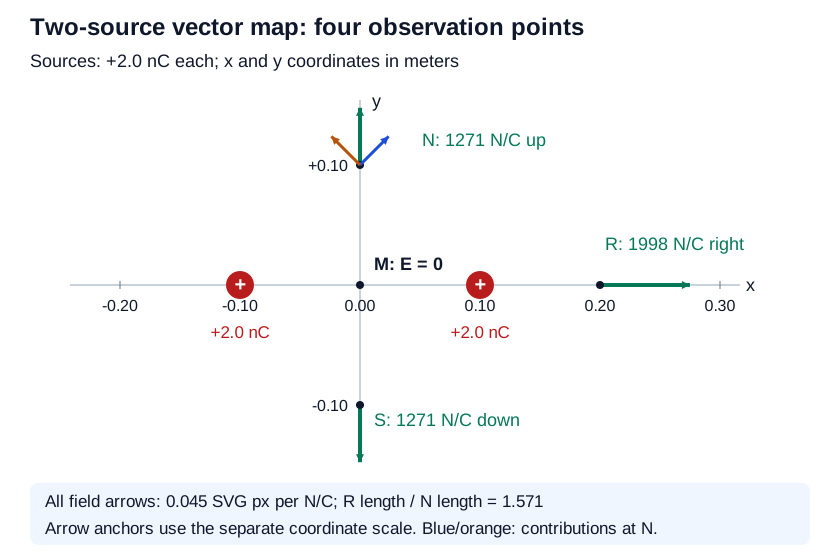
Inspect diagram labels
The diagram keeps its full size here. Focus the view and use the arrow keys, or scroll across it, to inspect every label.
Return to the unit problem →Try this problem in its lesson →
Bring a pair together from infinity
A +3.0 nC point charge is held fixed. A second point charge initially infinitely far away is brought to r = 0.20 m in vacuum. Compare second charges +2.0 nC and −2.0 nC in separate trials. Choose pair U = 0 at infinity and use k = 8.99 × 10⁹ N·m²/C².
Part a
For an external quasistatic assembly with negligible kinetic-energy change, determine the final U, the work done by the external agent from infinity, and the electric-force work in each trial. Explain each external-work sign by relating the agent’s force to the displacement.
Like-sign trial: U = W_ext = +2.697 × 10⁻⁷ J, W_E = −2.697 × 10⁻⁷ J. Opposite-sign trial: U = W_ext = −2.697 × 10⁻⁷ J, W_E = +2.697 × 10⁻⁷ J.
- Calculate |U| = (8.99 × 10⁹)(3.0 × 10⁻⁹)(2.0 × 10⁻⁹)/0.20 = 2.697 × 10⁻⁷ J; retain the product sign.
- Initial pair U is zero at infinity, so ΔU equals final U. Negligible ΔK makes W_ext = ΔU.
- For like signs the inward agent force has inward displacement, giving positive work against repulsion. For unlike signs the agent’s outward restraint has inward displacement, giving negative work against attraction.
- Electric work is −ΔU for each conservative pair interaction.
Scoring criteria
- 1 point: both signed final U values and infinite reference.
- 1 point: both W_ext values explicitly using negligible ΔK.
- 1 point: correct force/displacement sign explanations.
- 1 point: both opposite electric-work signs.
Part b
Construct U-versus-r graphs for the two pairs on common quantitative axes. Plot at least r = 0.20, 0.40 and 0.80 m, label values and units, and describe the r → ∞ limit. Distinguish this scaling from the force magnitude.
U values at 0.20, 0.40, 0.80 m are ±269.7, ±134.85, ±67.425 nJ respectively. Positive and negative inverse-distance curves approach zero from above and below. Force magnitude instead scales as 1/r².
- Double r to halve U; quadruple r to quarter U, keeping its sign.
- Plot the calculated points with signed nJ vertically and m horizontally and a common scale. Draw inverse-distance curves through them; no finite positive separation gives U = 0 for these nonzero charges.
- Describe the asymptotic infinity reference and contrast Coulomb force’s inverse-square magnitude.
Scoring criteria
- 1 point: all six plotted values and quantitative axes.
- 1 point: correct signed curve shapes/limits and 1/r versus 1/r² distinction.
Part c
In a different opposite-sign trial, remove the agent and release the second charge from rest at infinity in the idealized limit. At r = 0.20 m, calculate ΔK and W_ext. Explain why the negative final U is not the external work for this free motion.
W_ext = 0; ΔU = −2.697 × 10⁻⁷ J and ΔK = +2.697 × 10⁻⁷ J. Final U differs from external work because kinetic energy changes.
- With no external agent and fixed source, W_ext = ΔK + ΔU = 0.
- Use the same infinite U reference; the drop in pair energy becomes kinetic energy.
- The equality W_ext = U required negligible ΔK, which this trial violates.
Scoring criteria
- 1 point: zero external work and positive kinetic increase.
- 1 point: explains the missing negligible-ΔK condition.
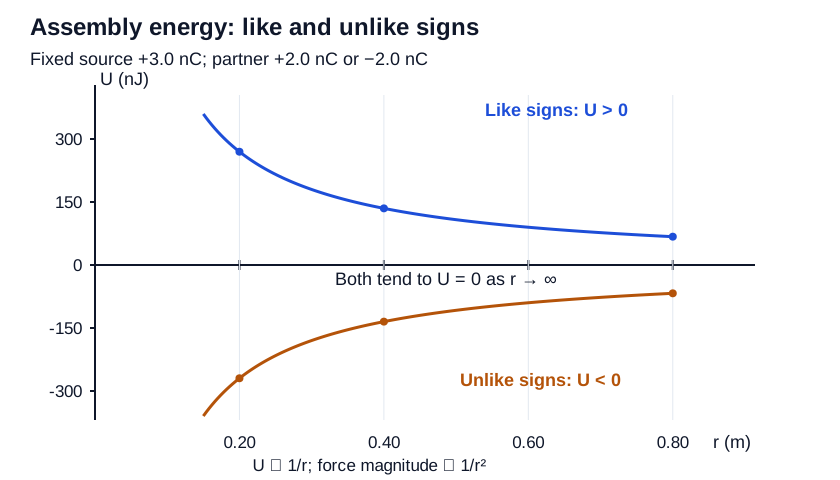
Inspect diagram labels
The diagram keeps its full size here. Focus the view and use the arrow keys, or scroll across it, to inspect every label.
Return to the unit problem →Try this problem in its lesson →
Read a field and predict actual motion
In a uniform static region, vertical equipotentials are 30 V at x = 0, 20 V at x = 0.020 m, and 10 V at x = 0.040 m. A nonperturbing particle has q = −1.0 nC, m = 2.0 × 10⁻⁶ kg and starts at (x,y) = (0.030 m,0) with velocity (0,+0.10 m/s). Ignore gravity and all other forces. The uniform region includes its motion for 0.20 s.
Part a
Construct the labeled contour map and a matching field-vector map at several points. Calculate E and state its direction, magnitude uniformity, perpendicularity to contours, and component along a contour.
E = 500 N/C right; equal arrows at all mapped points, perpendicular to the vertical contours, with zero y component.
- Eₓ = −(20 − 30)/0.020 = +500 V/m = +500 N/C; the second interval gives the same value.
- Place the three labeled vertical contours on common x coordinates; draw several equal-length rightward arrows on one scale.
- No potential change along y implies zero field component along these vertical contours.
Scoring criteria
- 1 point: 500 N/C right from signed voltage slope.
- 1 point: actual labeled maps at several locations, equal lengths and normal orientation.
- 1 point: zero contour-tangent component.
Part b
Predict the initial force and acceleration. Calculate the particle’s x and y coordinates at 0.20 s. Add its initial tangent and qualitative curved trajectory to your map, and explain why it does not follow a rightward field arrow.
Fₓ = −5.0 × 10⁻⁷ N; aₓ = −0.25 m/s². At 0.20 s, (x,y) = (0.025,0.020) m. The upward initial tangent bends left because the negative particle’s acceleration opposes E.
- Multiply signed q by E: aₓ = (−1.0 × 10⁻⁹)(500)/(2.0 × 10⁻⁶) = −0.25 m/s².
- x = 0.030 + (1/2)(−0.25)(0.20)² = 0.025 m; y = 0.10 × 0.20 = 0.020 m.
- Draw the upward initial tangent and the left-bending path. Initial velocity and negative-charge force determine the trajectory; a field arrow gives neither both coordinates nor the initial tangent.
Scoring criteria
- 1 point: signed force/acceleration.
- 1 point: both coordinates with independent horizontal/vertical reasoning.
- 1 point: actual curved path, upward initial tangent, and force versus field distinction.
Part c
Use the potential map to calculate ΔU and ΔK for that interval. Check ΔK from the velocity change and explain why moving between any two points on the same contour gives zero net electric work.
V_i = 15 V, V_f = 17.5 V; ΔU = −2.5 nJ and ΔK = +2.5 nJ. Equal-potential endpoints give −qΔV = 0 electric work.
- The uniform map is V = 30 − 500x in SI units. At x = 0.030 and 0.025 m, V is 15 and 17.5 V.
- ΔU = (−1.0 × 10⁻⁹)(+2.5) = −2.5 × 10⁻⁹ J, so electric-only ΔK = +2.5 × 10⁻⁹ J.
- vₓ,f = −0.25 × 0.20 = −0.050 m/s. The unchanged y kinetic energy cancels; ΔK = (1/2)(2.0 × 10⁻⁶)(0.050)² = 2.5 nJ.
- Same-contour endpoints have ΔV = 0; conservative electric work is −qΔV independent of route.
Scoring criteria
- 1 point: correct signed ΔV and ΔU.
- 1 point: matching positive ΔK with velocity check.
- 1 point: zero equipotential endpoint work with potential difference reasoning.
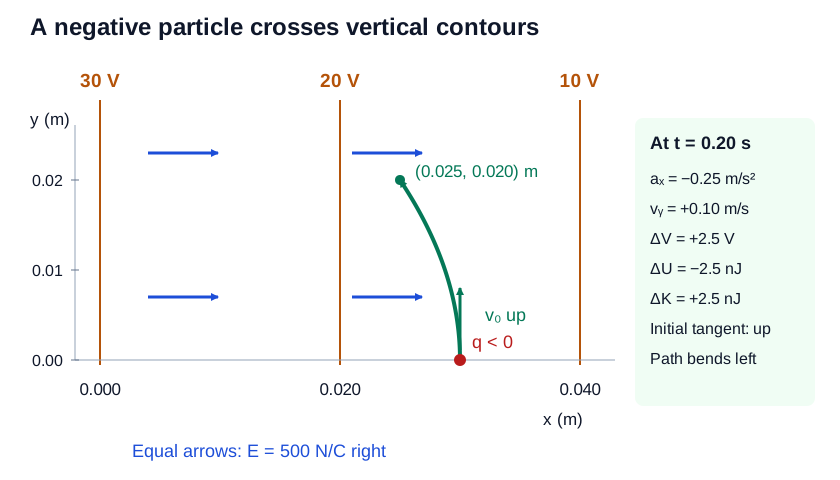
Inspect diagram labels
The diagram keeps its full size here. Focus the view and use the arrow keys, or scroll across it, to inspect every label.
Return to the unit problem →Try this problem in its lesson →
Is the plate field uniform everywhere?
Two broad horizontal conducting plates have uniform equal-and-opposite charge in the idealized model. The upper plate is at 12 V and the lower at 0 V. Separation d = 0.020 m and lateral size is 1.0 m. Points A, B and C lie far from all edges: A is near the upper plate, B is midway, and C near the lower plate. Point D is beside a finite plate end. Use the central approximation, air κ ≈ 1, and no other forces.
Part a
Calculate the central field. Draw arrows at A, B and C on one magnitude scale and state whether both magnitude and direction are constant. Explain the plate-sign direction and why A is not assigned a larger field just because it is nearer the upper plate.
E = 600 N/C downward at A, B and C. Use three equal-length parallel downward arrows. The fields of both broad plates combine; the central model does not use a one-source inverse-square distance from the nearby plate.
- E = ΔV/d = 12/0.020 = 600 V/m. Potential decreases downward from upper positive to lower negative plate, so E points downward.
- The ideal central plate contributions produce constant magnitude and direction; A, B and C differ in location, not in the assigned central field.
- Distinguish this extended-plate approximation from an isolated point-charge inverse-square field.
Scoring criteria
- 1 point: 600 N/C with correct sign direction.
- 1 point: actual equal-length central arrows and explicit constancy of both quantities.
- 1 point: plate-superposition/model explanation for no larger field at A.
Part b
Sketch the qualitative field near an end of the plates and explain why the constant central field cannot be assigned automatically at D. State the geometric and location conditions needed for your central approximation, and label any edge sketch direction-only if its arrow lengths have no common magnitude scale.
Near ends, field lines fringe and direction and magnitude vary. Here d/lateral size = 0.020, and points far from ends permit the central model. D is near an end, so its field needs a fringing description rather than an automatic 600 N/C downward value.
- Finite plate ends remove the broad-plane symmetry; curve field-line directions from the positive plate toward the negative plate near the ends.
- Specify separation much smaller than lateral dimensions and observations well away from edges.
- Use direction-only labels for the qualitative fringe; do not infer magnitudes from schematic curve or arrow lengths.
Scoring criteria
- 1 point: actual qualitative fringe sketch with correct positive-to-negative direction.
- 1 point: varying edge magnitude/direction and both central conditions stated.
- 1 point: honest direction-only convention rather than unsupported edge magnitude.
Part c
A particle with q = −2.0 nC and m = 4.0 × 10⁻⁶ kg enters the central gap at the midpoint with horizontal speed 0.50 m/s and zero vertical speed. Use x right and y upward. Find acceleration and its deflection over 0.080 m of central travel. Check for plate collision, and state why this calculation does not determine its path through an entry or exit fringe.
a_y = +0.30 m/s²; t = 0.16 s; y = +0.00384 m = 3.84 mm. This is less than the 10 mm midpoint-to-upper-plate distance, so no plate collision in this central interval. Fringe motion is not determined by constant central acceleration.
- Choose E_y = −600 N/C; a_y = qE_y/m = +0.30 m/s² and a_x = 0.
- t = 0.080/0.50 = 0.16 s; y = (1/2)(0.30)(0.16)² = 0.00384 m.
- Compare 3.84 mm with d/2 = 10 mm. The particle remains below the upper plate during this interval.
- A changing edge field would change force/acceleration; the prompt begins with central entry conditions and does not supply a fringe transit model.
Scoring criteria
- 1 point: upward acceleration and constant horizontal speed.
- 1 point: correct time and deflection.
- 1 point: collision comparison and qualified fringe limit.
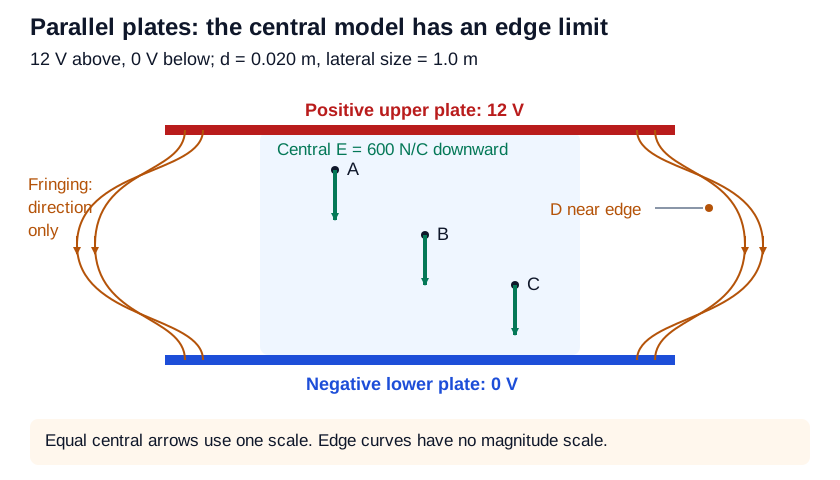
Inspect diagram labels
The diagram keeps its full size here. Focus the view and use the arrow keys, or scroll across it, to inspect every label.
Return to the unit problem →Try this problem in its lesson →