Magnetism and Current-Carrying Wires
Map fields from currents and distinguish segment forces from a loop’s net force and torque.
AP Physics 2 Topic 12.3 · College Board CED printed p. 85, 86 / PDF p. 92, 93 · See this topic in the course outline
A wire lets us organize many moving charges into a simple source. Learn two separate rules: current creates B around the wire, and an external B can push the wire.
Before you start
Map the field around a long straight wire
A current is moving charge, so a current-carrying wire produces a magnetic field. Around an ideal long straight wire, vectors are tangent to concentric circles centered on the wire. They have no radial component and no component parallel to the wire. Point your right thumb along conventional current; curled fingers give the field direction. For current out of the page, the circles run counterclockwise as seen by you.
In free space or air, , where r is the shortest perpendicular distance from the wire’s central axis, not the distance along the wire. Doubling I doubles B; doubling r halves B. This expression is an approximation when the straight wire is much longer than the distances of interest, with points away from the ends.
| r (cm) | B (μT) | 1/r (m⁻¹) |
|---|---|---|
| 2.0 | 30 | 50 |
| 4.0 | 15 | 25 |
| 6.0 | 10 | 16.7 |
B versus r is a falling inverse curve; B versus 1/r is a straight line through the origin with slope μ₀I/(2π).
Loop axes and vector superposition
For a circular current loop, curl right fingers with conventional current. The thumb gives B at the center along the loop’s axis, perpendicular to its plane. Counterclockwise current in a loop drawn in the page gives a field out of the page at its center. The field returns outside the loop; it does not simply end at the center.
Near several wires, first calculate each field separately, assign its direction at the observation point, and then add vectors. Equal-strength fields can reinforce or cancel. Two parallel wires with equal currents out of the page have opposite fields at the midpoint, so their net field there is zero. Reverse one current and the fields at the midpoint reinforce. A zero net field at one point does not imply neither source produces a field.
Force on a wire and turning of a loop
A wire in an external magnetic field can feel a force because its charge carriers feel magnetic forces. For a straight wire segment in uniform B, . Here ℓ is the length actually inside the field and θ is between conventional current and B. Point along current, curl toward B, and the thumb gives force; equivalent vector reasoning uses . Parallel or antiparallel segments feel zero force; a perpendicular segment has magnitude IℓB.
Opposite sides of a complete closed current loop in a uniform external field have equal and opposite forces. The net force is zero, but those forces can act at different locations and produce a torque that turns the loop. For example, a rectangular loop whose plane contains B can have a pair of opposite out-of-page and into-page forces; those cancel as vectors while still forming a turning pair. A nonuniform field can produce a net force. Always identify whether the question asks about one segment or the entire loop.
Add fields between two wires
Two long straight wires perpendicular to the page are 0.100 m apart. The left carries 4.00 A out of the page; the right carries 2.00 A out of the page. Find B at the midpoint.
The midpoint is 0.0500 m from each wire. Use the long-wire approximation and μ₀ = 4π × 10⁻⁷ T·m/A.
Why this step? Both sources meet the model and use perpendicular distance.
The left wire’s counterclockwise field is upward at its right side. The right wire’s field is downward at its left side.
Why this step? The right-hand rule supplies the signs before adding magnitudes.
B_left = 1.60 × 10⁻⁵ T; B_right = 8.00 × 10⁻⁶ T. Net B = 8.00 × 10⁻⁶ T upward.
Why this step? Opposite vectors subtract; the stronger source determines the direction.
Answer and check
8.00 μT upward. If the right current were reversed, the net would be 24.0 μT upward.
Find a wire segment’s magnetic force
A wire is 0.30 m long, but only 0.080 m lies in a uniform 0.250 T field into the page. A 1.50 A current flows rightward. Find the force.
Choose the segment inside the field as the magnetic-force region and ℓ = 0.080 m.
Why this step? Wire outside the field contributes no force in this idealized setup.
Current and B are perpendicular, so F = IℓB = (1.50)(0.080)(0.250) = 0.0300 N.
Why this step? The maximum-force case has sin θ = 1.
Rightward current crossed with into-page B gives upward force.
Why this step? Use conventional current for the wire rule, even if the carriers are electrons.
Answer and check
0.0300 N upward; use 0.080 m, not the entire wire length.
Make the graph variable carry the physics
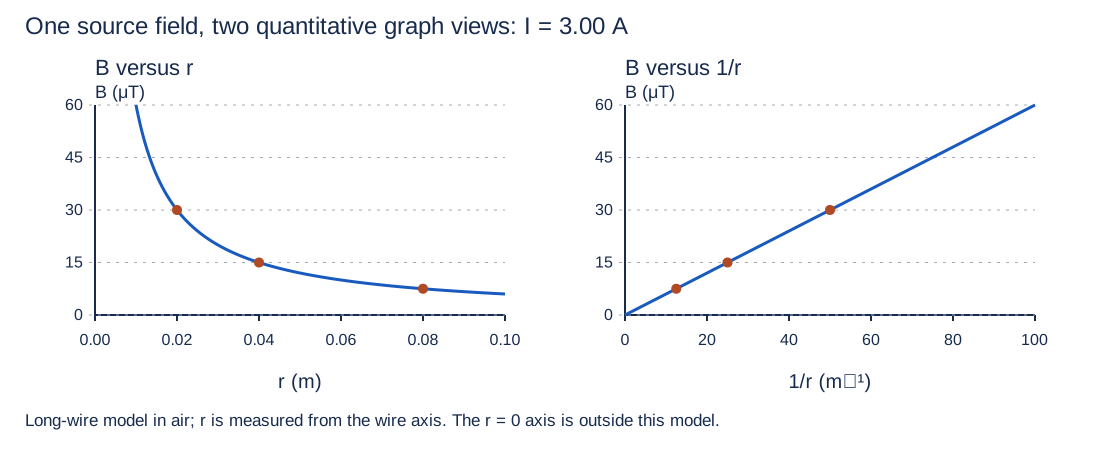
The field around a long straight wire is tangent to circles about its axis. At fixed current, increasing the radius spreads the field’s circulation over a larger circle and B decreases as 1/r. A B-versus-r graph therefore curves; a B-versus-1/r graph is straight because the horizontal variable is exactly the inverse distance already present in B = μ₀I/(2πr).
The straight-line slope is μ₀I/(2π), with units T·m, because teslas divided by m⁻¹ give T·m. The fitted origin belongs to the linearized variable: 1/r → 0 means r becomes very large. It is not a claim that the field is finite at the wire axis r = 0. Use the ideal long-wire relation outside the wire and away from its ends, and check the local tangent direction separately from its magnitude.
Inspect diagram labels
The diagram keeps its full size here. Focus the view and use the arrow keys, or scroll across it, to inspect every label.
Plot a wire field without confusing the axes
A long straight wire in air carries 3.00 A out of the page. Compare positions to its right at r = 0.0200, 0.0400, and 0.0800 m. Use μ₀ = 4π × 10⁻⁷ T·m/A.
Inspect diagram labels
The diagram keeps its full size here. Focus the view and use the arrow keys, or scroll across it, to inspect every label.
- B = (μ₀I/2π)/r = (6.00 × 10⁻⁷ T·m)/r. The fields are 30.0, 15.0, and 7.50 μT.
- Plot the same fields at r = 0.0200, 0.0400, 0.0800 m on the inverse curve, and at 1/r = 50.0, 25.0, 12.5 m⁻¹ on the straight graph.
- The straight slope is 0.600 μT·m = 6.00 × 10⁻⁷ T·m. It has distance in the numerator of the units even though reciprocal distance is plotted.
- The out-of-page current gives counterclockwise circles. At every specified point to the right, the tangent vector points upward and has no radial or axial component.
Answer and check
The field halves when r doubles. Both graphs show the same three measurements; their shapes differ because their horizontal variables differ. All specified field vectors point upward.
Try it from memory
Write your answer and reason before opening the worked answer. Your self-assessment is a study decision; it is not an automatically graded score.
Question 1
Create a quantitative B-versus-1/r graph from the teaching table’s three rows for I = 3.0 A. Label axes and units. Why does it form a straight line rather than the inverse curve of B versus r, and what does its slope mean?
Worked answer and reason
Plot (1/r, B) = (50 m⁻¹, 30 μT), (25 m⁻¹, 15 μT), and (16.7 m⁻¹, 10 μT), with suitable 0–50 m⁻¹ and 0–30 μT axes. B = [μ₀I/(2π)](1/r), so the slope is μ₀I/(2π) = 0.60 μT·m = 6.0 × 10⁻⁷ T·m. B versus r is curved.
Choose the horizontal variable from the functional dependence.
Question 2
A loop carries clockwise current as viewed from your side. Which way is its central magnetic field?
Worked answer and reason
Into the page, along the loop’s axis.
Curl the right fingers clockwise; the thumb points away from you.
Question 3
A student says a current loop in uniform B cannot turn because its net force is zero. Explain the missing distinction.
Worked answer and reason
Equal opposite forces on different sides can produce torque despite zero net force. Translation and rotation are different effects.
Force cancellation alone does not establish torque cancellation.
Question 4
I doubles, the in-field wire length triples, and B halves while the wire remains perpendicular. By what factor does F change?
Worked answer and reason
F changes by 2 × 3 × 1/2 = 3.
The perpendicular-force magnitude is proportional to all three factors.
JavaScript enables saved drafts and self-assessment. You can always work on paper.
Catch the tempting mistake
- The field of a straight wire points away from the wire.
- It is tangent to a circle centered on the wire, with no radial component.
- Add the field magnitudes of two wires before checking directions.
- Determine each local vector first; opposite fields subtract.
- Use the whole wire length in IℓB.
- Only the portion inside the stated field belongs in ℓ.
Put it to work
Give the physical reason as well as the calculation. The worked solutions are on a separate page.
- Problem 5 · quantitative graph and vector map
- Problem 6 · verbal and mathematical
- Problem 9 · experimental inference and symbolic derivation
- Problem 10 · experimental design and data
- Problem 11 · numerical table and experimental comparison
Explain and apply the model
Try these problems before opening the solutions. Show the physical model, your calculation or sketch, and the reason your conclusion follows.
Connect a field map to its inverse-distance graphs
A long wire in air carries 4.00 A out of the page. Measure at P to the right of its axis at r = 0.0200, 0.0400, and 0.0800 m, outside the wire and far from its ends. Use μ₀ = 4π × 10⁻⁷ T·m/A.
(a) Draw an arrowed field map around the wire, showing tangent directions at its right, top, left, and bottom. Explain whether B has radial or wire-parallel components, and calculate B at the three specified radii.
(b) Create B-versus-r and B-versus-1/r graphs using all three points. Supply numerical axes, scales, and units; distinguish the inverse curve from a straight fit. Determine the straight-line slope with units. Explain why its origin does not describe r = 0. Predict B at r = 0.0800 m if the current becomes 12.0 A.
Written working workspace
Drawing is temporarily unavailable. Work on paper if needed, then record your reasoning here.
Saving written working requires JavaScript. Keep your work on paper or in your own notes; the source problem above remains available.
Worked solution and rubric →Revisit the explanation →Revisit the explanation →
Scientific calculator workspace
Keep intermediate precision and report units. This calculator supports arithmetic and elementary functions.
Scientific calculator
This calculator requires JavaScript. Use the physics formula sheets and show your working manually.
+ − * / ^ ! · pi · e · sqrt · sin, cos, tan · asin, acos, atan · atan2(y,x) · ln, log · abs · exp · hypot(x,y). Use * between factors. Keep units in your written working.
For the teacher
- Use a compass map and then replace compass needles with tangent arrows.
- Ask for a straight-line B versus 1/r graph with slope units.
- Require separate diagrams for a source’s own field and force from an external field.
Source objectives and scope
- 12.3.A — Describe the magnetic field produced by a current- carrying wire.
- 12.3.B — Describe the force exerted on a current-carrying wire by a magnetic field.
Suggested skills are teaching guidance. The course applies all science practices across its objectives.
Science references for this teaching
- College Board AP Physics 2 CED, Unit 12 (supplied pinned source) — Official Unit 12 LO/EK scope and quantitative moving-charge angle boundary; raw 12.1.B4 normalized as 12.1.B.4
- OpenStax College Physics 2e: magnetic field lines — Closed-loop field convention and compass alignment
- OpenStax College Physics 2e: force on moving charge — Magnetic force magnitude and right-hand rule
- OpenStax College Physics 2e: Hall effect — Transverse force balance and Hall polarity
- OpenStax College Physics 2e: magnetic fields produced by currents — Long-wire field model and current-loop direction
- OpenStax College Physics 2e: force on a current-carrying conductor — Wire force and in-field length
- OpenStax College Physics 2e: Faraday and Lenz laws — Flux change and Lenz direction
- OpenStax College Physics 2e: motional emf — Sliding rod and mechanical-to-electrical energy accounting
Glossary and deeper reading · 10 refreshers
These editorial refreshers supplement the reading. Definitions and examples are added guidance; original source wording and recorded answers remain in their original context.
-
Electric charge
Electric charge is a conserved property that determines electric interactions. It can be positive or negative and is measured in coulombs; ordinary net charges arise from an imbalance of charged particles. For example, transferring electrons between initially neutral objects leaves one negatively charged and the other positively charged.
-
Electric current
Electric current is the net rate of charge flow through a specified cross section. It is measured in amperes, or coulombs per second, with direction defined by positive-charge motion. For example, the same steady current passes through each element of a simple unbranched series loop.
-
Conventional current
Conventional current points in the direction that positive charge would move through a circuit. In a metal wire, electrons usually drift in the opposite direction. For example, a current arrow pointing right in a metal wire does not mean the conduction electrons drift right.
-
Vector
A vector is a quantity with a magnitude and a direction, represented by an arrow or by components along chosen axes. Vectors add by adding corresponding components rather than simply adding their magnitudes. For example, an eastward displacement followed by a northward displacement produces a resultant pointing northeast. The zero vector has zero magnitude and no unique direction.
-
Superposition
Superposition means adding the separate contributions to obtain a total response in a linear model. Vector fields add vectorially, scalar potentials add algebraically, and wave disturbances add with their signs at each place and time. For example, equal but opposite electric-field contributions can give zero net field at one point while both sources remain present.
-
Torque
Torque describes a force’s turning effect about a chosen axis or point. Its magnitude is force times the perpendicular lever arm, and its direction or sign describes the rotation tendency. For example, pushing near the handle of a door produces more torque than the same perpendicular push near the hinge.
-
Net force
Net force is the vector sum of all forces acting on the object or system under consideration. For constant mass in an inertial frame, it equals mass times acceleration. For example, equal upward and downward forces give zero net force even though neither force is zero.
-
Magnetic field
A magnetic field assigns a vector direction and strength to each location and predicts interactions with moving charges, currents, and magnetic materials. Its strength is measured in teslas, and the force on a moving charge need not point along the field. For example, a compass aligns with the local field while a moving charge can be deflected perpendicular to it.
-
Force
A force describes an interaction that can change an object’s momentum. It is a vector measured in newtons, so both size and direction matter when forces are added. For example, a rope can pull a cart while the floor exerts friction in another direction.
-
Magnitude
Magnitude is the nonnegative size of a vector quantity. It does not specify direction, and it differs from a signed component. For example, a westward velocity can have a negative x component while its speed, the velocity magnitude, stays positive.