Magnetic Fields
Read magnetic maps and connect material magnetism with dipoles, domains, and response to an external field.
AP Physics 2 Topic 12.1 · College Board CED printed p. 80, 81, 82 / PDF p. 87, 88, 89 · See this topic in the course outline
Start with a map. A magnetic field tells us what direction a compass turns and helps predict forces on moving charge. Then zoom in: the behavior of a bulk magnet comes from the arrangement of many tiny dipoles.
Before you start
- Vector direction and vector addition
- Electric current as moving charge
Read a magnetic vector map
A magnetic field assigns one direction and strength to every location. It predicts interactions with moving charges, currents, and magnetic materials; it is not a map of the force on every possible test object. A compass north end points along the local field, whereas a moving charge can feel a force perpendicular to it. Draw arrows tangent to field lines and use denser lines for stronger field. Lines cannot cross because that would assign two directions to one field at one point.
Use ⊙ for a vector out of the page and ⊗ for a vector into the page. A uniform-field map has equal parallel arrows at equally spaced locations. Magnetic field strength is measured in teslas (T).
Dipoles and closed field loops
Every magnet in this course is a dipole: it has a north pole and a south pole together. There are no isolated magnetic monopoles in this model. Outside a bar magnet, field lines leave the north end and enter the south end; inside, they return from south to north. The entire line is a closed loop, even when a drawing shows only the outside portion. Cutting a bar magnet makes two smaller north–south dipoles, not a separate north pole and south pole.
Like poles repel; unlike poles attract. The field of a given dipole becomes weaker with increasing distance. Do not infer a uniform field from a sketch of a bar magnet: the direction and strength vary around it.
From electron motion to domain alignment
Atomic magnetic dipoles are associated with moving charge, including electron orbital motion and intrinsic spin. Spin is a quantum property; picturing an electron as an ordinary spinning ball is only a mnemonic. A circulating electric current also acts as a dipole. In a material, many dipoles pointing in different directions can largely cancel, so a material can contain dipoles without being a strong magnet.
Permanent magnetism and induced magnetism are properties of the whole system. Both arise when dipoles preferentially align. A permanent magnet keeps a substantial alignment after an external field is removed; induced magnetization depends on the field being present. A free compass experiences a turning tendency until its north end points along the external field. Alignment describes torque; a perfectly uniform field need not produce a net translational force on a complete dipole.
Compare ferromagnetic, paramagnetic, and diamagnetic responses
Composition matters because it determines how atomic dipoles can respond together. In ferromagnetic iron, nickel, and cobalt, regions called domains contain many aligned dipoles. An applied field can favor similarly oriented domains and leave substantial permanent magnetization. Heating or other changes can disrupt that alignment.
| Behavior | Microscopic response | After field removal |
|---|---|---|
| Ferromagnetic: iron, nickel, cobalt | Strong alignment of domains; may saturate | Can retain magnetization |
| Paramagnetic: aluminum, titanium, magnesium | Weak preferential alignment with the field | Alignment does not persist |
| Diamagnetic: present in all materials | Electronic response contributes a usually weak dipole alignment opposite the applied field | Induced response vanishes with the field |
All materials have a diamagnetic contribution. A stronger ferromagnetic or paramagnetic contribution can hide it, so “all materials are diamagnetic” does not mean every material has a net opposite response. These categories describe the net or dominant observed behavior.
Earth as an approximate dipole
Earth’s large-scale field can be approximated by a magnetic dipole. That model predicts a compass alignment and curved field lines, not a perfectly uniform field everywhere. The geographic and magnetic axes are not identical. The north-seeking compass end points roughly toward geographic north because the nearby region acts approximately like the south pole of a bar magnet. Local rocks, nearby currents, and details of Earth’s field can produce departures from the ideal dipole map.
Permeability is a response of matter
Magnetic permeability describes how much a material magnetizes in response to an applied magnetic field and therefore how the magnetic field in the material responds. Vacuum permeability is a constant used in AP calculations of fields in free space.
Matter can have a permeability different from vacuum because of its composition and arrangement of dipoles. Do not assume one fixed value applies to a material under every condition. Temperature, the direction of the applied field relative to the material, and field strength can change the response. A ferromagnet that approaches saturation does not keep magnetizing in direct proportion as the field grows. A supplied effective permeability applies to the conditions specified; a permeability ratio compares response under those conditions.
Predict what survives cutting a magnet
A north-left, south-right bar magnet is cut at its midpoint. A compass is placed just above the original north end. Predict the poles of each piece and the compass direction before the cut.
Model the original field as a dipole. Its outside field leaves the north end and returns to the south end.
Why this step? The direction is defined by the compass north pole and the closed-loop field map.
The left piece has north at its original left end and south at the new cut. The right piece has north at its new cut and south at the original right end.
Why this step? Each piece still contains aligned atomic dipoles; cutting does not create isolated poles.
The compass north end follows the local outside field away from the north end, with its exact tilt determined by its location.
Why this step? A compass aligns with the local field, not necessarily with the bar’s long axis.
Answer and check
Two dipoles remain. A correct sketch closes each piece’s field lines through that piece.
Explain a field-dependent response
Two equal-size samples are put in the same field. Sample F retains magnetization after removal; sample P has only a weak parallel response while the field is present. Why can a single permeability measured at room temperature fail to predict F’s response after strong heating?
Identify F as ferromagnetic-like and P as paramagnetic-like.
Why this step? Retention and weak temporary alignment distinguish the stated responses.
For F, the applied field favors domain alignment. Strong heating can disrupt the order, altering how much magnetization an external field produces.
Why this step? Permeability depends on the internal configuration and temperature, not just the sample’s name.
A room-temperature effective permeability is therefore not automatically valid for the heated state.
Why this step? The conditions of a measurement belong to the physical model.
Answer and check
F can retain aligned domains; P’s alignment does not persist. F’s permeability can change with temperature.
Why a circulating charge behaves like a dipole
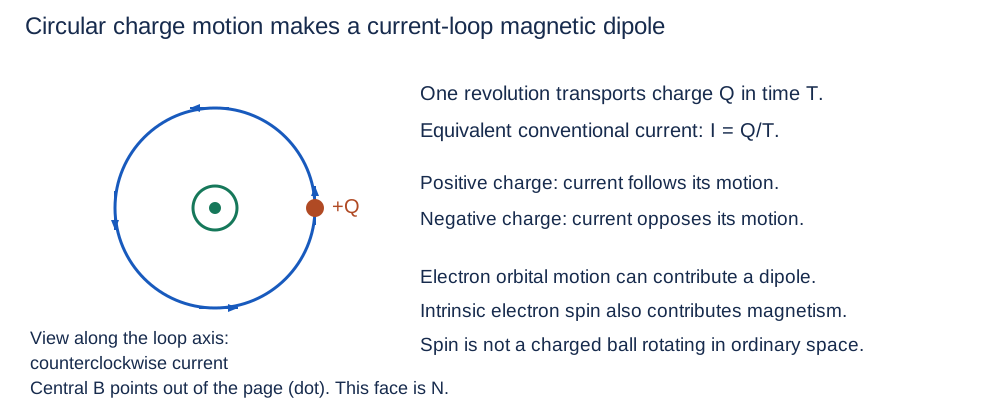
Imagine one positive charge making repeated circles. Each revolution transports that charge past a chosen point, so the circulation acts like a current loop. Curl the right fingers with conventional current: the thumb gives the loop’s axial field and points toward its north face. Reversing the circular motion reverses that field. A rotating distribution of charge can likewise contain circulating currents and have a magnetic dipole; no isolated magnetic pole is created.
In magnetic matter, electron orbital motion can supply such magnetic contributions. Electrons also have an intrinsic magnetic moment associated with quantum spin. Spin is not a tiny charged ball literally rotating, and the classical current-loop analogy does not describe an electron’s internal mechanics. Keep the useful connection—circulating charge can produce a dipole—while retaining this limit.
A material’s bulk magnetism depends on how its many dipoles combine. Differently oriented regions can nearly cancel even when each region contains aligned dipoles. An applied field can favor a common orientation: ferromagnetic iron, nickel, or cobalt may retain domain alignment afterward; paramagnetic aluminum, titanium, or magnesium develops weak alignment that does not persist. A usually weak diamagnetic contribution opposes the applied field in all materials, even when another contribution dominates. Permanent and induced magnetization are properties of the complete configuration.
Inspect diagram labels
The diagram keeps its full size here. Focus the view and use the arrow keys, or scroll across it, to inspect every label.
Turn a charge circulation into a dipole direction
A classical charge +2.00 nC makes one counterclockwise revolution every 4.00 μs as viewed along its axis. Treat the orbit as a steady repeated current; do not use this classical model to describe electron spin.
Inspect diagram labels
The diagram keeps its full size here. Focus the view and use the arrow keys, or scroll across it, to inspect every label.
- Each cycle carries Q = 2.00 × 10⁻⁹ C past a fixed point in T = 4.00 × 10⁻⁶ s, giving I = Q/T = 5.00 × 10⁻⁴ A = 0.500 mA.
- For positive charge, conventional current is counterclockwise. Curl right fingers counterclockwise; the thumb points out of the page. This viewing face is the loop’s north face.
- A negative charge of the same magnitude moving counterclockwise would have clockwise conventional current. Its axial field and pole orientation would reverse.
Answer and check
Equivalent current 0.500 mA counterclockwise; central field out of the page. This is a classical current-loop dipole illustration, not a mechanical electron-spin model.
Make the model respond
Focused Physics 2 model
Moving charge in a uniform magnetic field
Predict first. Which changes reverse the magnetic force, and which change its magnitude?
|F| = |q|vB sin θ; r = mv⊥/(|q|B); v⊥ = v sin θ; F = q(v × B)
- Allowed quantitative angles (discrete values)
- Selected or reference point
On a narrow screen, scroll within a figure to read its labels. The table and explanation provide the same physics in text.
Positive q gives force in −y. |F| = 4.005 × 10^−13 N; r = 0.1044 m.
Read the model data and comparisons
| Quantity | Value | Unit | Meaning or limit |
|---|---|---|---|
| Signed charge | 1.602 × 10^−19 | C | |
| Fixed particle mass | 1.673 × 10^−27 | kg | Proton mass; negative q represents a hypothetical particle of this same mass |
| Speed | 5.000 × 10^6 | m/s | |
| Speed fraction of c | 0.01668 | ||
| Perpendicular speed | 5.000 × 10^6 | m/s | |
| Parallel speed (signed) | 0 | m/s | |
| Field B along +z | 0.5 | T | |
| Force magnitude | 4.005 × 10^−13 | N | |
| Force component Fy | -4.005 × 10^−13 | N | Velocity transverse component is +x |
| Transverse radius | 0.1044 | m |
The magnetic force depends on the part of velocity perpendicular to B. It does no work on the particle, because force is perpendicular to velocity, so speed stays constant. Radius uses |q| and v⊥; the sign of q selects bending direction. At θ = 0° or 180°, there is no force and no circular component. Only θ = 90° gives a planar circle; other nonzero transverse cases give a helix.
Assumptions and limits. Uniform B along +z, no electric field, no collisions, fixed mass equal to the proton mass. q may have either sign but negative q is a hypothetical same-mass particle, not an electron. Quantitative force display is restricted to angles 0°, 90°, 180° by the AP Physics 2 boundary; other angles are qualitative. Nonrelativistic calculation restricted to v ≤ 0.1c; the UI maximum is about 0.067c. Zero q, B, or transverse speed gives zero force and no circle. No motion is animated. Projection and radius are schematic.
Try it from memory
Write your answer and reason before opening the worked answer. Your self-assessment is a study decision; it is not an automatically graded score.
Question 1
A student draws arrows leaving both ends of a bar magnet and stopping in empty space. Give two repairs.
Worked answer and reason
Label one end N and the other S. Outside arrows run N to S, and the paths continue through the magnet S to N to close.
A dipole has both poles and magnetic lines have no starting or ending monopoles.
Question 2
A material develops a weak magnetization opposite the external field. Which contribution is visible? Does its presence exclude a parallel contribution in other materials?
Worked answer and reason
The visible net response is diamagnetic. All materials have that contribution, but stronger parallel contributions may dominate elsewhere.
Distinguish a contribution common to all materials from the net response of a particular material.
Question 3
Why does a compass north end approximately point toward geographic north even though like magnetic poles repel?
Worked answer and reason
The Earth region near geographic north behaves approximately as a magnetic south pole, so it attracts a north-seeking pole. Earth is modeled as a dipole.
Geographic labels and physical magnetic polarity are different conventions.
Question 4
A material’s quoted permeability doubles when its orientation changes. Is that automatically a contradiction? Explain.
Worked answer and reason
No. Matter’s permeability can depend on orientation, temperature, and field strength; μ₀ in free space is constant.
The measured material response is not necessarily a universal constant.
JavaScript enables saved drafts and self-assessment. You can always work on paper.
Catch the tempting mistake
- Magnetic field lines begin at north and end at south.
- Only the outside part looks that way. Follow the line through the magnet: it is closed.
- Any iron sample must already be a strong permanent magnet.
- Domains can cancel at the sample scale. Composition enables ferromagnetism; domain arrangement determines the net magnetization.
- Permeability is always one fixed material constant.
- Use the value for the specified temperature, orientation, and field strength.
Put it to work
Give the physical reason as well as the calculation. The worked solutions are on a separate page.
- Problem 1 · field sketch and justified comparison
- Problem 2 · verbal and mathematical
- Problem 10 · experimental design and data
Explain and apply the model
Try these problems before opening the solutions. Show the physical model, your calculation or sketch, and the reason your conclusion follows.
From circular charge motion to a magnetic material
A classical charge +4.00 nC circulates counterclockwise once every 2.00 μs as viewed along the loop axis. Separately, an iron sample and an aluminum sample are placed in the same external magnetic field and then removed. These are distinct classical-loop and material experiments.
(a) Calculate the equivalent conventional current. Explain why the circular charge motion produces a magnetic dipole and determine its central field direction and the polarity of the face you view. Then predict both directions if the circulating charge is negative with the same magnitude and motion.
(b) Explain how electron motion can contribute magnetic dipoles in matter. Assess the statement “electron spin means a tiny charged sphere physically rotating”; distinguish the classical orbital/circulating-charge analogy from intrinsic spin.
(c) Use the configuration of dipoles and domains to explain why the iron may retain magnetization whereas aluminum has only weak temporary magnetization. State what happens to the paramagnetic alignment after field removal, and explain whether the diamagnetic contribution is absent from iron.
Written working workspace
Drawing is temporarily unavailable. Work on paper if needed, then record your reasoning here.
Saving written working requires JavaScript. Keep your work on paper or in your own notes; the source problem above remains available.
Worked solution and rubric →Revisit the explanation →Revisit the explanation →
Scientific calculator workspace
Keep intermediate precision and report units. This calculator supports arithmetic and elementary functions.
Scientific calculator
This calculator requires JavaScript. Use the physics formula sheets and show your working manually.
+ − * / ^ ! · pi · e · sqrt · sin, cos, tan · asin, acos, atan · atan2(y,x) · ln, log · abs · exp · hypot(x,y). Use * between factors. Keep units in your written working.
For the teacher
- Have students draw a full loop, including the magnet interior, before using a compass.
- Ask students to explain why a uniformly magnetized sample can still have two poles after cutting.
- Separate compass torque from a net translational force.
Source objectives and scope
- 12.1.A — Describe the properties of a magnetic field.
- 12.1.B — Describe the magnetic behavior of a material as a result of the configuration of magnetic dipoles in the material.
- 12.1.C — Describe the magnetic permeability of a material.
Suggested skills are teaching guidance. The course applies all science practices across its objectives.
Science references for this teaching
- College Board AP Physics 2 CED, Unit 12 (supplied pinned source) — Official Unit 12 LO/EK scope and quantitative moving-charge angle boundary; raw 12.1.B4 normalized as 12.1.B.4
- OpenStax College Physics 2e: magnetic field lines — Closed-loop field convention and compass alignment
- OpenStax College Physics 2e: force on moving charge — Magnetic force magnitude and right-hand rule
- OpenStax College Physics 2e: Hall effect — Transverse force balance and Hall polarity
- OpenStax College Physics 2e: magnetic fields produced by currents — Long-wire field model and current-loop direction
- OpenStax College Physics 2e: force on a current-carrying conductor — Wire force and in-field length
- OpenStax College Physics 2e: Faraday and Lenz laws — Flux change and Lenz direction
- OpenStax College Physics 2e: motional emf — Sliding rod and mechanical-to-electrical energy accounting
Glossary and deeper reading · 15 refreshers
These editorial refreshers supplement the reading. Definitions and examples are added guidance; original source wording and recorded answers remain in their original context.
-
Force
A force describes an interaction that can change an object’s momentum. It is a vector measured in newtons, so both size and direction matter when forces are added. For example, a rope can pull a cart while the floor exerts friction in another direction.
-
Electric charge
Electric charge is a conserved property that determines electric interactions. It can be positive or negative and is measured in coulombs; ordinary net charges arise from an imbalance of charged particles. For example, transferring electrons between initially neutral objects leaves one negatively charged and the other positively charged.
-
Vector
A vector is a quantity with a magnitude and a direction, represented by an arrow or by components along chosen axes. Vectors add by adding corresponding components rather than simply adding their magnitudes. For example, an eastward displacement followed by a northward displacement produces a resultant pointing northeast. The zero vector has zero magnitude and no unique direction.
-
Electric current
Electric current is the net rate of charge flow through a specified cross section. It is measured in amperes, or coulombs per second, with direction defined by positive-charge motion. For example, the same steady current passes through each element of a simple unbranched series loop.
-
Magnetic dipole
A magnetic dipole has a paired north–south magnetic character, modeled by a small magnet or a current loop. Its field lines form closed loops, and an external field can exert a turning torque on it. For example, cutting a bar magnet creates smaller dipoles rather than isolated north and south poles.
-
Field line
A field line is a drawn curve whose tangent shows the local direction of a vector field. Closer spacing conventionally represents greater field strength, and lines are a representation rather than physical threads. For example, electric field lines point away from a positive point charge and toward a negative one.
-
Torque
Torque describes a force’s turning effect about a chosen axis or point. Its magnitude is force times the perpendicular lever arm, and its direction or sign describes the rotation tendency. For example, pushing near the handle of a door produces more torque than the same perpendicular push near the hinge.
-
Ferromagnetism
Ferromagnetism is a strong collective magnetic response associated with aligned domains. Some ferromagnetic materials can retain substantial magnetization after an applied field is removed. For example, iron can become a permanent magnet when enough domain orientations remain aligned.
-
Magnetic domain
A magnetic domain is a region of a ferromagnetic material in which many microscopic magnetic dipoles are aligned. Different domains can have different orientations, so their contributions may largely cancel before magnetization. For example, an applied magnetic field can favor domains aligned with it and leave a piece of iron magnetized.
-
Diamagnetism
Diamagnetism is an induced magnetic response opposing an applied magnetic field. All materials have a diamagnetic contribution, but stronger magnetic responses can hide it in the net behavior. For example, a material described as diamagnetic has a net response weakly opposed to the applied field.
-
Paramagnetism
Paramagnetism is a usually weak tendency for a material’s magnetic dipoles to align with an applied field. The additional alignment generally disappears when the field is removed. For example, aluminum has a weak positive magnetic response under the conditions described in the course model.
-
Magnetic permeability
Magnetic permeability relates a material’s magnetic response to an applied field in a specified model. The response can depend on field strength, direction, and temperature, so one constant need not describe every condition. For example, a ferromagnetic core approaching saturation does not keep increasing its magnetization in direct proportion to the applied field.
-
Temperature
Temperature is a state quantity that determines the direction of net energy transfer through thermal contact. For a classical ideal gas it is proportional to the average translational kinetic energy per particle, rather than to the total energy of the sample. For example, a small hot metal sample can have a higher temperature but less total internal energy than a large cooler sample.
-
Conventional current
Conventional current points in the direction that positive charge would move through a circuit. In a metal wire, electrons usually drift in the opposite direction. For example, a current arrow pointing right in a metal wire does not mean the conduction electrons drift right.
-
Magnitude
Magnitude is the nonnegative size of a vector quantity. It does not specify direction, and it differs from a signed component. For example, a westward velocity can have a negative x component while its speed, the velocity magnitude, stays positive.