Wave Interference and Standing Waves
Reuse signed superposition and relative phase as the basis of optical interference.
Before this connection: Periodic waves and phase; Boundary reflection.
AP Physics 2 Topic 14.6 · College Board CED printed p. 119, 120, 121 / PDF p. 126, 127, 128 · See this topic in the course outline
Waves overlap by adding signed disturbances. Repeated overlaps can make beats or a pattern that appears to stay in place.
Before you start
- Signed quantities
- Sinusoidal waves
- Boundary reflection
Add point by point, then let the pulses pass
Interference is overlap of two or more waves. In the linear model, at the same place and time. The pulses pass through one another; they do not collide like solid carts. After overlap each resumes its original shape and direction in the ideal medium.
Same-sign displacements add constructively; opposite-sign displacements add destructively. Destructive does not always mean zero: +4 cm plus −1 cm gives +3 cm. An exact temporary cancellation of displacement does not destroy the waves' energy; energy remains in the medium's motion and interactions and the pulses reappear.
| x (m) | Pulse 1 (cm) | Pulse 2 (cm) | Net (cm) |
|---|---|---|---|
| 0 | 0 | 0 | 0 |
| 1 | 2 | −1 | 1 |
| 2 | 4 | −3 | 1 |
| 3 | 2 | −1 | 1 |
| 4 | 0 | 0 | 0 |
A graph through these points shows why the resultant need not resemble either original pulse. Superposition can create position- and time-dependent amplitude variations.
Nearby frequencies drift into and out of phase
Two tones of slightly different frequency alternately reinforce and oppose each other because their relative phase continually changes. The listener hears a repeating change in amplitude, called beats, rather than a new wave speed. . Two tuning forks at 256 Hz and 260 Hz give four loudness cycles per second.
For equal-amplitude 100 Hz and 102 Hz tones, they align at t = 0, oppose at 0.25 s, and align again at 0.50 s. The 2 Hz envelope describes amplitude variation; the individual tones still oscillate near 100 Hz. Tune one fork slightly higher and determine whether the beating speeds up or slows down to infer which frequency was higher.
Nodes and antinodes fit the boundaries
Two equal-frequency, equal-amplitude waves traveling in opposite directions can form a standing wave confined by boundaries. A node always has zero displacement. An antinode is a location where the oscillation amplitude is largest; its instantaneous displacement still passes through zero. Nodes stay fixed, while the medium between them oscillates.
A fixed string end is a displacement node; an ideal loose end is a displacement antinode. In a pipe, a closed end prevents air displacement, while an open end allows it. Thus a closed end is a displacement node and pressure antinode; an open end is a displacement antinode and pressure node. We neglect end corrections unless supplied.
| Ends | Allowed wavelengths | Allowed frequencies | Fundamental sketch in words |
|---|---|---|---|
| Node–node: fixed string | 2L/n, n = 1,2,3,… | nv/(2L) | half a wavelength; one interior antinode |
| Antinode–antinode: open pipe or loose-ended string | 2L/n | nv/(2L) | half a wavelength; one interior node |
| Node–antinode: closed–open pipe or fixed–loose string | 4L/n, n = 1,3,5,… | nv/(4L) | quarter a wavelength |
The longest allowed wavelength gives the lowest frequency, called the fundamental or first harmonic. Matching like boundaries permits all integer harmonics. Opposite boundaries permit only odd harmonics; the second allowed mode is the third harmonic, not the second harmonic. Adjacent nodes are λ/2 apart; a node and its adjacent antinode are λ/4 apart. Count those segments in a diagram before substituting numbers.
The second allowed mode is not always the second harmonic
A pipe is closed at one end and open at the other. Its length is 0.85 m and sound speed is 340 m/s. Find its first two allowed frequencies and locate their displacement nodes.
The closed end is a displacement node and the open end an antinode. The fundamental fits λ/4 = L.
Why this step? Boundary conditions decide the allowed pattern.
λ₁ = 4L = 3.40 m and f₁ = 340/3.40 = 100 Hz.
Why this step? The longest wavelength has the lowest frequency.
The next allowed pattern fits 3λ/4 = L: f₃ = 3f₁ = 300 Hz. It has displacement nodes at x = 0 and x = 2L/3; the open end x = L is an antinode.
Why this step? An odd number of quarter wavelengths connects unlike boundaries; f₂ = 200 Hz cannot fit.
Answer and check
100 Hz and 300 Hz. Their labels are first and third harmonics.
Infer which fork is high
A 440 Hz fork and an unknown fork beat at 3 Hz. Loading the unknown fork slightly lowers its frequency and the beats slow down. What was its initial frequency?
|funknown − 440| = 3 gives 437 Hz or 443 Hz.
Why this step? The beat rate alone leaves two possibilities.
Lowering the unknown frequency reduces the difference only if it began above 440 Hz.
Why this step? Use the controlled change to distinguish the candidates.
Answer and check
The unknown fork was 443 Hz.
Make fixed nodes from traveling contributions
Boundaries reflect a wave back into a confined region. On an ideal fixed-end string, a right-moving wave and a reflected left-moving wave can overlap at the same frequency and amplitude. Each contribution travels, but their sum can have a spatial amplitude pattern that stays in place. For yᵣ = A sin(kx − ωt) and yₗ = A sin(kx + ωt), the sine addition identity gives y = 2A sin(kx) cos(ωt), where k = 2π/λ and ω = 2πf. This algebra explains the pattern without calculus.
At sin(kx) = 0 the two contributions cancel for every time: those fixed points are nodes. Halfway between adjacent nodes, |sin(kx)| = 1, so the oscillation amplitude is largest: those locations are antinodes. When cos(ωt) = 0 the entire string passes through equilibrium, including its antinodes, but only the nodes remain at zero at every time. A zero snapshot alone cannot identify every point as a node.
Fixed endpoints require cancellation at x = 0 and x = L. Thus L must fit an integer number of half wavelengths, giving λₙ = 2L/n and fₙ = nv/(2L). The component waves can carry energy in opposite directions; the ideal equal-amplitude standing combination has no net one-way energy flow averaged over a cycle. Boundaries and superposition create the standing pattern, rather than a single traveling crest somehow stopping.
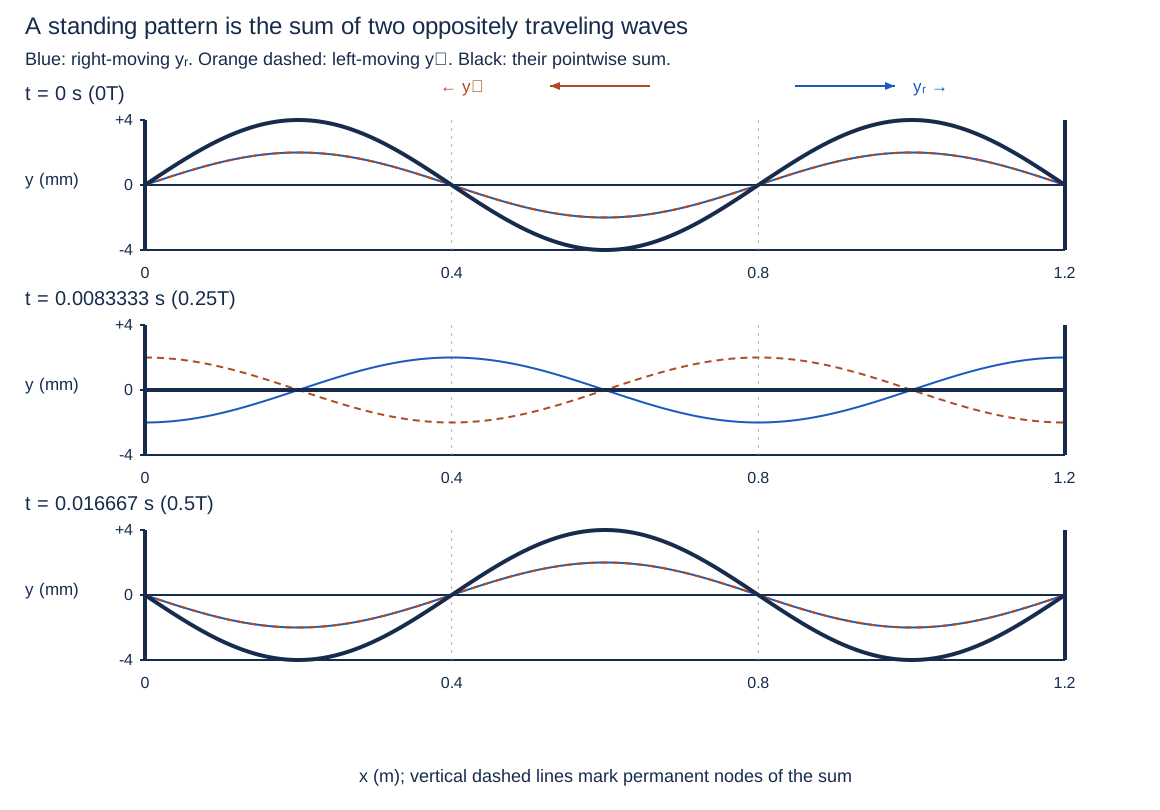
Inspect diagram labels
The diagram keeps its full size here. Focus the view and use the arrow keys, or scroll across it, to inspect every label.
Explain an equilibrium snapshot that is not all nodes
A 1.20 m ideal string is fixed at both ends. In the established third-harmonic state, right- and left-traveling waves each have A = 2.00 mm, λ = 0.800 m and f = 30.0 Hz. Use yᵣ = A sin(2πx/λ − 2πft), yₗ = A sin(2πx/λ + 2πft).
Inspect diagram labels
The diagram keeps its full size here. Focus the view and use the arrow keys, or scroll across it, to inspect every label.
- Add at the same x and t: y = (4.00 mm) sin(2πx/0.800 m) cos(60πt), with 60π in rad/s. The nodes are x = 0, 0.400, 0.800, 1.20 m.
- At t = 0 the sum has antinode extremes ±4.00 mm. At T/4 = 0.00833 s, the traveling profiles are equal and opposite and the sum is zero everywhere. At T/2 = 0.0167 s the standing profile is the negative of its initial profile.
- Permanent antinodes are at x = 0.200, 0.600, 1.00 m; their instantaneous displacements oscillate through zero.
- v = fλ = 24.0 m/s. The fundamental is v/(2L) = 10.0 Hz; 30.0 Hz is the third harmonic because the string contains three half wavelengths.
Answer and check
The two traveling components form a confined standing wave with four nodes and three antinodes. Its equilibrium snapshot does not make every point a permanent node.
Make the model respond
Focused Physics 2 model
Interference orders and standing waves
Predict first. Choose a model. Predict how wavelength changes bright orders or how harmonic number changes frequency.
Bright orders: d sin θₘ = mλ; exact screen y = L tan θₘ; small-angle estimate y ≈ Lmλ/d
- Exact finite screen positions
- Small-angle estimates
- Selected or reference point
On a narrow screen, scroll within a figure to read its labels. The table and explanation provide the same physics in text.
Order m = 1: θ = 14.48°, exact y = 0.5164 m; small-angle y ≈ 0.5 m.
Read the model data and comparisons
| Quantity | Value | Unit | Meaning or limit |
|---|---|---|---|
| Wavelength | 5.000 × 10^−7 | m | |
| Slit spacing | 2.000 × 10^−6 | m | |
| Screen distance | 2 | m | |
| Selected integer order | 1 | ||
| Required path difference mλ | 5.000 × 10^−7 | m | |
| Selected angle | 14.48 | ° | |
| Exact screen coordinate | 0.5164 | m | |
| Small-angle estimate | 0.5 | m | Only accurate when |mλ/d| ≪ 1 |
| Maximum allowed angular |m| | 4 | Equality gives grazing order, with no finite screen intersection | |
| Order -5 exact y | forbidden | m | |mλ/d| > 1 |
| Order -4 exact y | grazing | m | θ = -90° |
| Order -3 exact y | -2.268 | m | θ = -48.59° |
| Order -2 exact y | -1.155 | m | θ = -30° |
| Order -1 exact y | -0.5164 | m | θ = -14.48° |
| Order 0 exact y | 0 | m | θ = 0° |
| Order 1 exact y | 0.5164 | m | θ = 14.48° |
| Order 2 exact y | 1.155 | m | θ = 30° |
| Order 3 exact y | 2.268 | m | θ = 48.59° |
| Order 4 exact y | grazing | m | θ = 90° |
| Order 5 exact y | forbidden | m | |mλ/d| > 1 |
Two coherent slits produce constructive interference when the path difference is an integer wavelength. A bright-order number is an integer, not a continuous position. Convert the allowed angle to a flat-screen coordinate with tan θ. Using sin θ ≈ tan θ ≈ θ is a separate approximation and can noticeably underestimate positions at larger angles.
Assumptions and limits. Monochromatic coherent illumination, identical narrow slits, uniform center spacing, far-field interference, screen perpendicular to the central beam. The maximum-order condition uses exact trigonometry within this ideal far-field geometry. Finite slit width, missing orders from the diffraction envelope, brightness, peak width, and thin-film interference are not modeled.
Try it from memory
Write your answer and reason before opening the worked answer. Your self-assessment is a study decision; it is not an automatically graded score.
Question 1
At one point two pulses have displacements +5 mm and −8 mm. What is the net displacement, and what happens after overlap?
Worked answer and reason
−3 mm. In the ideal linear medium the pulses continue through one another with their original forms.
Destructive addition can leave a nonzero result; it does not mean pulses bounce or vanish.
Question 2
Adjacent displacement nodes on a standing string are 0.30 m apart. What is λ? At an antinode, must displacement always equal its maximum?
Worked answer and reason
λ = 0.60 m. No: an antinode is a location of maximum oscillation amplitude but its displacement changes in time.
Separate a fixed spatial amplitude pattern from the medium’s instantaneous motion.
JavaScript enables saved drafts and self-assessment. You can always work on paper.
Catch the tempting mistake
- The second resonance of a closed–open pipe is its second harmonic.
- Only odd harmonics fit those boundaries; the second resonance is the third harmonic.
Put it to work
Give the physical reason as well as the calculation. The worked solutions are on a separate page.
- Problem 11 · graphical
- Problem 12 · mixed
- Problem 19 · experimental
Explain and apply the model
Try these problems before opening the solutions. Show the physical model, your calculation or sketch, and the reason your conclusion follows.
Build a standing wave instead of assuming one
A 1.50 m ideal string is fixed at both ends. Two steady sinusoidal traveling contributions confined to the string are yᵣ = (1.50 mm) sin[2πx/(1.00 m) − 80πt] and yₗ = (1.50 mm) sin[2πx/(1.00 m) + 80πt], with t in seconds. Use sin(a−b)+sin(a+b) = 2 sin a cos b. The separate waves propagate in opposite directions.
(a) Add the displacements to obtain y(x,t), and explain why two waves traveling in opposite directions within the confined region can form a standing pattern. Verify that the sum satisfies both fixed endpoints at every time, even though each separate contribution need not vanish at an endpoint.
(b) Draw the separate right-moving and left-moving profiles and their pointwise sum over the full string at t = 0, T/4 and T/2. Use a common vertical scale in millimetres and horizontal scale in metres. Compute the three times, label permanent nodes/antinodes, and explain why the all-zero snapshot at T/4 does not make every point a node.
(c) Use the diagram’s node spacing to determine λ. Calculate v, identify the harmonic number, and determine the fundamental frequency. Explain why changing the right endpoint from fixed to ideally loose changes the allowed standing patterns.
Written working workspace
Drawing is temporarily unavailable. Work on paper if needed, then record your reasoning here.
Saving written working requires JavaScript. Keep your work on paper or in your own notes; the source problem above remains available.
Worked solution and rubric →Revisit the explanation →Revisit the explanation →
Scientific calculator workspace
Keep intermediate precision and report units. This calculator supports arithmetic and elementary functions.
Scientific calculator
This calculator requires JavaScript. Use the physics formula sheets and show your working manually.
+ − * / ^ ! · pi · e · sqrt · sin, cos, tan · asin, acos, atan · atan2(y,x) · ln, log · abs · exp · hypot(x,y). Use * between factors. Keep units in your written working.
For the teacher
- Ask students to add displacements at several x values, not just peaks. Diagnose whether pipe diagrams show displacement or pressure.
Source objectives and scope
- 14.6.A — Describe the net disturbance that occurs when two or more wave pulses or waves overlap.
- 14.6.B — Describe the properties of a standing wave.
Suggested skills are teaching guidance. The course applies all science practices across its objectives.
Science references for this teaching
- AP Physics 2 Course and Exam Description, official Unit 14 — Official topic/LO/EK scope and boundaries; local pinned source pages 117–134, equations visually checked on 118,120,130,132,134.
- OpenStax University Physics 1, Energy and Power of a Wave — Verification of fixed-amplitude mechanical-wave frequency scaling and distinction from electromagnetic intensity.
- OpenStax University Physics 1, Interference of Waves — Linear superposition and pointwise addition model.
- OpenStax University Physics 3, Single-Slit Diffraction — Verification of aperture minima and small-angle conditions.
- OpenStax University Physics 3, Interference in Thin Films — Verification of reflection phase and normal-incidence thin-film paths.
Related source reading
These alternative explanations and examples retain their source context. Draft placement does not add accepted exam coverage.
- Standing-wave source examples · alternative source explanation
- prescribed wave profiles · source context; placement review pending
Glossary and deeper reading · 13 refreshers
These editorial refreshers supplement the reading. Definitions and examples are added guidance; original source wording and recorded answers remain in their original context.
-
Wave
A wave is a propagating disturbance that can transfer energy without transporting the medium as a whole. Mechanical waves require a material medium, while electromagnetic waves can propagate through vacuum. For example, a pulse travels along a rope while individual rope segments move locally around their equilibrium positions.
-
Beats
Beats are periodic changes in resultant amplitude when waves of nearby frequencies interfere. The beat frequency equals the magnitude of the difference between those frequencies in the simple two-tone model. For example, two slightly detuned tuning forks produce repeating louder and quieter sound.
-
Reflection
Reflection occurs when a wave returns from a boundary into the region from which it arrived. For a light ray at a surface, the reflection angle equals the incidence angle when both are measured from the local normal. For example, a smooth mirror produces an orderly image while a rough surface scatters reflected rays in many directions.
-
Displacement
Displacement is the vector change in position from the start of an interval to its end. It depends on those endpoints rather than the length or shape of the path traveled. For example, walking around a closed track and returning to the start gives zero displacement but a nonzero distance traveled.
-
Constructive interference
Constructive interference occurs when overlapping wave contributions reinforce one another. For equal-frequency sinusoidal waves, in-phase contributions produce increased amplitude at the location considered. For example, coherent light arriving with an integer-wavelength path difference can form a bright interference fringe.
-
Superposition
Superposition means adding the separate contributions to obtain a total response in a linear model. Vector fields add vectorially, scalar potentials add algebraically, and wave disturbances add with their signs at each place and time. For example, equal but opposite electric-field contributions can give zero net field at one point while both sources remain present.
-
Frequency
Frequency is the number of complete repeating cycles per unit time. It is measured in hertz, meaning cycles per second, and is the reciprocal of the period. For example, a vibrating string with a higher frequency produces more cycles each second.
-
Oscillation phase
Phase specifies the position within a repeating oscillation cycle. A phase difference tells how much one oscillation leads or lags another at a chosen place and time. For example, two sinusoidal waves half a cycle out of phase can cancel when their amplitudes are equal.
-
Amplitude
Amplitude is the maximum magnitude of a repeating disturbance measured from its equilibrium value. It describes the size of the oscillation rather than its frequency or propagation speed. For example, pulling a spring-mounted mass farther from equilibrium increases its oscillation amplitude when it is released from rest.
-
Wave node
A wave node is a location where the specified oscillating quantity has zero oscillation amplitude in a standing-wave pattern. Displacement nodes and pressure nodes in a sound standing wave need not occur at the same positions, so the quantity must be named. For example, the fixed ends of an ideal vibrating string are displacement nodes.
-
Antinode
A wave antinode is a location where the specified oscillating quantity has its largest oscillation amplitude in a standing-wave pattern. Displacement antinodes and pressure antinodes describe different quantities, and their instantaneous values can still pass through equilibrium. For example, the center of a string in its fundamental two-fixed-end mode is a displacement antinode.
-
Pressure
Pressure is the normal force per unit area exerted on a surface. It is a scalar measured in pascals, with one pascal equal to one newton per square meter. For example, a gas exerts pressure throughout its volume through many microscopic collisions, even when its bulk motion is zero.
-
Wavelength
Wavelength is the spatial distance between neighboring points at the same phase of a periodic wave. It connects propagation speed and frequency through speed equal to frequency times wavelength. For example, neighboring crests of a sinusoidal water wave are separated by one wavelength.