Fission, Fusion, and Nuclear Decay
Account for mass-energy, nuclear binding, fission and fusion, and statistical radioactive decay.
AP Physics 2 Topic 15.7 · College Board CED printed p. 148, 149 / PDF p. 155, 156 · See this topic in the course outline
Nuclear reactions exchange rest energy with kinetic energy and photons while conserving the total. Radioactive decay adds a second idea: predictable ensemble statistics and unpredictable individual events.
Before you start
- Atomic notation
- Energy and momentum conservation
- Exponential graphs
Nucleons bind at short range and reactions conserve totals
At nuclear distances the strong interaction is the dominant binding interaction among protons and neutrons. It acts over a very short range; it is not a long-range force between ordinary neutral objects. Proton electric repulsion still matters, especially in large nuclei, so the balance affects stability.
In AP nuclear reactions the total nucleon number A is conserved: count every incoming and outgoing proton and neutron, including free particles. Momentum and total energy are also conserved. The rest mass of the products need not equal the reactants' rest mass because . If initial rest mass exceeds final rest mass, is available for kinetic energy of all products or emitted photons. If Q is negative, enough energy must be supplied. Momentum conservation often requires recoil even when a photon carries most of the released energy.
Mass defect includes every nucleon
Nuclear binding energy is the energy needed to separate a nucleus into free protons and neutrons. For a nucleus with Z protons and N = A − Z neutrons, . Both proton and neutron masses belong in the sum. A bound nucleus has less rest mass than the separated nucleons; assembling it releases energy and separating it requires energy.
Tables often list neutral atomic masses instead of bare nuclear masses. Then use , where mH is the neutral hydrogen-1 atomic mass. The Z electron rest masses cancel consistently on both sides; the approximation neglects the much smaller electronic binding corrections. Do not mix bare proton masses with a neutral atomic mass without correcting electrons. Use 1 u·c² = 931.5 MeV when masses are in atomic mass units.
Binding energy per nucleon, B/A, lets us compare nuclear stability trends. Energy-releasing fusion of light nuclei and fission of very heavy nuclei can produce more tightly bound products (greater average B/A), leaving less rest mass. It is the total initial-versus-final energy balance, not “all fusion always releases energy,” that determines Q.
Distinguish combining and splitting
Fusion combines smaller nuclei into a larger nucleus and can also emit subatomic particles. A representative supplied reaction is : initial A = 5 equals final A = 5. Bringing charged nuclei close generally needs energy to overcome electric repulsion before the short-range strong interaction can bind them.
Fission splits a heavy nucleus into two or more smaller nuclei and can emit particles. For a supplied induced fission channel, , A and charge balance. This is one possible channel, not a unique set of products to memorize.
Some nuclei fission spontaneously; others need an initiating input, such as neutron capture or supplied excitation, to reach a splitting pathway. Binding and the energy barrier constrain this behavior. A reaction can require triggering energy even if its completed products have lower total rest energy. Fission and fusion energies can appear as product kinetic energy and photons rather than disappearing as “lost mass.”
Half-life is a sample statistic
Radioactive decay is a spontaneous transformation to different nucleus/nuclei or to a lower energy level of the same nucleus. That last case includes gamma emission: the isotope need not change. The fall-2026 clarification is included in this definition. The time of an individual decay cannot be determined in advance; probability predicts the behavior of a population.
Half-life t₁/₂ is the time over which about half the initial parent nuclei decay in a large sample. After each further half-life, about half of the remaining parents survive. It is not a promise that every nucleus decays before t₁/₂, or that a surviving nucleus becomes “overdue.” For a small finite sample actual counts fluctuate; fractional expected counts represent an ensemble average rather than fractions of one physical nucleus.
Different unstable isotopes have half-lives from fractions of seconds to billions of years. Use the supplied half-life for the isotope; the element name alone does not fix it. Heating an ordinary sample is not the mechanism used to tune its intrinsic nuclear half-life in these AP tasks.
Exponential survival and dating
The decay constant λ describes the constant decay probability per unit time in the model. and . Keep time units consistent with λ. Half-life doubles when λ halves. The N-versus-t curve falls rapidly at first, then more slowly in absolute count because fewer parents remain; the fractional reduction over equal intervals stays the same.
| Elapsed time (h) | N/N₀ | Expected parent count |
|---|---|---|
| 0 | 1 | 800 |
| 2 | 1/2 | 400 |
| 4 | 1/4 | 200 |
| 6 | 1/8 | 100 |
A straight-line transformed graph is . For dating, . It requires a justified initial amount and a closed-system history: gaining or losing parents by another process spoils the inference. A measured activity (decays per time) is proportional to remaining N for one isotope, so its background-corrected ratios can also track decay; explain detector efficiency and background before treating counts as N.
| Time (h) | Expected parents | Log ratio |
|---|---|---|
| 0 | 800 | 0.000 |
| 2 | 400 | -0.693 |
| 4 | 200 | -1.386 |
| 6 | 100 | -2.079 |
| 8 | 50 | -2.773 |
Each interval of 2 h halves the remaining amount. The ordinary curve bends upward toward zero; its absolute decrease gets smaller. The log graph is a straight line of slope −ln2/2 = -0.347 h⁻¹. These are expected counts for an ensemble; they do not predict the exact time of a particular nucleus’s decay.
Use atomic masses consistently
Given neutral atomic masses mH = 1.007825 u and mHe-4 = 4.002603 u, and neutron mass mn = 1.008665 u, estimate helium-4 nuclear binding energy. Use 931.5 MeV per u.
Helium-4 contains two protons and two neutrons. With atomic masses, use two neutral hydrogen atoms so two electron masses cancel the two in neutral helium.
Why this step? Match nuclear versus atomic conventions before subtracting masses.
Δm = 2(1.007825) + 2(1.008665) − 4.002603 = 0.030377 u.
Why this step? The separated inventory includes every neutron as well as every proton.
B ≈ (0.030377)(931.5) = 28.30 MeV, or 7.07 MeV/nucleon.
Why this step? Positive mass defect means energy is required to separate the bound nucleus; small electronic binding corrections are neglected.
Answer and check
About 28.30 MeV total and 7.07 MeV per nucleon.
Dating a surviving parent fraction
A closed sample began with N₀ parents and now has 0.20N₀. The provided half-life is 5.0 years. Estimate elapsed time.
λ = ln2/5.0 = 0.1386 yr⁻¹.
Why this step? Match the decay-constant units to the requested time.
t = ln(N₀/N)/λ = ln5/0.1386 = 11.6 years.
Why this step? Invert the exponential instead of rounding to an integer number of half-lives.
The result is between 10 and 15 years, because the fraction is between 1/4 and 1/8.
Why this step? A half-life bracket independently checks the logarithm.
Answer and check
11.6 years, given the initial amount and closed-system assumption.
A graph of N/N₀ would place 0.20 at 11.6 years, between the 0.25 value at 10 years and 0.125 value at 15 years; the logarithmic graph has slope −0.1386 yr⁻¹.
Nuclear binding requires a short-range interaction
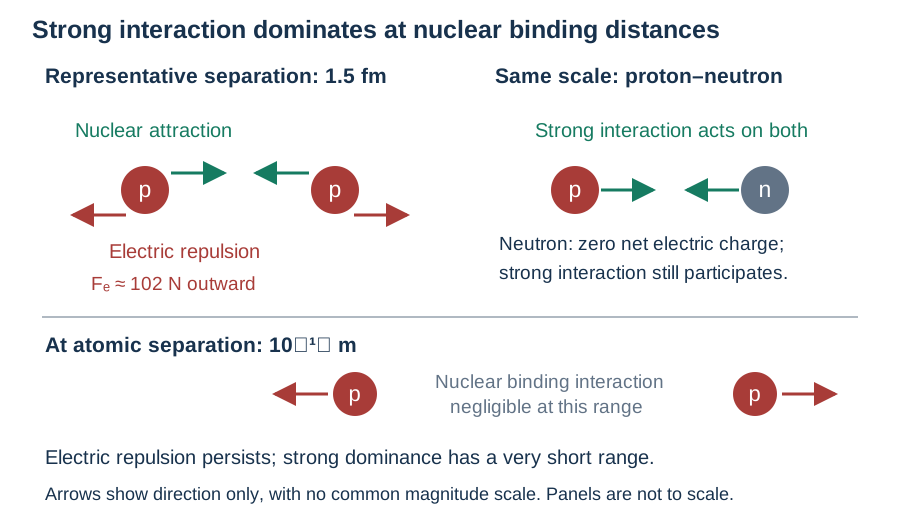
Protons repel electrically, yet stable nuclei contain closely spaced protons and neutrons. At representative nuclear binding separations of order 10⁻¹⁵ m, the strong interaction dominates the interactions among nucleons and provides the binding that a Coulomb-only description lacks. It acts between nucleons, including proton–neutron and neutron–neutron pairs; a neutron’s zero net electric charge does not remove its strong interaction.
Electric repulsion between protons still matters and helps constrain nuclear stability. For two protons 1.5 × 10⁻¹⁵ m apart, the Coulomb magnitude is about 1.02 × 10² N. That large outward force is why an explanation based only on electric forces cannot account for nuclear binding. At typical nuclear binding separations the strong interaction can overcome that repulsion. The nuclear interaction is not simply attractive at every conceivable separation, and the qualitative sketch gives no force law for its very shortest distances.
Range matters as much as strength. At an atomic separation of about 10⁻¹⁰ m, the short-range nuclear interaction between two protons is negligible while their electric interaction persists. Bringing two positive nuclei together for fusion therefore requires overcoming electric repulsion until they approach the range where nuclear binding becomes possible. Strong at nuclear scales does not mean dominant between ordinary separated atoms.
Inspect diagram labels
The diagram keeps its full size here. Focus the view and use the arrow keys, or scroll across it, to inspect every label.
Energy release must also satisfy vector momentum
In a nuclear reaction, total nucleon number, electric charge, total energy including rest energy, and vector momentum constrain the products. Rest mass alone need not be conserved. A decrease in total rest mass gives Q = (mᵢ − mᶠ)c², which can become kinetic energy of products and/or photon energy. Account for all products rather than assigning all released energy to the first one named.
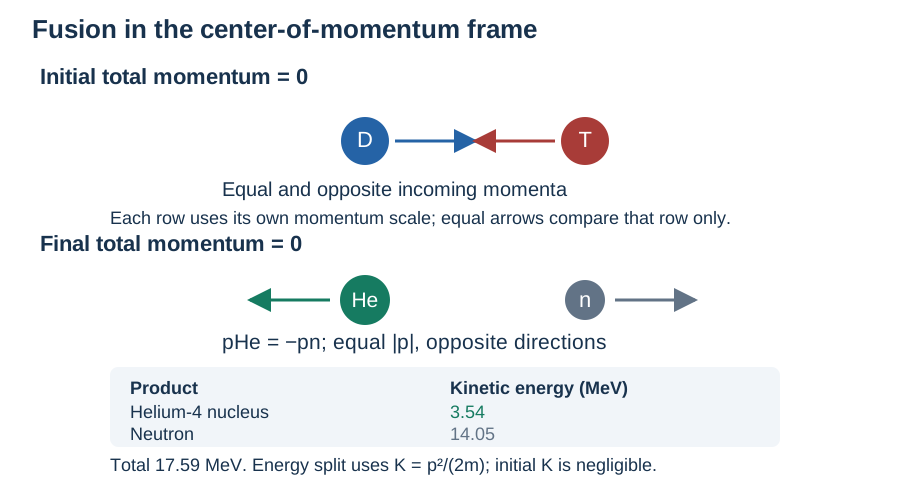
For the supplied fusion ²₁H + ³₁H → ⁴₂He + ¹₀n, nucleon number is 5 on each side and charge is +2e on each side. In the center-of-momentum frame, the initial total momentum is zero. If these are the only final products, their momenta must be equal and opposite. In the stated nonrelativistic product approximation, K = p²/(2m), so the lighter neutron carries more kinetic energy even though its momentum magnitude equals the helium nucleus’s.
Positive Q compares initial and final states; it does not remove a barrier along the reaction pathway. Fusion needs close approach despite electric repulsion. Fission can be spontaneous for one pathway or require neutron capture or excitation for another. The provided isotope, channel, and energy information determine the relevant conditions.
Inspect diagram labels
The diagram keeps its full size here. Focus the view and use the arrow keys, or scroll across it, to inspect every label.
A neutral neutron can still bind
Compare a proton–proton pair at 1.5 fm, a proton–neutron pair at the same typical nuclear binding separation, and two protons 10⁻¹⁰ m apart. Here 1 fm = 10⁻¹⁵ m. Use k = 8.99 × 10⁹ N·m²/C² and e = 1.60 × 10⁻¹⁹ C.
Inspect diagram labels
The diagram keeps its full size here. Focus the view and use the arrow keys, or scroll across it, to inspect every label.
- For the nearby protons, Fₑ = ke²/r² = 1.02 × 10² N, outward on each proton. Nuclear binding cannot be explained by this repulsion; the strong interaction dominates at nuclear binding separations.
- For the proton–neutron pair, the neutron has no net Coulomb charge in the AP point-charge comparison. Strong interaction still acts and can bind the pair at nuclear scale; lack of electric attraction does not mean lack of interaction.
- At 10⁻¹⁰ m, the proton–proton Coulomb repulsion is 2.30 × 10⁻⁸ N, while the extremely short-range nuclear binding interaction is negligible. The numerical decrease follows 1/r² for the electric force, not for the strong interaction.
Answer and check
Strong-interaction dominance is specific to nuclear distances and to nucleon interactions. The Coulomb values illustrate electric competition; no numerical strong-force law is inferred.
A lighter product receives more kinetic energy
For ²₁H + ³₁H → ⁴₂He + ¹₀n, use the supplied bare nuclear masses mD = 2.013553 u, mT = 3.015501 u, mHe = 4.001506 u, and mn = 1.008665 u. Work in the center-of-momentum frame with negligible initial kinetic energy, no photons in this channel, and nonrelativistic final K = p²/(2m). Use 1 u·c² = 931.5 MeV.
Inspect diagram labels
The diagram keeps its full size here. Focus the view and use the arrow keys, or scroll across it, to inspect every label.
- Nucleon and charge checks give 2 + 3 = 4 + 1 and 1 + 1 = 2 + 0. Every mass is a bare nuclear mass, so no atomic electron mass is mixed into the subtraction.
- Δm = 2.013553 + 3.015501 − 4.001506 − 1.008665 = 0.018883 u. Hence Q = 0.018883 × 931.5 = 17.59 MeV.
- Momentum conservation gives pHe + pn = 0. Their magnitudes are equal and directions opposite. Thus Kn/KHe = mHe/mn = 3.967 in the supplied nonrelativistic approximation.
- Use Kn + KHe = Q. This gives KHe = Qmn/(mHe + mn) = 3.54 MeV and Kn = QmHe/(mHe + mn) = 14.05 MeV. Their sum is 17.59 MeV.
Answer and check
Approximately 17.59 MeV of rest-energy decrease becomes 3.54 MeV of helium kinetic energy plus 14.05 MeV of neutron kinetic energy in this model. Opposite momenta conserve the initial zero total; the energy split neglects small relativistic corrections and initial kinetic energy.
Make the model respond
Focused Physics 2 model
Ensemble half-life and nuclear transformations
Predict first. After one half-life, is every nucleus halfway to decaying?
Expected surviving population: N(t) = N₀ 2^(−t/t½); activity = (ln 2/t½)N
- Ensemble expectation
- Selected or reference point
On a narrow screen, scroll within a figure to read its labels. The table and explanation provide the same physics in text.
After 2 half-lives, the expected surviving fraction is 0.25 and N = 1,000. Individual nuclei decay at unpredictable times.
Read the model data and comparisons
| Quantity | Value | Unit | Meaning or limit |
|---|---|---|---|
| Initial number of unstable nuclei | 4,000 | ||
| Illustrative half-life | 5 | s | Adjustable ensemble model; not the physical half-life of the example isotope |
| Elapsed time | 10 | s | |
| Survival probability of one nucleus | 0.25 | ||
| Expected surviving nuclei | 1,000 | Expectation may be fractional; an actual count is an integer | |
| Expected decayed nuclei | 3,000 | ||
| Expected activity | 138.6 | s⁻¹ | |
| Parent (A, Z) | 238, 92 | ||
| Daughter (A, Z) | 234, 90 | ||
| Emitted products | ⁴₂He (alpha) |
The curve predicts an ensemble mean under a constant independent decay probability; it is not a schedule for individual nuclei. In each half-life interval, half of the expected remaining population decays. Actual finite samples fluctuate and have integer counts. A decreases by 4 and Z decreases by 2; the alpha particle is a helium-4 nucleus, not a neutral helium atom. Nuclear mass number counts nucleons, while charge must be conserved including emitted particles. The adjustable seconds-scale half-life is hypothetical, not isotope data for the separate transformation example.
Assumptions and limits. Independent identical unstable nuclei, constant decay probability, one decay stage, no daughter growth/decay chain. N₀ is an initial count and N(t) an expected count. No stochastic simulation or claim that half of every small sample decays exactly in each interval. Transformation examples illustrate A/Z and charge bookkeeping; branching, energy release, and actual isotope half-lives are not modeled.
Try it from memory
Write your answer and reason before opening the worked answer. Your self-assessment is a study decision; it is not an automatically graded score.
Question 1
In ²₁H + ³₁H → ⁴₂He + ?, identify the missing product and explain where released energy can appear.
Worked answer and reason
The missing product is ¹₀n. Product kinetic energy and/or photons can carry energy corresponding to the decrease in total rest mass.
Count all A and charge before assigning mass-energy release.
Question 2
One nucleus has survived three half-lives. Must it decay in the next half-life? What is its model survival probability over that next interval?
Worked answer and reason
No deadline is implied. Conditional on still being a parent, it has a 1/2 probability of surviving the next half-life in the constant-rate model.
Ensemble exponential survival does not give an individual scheduled event.
Question 3
A fission channel has positive Q. Does that prove every nucleus of that isotope immediately splits without input?
Worked answer and reason
No. An energy barrier can prevent spontaneous splitting or make it rare; an input can initiate a reaction whose final products release more energy.
Distinguish net reaction energy from the path needed to reach the products.
JavaScript enables saved drafts and self-assessment. You can always work on paper.
Catch the tempting mistake
- Exactly half of any small collection must disappear each half-life.
- Half-life predicts an expected population fraction. Finite counts fluctuate and individual decay times remain unpredictable.
Put it to work
Give the physical reason as well as the calculation. The worked solutions are on a separate page.
- Problem 13 · mixed
- Problem 14 · mixed
- Problem 19 · experimental
Explain and apply the model
Try these problems before opening the solutions. Show the physical model, your calculation or sketch, and the reason your conclusion follows.
Binding, energy release, and recoil
Use representative nuclear binding separations of 1.5 fm and an atomic separation of 10⁻¹⁰ m, with 1 fm = 10⁻¹⁵ m. A supplied fusion channel is ²₁H + ³₁H → ⁴₂He + ¹₀n, with bare nuclear masses 2.013553, 3.015501, 4.001506, and 1.008665 u respectively. Its center-of-momentum frame has zero initial total momentum and negligible initial kinetic energy; the only final products are helium and neutron. Use k = 8.99 × 10⁹ N·m²/C², e = 1.60 × 10⁻¹⁹ C, 1 u·c² = 931.5 MeV, and the stated nonrelativistic final-product approximation K = p²/(2m). A separate supplied fission channel is ²³⁵₉₂U + ¹₀n → ¹⁴¹₅₆Ba + ⁹²₃₆Kr + 3¹₀n.
(a) Explain which interaction dominates nucleon interactions at typical nuclear binding separations and why a nucleus containing mutually repelling protons can be bound. Include proton–neutron and neutron–neutron interactions. Calculate the proton–proton electric-force magnitude at 1.5 fm, draw its direction, and explain why the short-range binding interaction does not dominate two protons separated by 10⁻¹⁰ m.
(b) For the supplied fusion channel, verify total nucleon number and electric charge, compute Q, and explain which energy is conserved and which mass quantity can change. Name the allowed forms of released energy in nuclear processes, then use the stated no-photon channel to account for this Q.
(c) Draw the final-product momentum vectors in the center-of-momentum frame, state their magnitude and direction relationship, and derive the kinetic-energy ratio Kn/KHe. Calculate both kinetic energies and check their sum. Evaluate the claim that two products with equal momentum magnitudes must receive equal kinetic energies.
(d) Contrast the supplied fusion and fission channels by what the nuclei do. Verify the fission channel’s total nucleon number and charge, including every free neutron. Explain why a positive-Q fission pathway can still need neutron capture or excitation rather than making every parent split immediately; relate fusion’s close-approach requirement to the short range discussed in part a.
Written working workspace
Drawing is temporarily unavailable. Work on paper if needed, then record your reasoning here.
Saving written working requires JavaScript. Keep your work on paper or in your own notes; the source problem above remains available.
Worked solution and rubric →Revisit the explanation →Revisit the explanation →Revisit the explanation →Revisit the explanation →
Can a neutral neutron take part in binding?
A student observes that neutrons have zero net electric charge and claims that the nucleus must be held together entirely by electric attraction. Choose the best explanation of binding among protons and neutrons.
(a) Select the explanation that accounts for both the nucleon types and the relevant distance scale.
Scientific calculator workspace
Keep intermediate precision and report units. This calculator supports arithmetic and elementary functions.
Scientific calculator
This calculator requires JavaScript. Use the physics formula sheets and show your working manually.
+ − * / ^ ! · pi · e · sqrt · sin, cos, tan · asin, acos, atan · atan2(y,x) · ln, log · abs · exp · hypot(x,y). Use * between factors. Keep units in your written working.
For the teacher
- Check all reactants and products, including emitted nucleons. Require a consistent nuclear-mass or atomic-mass convention; ask what the clock predicts for one nucleus versus a sample.
Source objectives and scope
- 15.7.A — Describe the physical properties that constrain the behavior of interacting nuclei, subatomic particles, and nucleons.
- 15.7.B — Describe the radioactive decay of a given sample of material consisting of a finite number of nuclei.
Suggested skills are teaching guidance. The course applies all science practices across its objectives.
Science references for this teaching
- AP Physics 2 Course and Exam Description, official Unit 15 — Official topic/LO/EK scope and boundaries; local pinned pages 143–158, equations and relevant clauses visually checked on 143–144,146,149–150,152–158.
- AP Physics 2 Course and Exam Description Clarifications, effective Fall 2026 — 15.7.B.1 current definition includes decay to a lower energy level of the same nucleus.
- OpenStax University Physics 3, Blackbody Radiation — Verification of Wien peak and integrated spectral intensity versus Stefan–Boltzmann total power.
- OpenStax University Physics 3, Photoelectric Effect — Verification of threshold, maximum kinetic energy, intensity distinctions, and retarding-potential experiment.
- OpenStax University Physics 3, The Compton Effect — Verification of positive electron-at-rest shift and photon energy/momentum accounting.
- OpenStax University Physics 3, Nuclear Binding Energy — Verification of all-nucleon mass defect and atomic-mass convention.
- OpenStax University Physics 3, Radioactive Decay — Verification of exponential survival, half-life, and nuclear transformation balances.
- OpenStax University Physics, Volume 3: 6.1 Blackbody Radiation — Primary textbook verification of the wavelength-based blackbody spectral shape, the distinction between peak height and complete spectrum area, Wien’s displacement law, and Stefan–Boltzmann emitted intensity and power.
Glossary and deeper reading · 16 refreshers
These editorial refreshers supplement the reading. Definitions and examples are added guidance; original source wording and recorded answers remain in their original context.
-
Kinetic energy
Kinetic energy is energy associated with motion relative to a chosen reference frame. For a nonrelativistic translating object it is one half of its mass times speed squared. For example, doubling a cart’s speed quadruples its translational kinetic energy when its mass stays fixed.
-
Photon
A photon is a quantum of electromagnetic radiation with energy proportional to its frequency. It has zero rest mass and no electric charge but carries energy and momentum. For example, increasing light’s frequency increases the energy of each photon, while increasing the number of same-frequency photons increases the total energy.
-
Linear momentum
Linear momentum is a vector describing an object’s motion and equals mass times velocity in the nonrelativistic model. The vector sum of momenta is conserved when the net external impulse on the system is zero. For example, two identical carts moving equally fast in opposite directions have zero total linear momentum but nonzero total kinetic energy.
-
Strong interaction
The strong interaction binds protons and neutrons at nuclear distances. It acts over a very short effective range between nucleons, while electric repulsion between protons also affects nuclear stability. For example, bringing nuclei close enough for fusion requires overcoming their electric repulsion before nuclear binding can occur.
-
Force
A force describes an interaction that can change an object’s momentum. It is a vector measured in newtons, so both size and direction matter when forces are added. For example, a rope can pull a cart while the floor exerts friction in another direction.
-
Mass number
Mass number is the total number of protons and neutrons in a nucleus. It is a count rather than the atom’s measured mass in kilograms or atomic mass units. For example, subtracting atomic number from mass number gives the neutron count of an isotope.
-
Nuclear binding energy
Nuclear binding energy is the energy required to separate a nucleus into free protons and neutrons. It equals the mass defect multiplied by the square of the speed of light, with both proton and neutron masses included. For example, forming a bound nucleus releases energy because its rest mass is smaller than that of its separated nucleons.
-
Electric charge
Electric charge is a conserved property that determines electric interactions. It can be positive or negative and is measured in coulombs; ordinary net charges arise from an imbalance of charged particles. For example, transferring electrons between initially neutral objects leaves one negatively charged and the other positively charged.
-
Energy level
An energy level is an allowed energy of a quantum system. Bound systems have discrete levels, and a transition between them requires an energy transfer equal to the level difference. For example, an atom emitting a photon drops to a lower energy level and transfers the difference to that photon.
-
Gamma emission
Gamma emission releases a high-energy photon when an excited nucleus moves to a lower nuclear energy state. It changes neither the proton count nor the neutron count, so the isotope can remain the same. For example, a daughter nucleus produced in another decay can subsequently emit a gamma photon as it loses excitation energy.
-
Half-life
Half-life is the time in which an ensemble of undecayed parent nuclei is expected to decrease to half its initial number. It is a statistical property of the isotope and does not predict the decay time of one nucleus. For example, after two half-lives a large ideal sample has about one quarter of its original parent nuclei remaining.
-
Isotope
Isotopes are atoms of the same element with different numbers of neutrons. They share an atomic number but have different mass numbers and can differ in nuclear stability. For example, carbon-12 and carbon-14 are isotopes because both have six protons but different neutron counts.
-
Decay constant
A decay constant describes the decay probability per unit time in an exponential radioactive-decay model. A larger constant corresponds to a shorter half-life for the same model. For example, a fixed fractional loss per time interval produces a falling exponential parent-nucleus count rather than a constant absolute loss.
-
Magnitude
Magnitude is the nonnegative size of a vector quantity. It does not specify direction, and it differs from a signed component. For example, a westward velocity can have a negative x component while its speed, the velocity magnitude, stays positive.
-
Electric force
Electric force is the interaction of an electric field with a charged object. For point charges at rest, like signs repel and opposite signs attract, with direction along their separation. For example, an electron and proton exert equal-magnitude opposite forces on one another despite having different masses.
-
Vector
A vector is a quantity with a magnitude and a direction, represented by an arrow or by components along chosen axes. Vectors add by adding corresponding components rather than simply adding their magnitudes. For example, an eastward displacement followed by a northward displacement produces a resultant pointing northeast. The zero vector has zero magnitude and no unique direction.