Chapter 6 Solutions
Worked solutions to all thirty problems, with the reason for each step. These explanations were added for this edition; the chapter answer key and original worked examples follow below.
Chapter problems → · Chapter answer key → · Original worked examples →
Problem 1
Original problem · clarified · added worked solution
Clarification: Use the asset model . Here the given r(t) is inserted into the exponent t r(t); it is not an instantaneous proportional growth rate.
Authored worked explanation for the original source problem.
Source review note: The source gives −42.40 dollars/year. The explicitly stated inserted-rate model gives about −423.62; a literal instantaneous-return interpretation gives positive growth instead. The original problem needs a model clarification.
If we use the source's constant-rate balance form with the varying rate inserted, the exponent is .
Why: The wording does not fully specify the asset model, so this assumption must be explicit.
, giving .
Why: Both the time factor and the changing rate contribute through the product rule.
At t=3, h≈0.359361 and h′≈−0.029574, so .
Why: Use the full initial amount 10000 dollars and retain units of dollars/year.
If r instead denotes the instantaneous percentage return, then is positive because r>0; that is a different growth model.
Why: A varying exponent coefficient is not interchangeable with an instantaneous growth rate.
Reviewed answer: Conditional on , dollars/year.
Takeaway: A rate description must specify the model before differentiation.
Final answer
Problem 2
Original problem · clarified · added worked solution
Clarification: Assume continuous compounding. The retirement fund is chosen so that interest at 5% supplies $50,000 per year without using the principal.
Authored worked explanation for the original source problem.
Source review note: The source value matches continuous compounding. Annual discrete compounding would instead give 1000000/(1.05)^30≈231377.45; the wording does not explicitly choose a convention.
To obtain 50000 dollars/year at a 5% continuous rate, the retirement balance must satisfy , so B=1000000 dollars.
Why: Divide desired yearly income by the specified rate.
If P is today's investment, , so .
Why: Discount the future balance with the same continuous model.
Reviewed answer: dollars under the source’s continuous model.
Takeaway: Use a consistent compounding convention throughout the calculation.
Final answer
Problem 3
Original problem · added worked solution
a) What is the optimum price point?
b) How many units will you sell at this price?
Authored worked explanation for the original source problem.
Source review note: The source price 5.30 dollars is a coarse approximation; e^(5/3)≈5.29449 rounds to 5.29 dollars to the nearest cent. The source sales quantity is consistent.
Revenue in 10000-dollar units is on [1,12].
Why: Revenue equals price times quantity.
gives ; .
Why: A negative second derivative makes this critical point a strict maximum.
R′ is positive below that price and negative above it, so it also beats both endpoints. At that price S=8−5=3, or 30000 units.
Why: A constrained absolute optimum needs its feasible interval checked.
Reviewed answer: dollars; sales 30000 units.
Takeaway: Optimize revenue, then convert the sales scale to actual units.
Final answer
Problem 4
Original problem · added worked solution
a) What is the optimum number of laptops your company should make for profit maximization?
b) What is the annual profit at that quantity?
Authored worked explanation for the original source problem.
Source review note: The source lists only 1,200,000 dollars, which is a coarse profit approximation and omits the requested production quantity.
Profit is for Q≥0.
Why: Subtract total cost from revenue before differentiating.
gives the positive critical quantity shown; .
Why: The negative quantity root is outside the production domain.
At that Q, , so .
Why: The critical-point equation simplifies the profit calculation.
Compare integer quantities 1825 and 1826; 1826 has the slightly larger profit.
Why: Laptops are indivisible, so the continuous result must be checked against neighboring integers.
Reviewed answer: laptops in the continuous model; maximum profit ≈1217161.24 dollars; integer optimum 1826 laptops.
Takeaway: A continuous optimum is a guide to the discrete production choice.
Final answer
Problem 5
Original problem · added worked solution
Authored worked explanation for the original source problem.
employees/year grows with t, while per year falls.
Why: Absolute growth counts new employees; relative growth divides that count by the current workforce.
The larger workforce can therefore add more people while each year's increase is a smaller percentage of the total.
Why: The two statements compare different quantities, so they do not conflict.
Reviewed answer: Example: for t≥0 has increasing but decreasing .
Takeaway: A falling percentage rate can coexist with a rising absolute rate.
Final answer
Problem 6
Original problem · added worked solution
Authored worked explanation for the original source problem.
gives x=5 and .
Why: The parabola opens downward.
Alternatively for every real x.
Why: Completing the square proves the maximum is global.
Reviewed answer: at x=5.
Takeaway: A global inequality can strengthen a local derivative test.
Final answer
Problem 7
Original problem · added worked solution
a) At which point does its absolute maximum value occur?
b) What is the maximum value?
Authored worked explanation for the original source problem.
For x>0, .
Why: A common denominator exposes the derivative's sign.
The derivative is positive for x<36 and negative for x>36, so 36 gives the absolute maximum.
Why: The function rises before and falls after this unique critical point.
Substitute into the original function to obtain 3ln36−6.
Why: The maximum value is a function height, not a derivative value.
Reviewed answer: At , maximum .
Takeaway: A sign change across the whole domain proves an absolute maximum.
Final answer
Problem 8
Original problem · added worked solution
Authored worked explanation for the original source problem.
Source review note: The source gives 4/3 cm²/s. With the stated volume rate 3 cm³/s and radius 2 cm, the reviewed surface rate is 3 cm²/s.
gives ; at r=2 and V′=3, cm/s.
Why: Differentiate with respect to time before inserting the instant's radius.
gives cm²/s.
Why: Surface rate and radius rate are related but have different units.
Reviewed answer: cm²/s.
Takeaway: Keep the geometric relation through both rate equations.
Final answer
Problem 9
Original problem · added worked solution
Authored worked explanation for the original source problem.
If side length is s, , so .
Why: Volume changes with both current side length and its growth rate.
At s=4 and s′=1, the rate is 3·16·1=48 cm³/s.
Why: Insert the current side after differentiation.
Reviewed answer: cm³/s.
Takeaway: A linear side rate produces a size-dependent volume rate.
Final answer
Problem 10
Original problem · clarified · added worked solution
Clarification: Treat the ladder as rigid, with its foot sliding on horizontal ground. Use the source diagram’s initial height 5 m and base distance 3 m; the top height is 5−3t² metres.
Authored worked explanation for the original source problem.
Source review note: The result uses the source diagram’s 5 m height and 3 m base with a rigid ladder and horizontal ground; the source rounds it to −0.75 rad/s.
The source diagram starts with vertical height 5 m and base distance 3 m, so the fixed ladder length is m.
Why: Use the initial right triangle to obtain the rigid hypotenuse.
At t=0.5, height is m and m/s.
Why: The printed displacement is measured from the initial height.
Since h=L sinθ, and .
Why: The horizontal leg is the coefficient converting vertical speed into angular speed.
Divide to obtain θ′≈−0.75147 rad/s, which rounds to −0.75.
Why: The negative sign means the angle is decreasing.
Reviewed answer: rad/s, assuming the rigid ladder geometry in the source image.
Takeaway: The ladder length stays fixed while both legs change.
Final answer
Problem 11
Added problem and worked solution
Find and classify the local extrema of .
Authored solution to an added practice problem.
, so the critical inputs are ±1.
Why: Stationary points occur where the derivative vanishes.
is negative at −1 and positive at 1; and .
Why: The second derivative classifies the curvature at each stationary point.
Reviewed answer: Local maximum at (−1,2); local minimum at (1,−2).
Takeaway: State both the critical input and its height.
Final answer
Problem 12
Added problem and worked solution
Find the absolute extrema of on .
Authored solution to an added practice problem.
gives x=−1 in [−2,2].
Why: Interior critical points are candidates along with endpoints.
, , and .
Why: Evaluate the original function at every candidate.
The smallest candidate value is −2 and the largest 7.
Why: Continuity on the closed interval guarantees the extrema are attained.
Reviewed answer: Absolute minimum −2 at x=−1; absolute maximum 7 at x=2.
Takeaway: Endpoints can win even when they are not stationary points.
Final answer
Problem 13
Added problem and worked solution
A student says every point with f′=0 is a maximum or minimum. Use to test the claim.
Authored solution to an added practice problem.
For , f′=3x²≥0 on both sides of zero.
Why: The derivative does not change from increasing to decreasing or vice versa.
The graph passes from negative heights to positive heights through zero.
Why: Values on either side lie on opposite sides of f(0), so it is neither a maximum nor a minimum.
Reviewed answer: No local maximum or minimum at zero.
Takeaway: A zero derivative is only a candidate for an extremum.
Final answer
Problem 14
Added problem and worked solution
A rectangular garden uses 40 m of fence on all four sides. Find the largest possible area and dimensions.
Authored solution to an added practice problem.
For sides x and y, gives y=20−x.
Why: The perimeter is the constraint.
has at x=10, with .
Why: Area is the quantity being maximized.
Then y=10; endpoints of the feasible interval give zero area.
Why: The positive critical point beats degenerate endpoint rectangles.
Reviewed answer: A 10 m by 10 m square; maximum area 100 m².
Takeaway: Use the constraint to reduce to one variable.
Final answer
Problem 15
Added problem and worked solution
A river forms one side of a rectangular garden. With 40 m of fence for the other three sides, find the dimensions maximizing area.
Authored solution to an added practice problem.
If x is each side perpendicular to the river and y is the parallel side, .
Why: Only three sides require fence.
has derivative 40−4x, so x=10 and y=20.
Why: The negative second derivative proves the interior maximum.
The maximum area is 10·20=200 m².
Why: Use the actual dimensions to compute the objective.
Reviewed answer: Widths 10 m and length 20 m; area 200 m².
Takeaway: Draw the constraint before differentiating.
Final answer
Problem 16
Added problem and worked solution
Cut equal squares from the corners of a 12 cm square sheet and fold an open box. Find the cut size maximizing volume.
Authored solution to an added practice problem.
for 0≤x≤6.
Why: Cutting removes twice x from each sheet dimension.
vanishes at x=2 and the degenerate endpoint 6.
Why: Use the product and chain rules.
V(0)=V(6)=0 and V(2)=128, so the useful maximum occurs at 2.
Why: The closed feasible interval includes the endpoint comparisons.
Reviewed answer: Cut squares of side 2 cm; box 8×8×2 cm; volume 128 cm³.
Takeaway: An endpoint critical value can describe a collapsed box.
Final answer
Problem 17
Added problem and worked solution
A closed cylindrical can holds cm³. Find the radius and height minimizing its surface area.
Authored solution to an added practice problem.
With , the constraint gives .
Why: Volume remains fixed while dimensions vary.
Surface area has .
Why: Include both circular ends for a closed cylinder.
gives r³=8, so r=2 and h=4. .
Why: Strict positive curvature gives the unique global minimum on r>0.
Reviewed answer: Radius 2 cm and height 4 cm.
Takeaway: Closed and open cylinders have different area objectives.
Final answer
Problem 18
Added problem and worked solution
Find the point on closest to .
Authored solution to an added practice problem.
A point on y=x is (x,x). Squared distance to (2,0) is .
Why: Minimizing distance and its nonnegative square gives the same point.
gives x=1 and .
Why: The squared distance is a convex quadratic.
The point is (1,1), at distance √2.
Why: Take the square root only after locating the optimum.
Reviewed answer: The closest point is (1,1); distance .
Takeaway: A squared-distance objective avoids a needless radical derivative.
Final answer
Problem 19
Added problem and worked solution
A fictional shop sells units at price p dollars. On , find the price maximizing revenue.
Authored solution to an added practice problem.
for 0≤p≤20.
Why: The upper price keeps the modeled sales nonnegative.
at p=10; .
Why: The quadratic has a unique maximum.
At p=10, q=100, R=1000; both endpoints give zero.
Why: Verify the constraint and evaluate actual units.
Reviewed answer: Price dollars; sales 100 units; maximum revenue .
Takeaway: A sales model needs a feasible price interval.
Final answer
Problem 20
Added problem and worked solution
A circular ripple has radius 3 cm growing at 2 cm/s. How fast is its area changing?
Authored solution to an added practice problem.
gives .
Why: Area depends on the changing radius.
At r=3 cm and r′=2 cm/s, A′=12π cm²/s.
Why: Keep the length units in both factors.
Reviewed answer: cm²/s.
Takeaway: Differentiate before substituting the instant's radius.
Final answer
Problem 21
Added problem and worked solution
A sphere gains volume at cm³/s when its radius is 2 cm. Find its radius rate.
Authored solution to an added practice problem.
.
Why: Differentiate the sphere volume with respect to time.
At V′=8π and r=2, cm/s.
Why: Solve for the requested linear rate rather than the volume rate.
Reviewed answer: cm/s.
Takeaway: The current surface area converts volume rate into radius rate.
Final answer
Problem 22
Added problem and worked solution
A 5 m ladder rests on level ground against a wall. Its base moves away at 2 m/s. How fast does the top fall when the base is 3 m from the wall?
Authored solution to an added practice problem.
A 5 m ladder satisfies , so .
Why: The fixed length provides the relation between the two legs.
At x=3, y=4 and x′=2, so .
Why: The height falls while the base moves outward.
Reviewed answer: m/s.
Takeaway: The sign carries the physical direction.
Final answer
Problem 23
Added problem and worked solution
A cone-shaped tank has height 6 m and top radius 3 m, point downward. Water enters at 1 m³/min. Find the height rate when the water is 2 m deep.
Authored solution to an added practice problem.
Similarity gives r/h=3/6=1/2, so .
Why: The water surface radius changes with height; it is not the full tank radius.
. At h=2 and V′=1, h′=1/π.
Why: Insert the current water depth after differentiation.
Reviewed answer: Water height rises at m/min.
Takeaway: Use similar triangles to eliminate the changing radius.
Final answer
Problem 24
Added problem and worked solution
Two walkers leave the same point at the same time. One goes east at 3 m/s and one north at 4 m/s. How fast does their separation grow?
Authored solution to an added practice problem.
If one walker is x meters east and the other y meters north of their common start, .
Why: The separation is a hypotenuse.
At the instant x=3t, y=4t, so d=5t and d′=5 m/s for t>0.
Why: The constant speeds form a 3–4–5 right triangle at every time.
Reviewed answer: m/s.
Takeaway: Two perpendicular speeds combine through geometry, not simple addition.
Final answer
Problem 25
Added problem and worked solution
A rectangle is 5 cm long and 4 cm wide. Its length shrinks at 1 cm/s while its width grows at 2 cm/s. Find its area rate.
Authored solution to an added practice problem.
For a rectangle, .
Why: Both dimensions change, so both product contributions matter.
At l=5, w=4, l′=−1, w′=2, the area rate is 5·2+4(−1)=6 cm²/s.
Why: A shrinking length gives a negative contribution but the width's increase is larger.
Reviewed answer: cm²/s.
Takeaway: Competing changes need their signed contributions added.
Final answer
Problem 26
Added problem and worked solution
A sign chart gives f′>0 on , f′<0 on , and f′>0 on . Assume f is continuous and stationary at −2 and 1. Classify the two points.
Authored solution to an added practice problem.
The derivative changes from positive to negative at −2.
Why: The function rises then falls, so its nearby values are lower than the height at −2.
At 1 it changes from negative to positive.
Why: The function falls then rises, creating a local minimum.
Reviewed answer: Local maximum at −2; local minimum at 1.
Takeaway: A first-derivative sign change classifies an extremum.
Final answer
Problem 27
Added problem and worked solution
Does have absolute extrema on ? Explain the role of the endpoints.
Authored solution to an added practice problem.
f(x)=x is increasing, and all its values lie strictly between 0 and 1.
Why: The interval omits both endpoints.
Any proposed smallest positive value can be halved to obtain a smaller allowed value; similarly any input below 1 has a larger allowed input.
Why: The bounding heights are approached but never attained.
Reviewed answer: No absolute minimum on (0,1); infimum 0. No absolute maximum either; supremum 1.
Takeaway: Bounds are not extrema unless the function actually reaches them.
Final answer
Problem 28
Added problem and worked solution
Maximize on .
Authored solution to an added practice problem.
throughout [0,3].
Why: The unrestricted peak at x=5 is outside the allowed interval.
The function increases to the right endpoint, where .
Why: A constraint can make an endpoint the optimum.
Reviewed answer: Maximum at x=3 with value 16.
Takeaway: Only feasible points are candidates.
Final answer
Problem 29
Added problem and worked solution
A fictional team has 400 employees and gains 12 employees/year at the current instant. State its absolute and percentage growth rates.
Authored solution to an added practice problem.
Divide the headcount rate 12 by the current headcount 400 to get 0.03 per year.
Why: A percentage rate is normalized by the current amount.
Multiply by 100 to express 0.03 as 3%.
Why: The absolute count and relative percentage use different units.
Reviewed answer: Absolute growth 12 employees/year; relative growth 3%/year.
Takeaway: Name the denominator when reporting a percentage rate.
Final answer
Problem 30
Added problem and worked solution
Two positive numbers have product 36. Find the pair with the smallest sum.
Authored solution to an added practice problem.
For x>0 and xy=36, write .
Why: The product constraint eliminates y.
gives x=6; .
Why: The sum is strictly convex on its positive domain.
Then y=6 and S=12; the sum grows without bound as x approaches 0 or infinity.
Why: This is the global minimum, not just a local one.
Reviewed answer: The two positive numbers are both 6; minimum sum 12.
Takeaway: Constraints and endpoint behavior turn a local test into a global conclusion.
Final answer
Chapter answer key and worked steps
Answers and worked steps for the original problems, including verified corrections where needed.
-
Checked answer
Conditional on , dollars/year.Problem 1 → -
Checked answer
dollars under the source’s continuous model.Problem 2 → -
Checked answer
dollars; sales 30000 units.Problem 3 → -
Checked answer
laptops in the continuous model; maximum profit ≈1217161.24 dollars; integer optimum 1826 laptops.Problem 4 → -
Original short answer
Answers will varyProblem 5 → -
Original short answer
Problem 6 → -
Original short answer
a. Problem 7 →
b. -
Corrected answer
cm²/s.Problem 8 → -
Original short answer
Problem 9 → -
Checked answer
rad/s, assuming the rigid ladder geometry in the source image.Problem 10 →
Source worked examples
These are the book’s example problems and worked steps, with the original explanations.
Example Problem 6.1.1
Find the absolute maximinima values and where they occur of the function on the closed interval .
Example Problem 6.1.2
Find and label all the critical x-values with either “local maxima” or “local minima” of the function on the closed interval .
Example Problem 6.2.1
You really want to win that contest! So you decide to start working on the highly efficient can that holds 250 of soda using the least amount of aluminum.
a) Find the dimensions of the cylindrical can.
b) What is the cost to manufacture one can, assuming a sheet of aluminum costs $0.001 per cm2?
c) Is this design realistic? If not, what should the dimensions be, given that the radius can’t be wider than 10 cm and the height no longer than 20 cm?
Example Problem 6.3.1
A droplet forming inside of a cloud has a diameter of 0.1 mm. The high humidity inside the cloud causes the rate of condensation to be 1 mm3/s.
a) At what rate does the diameter of the droplet increase after 3 seconds?
b) What was the original rate of increase of the droplet size when its diameter was still 0.1 mm?
Interactive 6.3.1 Example Problem 6.3.2
Read all original figure notes
Finding θ
t = 3 s
Example Problem 6.3.2
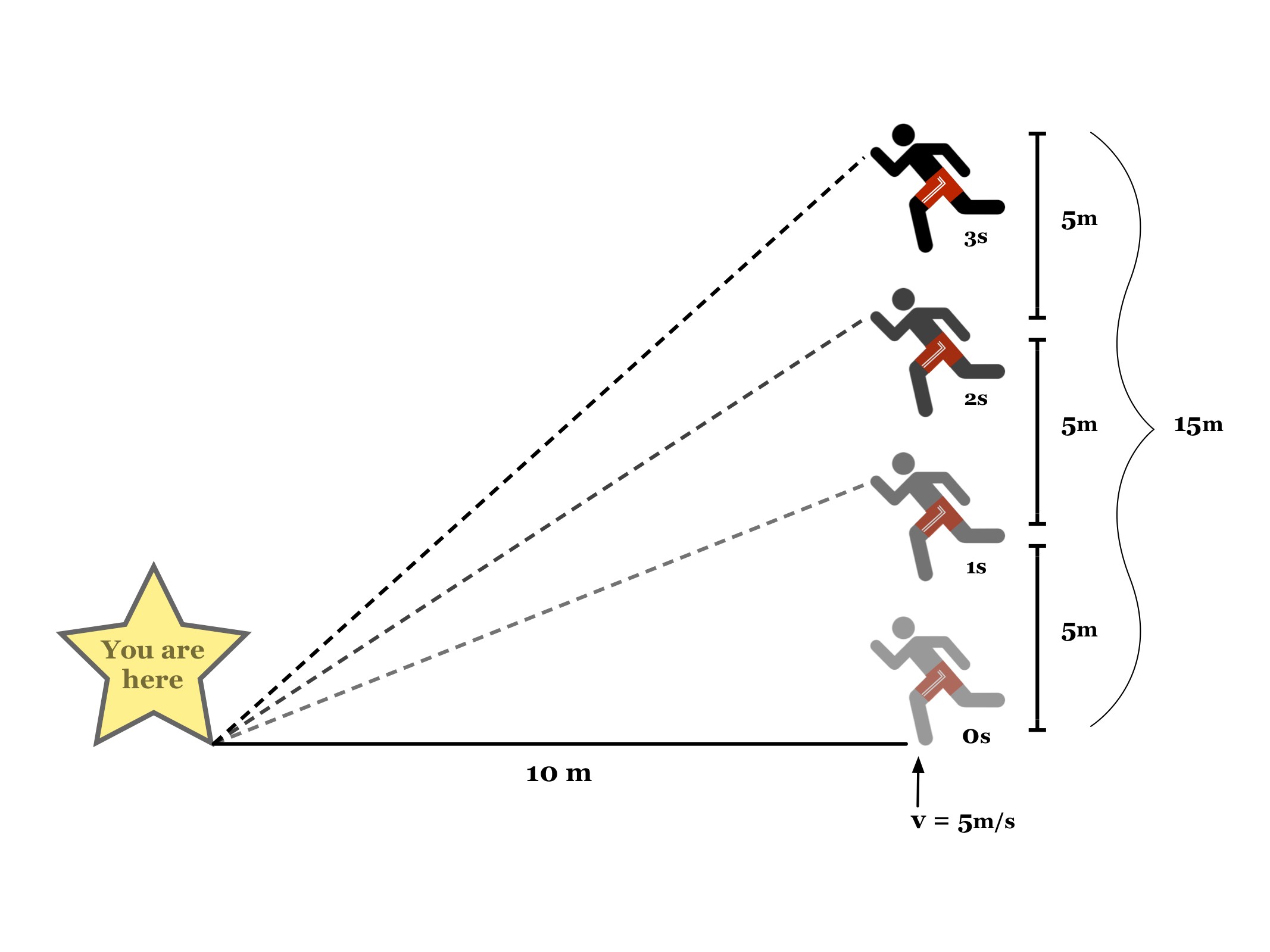
Your friend wants you to time him to see how fast he can run. He starts out 10 m east of you, and after you hit the start button on the timer, he runs at a speed of 5 m/s north. How fast is the angle between you changing relative to the original starting point after 3 seconds? (See Interactive 6.3.1 at left).
Interactive 6.3.1 Example Problem 6.3.2
Read all original figure notes
Finding θ
t = 3 s
Example Problem 6.4.1
Using the trapezoids method, estimate the area under the curve of from x = 0 to x = 2, with n, the number of trapezoids, equal to 4.
Gallery 6.4.1 Estimation accuracy using different methods of Approximation
Read all original image captions
Image 1
Image 2
Image 3
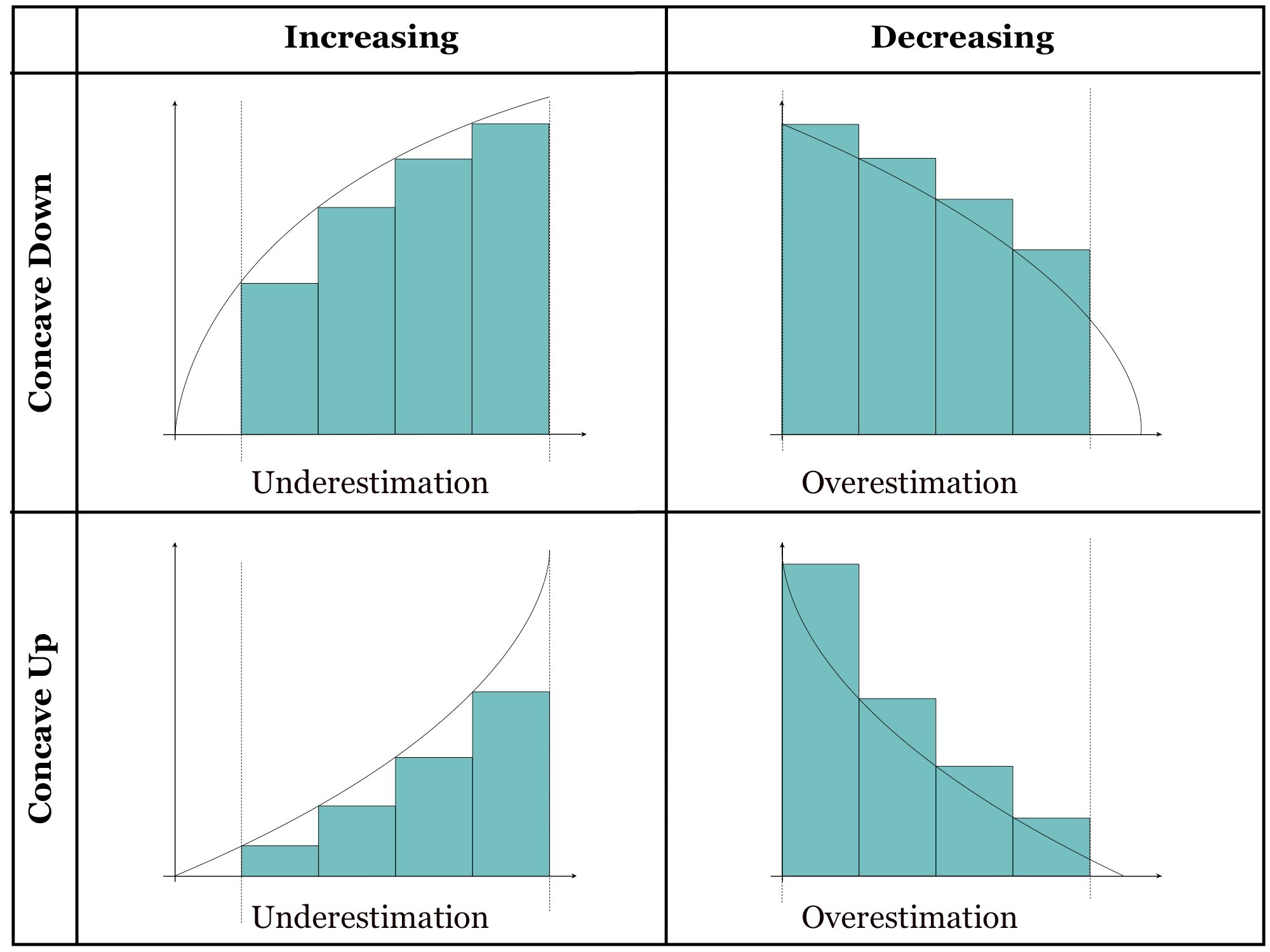
For a function that is concave up throughout the interval, midpoint sums underestimate the definite integral. Concave down throughout gives an overestimate. The sketches show the direction of the error; the word “slight” in an image is not a general error bound. The size depends on the function and partition.
Image 4
Interactive 6.4.1 The best way to estimate