Access this content offline
Omniguides
Skip to the reading

Related Rates

This original textbook reading covers part of the AP topic. Follow the AP course outline for complete topic instruction and practice.

Bursting bubbles

This section will discuss related rates. Related rates are changes in one thing with respect to another. When we covered optimization, everything was static. The volume of the can did not change. The area stayed the same. Now, everything is more dynamic.

Imagine you are pumping air in a balloon. If you have a balloon it might be handy to experience what I am talking about. As you pump air into the balloon, you are pumping a constant volume per second. However, the size of the balloon increases really quickly at first, and then slows down. The more air you pump into the balloon, the slower the balloon grows! To summarize,

dvdt=constant

drdt=variable (Initially high, then slows down)

In this case, drdt is not dependent on how much volume you are pumping per time. Instead, it depends on the radius itself. Whereas with optimization we only had one constraint, now we are given two. More specifically, we are given a constraint (volume) and an initial condition (the value of the radius, or another similar variable at that time). Suppose we wanted to compare the change in surface area of the balloon instead. We would have to be given the surface area at the time of interest. In this case, surface area would be the condition. Let’s try this out.

Example Problem 6.3.1

A droplet forming inside of a cloud has a diameter of 0.1 mm. The high humidity inside the cloud causes the rate of condensation to be 1 mm3/s. ​
a) At what rate does the diameter of the droplet increase after 3 seconds?

b) What was the original rate of increase of the droplet size when its diameter was still 0.1 mm?

  1. Here we are going to assume that the initial volume is negligible and the only thing that matters is the volume 3 seconds after condensation starts to occur. Why? because: V=43(0.1)3=0.0042 mm3≪3 mm3​
    In other words, the difference in volume is less than 0.2%. So let’s assume our droplet’s current volume is 3 mm3 . You are going to love what happens next! First, here is what we know:

V=43πr3

dVdt=1 mm3s

drdt=unknown

Can you guess what we have to do? Starts with an I. Rhymes with differentiation.

That’s right! Implicit differentiation! How? Let’s take the general derivative with respect to time of the volume function.

ddtV=ddt(43πr3)​
dVdt=43π⋅(ddrr3)⋅drdt

Now we can take the derivative with respect to r of the term inside the parentheses.

dVdt=43π⋅(3r2)⋅drdt

dVdt=43π⋅3r2drdt

dVdt=4πr2drdt

We know two of these unknown variables. We can solve for r after 3 seconds, and find drdt. First let’s solve for r for the new volume after 3 seconds.

3 mm3=43πr3

r=03.716=0.895 mm

What does this tell us? We can see that in just 3 seconds, the size of the droplet increased 9 times!

However, we know the rate slows down the larger the droplet gets. How much slower? We are about to find out (bolded). Let’s plug in r into our related rates equation.

1 mm3s=4π(0.895 mm)2⋅drdt

1 mm34π⋅0.801=drdt​
​
drdt=0.1mms

Are we done? No! The question asked us for the rate of diameter increase. Common sense tells us this is just twice the rate of radial increase, but we can prove it mathematically too, using implicit differentiation!

2r=D

ddt2r=ddtD

2drdt=dDdt

dDdt=0.2mms

b) This part asks us to find what the rate of increase in diameter originally was. We have done most of the work already, so let’s just go back to our related rates equation and plug in a new value for the radius, 0.05 mm (this is half the original diameter given to us in the question).

dVdt=4πr2drdt

1mm3s=4π(0.05 mm2)drdt

1mms4π⋅0.0025=drdt

drdt=31.83mms

Does this number seem high...? Nope! The droplet really does increase at a size of 31.83 millimeters per second! Why? Because when the droplet is really small, any moderate increase in volume will cause its size to become 3x or even 4x larger! Once the droplet becomes bigger, the same amount of volume ends up having a smaller effect.

For example, if you were living on $1 a day, and someone gave you one dollar, you would be relatively much richer than if you were making $100 per day and someone gave you that same dollar. The same concept applies here. Do we have our answer yet? Nope! Because we are asked for the change in diameter.

dDdt=2drdt=63.7mms​


Example Problem 6.3.2

Your friend wants you to time him to see how fast he can run. He starts out 10 m east of you, and after you hit the start button on the timer, he runs at a speed of 5 m/s north. How fast is the angle between you changing relative to the original starting point after 3 seconds? (See Interactive 6.3.1 at left).


We know that after three seconds, your friend has gone north 15 m based on his constant velocity of 5 m/s. Now we have a right triangle with the adjacent side equal to 10, and the opposite side equal to 15. We can find θ.​

θ=tan-11510=56.3º​


Interactive 6.3.1 Example Problem 6.3.2
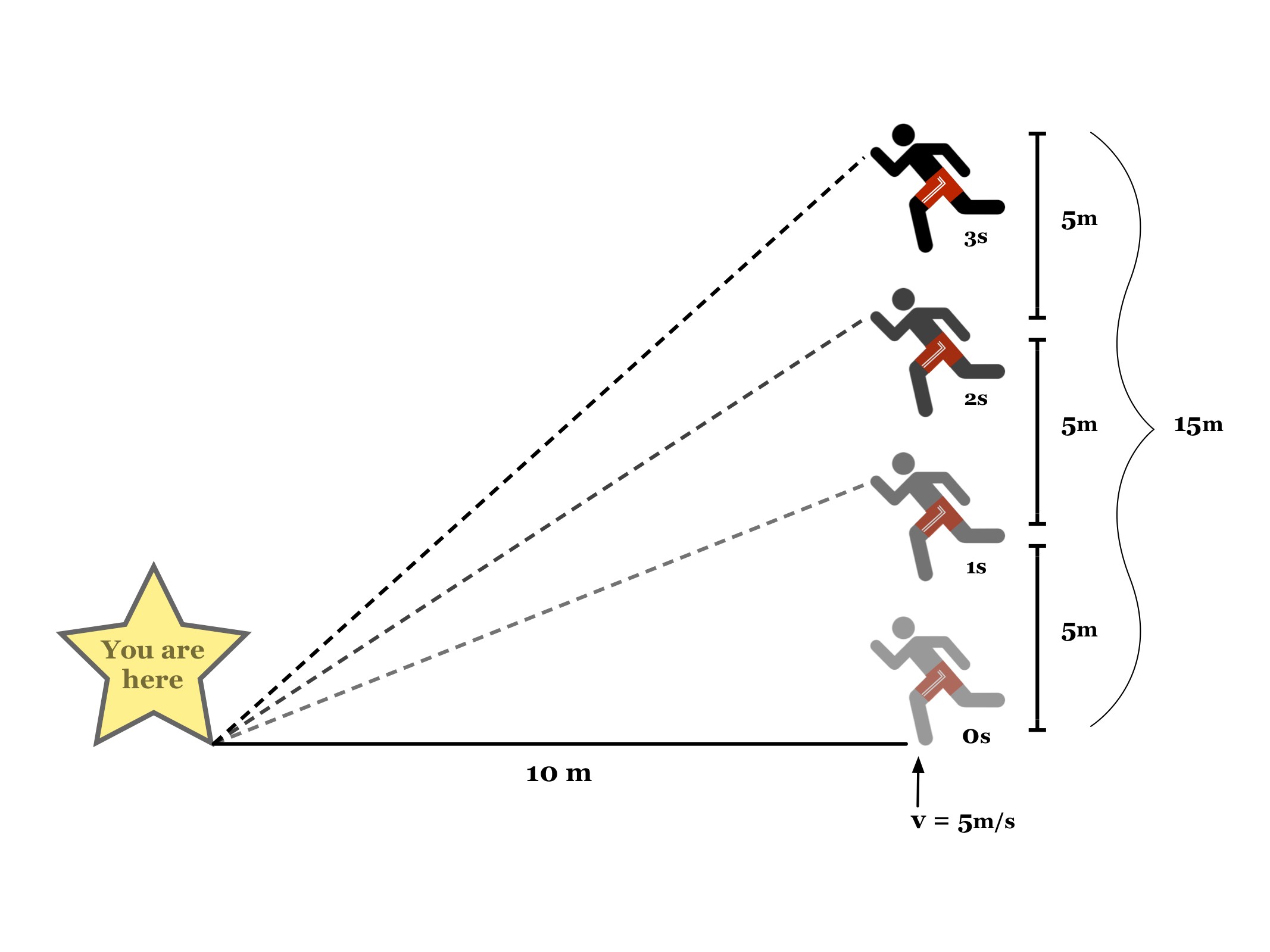
Interactive 6.3.1 Example Problem 6.3.2
Read all original figure notes

Finding θ

We do not know θ, but we can calculate it. After that we can find change in θ at our time of interest, 3 s

t = 3 s

As you can probably tell, this drawing is not to scale. We are dealing with your friend’s distance 3 seconds after starting.

Now how do we find the related rates equation? Let’s look at which two variables are changing. θ is changing and the vertical distance (or opposite side) is changing. Do we know an equation that relates these two? Yes we do!

tanθ=oppositeadjacent=NE

Rather than having to say opposite and adjacent all the time, let’s just call these north and east, because that is what they are. Since East doesn’t change, we can treat that as a coefficient to our changing variable, North, and take the implicit derivative with respect to time for both sides of the equation. (sizes below)

ddttanθ=1E⋅ddt(N)

sec2(θ)⋅dθdt=1EdNdt

We know all of these values except for dθdt , which we are trying to solve for. Notice that dNdt is just the velocity of your friend running north.

Plugging in these values gives us

3.25(dθdt)=110m⋅5m

dθdt=0.154s​
​
Our answer is not in degrees, however! It is in radians. Degrees is a unit. Radians are unit-less. We can convert this to degrees by multiplying our answer by 180ºπ , which gives

dθdt=8.82ºs

Pop Quiz 6.3.1 Related Rates

Question 1 of 5 · 0 correct

In all of our examples, what has the condition been a function of?

Select one answer.
Glossary and deeper reading · 2 refreshers

These editorial refreshers supplement the reading. Definitions and examples are added guidance; original source wording and recorded answers remain in their original context.

  • Optimization

    Optimization finds the greatest or least value of an objective while satisfying the problem’s constraints. Express the objective in suitable variables, determine the allowed domain, and compare all relevant candidates. For example, among rectangles with a fixed perimeter, writing area in terms of one side reduces the search to a one-variable problem. Endpoint and feasibility checks are part of the argument, not optional final details.

    Read more: 5.11 · Optimization →

  • Constraint in optimization

    A constraint restricts the quantities or choices permitted in a problem. It can be an equation, an inequality, or a requirement from the physical context. For example, a rectangle with perimeter 20 must satisfy 2l+2w=20 with positive side lengths. Use constraints to determine the objective’s allowed domain before searching for extrema.

Search lessons, terms and problems