Maximinima
This original textbook reading covers part of the AP topic. Follow the AP course outline for complete topic instruction and practice.
This reading includes verified answer corrections and explicitly stated clarifications.
When a derivative equals zero, the tangent line is horizontal. This gives us a candidate for a local maximum or minimum, but it does not guarantee one: y = x³ has a horizontal tangent at 0 and keeps increasing.
A ball at maximum height has zero vertical velocity in a differentiable motion model. More generally, a local extremum at an interior point of a differentiable function has derivative 0. Extrema can also occur where the derivative does not exist, as with |x| at 0.
Absolute maxima and minima
On a closed interval, absolute extrema may occur at interior critical points or at endpoints. Interior critical points are points in the domain where f′ = 0 or f′ does not exist. The endpoints are separate candidates for the absolute-extrema test; compare the function values at all of these candidates.
Example Problem 6.1.1
Find the absolute maximinima values and where they occur of the function on the closed interval .
Interactive 6.1.1 Maximinima of sin(πx)/πx
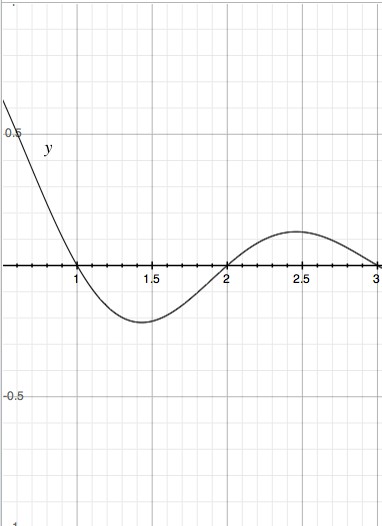
Read all original figure notes
Points where derivative = 0
Endpoint candidate
Refer to interactive 6.1.1 to visualize the process we just went through in Example 6.1.1. Notice the difference between absolute maximum and relative or local maximum.
What if we were asked to find just the critical points and label them “local maximum” or “local minimum”? Would it be feasible to take the derivative, find all the zeroes, and then plug ALL the zeroes back into the original function and calculate the values? Sure, it’s possible, but it would be time consuming. You might ask, oh how can I find out really easily if a point is a local maximum or local minimum? For this, we will need the help of the second derivative. Do you remember what the second derivative tells us about the original function? That’s right! Concavity. You are smart!
At a stationary point c where f′(c) = 0, a positive second derivative gives a strict local minimum and a negative second derivative gives a strict local maximum. If f′′(c) = 0 or does not exist, this test is inconclusive; check the first derivative or concavity on nearby intervals.
Example Problem 6.1.2
Find and label all the critical x-values with either “local maxima” or “local minima” of the function on the closed interval .
Points of Inflection
An inflection point is a point on a continuous graph where the concavity changes. A zero or undefined second derivative can give us a candidate, but we must check the concavity on each side. For x⁴, f′′(0) = 0 and no concavity change occurs.
- The derivative changes. If it was increasing before, it will now start to decrease and likewise, if it was decreasing before, it will start to increase.
- The concavity changes. If the function was concave up before the point of inflection, it will now be concave down, and vice-versa.
Caution: if the derivative equals zero at a point of inflection, then there is no local maximum or minimum at that point! This is another advantage to taking the second derivative of a function to make sure you are at a local maximum or minimum. It helps us see through a function’s tricks.
Glossary and deeper reading · 5 refreshers
These editorial refreshers supplement the reading. Definitions and examples are added guidance; original source wording and recorded answers remain in their original context.
-
Velocity in calculus
In one-dimensional motion, velocity is the derivative of position with respect to time. Its sign records direction relative to the chosen positive axis. For example, s(t)=t²−4t meters gives velocity 2t−4 meters per second. Speed is the magnitude of velocity and therefore cannot be negative.
-
Differentiability
Differentiability means that a function has a finite derivative at the point under discussion. Differentiability at a point implies continuity there, but continuity alone does not imply differentiability. For example, |x| is continuous at 0 but its left and right tangent slopes differ, so it is not differentiable there. Corners, cusps, vertical tangents, and discontinuities can prevent a finite derivative.
-
Absolute extremum
An absolute extremum is the greatest or least function value on the domain or interval under discussion. The comparison includes every allowed input, including included endpoints. For example, x² on [−1,2] has absolute maximum 4 at x=2 and absolute minimum 0 at x=0. An absolute extremum must be attained rather than merely approached.
-
Interval
An interval is a set of real numbers containing every number between any two of its members. Parentheses exclude an endpoint, while square brackets include it. For example, (1,4] includes 4 and every number between 1 and 4, but excludes 1. An infinite endpoint always uses a parenthesis because infinity is not a real endpoint.
-
Critical point
A critical number is an input in the function’s domain where its derivative is zero or does not exist. The corresponding point on the graph is called a critical point. For example, x³ has a critical number at 0, but it has no local maximum or minimum there. Critical numbers are candidates for extrema and need further analysis; inputs outside the domain are excluded.